Early Signs of Bed Bugs: How to Tell Before It’s Too Late
You wake up with a cluster of itchy red welts along your forearm. Nothing was there when you went to bed. The good news: bed bugs are easiest to beat when caught early — a dozen in a mattress seam is manageable; a thousand across three rooms is a professional job.
TL;DR: Don’t rely on bites alone — they mimic other bites, and some people never react. The real early signs are physical evidence: blood spots on sheets, dark droppings in mattress seams, shed skins, and tiny white eggs. Inspect within 6–8 feet of your bed with a flashlight. If you find evidence, contain it (don’t sleep elsewhere, heat-dry your bedding), skip bug bombs, and call a licensed pest professional if the problem spreads.
The Early Physical Signs of Bed Bugs
1. Bite patterns: clusters and zigzag lines
Small, red, itchy welts, often in a line or tight cluster of three, on skin exposed during sleep: arms, shoulders, neck, legs. Bites are the least reliable sign — they mimic mosquito, flea, and chigger bites, and some people never react.
2. Small blood spots on sheets and pillowcases
Tiny rust-colored dots on sheets near your head and torso — a recurring pattern is a classic early indicator.
3. Dark, rust-colored droppings in seams and cracks
The most dependable early sign. Dark brown or black fecal spots clustered along mattress seams, piping, and bed-frame joints. Press a suspect spot with a damp white cloth: fresh droppings smear dark reddish-brown.
4. Translucent shed skins and pearl-white eggs
Empty, bug-shaped skins — pale, translucent, poppy-seed to apple-seed size — mean bugs have been living and growing in that spot. Eggs are about 1 millimeter, pearly white, glued in clusters inside seams.
5. A sweet, musty odor (only in heavier cases)
Not an early sign. If you can smell bed bugs, the population is already substantial — call a professional.
Where to Inspect: The Hiding Spots Bed Bugs Love
About 80 percent of an infestation sits within 6 to 8 feet of where you sleep:
- Mattress seams, piping, and tufts — especially the wall-facing side near the head
- Box spring — pull off the bottom dust cover
- Headboard — pull it from the wall; inspect every joint and screw hole
- Bed frame and slats
- Nightstands and dressers — undersides, joints, back panels
- Baseboards and outlet covers near the bed
- Curtains and window frames near the bed
- Luggage and laundry piles — especially recent-travel items
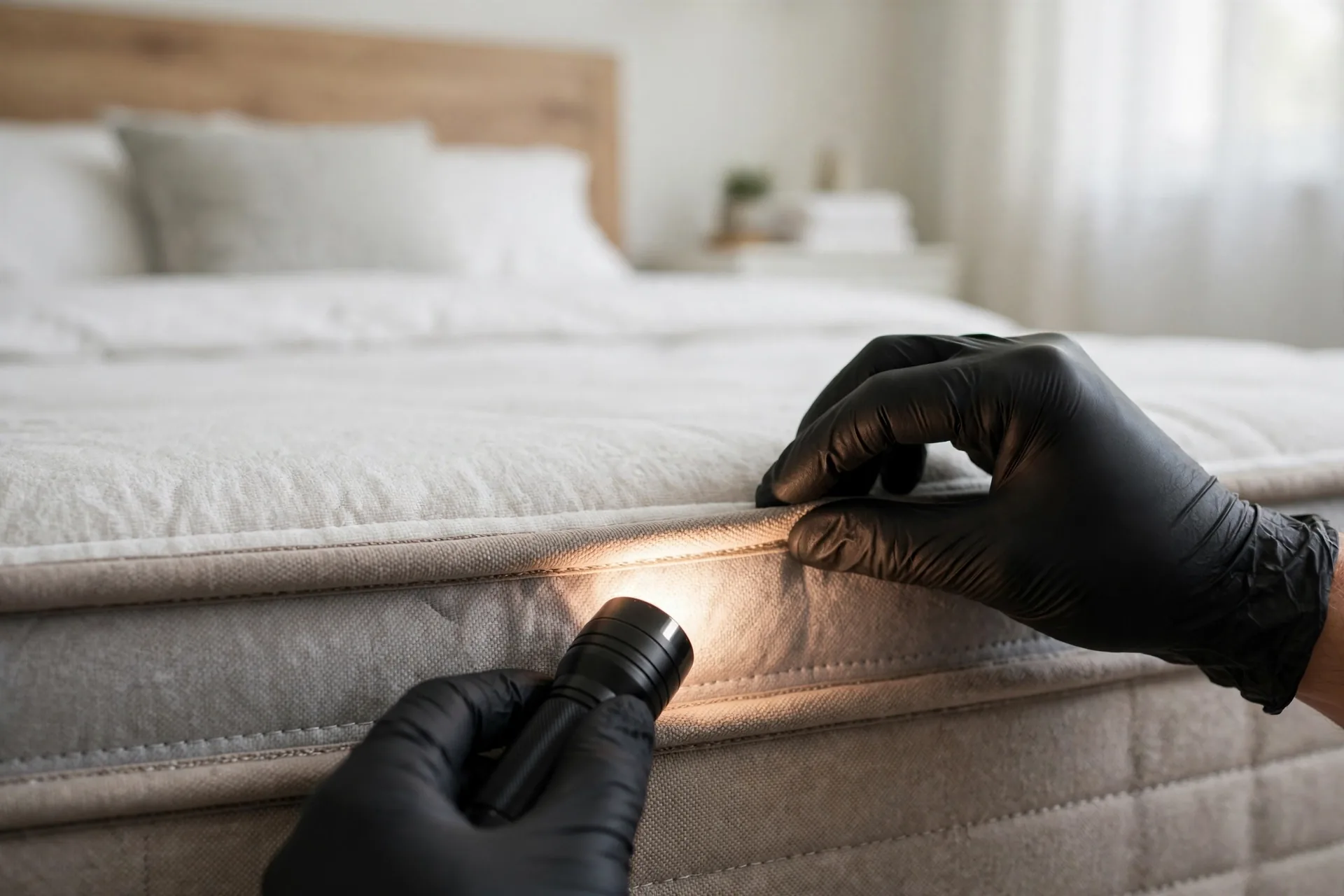
PRO TIP: Grab a flashlight and an old credit card. Run the card’s edge slowly along mattress seams while shining the light at a low angle. The raking light exposes droppings, skins, and eggs you’d miss head-on.
Bed Bugs vs. Look-Alikes
| Evidence | Bed Bugs | Carpet Beetles | Fleas |
|---|---|---|---|
| The bug itself | Flat oval, apple-seed size, reddish-brown | Tiny mottled beetle; fuzzy larvae | Tiny, dark brown, built to jump |
| Where they hide | Mattress seams, headboard — within 6–8 ft of sleepers | Closets, under beds — lint and wool | Pet bedding, carpets |
| Signs left behind | Dark fecal spots that smear reddish | Shed larval skins; holes in natural fibers | “Flea dirt” that turns red on wet paper |
| Bites | Lines or clusters of 3 overnight | Don’t bite | Cluster around ankles |
What to Do Next If You Find Early Signs
Contain first:
- Don’t sleep in another room. It sends hungry bugs looking for you — spreading the infestation.
- Strip the bed — wash hot and dry on the highest heat for at least 30 minutes.
- Declutter around the bed. Bag nearby items and keep them sealed.
- Vacuum thoroughly — seams, frame, baseboards, carpet edges. Empty the vacuum into a sealed bag immediately.
- Install bed-bug-rated mattress and box-spring encasements.
- Put interceptors under each bed leg.
Skip total-release foggers (“bug bombs”). They drive survivors deeper into walls.
Call a licensed pest professional when: bugs or heavy evidence in more than one room, interceptor catches aren’t dropping, or you live in a multi-unit building. For more pest prevention guides, see our Pest Control section.
Bottom Line
- Evidence beats bites.
- Inspect within 6–8 feet of the bed first.
- Compare before you conclude — carpet beetles and fleas cause frequent false alarms.
- Containment beats panic — heat-dry bedding, vacuum, monitor with encasements and interceptors.
- Skip bug bombs, respect the label.
- Call a pro for heavy or spreading infestations.
Frequently Asked Questions
Can you have bed bugs without any bites?
Yes — many people show little or no reaction. Physical evidence, not your skin, is the diagnostic standard.
Do bed bugs spread disease?
According to the CDC, bed bugs are not known to transmit diseases to people.
Can I get rid of bed bugs myself?
A very small, very early infestation confined to one bed is sometimes beatable with disciplined containment. Most infestations need a licensed professional.
How did bed bugs get into my clean house?
They hitchhike on luggage, purses, secondhand furniture, used clothing, and even library books — cleanliness doesn’t prevent them.
How fast does a small infestation grow?
A single female can lay hundreds of eggs, and the population can roughly double every couple of weeks under good conditions.