Best Christmas Tree Storage — Bags, Bins & Rolling Stands
The best Christmas tree storage is a breathable storage bag: the tree stays at full length, the branches are never bent at a hard angle, and moisture escapes instead of sitting inside and mildewing. A good bag costs roughly $25–$60, a rigid bin runs roughly $20–$40, and the original cardboard box is free — and the box is also the worst option of the three.
Every January the same thing happens: the tree comes down, and the fluffed branches that filled the living room will not fit back into the box they came in. So the tree gets squeezed, folded and forced, and by next December the branches are bent, the lights are tangled, and the tree looks tired. A year of storage should not cost you a year of your tree’s life. The right container protects the shape, keeps the dust and damp out, and makes next year’s setup ten minutes faster.
This guide to the best Christmas tree storage compares the three real options — breathable bags, rigid bins and rolling stands — by tree height, by cost, and by what actually fits. It covers tree-only storage: bags, boxes and stands for the tree itself. For the ornaments, lights and garland, our guide to how to store Christmas decorations covers the rest of the holiday storage job.
TL;DR — Best Christmas Tree Storage at a Glance
1. Best overall: a breathable storage bag — best for trees 6 ft and taller, no hard bends, moisture escapes.
2. Best budget rigid option: a large plastic bin — good protection, but watch the size: a 7 ft tree rarely fits one bin.
3. Worst option: the original cardboard box — absorbs humidity, softens, collapses, and invites pests. A fluffed tree never fits back in it.
4. Match the bag to the tree: a 7–7.5 ft tree needs a 48-inch duffel with sections laid side by side, not stacked.
5. Before you pack: remove the batteries from every lit piece, dry the tree fully, and never compress the greenery to make it fit.
6. Store dry and temperature-stable: not a hot attic, and never on a damp garage floor.
That is the short version of the best Christmas tree storage — the sections below compare each option in full.
What Is the Best Christmas Tree Storage?
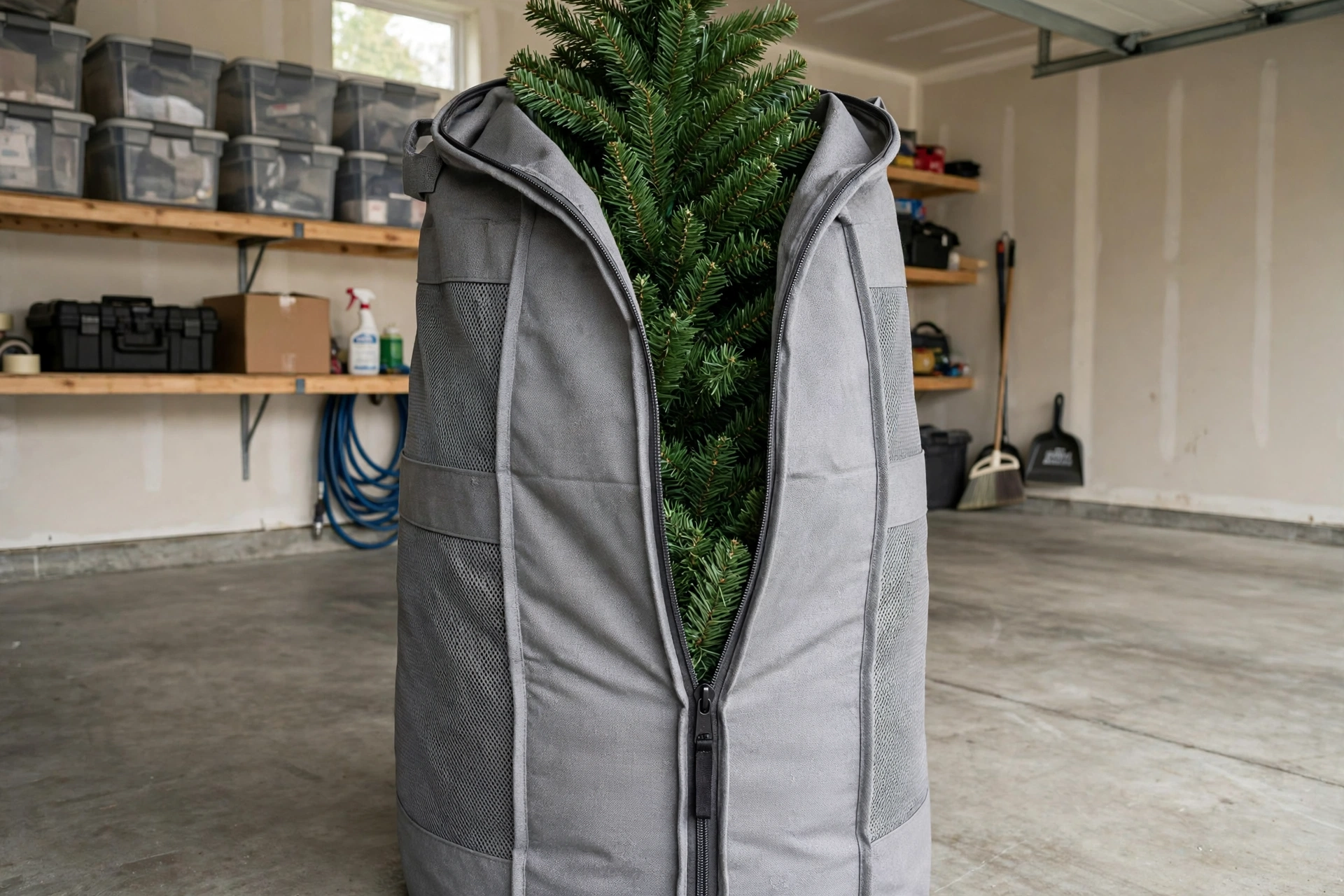
The best Christmas tree storage for most homes is a breathable storage bag, because it protects the tree’s shape without trapping moisture. The tree lies or stands at full length, so no branch is bent at a hard 90-degree angle, and the breathable fabric lets damp air escape instead of holding it against the branches where it mildews. For trees 6 ft and taller, the bag wins on every count that matters: shape, moisture, weight and price.
The bag’s only real weakness is that it does not protect against crushing — do not stack heavy boxes on top of it. If the storage spot has things piled on the tree, a rigid bin or a rolling stand is the better call. But in a normal garage or closet, where the tree sits on its own shelf or on the floor, the breathable bag is the best Christmas tree storage you can buy, and it costs less than most of the ornaments it protects.
| Storage method | Typical cost | Best for | Watch out for |
|---|---|---|---|
| Breathable storage bag | $25–$60 | Trees 6 ft+, flocked trees | No crush protection |
| Rigid plastic bin | $20–$40 | Small trees, stacking | 7 ft tree rarely fits one bin |
| Rolling stand | $40–$80 | Trees stored upright, garages | Needs floor space |
| Original cardboard box | Free | Nothing — worst option | Absorbs humidity, collapses |
All prices are rough planning estimates from current guides, not quotes.
Storage Bag vs Box vs Bin: Which Wins?
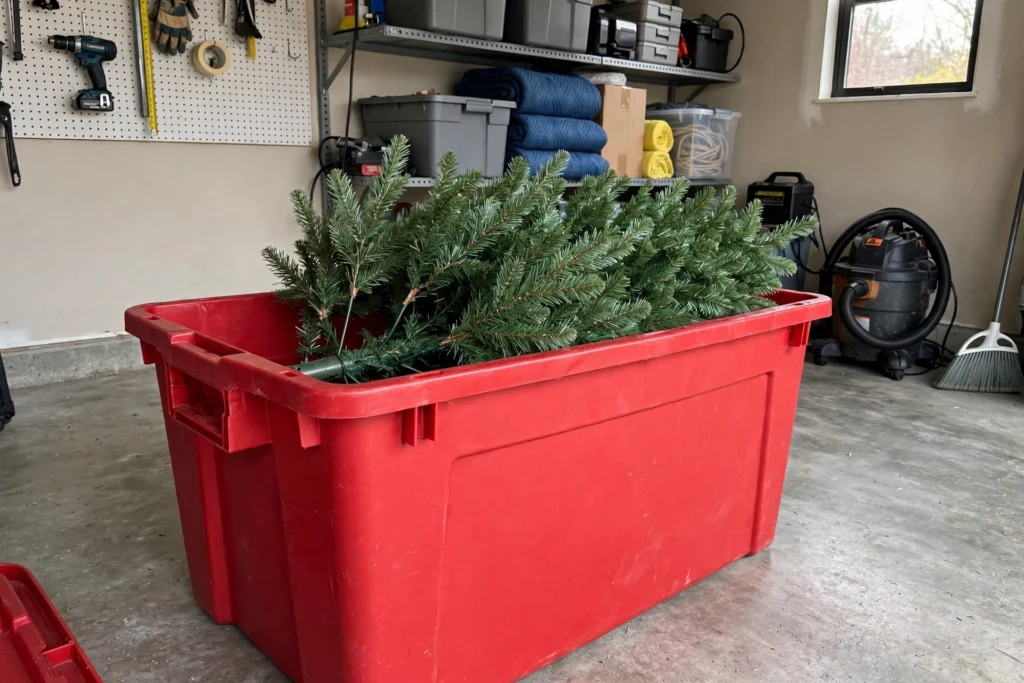
A breathable bag beats the original box on every count, and it beats a rigid bin for most trees. The box is the worst option: cardboard absorbs humidity, softens over a year in the garage, collapses under its own weight, and invites pests — and a fluffed tree never fits back into the box it shipped in, because the branches are fuller now than they were when they were factory-packed. The bin is sturdy and stackable, which the bag is not, but a 7 ft tree in sections rarely fits a single standard bin, so you end up buying two and splitting the tree across them.
The bag wins because it is built for the job: sized to the tree, soft enough not to crush the branches, and breathable so damp air escapes. The bin wins only when the tree has to survive being stacked under other boxes, or when the storage spot is damp enough that a soft bag would soak through. Choose the bag for a normal garage or closet, the bin for a crowded storage room where things get piled, and never choose the box.
What Size Storage Bag Fits My Tree?
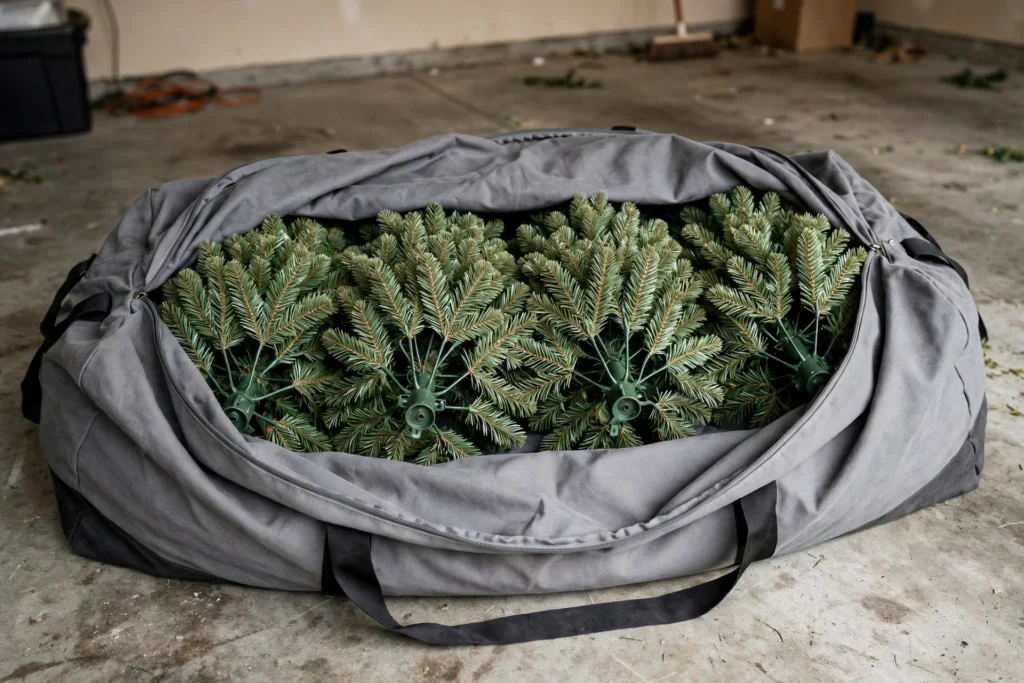
Match the bag to the tree’s height and its girth, not just its height. A 7–7.5 ft tree needs a 48-inch duffel-style bag with the sections laid side by side and flat — never stacked on top of each other, because the weight bends the lower branches. A 6 ft tree fits a 40-inch bag. A 9 ft tree needs the longest bags made, usually 60 inches or more, and often a second bag for the top section.
Girth matters as much as height: a full, wide tree needs a wider bag than a slim pencil tree of the same height. Measure the widest section of the tree after it is taken apart, then add a few inches for the branches to sit without being pressed flat. If the bag is too tight, the branches get crushed into the shape of the bag and stay that way. A bag that is slightly too big is always better than a bag that is slightly too small — the extra room is what keeps the tree looking new.
PRO TIP: Lay Sections Side by Side, Never Stacked
The fastest way to ruin a stored tree is to stack its sections in one bag. The bottom section carries all the weight and its branches bend permanently. Lay the sections flat, side by side, in a wide duffel — it takes a bigger bag, but your tree will look the same next December as it did this one.
How Do I Store a Flocked Christmas Tree?
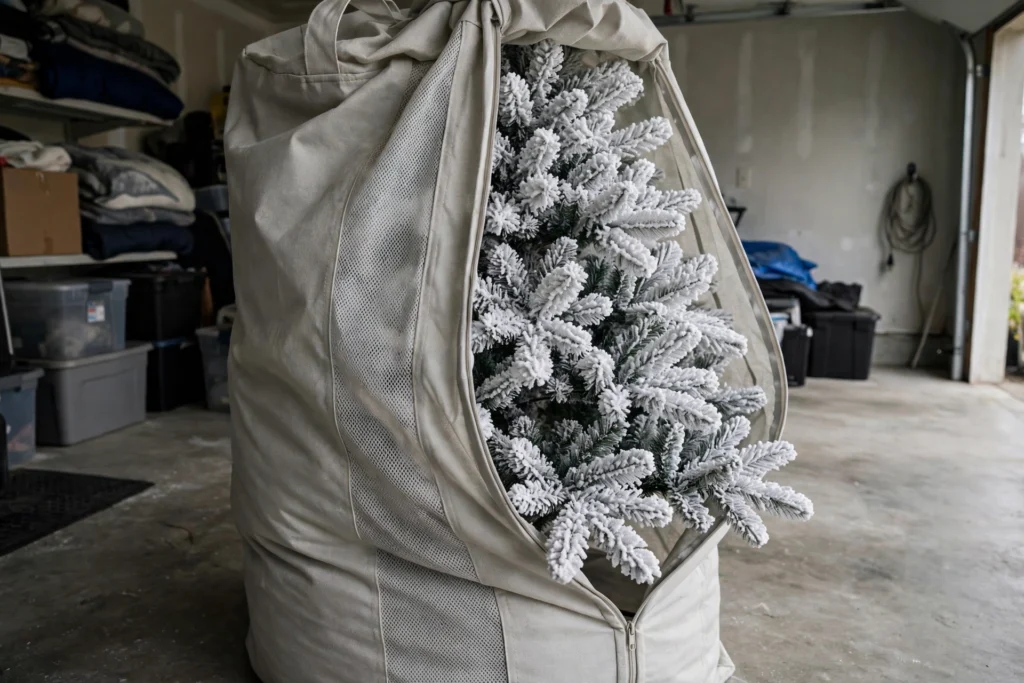
A flocked tree goes in a breathable bag, never in a sealed bin. The flocking — the white, snow-like coating — holds moisture, and a sealed bin traps that moisture against the branches for eleven months, which is how flocking yellows, clumps and falls off in patches. A breathable bag lets the flocking dry out and stay dry, and the soft fabric does not rub the coating off the way a hard bin edge does.
Handle a flocked tree gently at every step: take it apart slowly, do not shake it hard to get the flocking off, and do not wrap the sections tightly in plastic. If the flocking sheds a little during packing, that is normal — a light shake outside before storage gets the loose flakes off, and the rest stays put. Store the bag somewhere the temperature stays steady, because freeze-and-thaw cycles in an uninsulated attic make flocking brittle.
Should I Take My Tree Apart Before Storing It?
Yes — take the tree apart into its sections before storing it, unless you are using a rolling stand that stores the tree upright and fully assembled. Sectioning the tree is what makes it fit a bag or a bin at all, and it is what lets the branches lie flat instead of being folded back on themselves. Label the sections top, middle and bottom with a strip of masking tape as you take them down, so next year’s setup is not a guessing game.
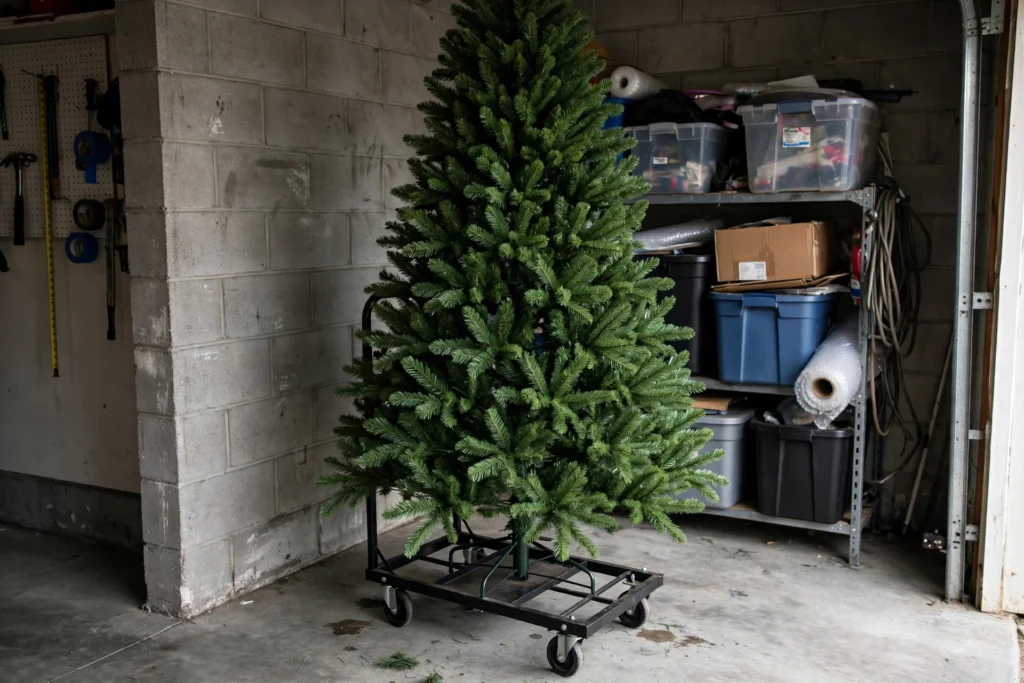
The one exception is the rolling stand: if you have the floor space, a stand lets the tree stay assembled and upright, rolled into a corner of the garage. It is the fastest setup next year — wheel it out, fluff, done — but it takes a full tree’s worth of floor space all year, and it costs more than a bag. For most homes, sections in a bag are the better trade.
Where Should I Store My Christmas Tree?
Store the tree somewhere dry and temperature-stable: a closet, a spare room, or a dry garage shelf. The two places to avoid are a hot attic and a damp garage floor. A hot attic bakes the plastic branches and the wiring all summer, and the temperature swings make flocking brittle and glue joints weak. A damp garage floor wicks moisture up into the bag, and a bag sitting in a puddle is a mildew problem waiting for December.
If the garage is the only option, put the bag on a shelf or a pallet, never directly on the concrete. A few inches of air underneath is enough. Keep the tree away from the water heater and the furnace, and do not store it against an exterior wall that sweats in winter. The rule is simple: if you would not store a good coat there, do not store your tree there.
What Mistakes Ruin a Stored Christmas Tree?
The mistakes that ruin a stored tree are all made in the ten minutes of packing it away. Never compress the greenery to force it into a bag that is too small — crushed branches stay crushed. Never store the tree wet: if it came in from the rain or the snow, let it dry fully indoors first. Never leave the batteries in a lit tree — batteries leak over eleven months and corrode the contacts, and a leaked battery can ruin a whole string of lights. And never use the original cardboard box: it absorbs humidity, softens, collapses, and invites pests.
One more mistake is easy to miss: storing the tree skirt and the tree topper in the same bag as the tree, loose. A heavy topper rolling around in the bag bends branches, and a skirt stuffed in on top presses everything flat. Pack the Christmas tree skirt and the topper in their own bag or box, and keep the tree bag for the tree alone.
What is the best way to store a 7 ft Christmas tree?
A breathable storage bag in a 48-inch duffel size, with the sections laid flat side by side, not stacked. A 7 ft tree rarely fits a single rigid bin, and the original cardboard box is the worst option — it absorbs humidity and collapses. Store the bag on a shelf in a dry, temperature-stable spot.
Can I store my Christmas tree in the garage?
Yes, if the garage is dry and the bag sits on a shelf or a pallet, never directly on the concrete floor. Avoid a hot attic, which bakes the branches and wiring, and avoid any spot where water can pool. If the garage gets damp, a rigid bin protects better than a soft bag.
How do I store a pre-lit Christmas tree?
Take it apart into sections, remove the batteries from every lit piece, and coil the light strings loosely instead of wrapping them tight around the branches. Store it in a breathable bag so moisture can escape. Never leave batteries in over the summer — they leak and corrode the contacts.
Is a Christmas tree storage bag worth it?
Yes, for any tree 6 ft or taller. A bag costs roughly $25–$60, protects the tree’s shape, lets moisture escape, and makes next year’s setup faster. Compared with replacing a tree that was crushed in its box, the bag pays for itself in a single season.
What size storage bag do I need for a 9 ft tree?
A 9 ft tree needs the longest bags made, usually 60 inches or more, and often a second bag for the top section. Measure the widest section after taking the tree apart and add a few inches for the branches to sit uncompressed. A bag that is slightly too big is always better than one that is slightly too small.
Can I leave my tree assembled and store it upright?
Yes, if you use a rolling storage stand and have the floor space. The tree stays assembled on its stand and wheels into a corner of the garage. It is the fastest setup next year, but it takes a full tree’s worth of floor space all year and costs more than a bag — roughly $40–$80, a rough planning estimate, not a quote.