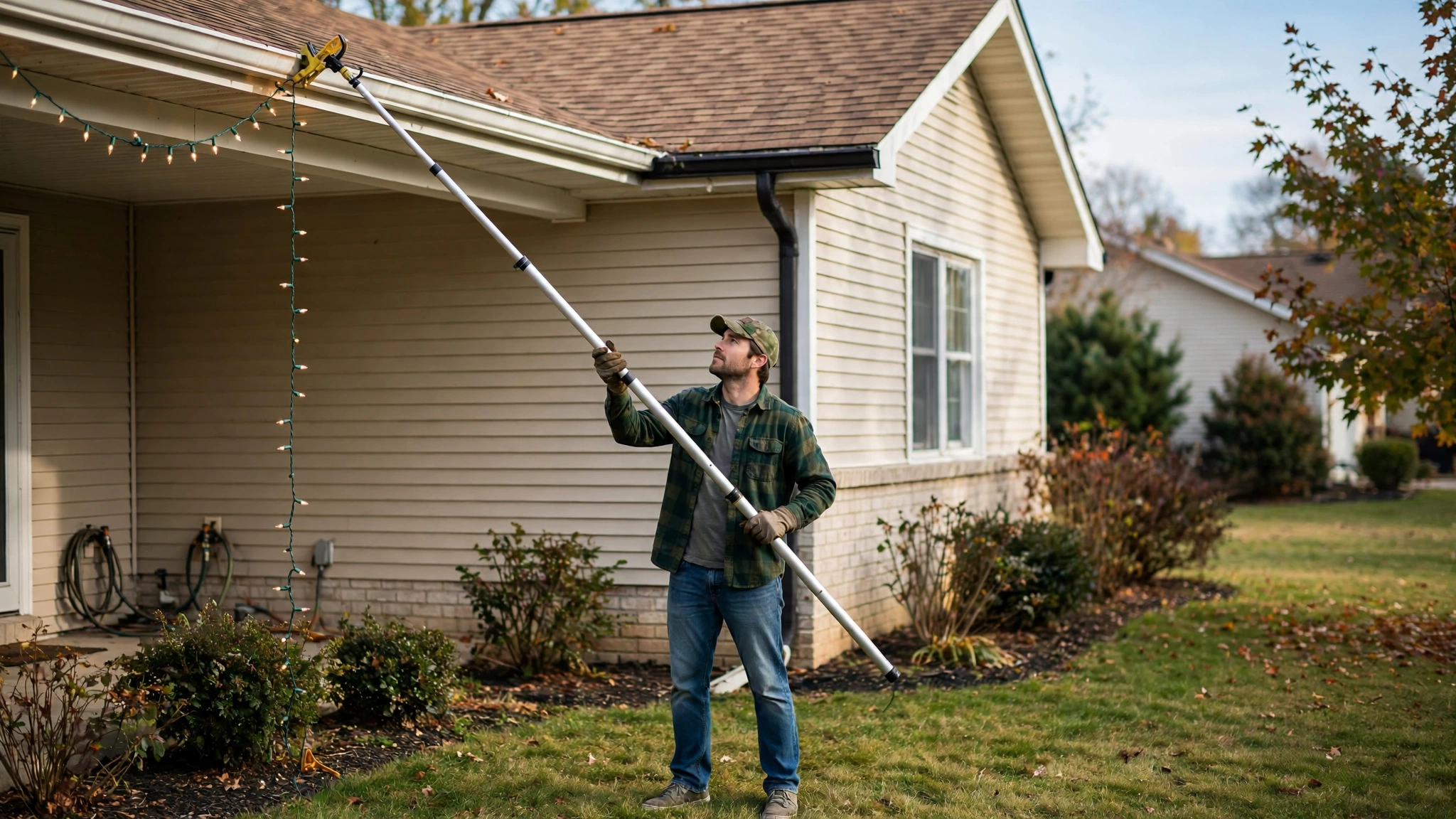
How to Hang Christmas Lights Without a Ladder (Poles, Clips & Limits)
Ladder falls send thousands of people to emergency rooms every December, and plenty of them were decorating. So the question deserves a straight answer: yes, you can hang Christmas lights without ladder access to your roofline — using an extension pole with light-hanging clips — and for single-story homes it works genuinely well. It is slower than ladder work and it will not conquer a steep two-story roofline, and pretending otherwise helps nobody. Here’s exactly how the pole method works, where its limits are, and the ground-level display strategies that let you skip the high work entirely and still have the best-looking house on the street.
TL;DR
To hang Christmas lights without ladder: buy a telescoping decorating pole (11–16 ft) plus pole-compatible clips, pre-attach a clip to the string at every bulb (or every 12–18 inches for minis), then raise, hook each clip onto the gutter edge or shingle lip, twist to release, and move on — both feet on the ground the whole time. Expect it to take ~2× longer than ladder work and to suit single-story rooflines best. For two-story homes, the honest ladder-free options are: decorate only the reachable first story + ground level, or hire the roofline out. Nobody’s display is worth a fall.
What You Need
| Item | Cost | Notes |
|---|---|---|
| Telescoping decorating/light-hanging pole | $25–$60 | 11–16 ft typical; threaded tip fits clip adapters |
| Pole-compatible light clips | $10–$25 per pack | Must match your pole’s system AND your bulb size (mini, C7, C9) |
| Your light strings | — | Tested and working before you start (see below) |
| A helper/spotter | Free | Feeds string, watches alignment, saves your neck |
| Optional: magnetic clips | $10–$20 | Only for steel gutters/fascia — test with a fridge magnet first |
Test everything on the ground first. Pole-hanging a string and then discovering it’s dead is a special kind of misery. Plug every string in on the lawn; fix fuses and bulbs down here (our dead-string diagnosis guide walks it in 10 minutes).
The Pole Method, Step by Step
- Pre-clip the entire string on the ground. Snap a clip onto the string at every bulb for C7/C9 (they’re designed to hang bulb-by-bulb), or every 12–18 inches for mini strings. This is the slow, essential prep that makes the pole work possible — each clip gets placed individually.
- Lay the string out along the roofline, in the order you’ll hang it, plug end at the outlet.
- Screw the first clip into the pole’s tip adapter. Raise the pole vertically — never at a long angle; your control evaporates past ~30° and your shoulders file a complaint.
- Hook the clip onto the gutter’s front edge (or under the shingle lip for shingle-tab clips), give the pole the release twist/pull per its design, and lower it empty.
- Repeat, clip by clip, stepping along the house. Your spotter feeds slack so the hanging section never drags and unhooks the previous clips.
- Corners and ends are the fiddly part: leave extra slack at corners, and secure the string’s end so tension doesn’t pull the last clips free.
Realistic pace: a 40-foot single-story roofline takes 30–45 minutes by pole versus 15–20 by ladder. That’s the honest trade — slower, straighter than you’d expect, and zero time spent three rungs up holding a string in your teeth.
The Honest Limits
- Height: An 11–16 ft pole used by a standing adult comfortably reaches most single-story gutters (8–10 ft). Two-story rooflines at 18–22 ft demand 20+ ft poles that flex and wander — technically possible, practically miserable, and precision disappears.
- Line straightness: Pole-hung lines are ~90% as tidy as ladder-hung. Slight waviness at a distance reads fine; perfectionists will notice at corners.
- Wind: Don’t pole-hang on a windy day. A 14-ft pole with a string catching wind is a sail with a handle.
- Steep or complex roofs: Dormers, peaks, and second-story gables are ladder/aerial territory. Skip them (see below) rather than inventing a method.
Skip the Roofline Entirely: Ground-Level Displays That Look Intentional
Some of the best-looking displays never touch the roof. Ground-level decorating is fully ladder-free and, done with a plan, looks designed rather than defaulted:
- Bushes and hedges: net lights drape on in minutes and read as a solid wall of light at night
- Tree trunks and low branches: wrap trunks spirally from the ground; a pole extends your reach into lower canopies
- Railings, fences, porch columns: weave or clip strings at arm’s height — columns wrapped in spirals look genuinely premium
- Windows and doors from inside: indoor strings taped/clipped inside the glass glow outward with zero weather issues
- Pathway and stake lights: outline the walkway and garden beds; they give the display its “finished” edges
- The first-story-only rule: light what you can reach well rather than everything thinly. A crisp porch + bushes + one tree beats a sagging attempt at the whole roof.
PRO TIP
If the roofline is the whole point for you and ladders are out, the permanent solution is, literally, permanent: professionally installed or DIY permanent outdoor lights go up once and never come down — no annual ladder, no annual pole. Our permanent Christmas lights cost guide breaks down pro pricing ($3,000–$6,000+) vs the new DIY track kits ($200–$700) that are taking over this category. One installation replaces a decade of Decembers on a ladder.
If You Do Use a Ladder Anyway
Follow the full method in our main guide to hanging Christmas lights — plus the three rules that prevent most falls: keep three points of contact, never lean past the ladder’s rails (move the ladder instead), and never rest an extension ladder against the gutter itself (it can dent and slide — use a standoff). Decorating is a two-person job; the spotter isn’t optional.
And one more legitimate option, because “hang christmas lights without ladder” sometimes really means “I shouldn’t be doing this at all”: hire it out. Pro installation for a typical home runs a few hundred dollars with takedown included — our Christmas light installation cost guide has the numbers. Cheaper than one ER visit, every time.
Key Takeaways
- Pole + compatible clips is the real method: pre-clip on the ground, place clip-by-clip from below, spotter feeding slack.
- Honest scope: single-story rooflines, yes — about 2× slower than a ladder, ~90% as tidy. Two-story rooflines, no.
- Ground-level displays (nets on bushes, wrapped columns, staked paths) can carry a whole house’s look with zero height work.
- Watch for overhead power lines before raising any pole — always.
- Permanent lights or a hired installer are the legitimate “never again” options — and both beat a fall.
Can you really hang Christmas lights with a pole?
Yes — decorating poles with clip adapters are a real, established product category. Pre-clip the string on the ground, then place each clip on the gutter or shingle edge from below. It works best on single-story rooflines and takes about twice as long as ladder work.
What kind of pole do I need to hang lights without a ladder?
A telescoping pole (11–16 ft for single-story) with a threaded or proprietary tip that matches pole-compatible light clips — the clip system is the key part, not the pole itself. Check clip compatibility with your bulb size (mini vs C7/C9) before buying.
How do you hang lights on a two-story house without a ladder?
Honestly: you mostly don’t, at least not the second-story roofline — 20+ ft poles flex too much for controlled clip placement. The ladder-free two-story strategies are decorating the first story and ground level only, or hiring the upper roofline out.
Are magnetic clips good for hanging Christmas lights?
Only where a magnet actually sticks — steel gutters, fascia, or metal roofing. Most modern gutters are aluminum (non-magnetic). Test with any magnet first; where they work, they’re fast and fully ladder-free for reachable edges.
How do you hang icicle lights without a ladder?
Same pole-and-clip method — clips pre-attached along the string — with extra patience: icicle drops tangle as you raise the pole, so work slowly and let your spotter manage the drops. Net effect is identical: fine on one story, frustrating on two.
Is it safer to hang lights with a pole than a ladder?
Yes for falls — both feet stay on the ground, and ladder falls are among the most common December injuries. Keep the other hazards in mind: look up for overhead power lines before raising any long pole (the critical rule), and don’t work in wind or on wet/icy ground.