Tank vs Tankless Water Heater: Honest Pros and Cons
It always happens at the worst possible moment. The shower turns lukewarm at 6:45 a.m., your teenager is screaming from the other bathroom, and the old tank in the garage is hissing like it’s personally offended. Here’s the honest version: neither type is right for everyone, and the wrong choice can cost you $3,000 extra with nothing to show for it.
TL;DR: A traditional tank water heater costs roughly half as much up front ($1,400–$2,800 installed) and lasts 8–12 years. A tankless unit costs $2,800–$5,500+ installed, lasts 20+ years, and cuts water-heating energy use by about 24–34%. Tankless pays off in long-term homes with gas service and realistic flow demands. Tank wins on budget, simple swaps, and big simultaneous loads.
How Each Type Actually Works
The Traditional Tank
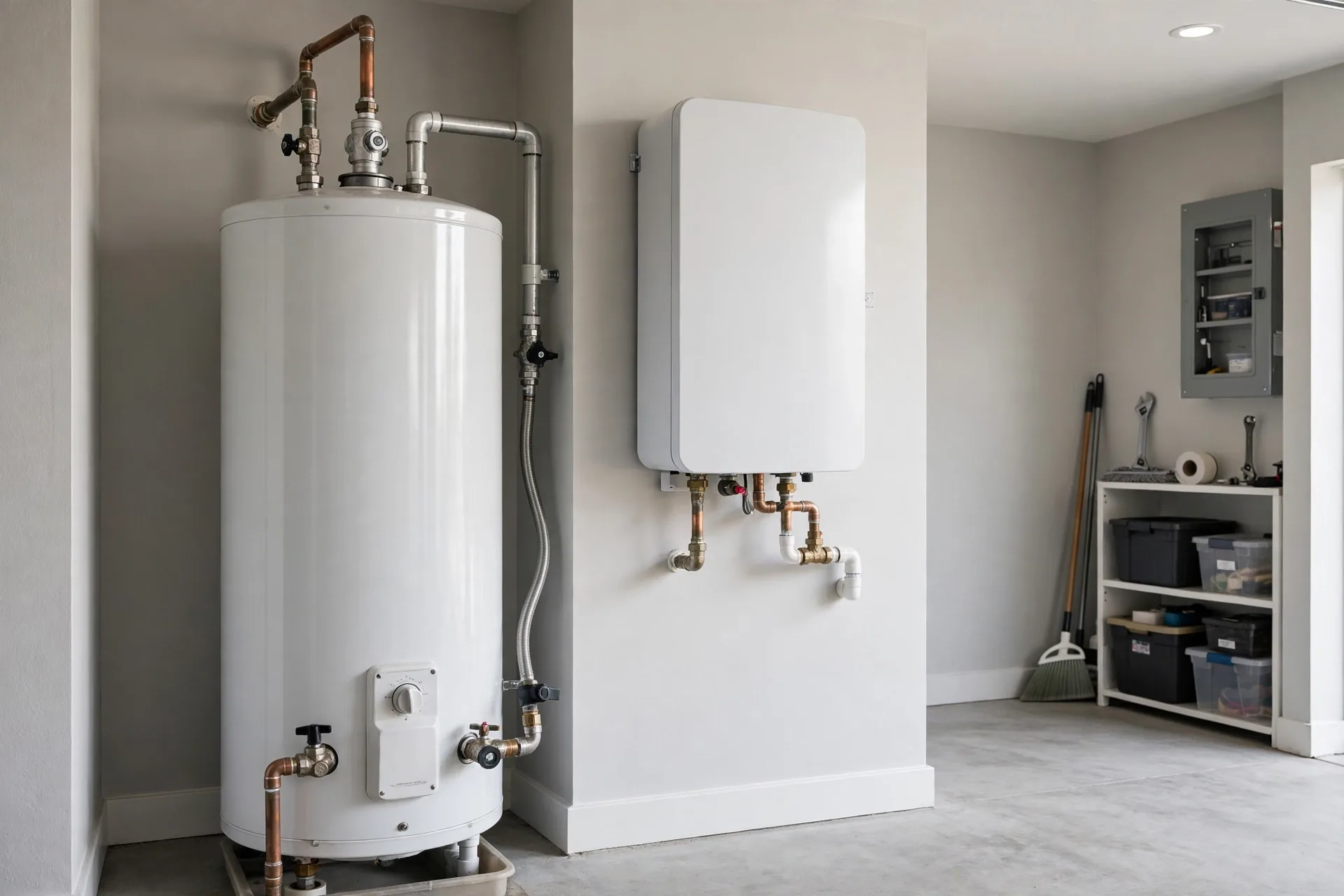
A tank water heater keeps 40, 50, or 75 gallons of water hot around the clock. The catch is standby loss: the tank reheats water all day whether anyone’s showering or not — typically wasting 25–30% of its energy.
The Tankless (On-Demand) Unit
A tankless unit heats water only when a tap opens. No storage, no standby loss. The trade-off: the unit can only heat so much water at once — exceed its flow rate and everyone gets lukewarm water, so sizing is everything.
The Real Cost Difference (2026 Prices)
Traditional tank water heater:
- 40–50 gal gas tank, like-for-like swap: $1,400–$2,800 installed
- 50 gal electric tank: $1,100–$2,000 installed
Tankless water heater:
- Whole-house gas tankless (199,000 BTU, ~9–10 GPM): $2,800–$5,500 installed
- Whole-house electric tankless: $1,500–$3,500 installed — many homes need an electrical panel upgrade ($1,500–$3,000)
- Gas line upsizing or venting re-route: add $1,500–$3,000
A third option: heat pump (hybrid) water heaters run $2,500–$4,500 installed and use roughly one-third the electricity of a standard electric tank.
Tank vs. Tankless: Side-by-Side Comparison
| Traditional Tank | Tankless | |
|---|---|---|
| Upfront cost (installed) | $1,100–$2,800 | $2,800–$5,500+ (past $7,000 with gas/vent work) |
| Operating cost (gas) | ~$300–$450/year | ~$200–$320/year |
| Efficiency (UEF) | Gas: 0.60–0.70; Electric: 0.93–0.96 | Gas condensing: 0.91–0.96; Electric: 0.98+ |
| Energy savings | Baseline | 24–34% less (DOE, homes using ≤41 gal/day) |
| Lifespan | 8–12 years | 20+ years |
| Hot-water delivery | ~70–90 gal first hour (50-gal gas), then 30–60 min recovery | Endless below its flow rate |
| Space | ~2 ft diameter floor footprint | ~2×3 ft wall-mounted box |
| Maintenance | Annual flush (~30 min, easy DIY) | Annual descaling required, critical in hard water |
| Best for | Budget swaps, short stays, high simultaneous demand | Long-term homes, tight spaces, lower long-term bills |
Tank Water Heater: Pros and Cons
Pros
- Half the upfront cost — one of the cheapest major home upgrades
- Simple, cheap installs — a half-day job with no new venting or gas work
- Handles simultaneous demand — a 50-gal tank shrugs off two showers and a dishwasher at once
- Works during power outages (gas models)
Cons
- Standby loss — burns energy 24/7
- Shorter life — 8–12 years
- Finite hot water — run the tank dry and you’re waiting 30–60 minutes
- Catastrophic failure mode — a failed tank can dump 50 gallons onto your floor
Tankless Water Heater: Pros and Cons
Pros
- Endless hot water
- Lower energy bills — roughly 24–34% less water-heating energy
- Lasts 20+ years
- Tiny footprint — reclaims real floor space
Cons
- High upfront cost — 2–3× a tank swap
- Flow-rate limits — undersizing is the #1 tankless complaint
- “Cold-water sandwich” — a 5–15 second blast of cold water between draws
- Annual descaling is non-negotiable in hard-water areas
Which One Actually Saves You Money?
A gas tankless unit saves roughly $100–$150/year versus a gas tank. If the tankless install costs $2,000 more, payback takes 13–20 years. If the premium is only $1,000, payback drops to 6–10 years.
PRO TIP: Get quotes for BOTH options before deciding. Ask each contractor specifically: “Does my gas line need upsizing? Does the venting need to change?” Those two answers determine whether tankless makes financial sense for you.
Sizing and Installation: What Catches Homeowners Off Guard
- Household size — 1–2 people: 40-gal tank or 6–7 GPM tankless. 3–4 people: 50-gal tank or 8–10 GPM tankless. 5+: 75-gal tank or 10+ GPM.
- Simultaneous use — Shower = 1.75–2.5 GPM, dishwasher ~1.5 GPM, washing machine ~2–3 GPM.
- Groundwater temperature — Cold-climate homes should size up.
- Fuel availability — No gas line? Consider a heat pump water heater instead.
Installation reality: Swapping a tank for a tank is a half-day job. Converting to tankless can take 1–2 days. Gas-line and venting mistakes can cause carbon monoxide hazards — firmly “call a licensed pro” territory.
Bottom Line
- Tank heaters cost $1,100–$2,800 installed, last 8–12 years — cheapest, simplest option.
- Tankless heaters cost $2,800–$5,500+ installed, last 20+ years, cut water-heating energy use by about 24–34%.
- Payback on tankless is typically 6–10 years with a clean install — or 13–20+ years with gas-line upgrades.
- The #1 tankless mistake is undersizing.
- Maintenance is mandatory for both: flush a tank yearly, descale a tankless yearly.
Choose a tank water heater if: replacing a dead unit on a budget, selling within 5 years, high simultaneous demand, or the tankless quote exceeds $6,000.
Choose a tankless water heater if: staying 10+ years, natural gas with adequate line, tight on space — and you’ll do the annual descaling.
Frequently Asked Questions
Can I replace my tank with a tankless using my existing gas line?
Sometimes — a whole-house gas tankless usually needs a 3/4″ gas line. A licensed plumber must do a gas-load calculation.
Do tankless water heaters really save money?
On energy, yes — roughly 24–34% less. Overall savings depend on the install premium.
What size tankless do I need for a family of four?
Most need 8–10 GPM. In cold climates, size toward the top of the range.
Do tankless water heaters work in cold climates?
Yes, but colder groundwater reduces effective flow rate — size for your climate’s groundwater temperature.
How often does a tankless water heater need flushing?
Once a year, no exceptions — more often with hard water.