C7 vs C9 Christmas Lights: Which Size Should You Choose?
They’re the two classic silhouettes of Christmas — the smaller C7 and its bigger sibling the C9 — and choosing wrong doesn’t ruin a display, but it does quietly make it look off: C7s lost on a big two-story roofline, C9s crowding a cozy porch. The C7 vs C9 Christmas lights decision comes down to one thing most guides bury: viewing distance. C7s are detail bulbs for near viewing; C9s are impact bulbs built to read from the street. Here’s the full comparison — sizes, bases, brightness, spacing, running cost — and the simple rule that settles it for any spot in your display.
TL;DR
C7: ~2″ bulb, E12 (candelabra) base, softer glow, spaced 6–12″ apart — best for windows, wreaths, indoor trees, small homes, and anything viewed up close. C9: ~3″ bulb, E17 (intermediate) base, brighter and bolder, spaced ~12″ apart — best for rooflines, large outdoor trees, and anything viewed from 30+ feet. The bases are not interchangeable — a C9 bulb physically cannot screw into a C7 socket. In LED form both sip power; in incandescent, a C9 burns 7W per bulb vs the C7’s 5W, which adds up fast on a roofline.
C7 vs C9 Christmas Lights: Side-by-Side Numbers
| Feature | C7 | C9 |
|---|---|---|
| Bulb height | ~1.5–2 inches | ~2.5–3 inches |
| Bulb diameter | ~⅞ inch | ~1⅛ inches |
| Base | E12 (candelabra) | E17 (intermediate) — not interchangeable |
| Incandescent wattage | ~5W per bulb | ~7W per bulb |
| LED wattage | ~0.5–1W per bulb (varies by quality) | ~1W per bulb typical |
| Typical string | 25 bulbs | 25 bulbs |
| Standard spacing | 6–12 inches | 12 inches |
| Brightness character | Soft, warm, detailed | Bright, bold, reads at distance |
| Classic uses | Windows, doors, wreaths, indoor trees, bushes | Rooflines, big trees, commercial displays, pathways |
| String price (LED, 25 ct) | Lower | Higher (~20–40% more) |
The Viewing-Distance Rule
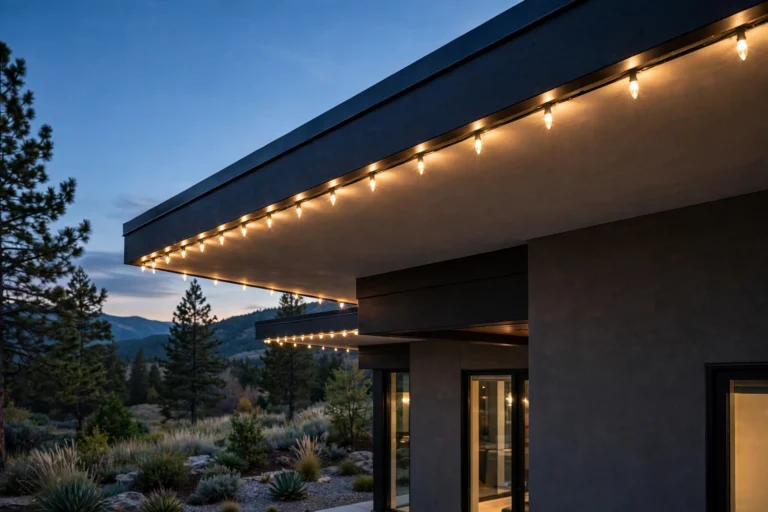
Stand where your audience stands. If viewers are within ~15 feet — a porch, a window, an indoor tree, a walkway — C7s look refined and C9s can look oversized. If viewers are 30+ feet away — the street looking at your roofline — C7s visually shrink and can disappear against a large facade, while C9s hold their presence. Between 15 and 30 feet, either works; let the house decide: small/ranch homes lean C7, large/two-story homes lean C9. Professional installers overwhelmingly run C9s on rooflines for exactly this reason — the roofline is always a distance feature — and C7s or minis everywhere the eye gets close.
Brightness, Honestly
A C9 isn’t just bigger; per bulb it genuinely outputs more light, and its larger lens projects that light further. On incandescent strings that’s 7W vs 5W per bulb — a 25-bulb C9 roofline string burns 175W against the C7’s 125W, a gap that shows up both in presence and on the electric bill (three C9 strings ≈ 525W; our electricity cost guide prices that out). In LED, both are so efficient that the running-cost argument nearly vanishes (a 25-bulb LED set of either size draws roughly 5–25W total) — choose on looks and leave the bill out of it. One LED nuance: faceted LED C9s mimic the vintage incandescent glow remarkably well now; smooth/opaque “ceramic-look” LEDs give the retro painted-bulb vibe without the heat.
Spacing and Coverage
Spacing is where displays quietly succeed or fail:
- C9 at 12″ spacing is the roofline standard — one bulb per foot reads as a clean dotted line from the street
- C7 at 6–12″ — tighter spacing (6″) gives a denser, more detailed line for windows and garlands; 12″ suits bushes and small trees
- Mixing spacing rhythms on the same sightline looks accidental; pick one rhythm per feature
- Count your footage before buying: a 40-ft roofline at 12″ spacing needs 40 sockets — two 25-bulb C9 strings with slack to spare
Connection limits differ by size too — big incandescent bulbs hit watt ceilings fast (2–3 C9 sets end-to-end max; see how many strings you can connect).
Where Each Wins: A Room-by-Room, Feature-by-Feature Verdict
Use this verdict sheet when choosing between C7 vs C9 Christmas lights for each part of your display:
| Feature | Winner | Why |
|---|---|---|
| Roofline | C9 | Distance + scale; the pro standard |
| Large outdoor tree (10 ft+) | C9 | Presence through dense foliage |
| Indoor Christmas tree | C7 (or minis) | Close viewing; C9s overwhelm branches |
| Windows & doors | C7 | Detail scale matches trim |
| Wreaths & garlands | C7 | Fits the greenery’s scale |
| Bushes & hedges | Tie | C7 for a fine sparkle, C9 for bold dots |
| Pathway outlining | C9 | Visible guide lights from the street |
| Small apartment/condo | C7 | Proportion |
| Commercial storefront | C9 | Must read from across a parking lot |
PRO TIP
The best-looking displays often use both — deliberately. C9s on the roofline for impact, C7s on the porch and windows for detail, minis on the tree. The trick is keeping one color temperature across all of them: mixing a warm-white C9 with a cool-white C7 reads as a mistake even when the sizes are perfect. Buy spare bulbs at the same time as the strings — matching a discontinued warm white two seasons later is a special frustration.
If you want that C9 roofline look without the annual ladder climb, see our guide to the best permanent outdoor lights.
Can you put a C9 bulb in a C7 socket?
No. C7 bulbs use an E12 candelabra base; C9s use a larger E17 intermediate base. They are physically different sizes and cannot be swapped either way. Buy strings and replacement bulbs in the size you actually own.
Are C9 lights brighter than C7?
Yes — per bulb, noticeably. The C9’s larger bulb and (in incandescent) higher wattage (7W vs 5W) produce a bolder point of light designed to carry across distance. Up close, the difference reads as presence, not just brightness.
Which is better for a roofline, C7 or C9?
C9, for most homes — it’s the professional standard because rooflines are viewed from the street, where C7s shrink. The exception is a small single-story home with a low roofline close to the sidewalk, where C7s can look more proportionate.
Do C9 lights use a lot more electricity?
In incandescent, yes: 175W vs 125W per 25-bulb string, and heavy C9 displays are the classic December bill surprise. In LED, both sizes use so little (a whole string often under 25W) that the difference is pocket change.
What does the “C” and the number mean?
“C” stands for candle (the bulb’s flame-like shape); the number is the bulb’s diameter in eighths of an inch — a C7 is 7/8″ wide, a C9 is 9/8″ (1⅛″) wide. The same system names mini lights’ bigger cousins: C6 (6/8″) is the smaller size often found on pre-lit trees.
Can I mix C7 and C9 in one display?
Yes — it’s what most polished displays do — as long as each string is one size (the bases force this anyway), the color temperature matches across sizes, and each size is assigned to features at its natural viewing distance.
Is C7 or C9 bigger?
C9 is bigger — about twice the size of C7. A C9 bulb is about 2.5–3 inches tall and about 1⅛ inches in diameter, while a C7 bulb is about 1.5–2 inches tall and about ⅞ inch in diameter.
What is the difference between C7 and C9 bulbs?
Size and brightness. The C9 is larger — about 2.5–3 inches tall and about 1⅛ inches in diameter, versus about 1.5–2 inches tall and about ⅞ inch in diameter for the C7 — and brighter, with a bold, bright glow designed to read from the street, while the C7 has a softer glow for close-up viewing. C9 bulbs use an E17 intermediate base, while C7 bulbs use an E12 candelabra base.
How big are C9 Christmas lights?
C9 bulbs are about 2.5–3 inches tall and about 1⅛ inches in diameter (9/8″ wide), with an E17 intermediate base.
Key Takeaways
- C7 = detail (E12 base, ~2″, close viewing). C9 = impact (E17 base, ~3″, street distance). Bases never interchange.
- The decider is viewing distance: under ~15 ft choose C7; over ~30 ft choose C9.
- Rooflines belong to C9; windows, wreaths, and indoor trees belong to C7.
- Incandescent C9s are the running-cost hogs (7W/bulb); in LED, buy on looks alone.
- Mixing sizes by feature is pro practice — just hold one color temperature across everything.