Do Solar Christmas Lights Work in Winter? An Honest Answer
The pitch is irresistible: no cords, no outlets, no electric bill — stake the panel and the lights run themselves. And in June, they would. But Christmas lands in the worst solar month of the year, so the only question that matters is the December one: do solar Christmas lights work in winter, really? The honest answer: yes, as accents — expect 4–8 hours after a sunny day, 2–4 hours in typical midwinter conditions, and occasional dark nights in cloudy northern climates. They will not reliably carry a main roofline display in Seattle or Chicago. In Phoenix or Denver, they might. Here’s the physics, the realistic numbers, and how to set solar lights up so they perform at the top of their range.
TL;DR
Solar Christmas lights work in winter if the panel gets direct sun: runtime runs 6–8 hours after clear days, 2–4 hours through cloudy stretches, and near zero after several dark days in northern latitudes. December stacks every disadvantage at once — shortest days, lowest sun angle, most cloud cover, and cold that cuts battery capacity 20–40%. Success recipe: a detachable panel on a long lead placed in your sunniest south-facing spot and tilted steeply (45–60°, which also sheds snow), a battery of 2,000 mAh or more, modest bulb counts, and steady-on (not flashing) modes. Use solar for fences, trees, mailboxes, and pathways far from outlets; keep the core display plug-in.
Do Solar Christmas Lights Work in Winter? Why December Is the Hardest Month
Four separate problems arrive together:
- Shortest days of the year. Around the solstice, northern US cities get 8–9 hours of daylight; the panel’s charging window is half its summer length.
- Low sun angle. Winter sun crawls along the southern horizon — panels lying flat or facing the wrong way collect a fraction of their rating, and houses/trees cast shadows that didn’t exist in July.
- Cloud cover. Overcast panels produce roughly 10–25% of rated output. One grey week is a slow-motion blackout: each day the battery starts lower than the day before.
- Cold batteries. Lithium cells lose an estimated 20–40% of usable capacity below freezing; the cheaper NiMH batteries in budget sets fare worse. The energy is “still there” — it returns when warmed — but it isn’t available to your lights at 15°F.
Nothing here is a defect. It’s geometry and chemistry, and it explains the universal review pattern: delighted buyers in October (longer days, test runs) and furious ones by December 20th.
Real Winter Runtimes (Not Box Claims)
| Conditions | Typical runtime per night |
|---|---|
| Clear sunny day, panel well-placed | 6–8 hours |
| Mixed/partly cloudy week | 3–5 hours |
| Heavily overcast stretch (Pacific NW, Great Lakes) | 1–3 hours, some nights none |
| After snow covers the panel | Zero until cleared |
| Sunny-winter climates (AZ, CO, TX, FL) | 6–10 hours — near summer performance |
Modes matter too: a steady-on string drains the battery far faster than twinkle/flashing modes — several owners get double the runtime by switching modes, at the cost of the classic look. And brightness fades before the lights quit: many sets dim progressively through the night as voltage sags, so “4 hours” may mean 2 bright + 2 faint.
Where Solar Genuinely Wins
- Decor far from any outlet: the back fence, a street tree, the mailbox, a detached garage, grave sites, and garden features where a cord would cross walkways or a driveway
- Accent layers: pathway markers, wreath on a gate, a small tree in the front bed — places where “on most nights, for a few hours” is a perfectly good outcome
- Zero running cost and zero cord clutter, and no contribution to breaker/GFCI drama (contrast: our plug-in troubleshooting guide)
- Sunny-winter regions: in the Southwest and Mountain West, December sun is strong enough that solar performs close to its marketing
Where it loses: your main display — roofline and hero tree — anywhere north with real winters, and any night you’re hosting and actually counting on the lights.
The Setup That Squeezes Out Maximum Performance
- Panel placement is everything. Detachable panel on a long cable > fixed panel on the stake, every time: mount it in the single sunniest spot you own (south-facing, unshaded 10 a.m.–2 p.m.), even if that’s 10 feet from the lights.
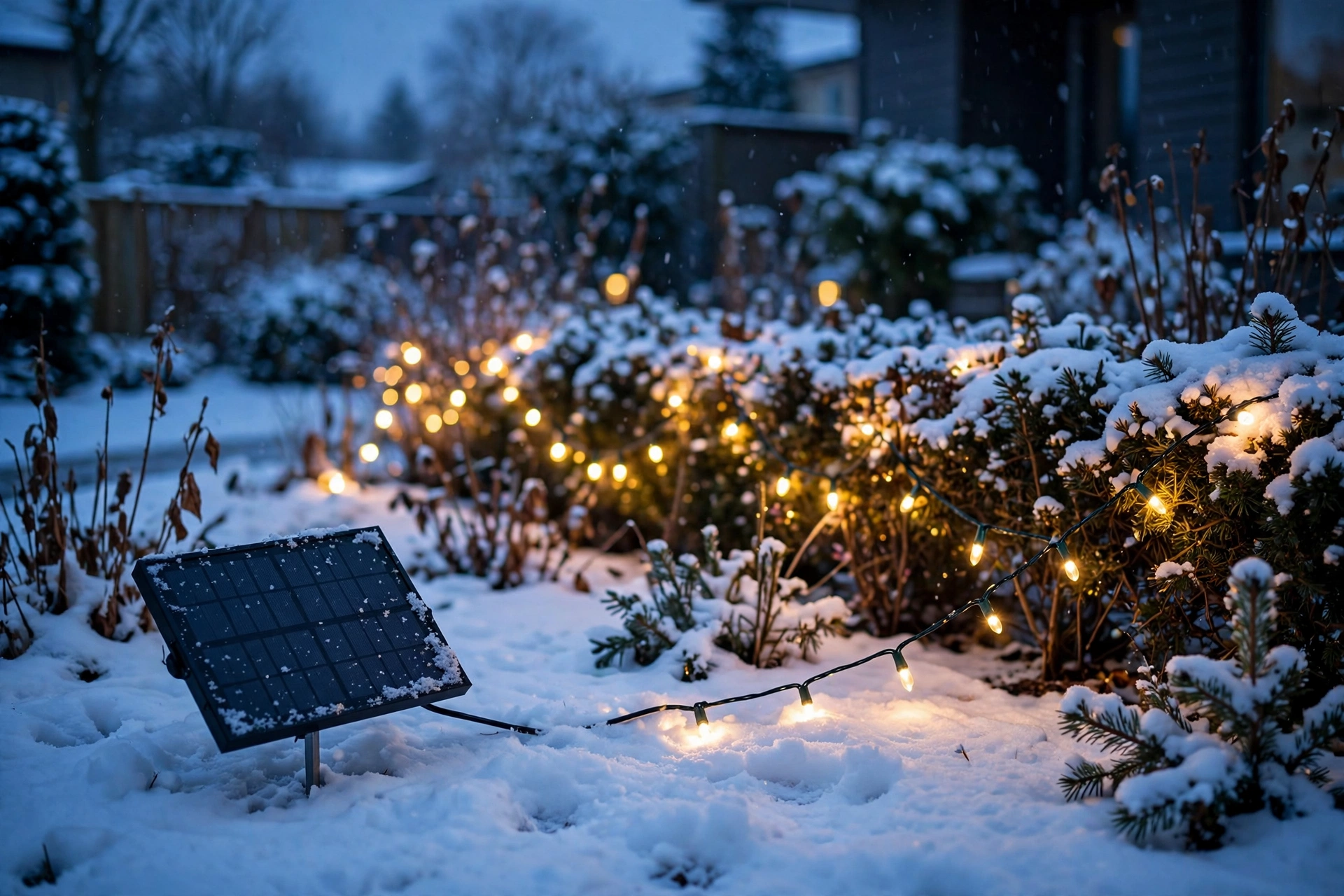
- Tilt it steeply — 45–60°. A near-vertical winter tilt faces the low sun directly and sheds snow by gravity. A flat panel under 2 inches of snow charges exactly nothing.
- Battery size is the spec that matters: 2,000 mAh+ (lithium preferred) bridges multi-day grey stretches; sub-1,000 mAh budget sets are fair-weather toys.
- Pre-charge before the season: let new sets charge 2 full sunny days before judging them — they ship half-empty.
- Housekeeping: wipe the panel when you pass it; snow, frost film, and grime each shave real percentages. After storms, check the panel before blaming the lights.
- Buy for your latitude: shoppers in cloudy regions should favor sets marketed on low-light performance and larger panels over raw bulb count — a modest 50-bulb string on a big panel outlasts a 200-bulb string on a postage stamp.
PRO TIP
Run the hybrid display the pros quietly use: plug-in LED for the roofline and tree (reliable, on a timer), solar for everything beyond cord reach. Each technology does the job it’s actually good at, the display never fully dies on a cloudy week, and your total solar investment stays in the cheap seats while you learn how your yard’s winter sun behaves.
Solar vs Plug-In: The Honest Scorecard
| Factor | Solar | Plug-in LED |
|---|---|---|
| December reliability (northern US) | Low–moderate | High |
| Runtime per night | 2–8 hrs (weather-dependent) | Unlimited (timer-set) |
| Running cost | $0 | ~$3/season for a typical display (cost guide) |
| Install | No cords; panel placement critical | Needs outlets/cords; placement free |
| Brightness | Modest, fades as battery drains | Full and steady |
| Maintenance | Panel cleaning, snow clearing, battery replacement every 1–3 yrs | Near zero |
| Best role | Accents away from outlets | Core display |
Frequently Asked Questions
Do solar Christmas lights charge on cloudy days?
Yes, but at roughly 10–25% of their sunny-day rate. A single cloudy day is survivable on a good battery; a cloudy week drains most sets to empty in northern winters. Panel placement and battery size decide how much grey weather you can bridge.
How long do solar Christmas lights stay on at night in winter?
Realistically 4–8 hours after a sunny day, 2–4 hours in typical mixed December weather, and sometimes zero after several overcast days or under snow cover. Claims of “8–10 hours” assume strong sun that most northern Decembers don’t deliver.
Why do my solar lights work some nights and not others?
Charge debt. Each short, grey day harvests less than the night spends, so the battery trends downward until a sunny day refills it. Dim-then-dead patterns across a cloudy week are the signature — the lights aren’t broken; they’re underfed.
Can cold weather damage solar Christmas lights?
Cold mostly pauses rather than damages: battery capacity drops sharply below freezing and returns when warmed. Real damage comes from water ingress freezing inside housings and from leaving batteries fully discharged in storage all summer — store sets charged, indoors, and replace tired batteries (usually standard rechargeable AAs) before blaming the panel.
Are solar Christmas lights worth it?
For accents far from outlets and in sunny-winter regions, yes — they’re cheap, cordless, and cost nothing to run. As your only display in a cloudy northern climate, no — you’ll spend December managing them. The hybrid (plug-in core + solar accents) is the setup that satisfies most people.
Do solar lights work behind a window (for indoor trees)?
Poorly. Window glass cuts panel output substantially, winter sun through a window is brief, and the geometry rarely aligns. Indoor solar novelties (like tree toppers) need a south-facing sill and modest expectations; battery-operated lights are the reliable indoor cordless choice.
Key Takeaways
- Yes, they work in winter — within physics: 6–8 hrs after sun, 2–4 in grey weather, sometimes none in the cloudy north.
- December stacks short days + low sun + cloud + cold-degraded batteries; none of it is fixable, all of it is manageable.
- Panel placement (sunniest spot, steep tilt), battery size (2,000 mAh+), and detachable panels separate the sets that work from the sets that disappoint.
- Solar’s winning role: accents beyond cord reach. Plug-in LED’s winning role: the core display.
- Judge a set after two fully sunny charge days — and expect the first cloudy week to tell you the truth about it.