Locally Grown Baby Shower: A Farmers Market Theme That Feels Like Home
TL;DR
A locally grown baby shower turns a farmers market into the party: wooden crates, sunflowers in mason jars, potted herbs and a grazing table, all set up at home. Decorate three areas only — entrance, food table and gift table — and spend roughly $40–$100 on pieces guests can eat, plant or take home.

The farmers market is having a moment as a baby shower theme, and it is easy to see why. A locally grown baby shower feels warm and personal in a way a balloon arch never does: real food, real flowers and real wood, set up in your own living room. This guide covers the full look — the market-stall centerpiece, the grazing table, the favors guests actually keep — plus what it costs and the one timing mistake to avoid. Prices below are rough planning estimates, not quotes. For the wider picture, start with our guide to baby shower decorations.
What Is a Locally Grown Baby Shower?
A locally grown baby shower is a farmers market themed celebration built around fresh local produce, flowers and herbs instead of balloons and plastic decor. Wooden crates, mason jars, sunflowers and potted herbs set the scene, and much of the decor doubles as food or favors. It suits a home party and feels warm, seasonal and personal.
The idea is simple: one market run does three jobs. The same crate of apples that decorates the entrance becomes the grazing board, and the potted herbs on the food table go home as favors. Nothing is bought just to look pretty for two hours and then thrown away, which is why a locally grown baby shower costs less than a balloon-heavy theme while looking more expensive.
It is also gender-neutral by default, which suits parents who are keeping the baby’s sex a surprise. Sage green, terracotta and cream work for any baby, and the theme fits late spring through early fall best, when markets are full — late April to June and late August to early October are the sweet spots for an outdoor version.
How Do You Set Up a Farmers Market Baby Shower at Home?
Set up a farmers market baby shower at home by choosing three focal areas only: the entrance, the food table and the gift table. Stack wooden crates as shelves, fill mason jars with sunflowers, and lay a burlap runner down the food table. Shop the morning of the party so produce and flowers stay fresh.
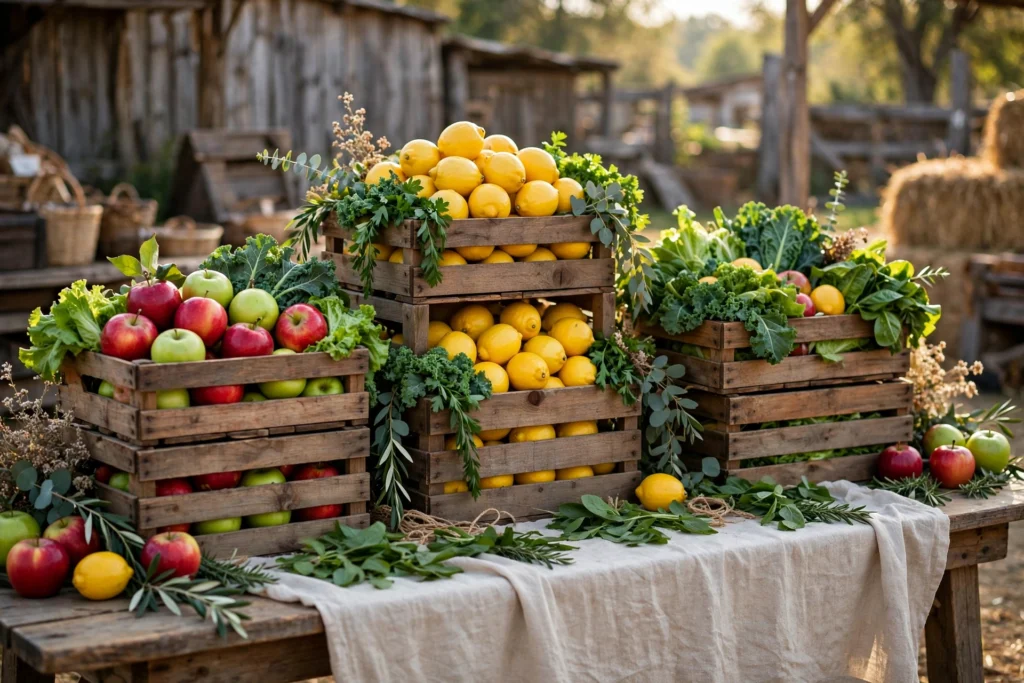
Start at the entrance, because it sets the tone before anyone sees the food. A chalkboard welcome sign, one crate of sunflowers and a basket of apples is enough — guests should feel they have walked into a market, not a warehouse. The food table is the second focal area: crates at different heights, a burlap runner, and the grazing board as the centerpiece. The gift table needs the least: a linen cloth, one jar of flowers and the favors lined up in a row.
PRO TIP
Decorate in layers of height, not in a flat line. Crates stacked two high, jars on books, and one tall sunflower stem break up the table so the eye moves around — a flat row of small items reads as clutter, however pretty each piece is.
Keep the rest of the house alone. A locally grown baby shower works because it concentrates the theme in three places; scattering crates and jars into every room dilutes it and triples the cleanup. If the party spills into the backyard, one crate of flowers by the back door is all the extra decor you need.
What Decor Makes a Locally Grown Baby Shower Look Real?
The decor that makes a locally grown baby shower look real is produce itself: wooden crates of apples and lemons, sunflowers in mason jars, potted herbs, and a sage green, terracotta and cream palette. Skip balloons and plastic banners entirely. Real food and flowers do the decorating, so the table looks like a market stall, not a party aisle.
Texture does the heavy lifting here. Gingham, burlap, linen and jute give the table a market feel that no plastic prop can match, and they cost little: a burlap runner runs about $10–$15, and a gingham cloth about $8–$12. Pair them with real wood — crates, cutting boards, a wooden cake stand — and the whole setup photographs warm and rich, even in a plain living room. A locally grown baby shower looks real precisely because nothing on the table is fake.
| Decor element | What it does | Rough cost (planning estimate, not a quote) |
|---|---|---|
| Wooden crates | Shelves, risers, market-stall look | About $12 each |
| Sunflowers in mason jars | Color, height, photo focal point | $8–$12 a bunch |
| Potted herbs | Centerpieces that double as favors | About $2 each |
| Burlap or gingham runner | Texture, market feel | $8–$15 |
| Warm-white string lights | Evening glow, photos | $25–$30 |
| Chalkboard welcome sign | Entrance focal point | $10–$20 |

Skip the plastic fruit, the printed market backdrops and the foil balloons. The one thing that kills this theme is anything that looks like a picture of a market instead of a market — guests can tell in a second, and the camera can too. If a piece is not real, edible or plantable, leave it out.
How Much Does a Locally Grown Baby Shower Cost?
A locally grown baby shower costs roughly $40–$100 for the full decor look, with wooden crates at about $12 each, wildflowers at $8–$12 a bunch, and herb-pot favors at about $2 each. A 48-foot string of warm-white lights runs $25–$30. Buying produce that also serves as food keeps the budget low.
The triple-duty trick is what keeps the number down. A $20–$30 market-stall crate is decor, grazing board and favor station in one; flowers at $15–$25 cover the entrance and the food table; herb-pot favors at $25–$40 for a dozen guests are the only favor cost. Compare that with a balloon arch alone, which can run $50–$150 and is gone by evening — the market theme spends the same money on things people eat or take home.
| Item | Rough cost (planning estimate, not a quote) |
|---|---|
| Market-stall crate setup | $20–$30 |
| Flowers (sunflowers + wildflowers) | $15–$25 |
| Herb-pot favors (12 guests) | $25–$40 |
| Wooden crates (2–3) | $24–$36 |
| String lights (48 ft, warm white) | $25–$30 |
| Burlap runner + chalkboard sign | $18–$35 |
| Full decor look | $40–$100 |
A locally grown baby shower also scales down gracefully: for eight guests, one crate, one bunch of sunflowers and six herb pots can carry the whole look for about $40. The mistake is buying decor for thirty guests when twelve are coming — produce is perishable, so buy for the guest list you have, not the one you wish you had.
What Food Fits a Farmers Market Baby Shower?
Farmers market food means grazing boards, fruit skewers, crusty bread, local cheese, and seasonal salads served at room temperature. Keep it simple: one main grazing board, one hot dish such as a baked pasta, and a fruit dessert. Everything should be easy to eat standing up, with no carving and no last-minute cooking.
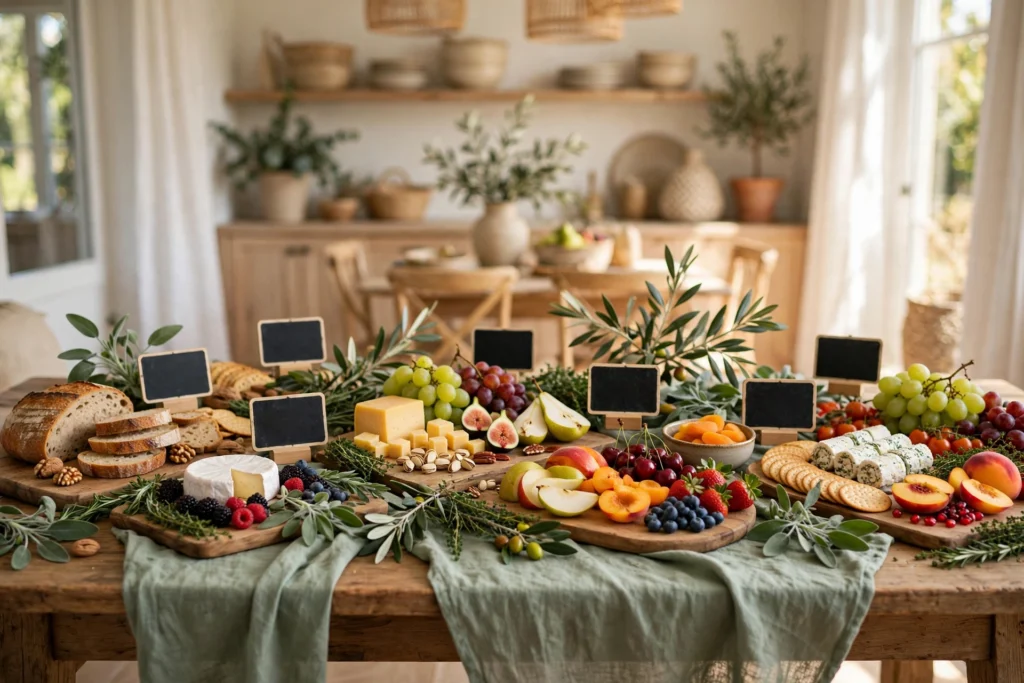
The grazing board is the meal, not the appetizer. Build it from the same produce that decorates the table — apples, grapes, lemons, figs when in season — plus local cheese, cured meats, nuts, honey and crusty bread, all laid out on wooden boards. Fruit skewers are the easiest finger food of all: melon, berries and grapes on short skewers, made the morning of and kept chilled until serving. A locally grown baby shower menu should taste like the market it is named after, so buy what is in season that week rather than forcing an out-of-season recipe.
Drinks stay simple too: infused water with cucumber and lemon, a lemonade stand-style jug, and sparkling water. Skip the signature cocktail bar — it fights the theme and adds cost. For dessert, a fruit tart, a berry pavlova or a simple cake topped with fresh figs and herbs keeps the market feeling right through the last course.
What Favors Do Guests Actually Take Home?
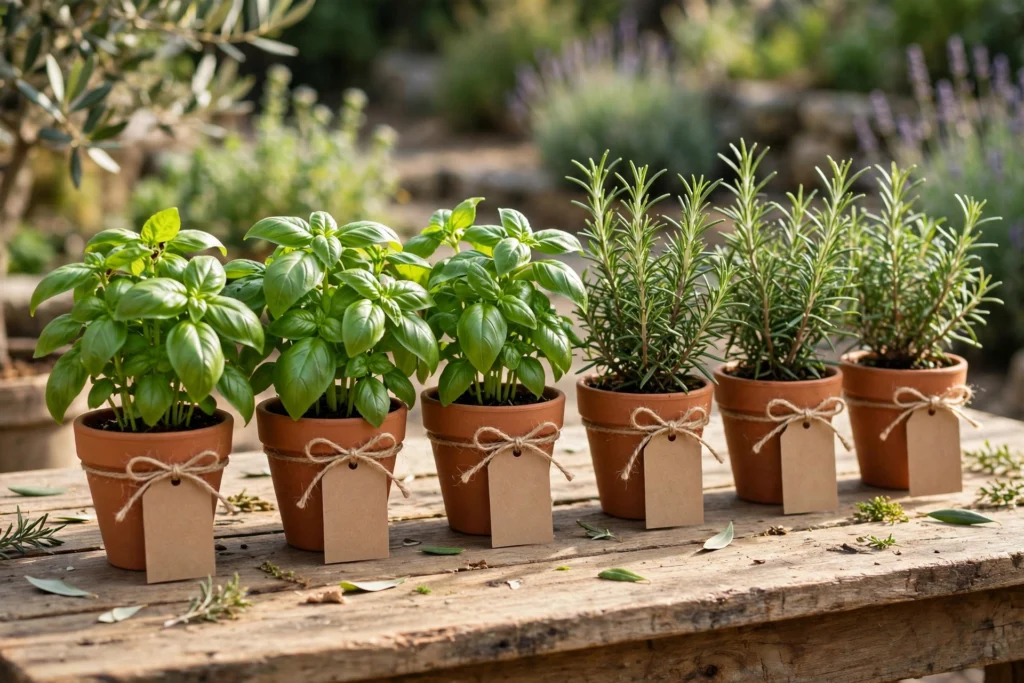
The favors guests actually take home are potted herbs, small jars of local honey, and seed packets tied with twine. A potted basil or rosemary plant costs about $2–$3 and gets used in a real kitchen, while a seed packet costs under $1. Skip personalized trinkets — useful favors beat decorative ones every time.
Potted herbs win because they are decor first and favor second: they sit on the food table all afternoon, smell wonderful, and then go home in a guest’s bag. Basil, rosemary and mint are the safest picks — hard to kill, easy to use, and happy on a kitchen windowsill. Tie a small kraft tag around each pot with the baby’s name and the herb’s name; the tag costs pennies and makes the favor feel personal without a custom order.
A locally grown baby shower also suits seed packets for a bigger guest list: a packet of wildflower or herb seeds costs under $1 each, and a basket of them by the door lets guests take one on the way out. Small jars of local honey are the premium option at $3–$5 each — save them for a small shower of eight to twelve, where the cost stays reasonable.
How Do You Make a Market-Stall Centerpiece?
Build a market-stall centerpiece by stacking two wooden crates at different heights, topping them with sunflowers in mason jars, and tucking apples, lemons and leafy herbs around the base. A small chalkboard sign names the farm or market. The whole stall costs $20–$30 and takes about fifteen minutes to assemble.
Start with the base: one crate flat on the table, one crate stacked on top of it at a slight angle so the display reads as a stall, not a box. Put the tallest element — sunflowers in a mason jar — at the back, so it rises above everything else and photographs well. Then fill the front with color: a row of lemons, a small pile of apples, and a few sprigs of rosemary tucked between them. The chalkboard sign goes at the front edge, angled toward the guests.
PRO TIP
Style the produce the morning of the party, never the night before. Cut flowers wilt, apples brown where they are handled, and leafy herbs droop overnight — a centerpiece built at 9 a.m. looks alive at 2 p.m., while one built the night before looks tired before the first guest arrives.
Keep the stall low enough that guests can see each other across the table — nothing above 18 inches tall in the middle of a food table. If the sunflowers are too tall, trim the stems and use a shorter jar. The centerpiece should frame the conversation, not block it.
What Mistakes Ruin a Locally Grown Baby Shower?
The mistakes that ruin a locally grown baby shower are styling the produce too early, using too many colors, and buying plastic market props instead of real food. Produce wilts fast, so style it the morning of the party. Keep the palette to sage green, terracotta and cream, and let real fruit and flowers carry the color.
The wilt warning is the one nobody else leads with, and it matters most. A market theme is built on fresh things, and fresh things have a clock: sunflowers droop after a day out of water, herbs wilt in a warm room, and cut fruit browns within hours. Buy the morning of, keep flowers in water until the last hour, and put the fruit out no more than an hour before guests arrive.
The second mistake is color chaos. Five bright colors — red, yellow, pink, blue and orange — make the table look like a produce aisle, not a party. Three colors are enough: sage green as the base, terracotta as the warm accent, and cream to calm it down, with the produce itself supplying the bright notes. A locally grown baby shower with a tight palette looks deliberate and expensive; the same table in every color looks accidental.
Frequently Asked Questions
How far in advance should I buy produce for a locally grown baby shower?
Buy produce the morning of the party. Flowers and herbs wilt fast, cut fruit browns within hours, and a centerpiece styled the night before looks tired by party time. Crates, jars, runners and lights can be bought weeks ahead — only the fresh things need the morning run.
Can you host a locally grown baby shower indoors?
Yes — a locally grown baby shower works beautifully indoors, and most of them are. The theme needs three focal areas (entrance, food table, gift table), not a garden. Put the market stall on the food table, the welcome sign by the front door, and let the sunflowers and herbs bring the outdoors in.
What colors work best for a farmers market baby shower?
Sage green, terracotta and cream are the classic palette, with mustard as an optional fourth accent. The produce itself adds the bright color — yellow sunflowers, red apples, green herbs — so the base palette should stay calm and let the food do the talking.
How many guests can a farmers market baby shower handle at home?
Eight to twenty guests is the sweet spot at home. The grazing-board format scales easily, and one market-stall centerpiece serves a table of twelve. Above twenty, add a second grazing board and a second crate display rather than stretching one table thin.
Are herb-pot favors expensive for a locally grown baby shower?
No — a potted herb favor costs about $2–$3 each, so a dozen guests cost $25–$40 total. Basil, rosemary and mint are the cheapest and hardiest picks. For a bigger list, seed packets under $1 each keep the favor budget under $20.
What if there is no farmers market near me?
Use grocery-store produce and garden herbs — the theme is about fresh and local-looking, not a specific shop. Pick what is in season, buy whole fruit rather than pre-cut, and add potted herbs from a garden center. The crates, jars and palette do the rest.
Final Thought
A locally grown baby shower is proof that the prettiest party is often the simplest one: real food, real flowers, real wood, and a morning at the market instead of a week of ordering props. Buy fresh, style late, keep three colors, and let the produce do the decorating — guests will remember the sunflowers and the herb pots long after they have forgotten the balloons at every other shower.