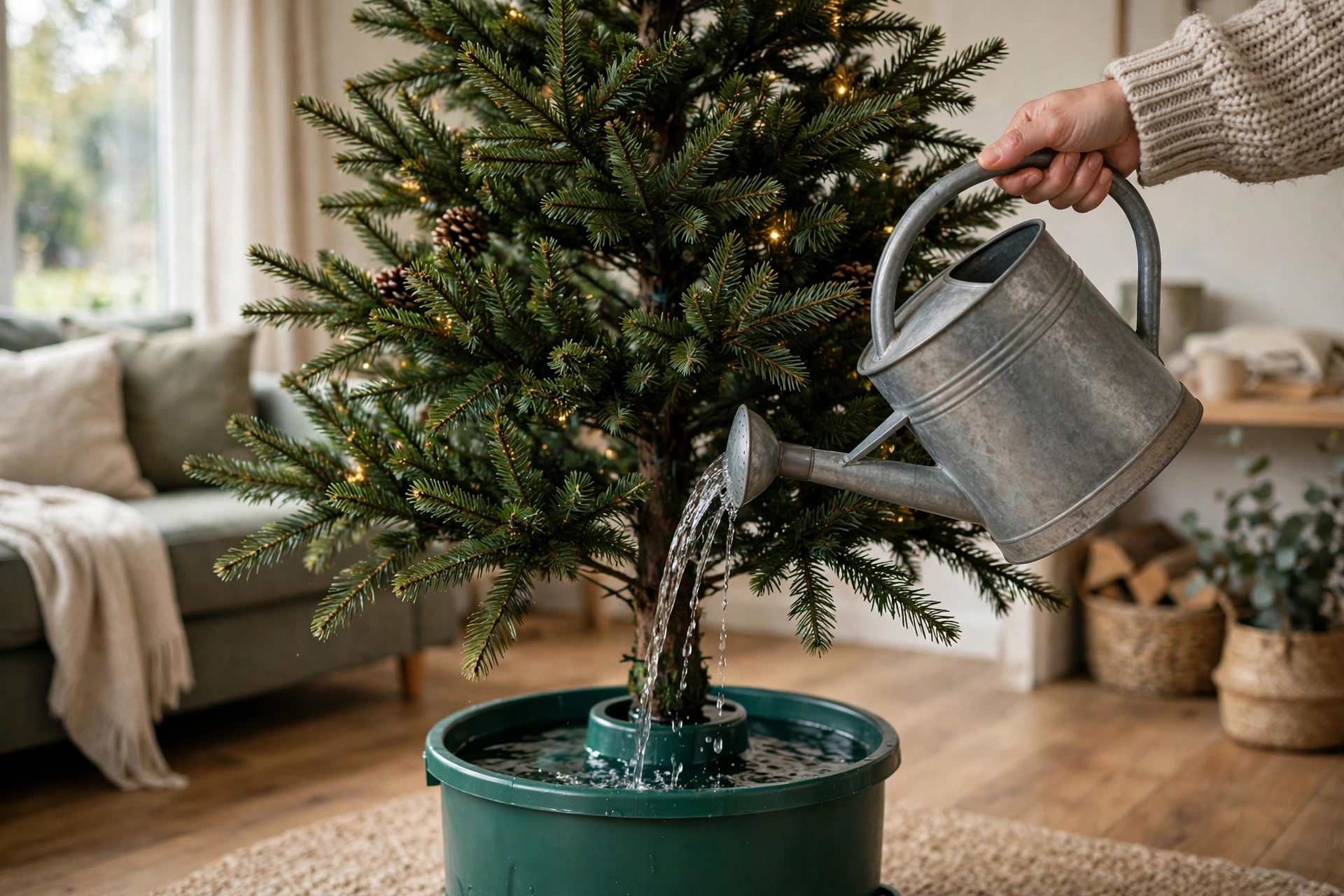
How to Keep a Real Christmas Tree Fresh All Season
You pick the perfect tree full, fragrant, that classic Christmas shape. Two weeks later it’s shedding needles, the branches are drooping, and the living room smells like a lumber yard. The difference between a tree that’s glorious on Christmas morning and one that’s a fire hazard by New Year’s isn’t luck. It’s water, placement, and five minutes of daily care. Here’s how to keep Christmas tree fresh from the day it comes home until it comes down.
A real Christmas tree is a cut plant fighting to stay alive in the driest room of your house. Give it consistent water and cool placement, and five to six weeks of freshness is straightforward.
TL;DR: Cut a half-inch slice off the trunk before setup, use a stand that holds at least a gallon of water, and never let the reservoir run dry — a fresh tree drinks up to a quart or more daily in week one. Keep it away from heat vents, fireplaces, and direct sun, use cool-running LED lights, and test needles weekly. A watered tree stays fresh 5–6 weeks; a dry tree is a fire risk.
Start With a Fresh Tree
Everything downstream depends on the tree’s condition at purchase. A tree cut three weeks ago and baking on a sunny lot will never last, no matter how faithfully you water it. Buy as close to cutting as you can — choose-and-cut farms, where you watch the tree come down, are the gold standard.
At a retail lot, run these checks before you pay:
The needle test. Bend a green needle between your fingers. On a fresh fir, it bends without snapping. If needles snap like dry twigs, walk away.
The branch test. Lift a branch six inches and let it drop. A fresh tree drops almost no green needles. If they rain down, keep looking.
The trunk check. Ask when the trees arrived and whether trunks were stored in water. If the cut end looks dried and sealed with sap, it’ll need a fresh cut — which you should do anyway.
Species matters too. Fraser and Nordmann firs hold needles longest — 6+ weeks with good care. Douglas fir is fragrant and affordable but drops faster. Spruces are beautiful but shortest-lived indoors — plan on 3–4 weeks max.
| Species | Needle retention | Fragrance | Typical price tier |
|---|---|---|---|
| Fraser fir | Excellent (5–6+ weeks) | Strong, classic | $$ |
| Nordmann fir | Excellent (5–6+ weeks) | Mild | $$$ |
| Noble fir | Very good (4–6 weeks) | Pleasant | $$$ |
| Douglas fir | Good (4–5 weeks) | Very strong | $ |
| Colorado blue spruce | Fair (3–4 weeks) | Mild, sharp needles | $$ |
| Norway spruce | Fair (3–4 weeks) | Strong | $ |
The Fresh Cut: The Single Most Important Step
A cut Christmas tree seals its own trunk within hours — sap hardens over the cut end and blocks water uptake, which is why a tree can sit in a full stand and still dry out. The fix takes thirty seconds: saw a clean half-inch slice off the bottom right before setup.
Do this at home, not at the lot — a fresh cut starts sealing within 4–6 hours. If the tree must wait a day, store it upright in a bucket of water in a cool garage. Use a sharp saw for a flat cut; ragged cuts absorb poorly. Don’t whittle the trunk to fit a small stand — that removes the bark and outer wood where most absorption happens.
Skip the folk remedies. Aspirin, sugar, bleach, and commercial preservatives show no benefit over plain tap water in university extension trials — some can even damage the cut tissue. Plain water, kept topped up, is the entire formula.
How to Keep Christmas Tree Fresh with Daily Watering
Here’s the number that matters: a freshly cut tree can drink a quart to a gallon of water per day in its first week. And the critical rule: never let the water drop below the cut trunk. A few hours of air exposure lets sap reseal the cut — refilling afterward won’t fully restart uptake.
Set yourself up to win:
- Buy a stand with real capacity. At least one gallon for a 6–8 foot tree. The cheap stands that hold a pint are the #1 cause of dried-out trees.
- Check water twice daily for the first week. Morning and evening. After 7–10 days, uptake slows and once-daily checks are enough.
- Make it reachable. Place the stand where you can reach the reservoir without crawling under low branches, and keep a watering can nearby as a visual reminder.
How long does heavy drinking last? Typically the first week to ten days, then consumption tapers. But “tapers” doesn’t mean “stops” — keep checking until the tree comes down.
Pro Tip
Set a phone reminder for tree watering for the first two weeks — morning and night. One missed evening in a warm room can seal the trunk and end the tree’s freshness weeks early.
Placement: Keep It Away From Heat
Your tree is a drying plant, and your house in December is a dehydration machine. Forced-air heating drops indoor humidity to desert levels, and every heat source near the tree accelerates needle loss dramatically. Placement is the second-biggest freshness factor after water.
Keep the tree away from:
- Heating vents and radiators. A tree over a floor vent is being blow-dried 24/7. No watering schedule compensates for direct forced heat.
- Fireplaces and wood stoves. Brutal radiant heat, and a drying tree next to open flame is the fire scenario every safety agency warns about. Several feet of clearance, minimum.
- Direct sun through south-facing windows. Winter sun through glass is surprisingly strong.
- Exterior doors that open constantly. The dry heated air rushing past does the damage.
Ideal placement: the coolest room you’ll decorate, away from vents, with stable temperature. A small humidifier nearby genuinely helps the tree, your skin, and your hardwood floors.
Lights and Decorations: Keep the Heat Down
Incandescent mini-lights run hot — a real heat load and ignition risk on a dry tree. LED Christmas lights run nearly cool, use a fraction of the electricity, and don’t bake needles.
- Check strands for cracked insulation or loose sockets before hanging.
- Don’t overload outlets — follow the manufacturer’s end-to-end connection limit on the tag.
- Turn lights off overnight and when you leave. A $10–$15 timer plug handles this automatically.
- Keep heavy ornaments off weak branch tips; the weight accelerates droop.
The Weekly Freshness Check
Don’t guess — test. Once a week, run the same checks you did at the lot:
- Needle bend test. Green needles should still bend, not snap.
- Branch tap test. Tap a branch over white paper. A few brown interior needles are normal; green needles falling in quantity means trouble.
- Trunk scratch test. Scratch outer bark with your thumbnail. Green, moist tissue underneath means the tree is still drinking; brown and dry means uptake has stopped.
- Fragrance check. A fresh fir smells like Christmas when you brush it. No scent means moisture is going.
If the tree fails these tests, it’s done — even if it still looks okay from across the room.
When a Dry Tree Becomes a Fire Hazard
The National Fire Protection Association reports that Christmas tree fires, while not the most common holiday fires, are disproportionately deadly — a dry tree can go from spark to fully engulfed in under a minute.
Dry tree + heat source = ignition. A well-watered tree resists fire; a dried-out one is kindling shaped like a decoration.
Warning signs your tree needs to come down now:
- Needles snap rather than bend across most of the tree
- Heavy green needle drop daily despite watering
- Branches droop and don’t spring back
- The trunk scratch test shows dry, brown tissue
- It’s been up 6+ weeks regardless of appearance
When it’s done, take it down promptly — most municipalities offer curbside pickup in January, and many chip trees into mulch.
Pro Tip
Never burn your Christmas tree in the fireplace. The resin-heavy wood burns explosively hot, throws sparks, and coats the flue with creosote — one of the fastest ways to start a chimney fire. Recycle or chip it instead.
Needle Drop Fixes
Some shedding is normal — interior needles drop naturally in the first days. Heavy green drop signals a water or heat problem. Troubleshoot in order:
- Check the water first. If the reservoir ran dry, refill immediately — but if the trunk was exposed for hours, uptake may be permanently reduced. Re-cutting the trunk can buy another week or two.
- Check for heat. A forgotten vent, a radiator behind the tree, sun through a morning window — move the tree or block the heat.
- Cut light heat. Swap incandescents to LEDs mid-season if you haven’t; it’s not too late.
- Raise humidity. A humidifier near the tree slows moisture loss.
For cleanup, a tree skirt or mat catches most needles — a quick daily pass with a handheld vacuum keeps them out of the carpet.
Bottom Line
- Fresh cut + plain water is 90% of it. Half-inch slice at setup, a gallon-capacity stand, never let the reservoir run dry.
- First-week thirst is extreme — up to a gallon a day. Check morning and evening for 10 days.
- Heat is the enemy. Away from vents, radiators, fireplaces, and direct sun.
- LED lights run cool — safer and easier on needles than incandescents.
- Test weekly — needle-bend, branch-tap, trunk-scratch.
- A dry tree is a fire hazard. Brittle needles and no fragrance mean it comes down now.
Frequently Asked Questions
How often should I water my Christmas tree?
Check twice daily for the first 7–10 days — a fresh 7-foot tree can drink a quart to a gallon per day. After uptake slows, once daily is enough. The iron rule: never let water drop below the cut trunk, or sap reseals the cut and absorption stops.
Should I put anything in the Christmas tree water?
No. Plain tap water outperforms every additive tested — sugar, aspirin, bleach, and commercial preservatives show no meaningful benefit in university trials, and some can damage the cut tissue.
How long will a real Christmas tree last indoors?
Fraser/Nordmann firs: 5–6+ weeks watered daily. Douglas fir: 4–5 weeks. Spruces: 3–4 weeks. Unwatered, any species can dry out in under two weeks.
Why is my Christmas tree dropping needles already?
Heavy green drop in the first two weeks means a water problem (empty reservoir, sealed trunk) or heat problem (vent, radiator, direct sun). Check water first, then heat.
Can I revive a dried-out Christmas tree?
Partially. Re-cutting half an inch off the base can restore some uptake and buy another week or two. If needles are brittle throughout and the trunk scratches brown, the tree is finished — take it down.
Is a dry Christmas tree really a fire danger?
Yes. A watered tree is very difficult to ignite; a dry one can be fully engulfed in under a minute. Keep it away from heat, use LEDs on a timer, and take it down once it fails the freshness tests.