When to Put Up (and Take Down) Your Christmas Tree
The neighbors put theirs up the day after Thanksgiving. Your cousin does it November 1st. Your grandmother insists it should be Christmas Eve or nothing. Every year, the same debate and this year, with a real tree in the garage and opinions flying, you want an actual answer, not just tradition.
The “right” time depends on your tree type: artificial trees are a scheduling question, real trees are a biology question. Get it right and your tree is glorious on Christmas morning; get it wrong and you’re sweeping needles by December 15th.
TL;DR: Put up an artificial tree whenever you like most households do it the weekend after Thanksgiving. For a real tree, wait until the first or second week of December: even a well-watered real tree stays fresh about 5–6 weeks indoors, so a late-November setup risks a dry, shedding tree by Christmas. Take the tree down by the first week of January (Twelfth Night, January 5th, is the traditional deadline). Keep a dry tree away from heat sources and take it down early if needles turn brittle — that’s a fire risk, not a decoration.
The Short Answer by Tree Type
If you just want the date, here it is:
| Tree type | Put it up | Take it down | Why |
|---|---|---|---|
| Artificial | Anytime — most do the weekend after Thanksgiving | Early January | No freshness limit; it’s about your schedule and storage |
| Real (fir) | First–second week of December | First week of January | 5–6 weeks of peak freshness with daily watering |
| Real (spruce) | Second week of December | First week of January | 3–4 weeks of peak freshness; shorter-lived species |
| Real (early setup) | Day after Thanksgiving at the earliest | First week of January | Pushes the freshness window — only with strict watering |
The asymmetry is the whole story: a cut fir is slowly drying from the moment it’s cut. Five to six weeks is the realistic freshness window — count everything backward from Christmas Day.
Why Real Trees Should Wait Until December
A Fraser or Nordmann fir, watered daily and kept from heat, looks great about 5–6 weeks. Up December 1st, it’s at peak on Christmas. Up November 15th, you’re spending the margin — any lapse (a missed watering, a forgotten vent) shows as needle drop when guests arrive.
Spruces are even less forgiving: 3–4 weeks of good looks means a mid-December setup for Christmas Day. If you bought a spruce because it was cheap and beautiful at the lot, plan the latest setup of all.
Trees cut in early November and stored on lots are already aging before you buy — later shopping usually means a fresher tree. Ask the lot when their trees arrived.
The exception: at a choose-and-cut farm, the clock starts when you cut. A tree cut December 1st is genuinely fresher than a pre-cut tree bought the same day — the one scenario where late-November setup works.
Pro Tip
Buying Thanksgiving weekend? Choose a fir, not a spruce, and water religiously from day one. Buying mid-December? Even a spruce will make Christmas.
The Tradition Calendar (If You Care About That)
If your household follows tradition, here’s the calendar:
- Advent: The Christmas season in Western Christian tradition begins on the fourth Sunday before Christmas (late November/early December). Many families put the tree up on the first Sunday of Advent.
- Thanksgiving weekend: The de facto American standard — no religious basis, just the long weekend when everyone’s home and the holiday mood kicks in.
- Christmas Eve: The old European tradition — the tree goes up December 24th and the magic is concentrated into the holiday itself. Still practiced in parts of Germany and Eastern Europe.
- St. Nicholas Day (December 6th): A common tree-day in some Catholic households.
- Twelfth Night (January 5th): The traditional takedown deadline — the eve of Epiphany, ending the twelve days of Christmas. Superstition in some traditions holds that leaving decorations up past this invites bad luck.
None conflict with the biology if you set up in early December. The November 1st crowd with a real tree is fighting physics by mid-December. Match the tradition to the tree: Advent works for both types, while a Christmas Eve setup is the kindest timing you can give a real spruce.
The Case for Putting It Up Early Anyway
People put trees up in November because it makes them happy — and with kids, anticipation is half the magic. If early setup is what you want, it works with conditions:
- Use an artificial tree. This is the real answer for November setups. No freshness clock, no watering, no needle drop. Put it up October 30th if you want.
- If it must be real, buy late and store right. Buy Thanksgiving weekend but keep it in a cool garage in a bucket of water until setup. Every cool, hydrated day outdoors is a day it isn’t drying in your living room.
- Water like you mean it. Early setup + casual watering = a brown tree by Christmas. Early setup + twice-daily water checks = a fighting chance.
- Keep it cool. Lower the thermostat a couple of degrees in the tree room — it measurably improves needle retention over six weeks.
Pro Tip
Love the early look with a real tree? Go two-stage: outdoor lights and wreaths in November, tree inside in December when its freshness window opens.
When to Take It Down
Twelfth Night (January 5th) is the traditional deadline — and the practical one. By early January, even a well-kept fir is past peak: needle drop accelerates and fire risk climbs. A tree indoors six-plus weeks is significantly drier than at Christmas.
Signs it’s time regardless of the calendar:
- Green needles dropping daily despite the stand having water
- Branches that don’t spring back when bent
- The tree no longer smells like anything when you brush it
- It’s been up more than 6 weeks (fir) or 4 weeks (spruce)
Don’t let a spent tree sit for weeks. Take it down, strip the lights and ornaments, and get it out — most municipalities run curbside pickup in early January and chip trees into mulch.
Artificial tree owners: takedown is about your schedule, not safety. Store it properly (see our storage guide) so next November isn’t a tangled nightmare.
What About Outdoor Trees and Decorations?
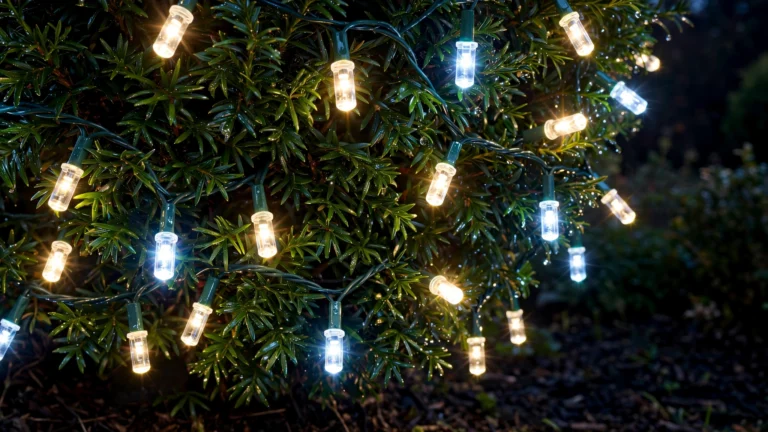
Outdoor timing is forgiving. Cold air preserves wreaths and garlands far longer than indoor heat preserves a tree — a late-November wreath looks fine through December. Hang outdoor lights whenever weather allows (many do it in November) and just don’t switch them on until after Thanksgiving.
One practical note: if you’re hiring someone to hang outdoor lights, book early — professional installers fill their November schedules by mid-October in most markets. Our breakdown of Christmas light installation costs covers what to expect.
Pro Tip
Hang outdoor lights in early November while weather allows, on a timer starting after Thanksgiving. You skip the freezing-ladder weekend; the street still gets the full show.
The Fire-Safety Timing Rule
Biology has veto power over the calendar. A dry tree can go from spark to fully engulfed in under a minute, and risk rises steeply after 4–5 weeks indoors — which is why takedown timing matters as much as setup.
Non-negotiable rules for the whole season:
- Water daily. A dry stand is the #1 accelerator of everything bad.
- Keep the tree away from fireplaces, radiators, heating vents, and candles — several feet minimum.
- Use LED lights (they run cool) on a timer, off overnight.
- If the tree fails the freshness tests (brittle needles, no scent, dry trunk), take it down immediately — don’t wait for the weekend.
For the full routine, see our guide to keeping a real Christmas tree fresh all season.
Bottom Line
- Artificial tree: put it up whenever makes you happy — Thanksgiving weekend is the popular standard.
- Real fir: first or second week of December; real spruce: second week of December. Count 5–6 weeks (fir) or 3–4 weeks (spruce) backward from Christmas.
- Take it down by Twelfth Night (January 5th) — tradition and fire safety agree on this one.
- Early November + real tree only works with strict daily watering, cool placement, and a fir species.
- A dry tree overrides the calendar. Brittle needles and no fragrance mean it comes down now, whatever the date.
- Book outdoor light installers by mid-October — their November fills up fast.
Frequently Asked Questions
Is it too early to put up a Christmas tree in November?
Artificial: no, it’s personal preference. Real: mid-to-late November demands strict daily watering and cool placement for 6+ weeks of freshness — early December is safer.
When is the traditional day to put up a Christmas tree?
Traditions vary: the first Sunday of Advent (late November/early December) is common, Christmas Eve is the old European standard, and Thanksgiving weekend is the modern American default. There’s no single “correct” traditional date.
When should I take my Christmas tree down?
By Twelfth Night, January 5th, per tradition — and per fire safety, since real trees dry out significantly after 5–6 weeks indoors. Take a real tree down earlier if needles turn brittle or drop heavily.
How long does a real Christmas tree last once it’s up?
Fraser and Nordmann firs: 5–6+ weeks with daily watering. Douglas fir: 4–5 weeks. Spruces: 3–4 weeks. Without consistent water, any species can dry out in under two weeks.
Can I put my real tree up the day after Thanksgiving and have it last?
It’s the edge of the window. Choose a fir, cut the trunk fresh, water twice daily for 10 days, keep it from heat. Perfect care makes Christmas; casual care sheds by mid-December.
What do I do with my real tree after Christmas?
Strip lights, ornaments, and stand, then use curbside pickup (usually early January) — most trees are chipped into mulch. Never burn it indoors: resin-heavy wood burns dangerously hot and causes creosote buildup.