How to Store Christmas Lights and Decorations So They Last
Every January, the same ritual plays out in garages across the country: armfuls of Christmas lights get shoved into a box “just for now,” ornaments land in whatever bag is handy, and the tree gets wrestled into a carton that’s already falling apart. Eleven months later, you open that box to a knotted brick of wire, three dead strands, a crushed wreath, and ornaments rattling around loose. Half your decorating weekend disappears into untangling and replacing things that would have survived proper storage.
An hour of careful packing in January saves replacement money and a weekend of frustration next November. Here’s the method: triage before boxing, tangle-proof wrapping, the right bins and materials, and where to store it all.
TL;DR: Test every strand before storing and repair or toss the dead ones now. Wrap lights around cardboard flats, hangers, or a reel — never stuff them loose into bags. Use rigid, latching plastic totes (not cardboard), keep bulbs in their sockets, remove all batteries, and store in the coolest, driest spot available.
Step 1: Test and Triage Before Anything Goes in a Box
The most valuable storage step happens before packing: plug in every strand and check it. Mark dead or half-dead strands with painter’s tape and decide on the spot — repair now or discard. A blown fuse or single bad bulb is a five-minute fix in January; it’s an infuriating discovery next November when you’d rather be decorating.
Be honest about what isn’t worth keeping. Incandescent strands with brittle wire, cracked sockets, or missing safety labels should be recycled, not stored — many municipalities and hardware stores run January light-recycling programs. Keeping a dead strand “just in case” costs storage space and guarantees disappointment. What survives triage is worth packing carefully.
How to Wrap Christmas Lights So They Never Tangle
Tangles have one cause: loose wire with free ends. Every reliable method works by keeping the strand under light tension with both ends secured:
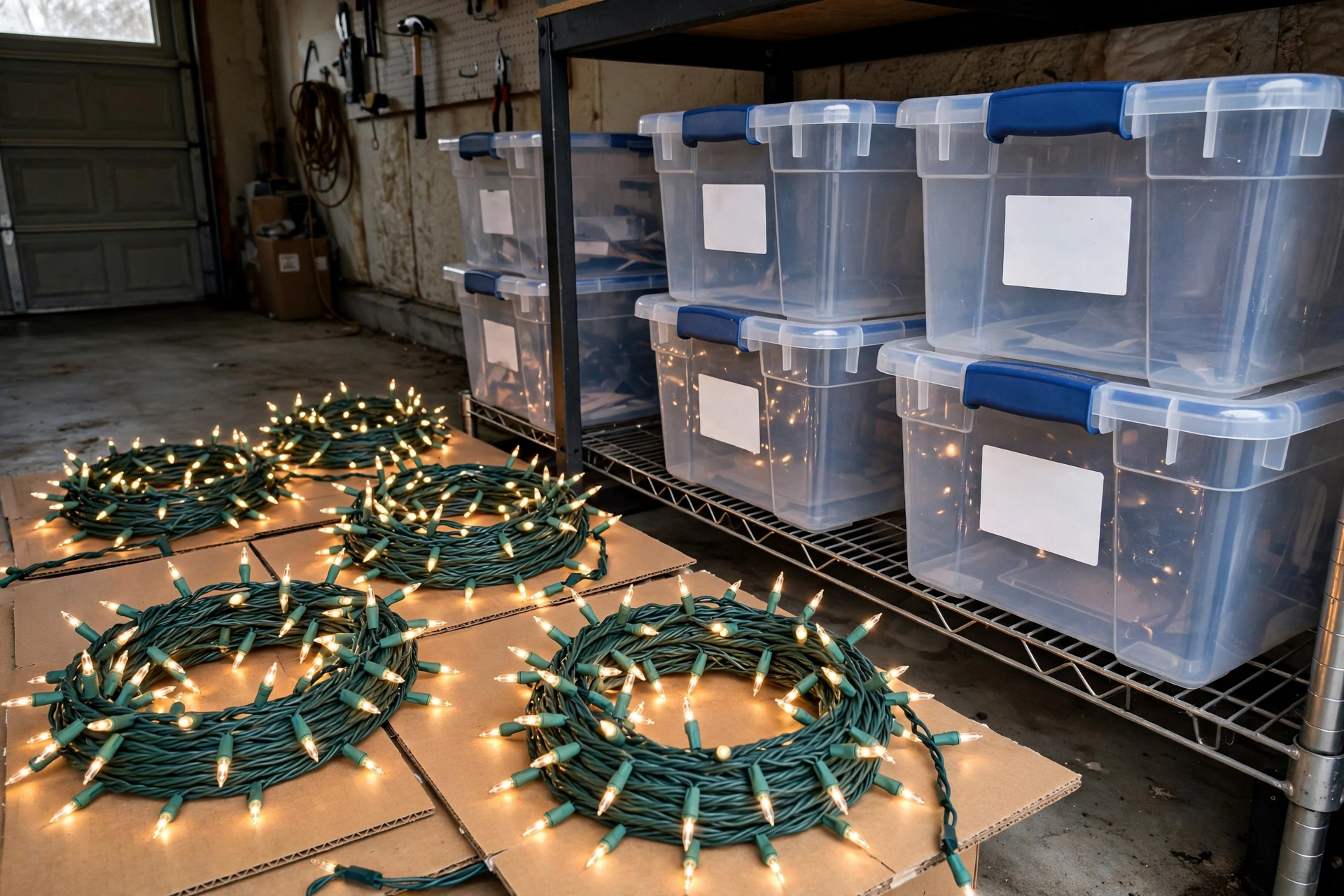
The cardboard flat (free, excellent). Cut a sturdy cardboard rectangle about 12 inches wide. Starting at the plug end, wrap the strand in neat, slightly overlapping loops and tuck the far end through a slit in the cardboard edge. Stack flats in a tote like files. Costs nothing, works perfectly.
The hanger wrap (free, fast). Hook the plug end over a sturdy plastic hanger’s hook, wrap figure-eight style around the two arms, and secure the far end with a twist tie. Hangers hook onto a closet rod or a dowel across the tote.
The ball wrap (no materials needed). Loop the strand loosely around your hand, then wrap the remaining length around the middle of the loops to form a ball, tucking the end under the final wraps. Keep it loose — tight balls stress wire at the bends. Fine for short strands.
The storage reel (best for big collections). Hand-crank light reels wind strands quickly and evenly with a built-in end clip. If you own more than a dozen strands, a $10–$15 reel pays for itself in untangling avoided.
Segment and bag (for net lights and garland). Fold in thirds, secure each bundle with two zip ties or Velcro straps, and bag individually. Net lights are the worst tanglers in existence; separate bags are the only reliable defense.
| Method | Cost | Tangle protection | Best for |
|---|---|---|---|
| Cardboard flat | Free | Excellent | Most households — best free method |
| Hanger wrap | Free | Very good | A few strands; hangs in closets |
| Ball wrap | Free | Good | Short strands in a hurry |
| Storage reel | ~$10–15 | Excellent | 12+ strands; fastest for big displays |
| Segment + bag | Pennies | Excellent | Net lights, garlands, icicle strands |
Two rules for every method: keep the plug end accessible (don’t bury it mid-wrap), and don’t wrap tight enough to kink the wire — gentle loops, not guitar-string tension. Leave bulbs in their sockets: the sockets protect bulbs better than any separate container, and removing 100 bulbs creates 100 chances to lose bulbs or bend contacts.
Pro Tip
Photograph your display before takedown — roofline, tree, mantel. Next November those photos turn “how did we do this last year?” into a two-hour job, and show exactly which strand lengths go where.
The Right Bins: Ditch the Cardboard Boxes
Cardboard is the enemy of long-term storage: it absorbs moisture, collapses under stacking, invites pests, and offers zero defense against heat or damp. The upgrade is simple — rigid plastic totes with latching lids.
Choose clear or translucent totes in the 18–30 gallon range: big enough to be useful, small enough to carry. Label every tote on two sides with a marker and painter’s tape: “ROOFLINE LIGHTS,” “TREE ORNAMENTS — FRAGILE.” Generic “Christmas” labels on six identical totes help nobody. Color-code if you like: red lids for lights and electrical, green for ornaments and soft decor.
Drop two or three silica gel packs into each tote before latching. They absorb residual sealed-in humidity and cost almost nothing in bulk — cheap insurance against corroded contacts and musty fabric.
Pro Tip
Store each zone’s decorations together: roofline lights, clips, timer, and extension cords in one tote; tree ornaments, skirt, and topper in another.
Storing Ornaments Without the Casualties
Ornaments break from impact and pressure. Divided ornament boxes with individual compartments solve both and cost little. Wrap fragile or heirloom pieces individually in plain tissue paper first — skip newspaper, whose ink transfers to light-colored ornaments. Small sturdy ornaments can go in egg cartons inside a tote. Don’t stack anything heavy on the ornament tote, and mark it FRAGILE on all sides so it doesn’t end up buried under the tree.
Wreaths, Garland, and the Artificial Tree
Wreaths get crushed more than any other decoration. Store them in dedicated wreath bags or rigid round boxes that hold their shape, or hang them on hooks in a closet or on the storage-room wall. A wreath flattened under boxes for eleven months never looks round again.
Garland coils neatly in large, loose loops (2–3 feet across), secured with twist ties and laid flat or hung. Tight coils kink the wire frame permanently.
Artificial trees deserve better than the original box, which disintegrates after two seasons. A dedicated tree storage bag — the upright duffel style — protects branches and fits in a closet. Compress branches gently upward, the way they came, rather than forcing them down; bent tips never fully straighten. For pre-lit trees, never crush or sharply fold sections where light strings attach — broken pre-lit wiring, usually caused in January rather than December, is the number one artificial-tree killer. Wrap sections in old sheets before bagging to stop branches snagging each other.
Where to Store It All: Location Matters
Heat and moisture are the two great decoration killers, and most default spots serve one or the other:
Attics are the most common and most damaging choice. Summer attics hit 140–150°F, softening PVC wire insulation, melting adhesives, warping plastic, and draining forgotten batteries. If the attic is your only option, use sealed rigid totes with extra silica gel, keep them on shelving off the floor, and never store candles or wax decor up there.
Basements and crawl spaces bring dampness: musty fabric, corroded contacts, moldy wreaths. Sealed totes plus silica gel handle moderate dampness; a basement that floods or smells musty is wrong for anything but the hardiest plastic decor.
Garages sit in the middle — fine with sealed, latched totes, since swings are milder than attics and most stay dry. Interior closets, under beds, and spare rooms are the gold standard: stable temperature, low humidity, no pests. Give fragile items (ornaments, heirlooms, pre-lit tree sections) the indoor spots; let hardy outdoor decor take the garage.
One last task before sealing totes: remove batteries from every remote, battery candle, and animated decoration. Alkalines leak when left in devices for months, and a leak ruins the compartment — sometimes the whole decoration. Bag batteries separately or recycle them and buy fresh next year.
Pro Tip
Tape a one-page inventory inside the storage closet door: tote count, contents, and replacements needed (“buy 2 warm-white LED strands,” “wreath bag ripped”). Next November you shop from a list instead of discovering gaps mid-project.
Bottom Line
- Test every strand before storing — repair or recycle dead ones in January, not next November.
- Wrap with tension and secured ends — cardboard flats, hangers, or a reel; never stuff strands loose into bags.
- Rigid latching plastic totes beat cardboard; label two sides and group by zone.
- Keep bulbs in their sockets; bag spares and fuses inside the tote lid.
- Ornaments in divided boxes with tissue; wreaths in rigid round containers or on hooks.
- Pre-lit trees: don’t crush wired sections; bag sections individually.
- Remove all batteries — leaks destroy compartments.
- Attic heat (140°F+) and basement dampness are the top killers; sealed totes + silica gel defend against both, with fragile items earning indoor closet space.
Frequently Asked Questions
What is the best way to store Christmas lights so they don’t tangle?
Wrap each strand around a cardboard flat, a sturdy hanger, or a light reel, keeping gentle tension with both ends secured. Tangles come from loose wire with free ends — any method fixing both ends works. Never stuff strands loose into bags.
Can I store Christmas lights in the attic?
You can, but it’s the harshest common spot — summer attics reach 140–150°F, degrading insulation, adhesives, and plastic. If it’s your only option, use sealed rigid totes (not cardboard), add silica gel, and shelve them off the floor. A closet or garage is better.
How do I store a pre-lit artificial tree?
Separate into sections, compress branches gently upward, and never crush or sharply fold wired sections — broken pre-lit wiring from rough January handling is the top artificial-tree killer. A dedicated tree bag outlasts the original box, which typically falls apart after two seasons.
Should I remove the bulbs before storing light strands?
No — leave them in. Sockets protect bulbs better than any separate container, and removing 100 bulbs creates 100 chances to lose bulbs or bend contacts. Wrap carefully with bulbs in place; keep spares bagged in the tote lid.
How long do Christmas lights last in storage?
LED strands stored properly (dry, moderate temperature, uncrushed) routinely last 10+ seasons — their 25,000–50,000-hour rating dwarfs a few hundred hours of holiday use. Incandescents last fewer seasons as bulbs and insulation degrade. What kills lights in storage is heat, moisture, and crushing — not time.
What is the best way to store fragile glass ornaments?
Wrap each in plain tissue paper (not newspaper — ink transfers), then place in a divided ornament box so pieces can’t knock together. Mark FRAGILE on all sides, keep heavy items off it, and give heirlooms indoor closet space over attic or garage.