Half Your Christmas Lights Out? How to Find and Fix It
You plug in the strand, step back to admire your work, and half of it is dark. Not the whole strand just one section, dead from some invisible point onward, while the other half burns bright. It’s the most common Christmas light failure in existence, and it has one of the most satisfying fixes: find the single bad bulb or loose connection, and the whole section comes back to life. Here’s how to fix christmas lights half out, in the order a pro checks them: fuse first, then the bad bulb, then the right fix.
It helps to know why “half out” happens because the cause tells you where to look. This guide walks the diagnosis in order: the 30-second fuse check, the visual inspection, the tester method that finds the culprit in minutes, and how to know when a strand isn’t worth saving.
TL;DR: Half a strand goes dark when one bulb’s shunt fails in a series circuit — current can’t pass the break, so every bulb downstream goes out. Unplug the strand, check the plug’s fuse first, then find the bad bulb: inspect for darkened or loose bulbs in the dark section starting at the lit/dark boundary, reseat firmly, and replace burned-out bulbs with the same voltage. A $15–$25 light tester finds the break in minutes.
Quick Diagnosis: Match Your Symptom to the Fix
Match what your strand is doing to the likely cause in this table, try the first fix listed, and only work through the full steps below if that doesn’t cure it. If a strand dies the moment you connect another one, the run is overloaded rather than faulty — check how many christmas light strings can you connect before you blame the bulbs.
|
Symptom |
Likely cause |
First fix |
|---|---|---|
|
Half the strand dark, other half fine |
One bulb loose or its shunt failed in the dark section |
Reseat bulbs starting at the lit/dark boundary; swap-test with a known-good bulb |
|
Entire strand dead |
Blown fuse in the plug |
Replace the fuse in the male plug (Step 1) |
|
Section flickers when you wiggle the wire |
Broken wire or loose socket contact |
Pressure-test along the wire to find the break; replace that section |
|
Only one bulb dark, rest of strand fine |
Just that bulb (parallel circuit or working shunt) |
Replace the single bulb |
|
Strand dies when you connect another one |
Overloaded run / fuse blown by too many strands |
Reduce strands per connection |
|
LED section dark, bulbs look fine |
Wire break or failed LED pod |
Pierce-test the section with an LED tester |
Christmas Lights Half Out: Why It Happens

Most mini-light strings are wired as series circuits: electricity flows through each bulb in sequence, like cars through a single-lane tunnel. A typical 100-count strand is actually two separate 50-bulb series circuits — which is why failures so often take out exactly half.
Each bulb contains a tiny backup called a shunt, designed to carry current past a burned-out filament so the rest stays lit. When a bulb burns out and its shunt works, you barely notice. But shunts fail — especially in older strands or after rough handling. When the shunt fails too, current stops at that bulb, and every bulb downstream goes dark with it. One failed component, fifty dark bulbs — and one targeted fix brings them all back.
Safety First: Unplug Before You Touch
Every step below starts with the strand unplugged. Light strings run on full household current at the plug end, and you’ll be handling bulbs and sockets with your fingers. No live troubleshooting — ever.
Give the strand a quick safety assessment too. Brittle or cracking insulation, broken or melted sockets, a loose plug, or a cord that gets warm in use — stop. That’s a replacement candidate, not a repair. No strand is worth a fire risk, and new LED strands cost less than the hour you’d spend nursing a dangerous one.
Step 1: Check the Fuse in the Male Plug (30 Seconds)
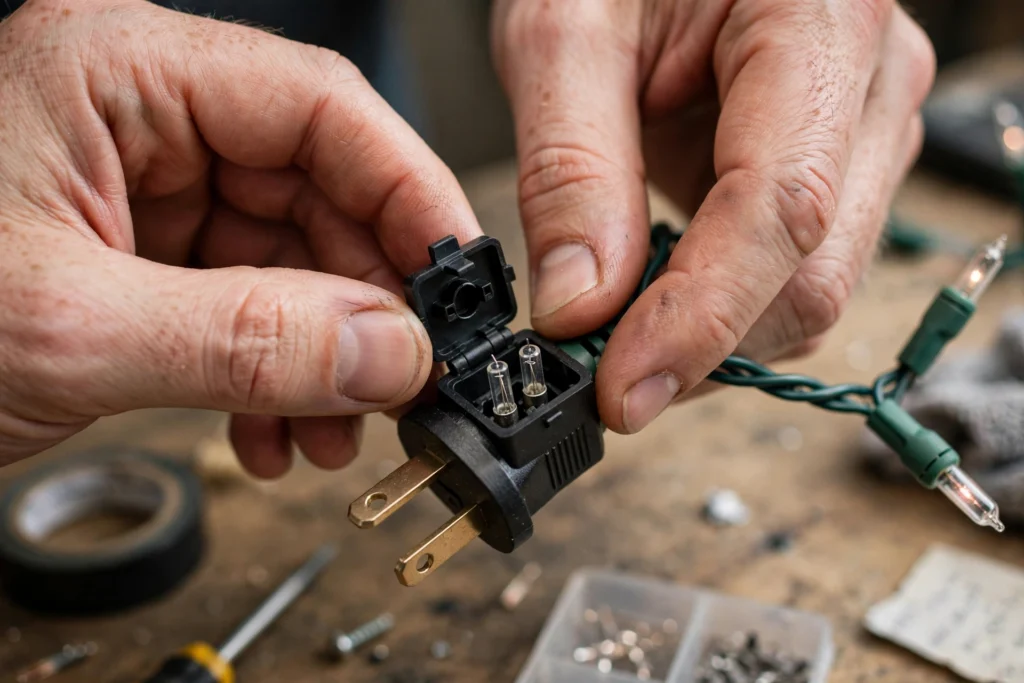
Always check the fuse first, because it takes 30 seconds and fixes more ‘dead’ strands than any other step. The fuses live in the male plug — the end with the prongs, not the socket end. Slide the small cover open, pull both fuses, and hold them to the light: a broken filament or dark scorch mark means blown.
- Unplug the strand. Never open the fuse compartment while it is live.
- Slide the fuse cover on the male plug toward the prongs.
- Remove both fuses — most plugs carry one active fuse and often one spare in the same compartment.
- Replace a blown fuse with the SAME rating (usually 3A or 5A, 125V — printed on the plug).
- Plug in and test. If the new fuse blows instantly, the strand has a short: stop here and replace the strand.
Pro Tip
Repeatedly blowing the same strand’s fuse means it’s drawing too much current — usually too many strands end to end, a damaged cord partially shorting, or moisture in an outdoor connection. The fuse is the messenger; find what it’s warning you about instead of just replacing it again.
Step 2: Find the Bad Bulb
Unplugged, work through the dark section methodically. Current flows from the plug end, so the break is the first dead bulb counting from the plug side of the dark section — start at the boundary between lit and dark and work outward. You rarely need to check all fifty.
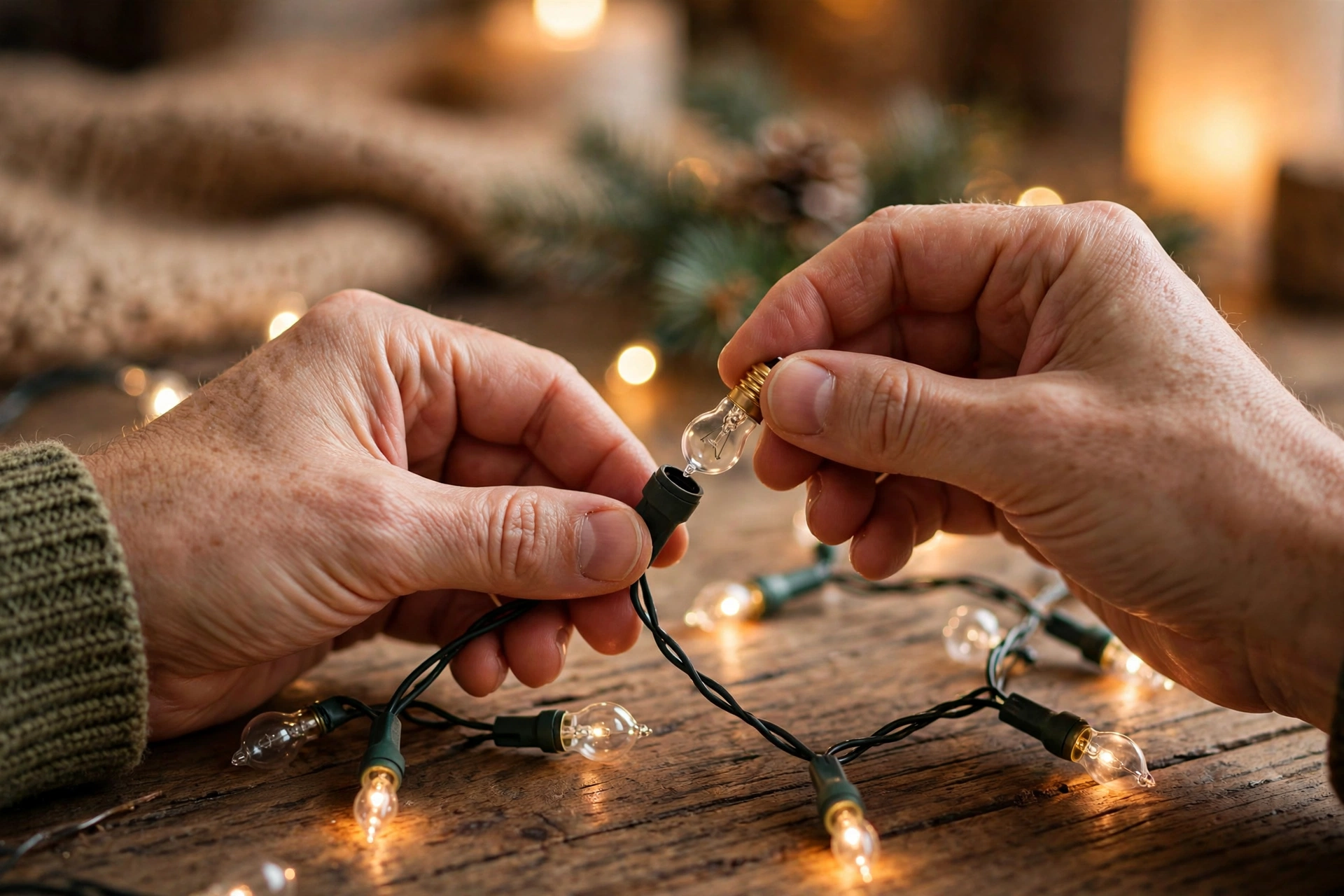
Visual inspection first. Look for blackened or smoky bulbs, visibly broken filaments, bulbs sitting loose or crooked, or empty sockets. Pull each suspect, check that the tiny wire leads on its base aren’t bent or broken, and push it firmly back until it seats with a definite click. Loose bulbs are a surprisingly common cause — the bulb is fine, it’s just not making contact.
Pro Tip
When you find the bad bulb, replace its two neighbors as well. Adjacent bulbs have been running under abnormal voltage stress and are the most likely to fail next — often within days. Three fresh bulbs now beats repeating the hunt next weekend.
Use a Light Tester to Find the Bad Bulb in Minutes
A light tester is the difference between a 5-minute fix and an afternoon of pulling bulbs. For incandescent strands, a LightKeeper Pro-style tool sends a pulse through the set that repairs a failed shunt and beeps you to the dead bulb. For LED strands, an LED tester pierces the wire insulation and pinpoints the break. Both cost roughly $20–$30 once and pay for themselves the first season.

- Use the pulse method on incandescent strands: plug the strand into the tester, pull one bulb in the dark section, insert that socket into the tester, and pull the trigger — the pulse fixes most shunt failures.
- Follow the voltage detection along the wire: move the tester along the dark section and note where the signal stops — that is where the break is.
- For LED strands, pierce-test pod by pod as described in the LED section below: clamp the tester over each pod until the rest of the section lights, and the last dark point is the break.
Step 3: Replace the Bulb Correctly
Not just any bulb will do. Mini-light bulbs carry a specific voltage — typically 2.5 volts in a 50-bulb series circuit on 120-volt household current (120 ÷ 50 = 2.4, rounded to the standard 2.5V). Wrong voltage causes real problems: too low burns out almost immediately; too high glows dimly while forcing extra voltage onto neighbors, shortening their lives.
Match voltage (printed on the bulb base or packaging — 2.5V is standard for 50-light sections), bulb style (mini vs. C7/C9 aren’t interchangeable), and for LEDs, the same color temperature if matching matters. Keep the manufacturer’s spare bulbs or buy a multi-pack of the correct voltage. When inserting, fold the wire leads neatly against the base and push fully into the socket — a half-seated bulb is just a future failure.
How to Fix Christmas Lights Half Out When the Strand Is LED
LED strands rarely die from one bulb, because most are wired in parallel pods — so a dark LED section almost always means a wire break or one failed sealed pod. Work the section with an LED tester instead of pulling bulbs: it pierces the insulation, finds where the voltage stops, and can bypass the dead spot.
- Check the pods first: a cracked, yellowed, or loose pod is the prime suspect in a dark LED section.
- Clamp an LED Keeper-style tester over each pod in turn and work along the section until the rest lights — the last point that stays dark is the break.
- Sealed, non-replaceable pods can’t be swapped out: bridge the dead pod with a bypass jumper, or replace that section of the strand.
- If the LED section is half DIM rather than dark, suspect the rectifier plug failing or voltage drop on an over-long run — shorten the run first before replacing parts.
Quick Diagnosis Table
| Symptom | Most likely cause | Fix |
|---|---|---|
| Exactly half the strand is dark | Failed bulb/shunt in that 50-bulb circuit | Find and replace the bad bulb |
| Whole strand is dark | Blown fuse in the plug | Replace with same-rating fuse |
| Section flickers when touched | Loose bulb or corroded contact | Reseat bulbs; clean corrosion dry |
| Lights, then dies after minutes | Overloaded run or damaged cord | Reduce end-to-end strands; inspect cord |
| Plug or cord feels hot | Overload or failing connection | Unplug immediately; split load; replace cord |
| Random bulbs out everywhere | Multiple burned-out bulbs, shunts holding | Replace individual bulbs; assess strand age |
| New LED section dim, not dark | Wrong replacement bulb voltage | Swap in correct voltage bulb |
When to Stop Fixing and Replace the Strand
Some strands have earned retirement. Replace rather than repair when: insulation is brittle, cracked, or sticky; multiple sockets are broken or corroded; new failures keep appearing after several bulb swaps (the strand is at end of life); it’s an incandescent strand pushing a decade old; or the repair would take longer than the $8–$15 a new LED strand costs.
Consider upgrading, too. Modern LED strings use a fraction of the power, run cool, and — most relevant here — typically use parallel or regulated circuits where one bad bulb doesn’t kill its neighbors. The strand you’re fixing today might be the last one you ever have to fix.
Pro Tip
Tape a small bag of spare bulbs and fuses inside each light tote’s lid, labeled with strand type and voltage (“2.5V mini — roofline tote”). Next December the exact parts are with the lights, not lost in the house.
PRO TIP
Test every strand on the ground BEFORE you hang it, and fix it at waist height with good light. Ninety percent of half-out frustration is people troubleshooting on a ladder in the cold — the fix is identical, only the mood is worse.
Bottom Line
- Half-out = one break in a series circuit. Fix the single failed bulb or connection and the section returns.
- Check the fuse first — 30 seconds, and it rules out the simplest cause.
- Start at the lit/dark boundary and work outward from the plug side — the culprit is near the front of the dark section.
- A $15–$25 tester turns a 45-minute hunt into 5 minutes and can repair failed shunts.
- Match replacement voltage exactly (usually 2.5V for 50-light sections) — wrong voltage kills bulbs fast.
- Replace the bad bulb’s neighbors too — voltage-stressed, they fail next.
- Retire strands with brittle wire, cracked sockets, or recurring failures; LED upgrades largely eliminate this chore.
Frequently Asked Questions
Why did half of my Christmas lights go out?
A 100-count strand is wired as two 50-bulb series circuits. Each bulb has a shunt meant to carry current past a burned-out filament, but when a bulb’s shunt fails, current stops there and everything downstream in that circuit goes dark — reading as exactly half the strand.
Can one bad bulb really darken half the lights?
Yes — that’s series wiring. Current must pass through every bulb in sequence, so one break darkens everything downstream. The fix is equally concentrated: restore the connection at that one point and all fifty bulbs return.
How do I find the bad bulb without a tester?
Unplug the strand and start at the lit/dark boundary, working outward from the plug side. Look for blackened, broken, or loose bulbs; pull each suspect, check its wire leads, and reseat firmly. The culprit is almost always within the first few bulbs past the boundary.
Why do my Christmas lights keep blowing fuses?
Recurring blown fuses mean overcurrent: too many strands end to end (max 3 for incandescent), a damaged cord partially shorting, or moisture in an outdoor connection. Never upsize the fuse — find the underlying problem the fuse is flagging.
Is it worth fixing old Christmas lights or should I replace them?
Fix if wire and sockets are sound and it’s one bad bulb or fuse — a ten-minute job. Replace if insulation is brittle, sockets are damaged, failures recur, or it’s an aging incandescent. At $8–$15 for a new LED strand, long repairs on worn strings are false economy — and LEDs largely avoid the half-out failure.
Do LED Christmas lights have the same half-out problem?
Much less often. Most LED strings use parallel or regulated circuits where one dead bulb doesn’t darken neighbors — a dead LED is usually just one dead LED. When an LED section does go dark, suspect damaged wire, a failed rectifier in the plug, or a bad connection — and check the fuse first, same as always.
Why is exactly half of my Christmas light strand out?
Most mini-light strands are wired as two separate series circuits of 50 bulbs. When one bulb’s shunt fails in a circuit, current stops at that break and every bulb after it goes dark — which is why the outage is so often exactly half the strand.
Can I cut off the dead half and keep using the rest?
Sometimes, on incandescent mini-lights: each 50-bulb circuit is independent, so the working half can be kept if you cut at the circuit boundary and fit a proper plug — never leave cut wire ends taped as a permanent fix. On LED and sealed strands, no: replace the section or the strand.
Is it safe to use a strand that is half out?
If the cause is a bulb or shunt and the wiring is undamaged, the lit half is safe to use. If you see frayed, chewed, or scorched wire, or the plug gets warm, unplug it and replace the strand — that is a fire risk, not a bulb problem. And if the strand keeps tripping the breaker, treat that as a separate fault and diagnose it before using the strand again.
Why do my lights come back on when I wiggle the wire?
A loose socket contact or a partly broken wire making intermittent contact. Reseat every bulb in that section firmly; if it still flickers, the wire itself is breaking down and that section should be replaced.
How much does it cost to fix a half-out strand vs replace it?
A fuse costs cents, replacement bulbs a few dollars, and a tester $20–$30 once. Fixing is worth it for quality strands and pre-lit trees; for a cheap strand with multiple failures, a new set ($8–$25) is the smarter spend. Either way, learn how to store christmas lights properly at season’s end so the fix lasts.