54 Outdoor Lighting Ideas for Every Corner of Your Yard
The best outdoor lighting ideas do three jobs at once: they make your home look beautiful after dark, they make it safer to move around, and they make you actually use your yard at night. Most homes get one porch bulb and call it done — and then wonder why the patio sits empty all summer.
This list is organized by where the light goes, not by what’s trendy: front yard first, then backyard and patio, paths and steps, garden drama, water features, budget and solar tricks, and finally the seasonal ideas. Every entry includes the one practical detail that makes it work — placement, spacing, or the mistake to avoid. Steal two or three ideas per zone and your yard will look designed, not decorated.
TL;DR
Layer light at three heights — overhead (string lights, pendants), mid-level (sconces, lanterns), and ground level (path lights, uplights). Start with the front walk and the patio, add uplighting to one tree and your facade, and put everything on timers or smart controls so the system runs itself. The single highest-impact upgrade on this list: permanent roofline track lighting you install once and control by app for every season.
PRO TIP
The three-level rule is what separates a “lit” yard from a designed one. Overhead light alone looks like a construction site; ground light alone looks like an airport runway. One source at each height — high, eye level, and low — creates the depth that makes people say a yard “feels expensive,” and none of the three has to be pricey.
Front Yard & Curb Appeal (Ideas 1–8)

1. A Matching Pair of Porch Sconces
Flank the front door with two warm-white sconces at eye level, roughly 66 inches from the floor. A matched pair reads as architecture, not hardware-store afterthought. Choose 2700K bulbs — the amber warmth is what makes a home look welcoming instead of interrogated.
2. Permanent Roofline Track Lighting
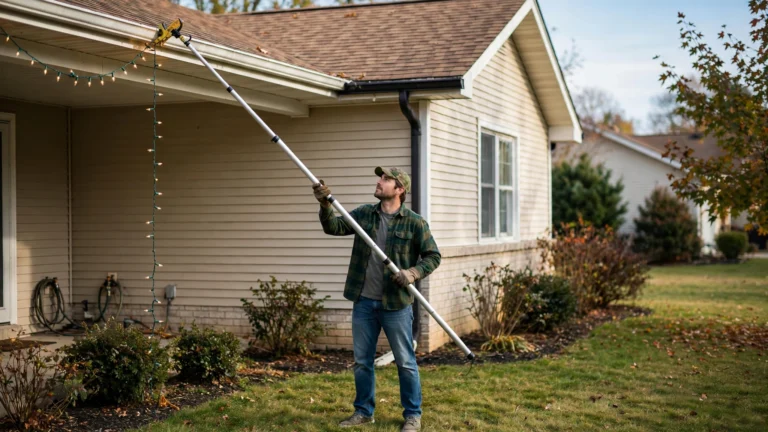
The install-once upgrade: slim, color-matched tracks under your eaves hold LED pucks that wash the wall in a soft scalloped glow every night of the year — no ladders, no seasonal hanging. Our guide to the best permanent outdoor lights compares the top systems, and the permanent Christmas lights cost breakdown shows what pros charge versus DIY.
3. Wall-Wash Uplights on the Facade
Place two or three ground spotlights 12–18 inches from the foundation, aimed up at a shallow angle, and plain siding turns into texture. Space them to graze across brick or stone rather than blasting flat spots of light — grazing reveals relief; head-on beams flatten it.
4. Path Lights to the Front Door
Line the walkway on alternating sides, every 6–8 feet, with low fixtures that throw light down at the path — not into guests’ eyes. Alternating beats both-sides symmetry, which reads as a runway. Keep fixtures under 12 inches tall so the daytime garden stays the star.
5. Uplight One Statement Tree
One dramatic tree beats five mediocre ones. A single well light or spotlight at the trunk base, aimed into the canopy, gives the whole front yard a focal point. For a wide canopy, use two fixtures at 45-degree angles to avoid the flat “flashlight from below” look.
6. A Lighted House Number
Backlit or solar house numbers are a tiny expense with outsized effect: guests and delivery drivers find you, and the entry feels finished. Mount at eye level near the door where the porch light won’t wash it out. It’s also the one idea on this list an ambulance driver will thank you for.
7. Low Bollards Along the Driveway
Short, shielded bollards mark a driveway’s edge without the glare of a floodlight. Space them 8–10 feet apart on the approach side. In snow country, choose metal fixtures tall enough to stay visible above a plowed bank — about 24 inches.
8. A Porch Pendant or Chandelier
On a covered porch, swap the builder-grade flush mount for a hanging pendant or small outdoor chandelier over the seating zone. It drops the light to where people actually sit and instantly makes the porch read as a room. Just confirm the fixture is damp- or wet-rated for your exposure.
Backyard & Patio (Ideas 9–18)

9. The Bistro String-Light Canopy
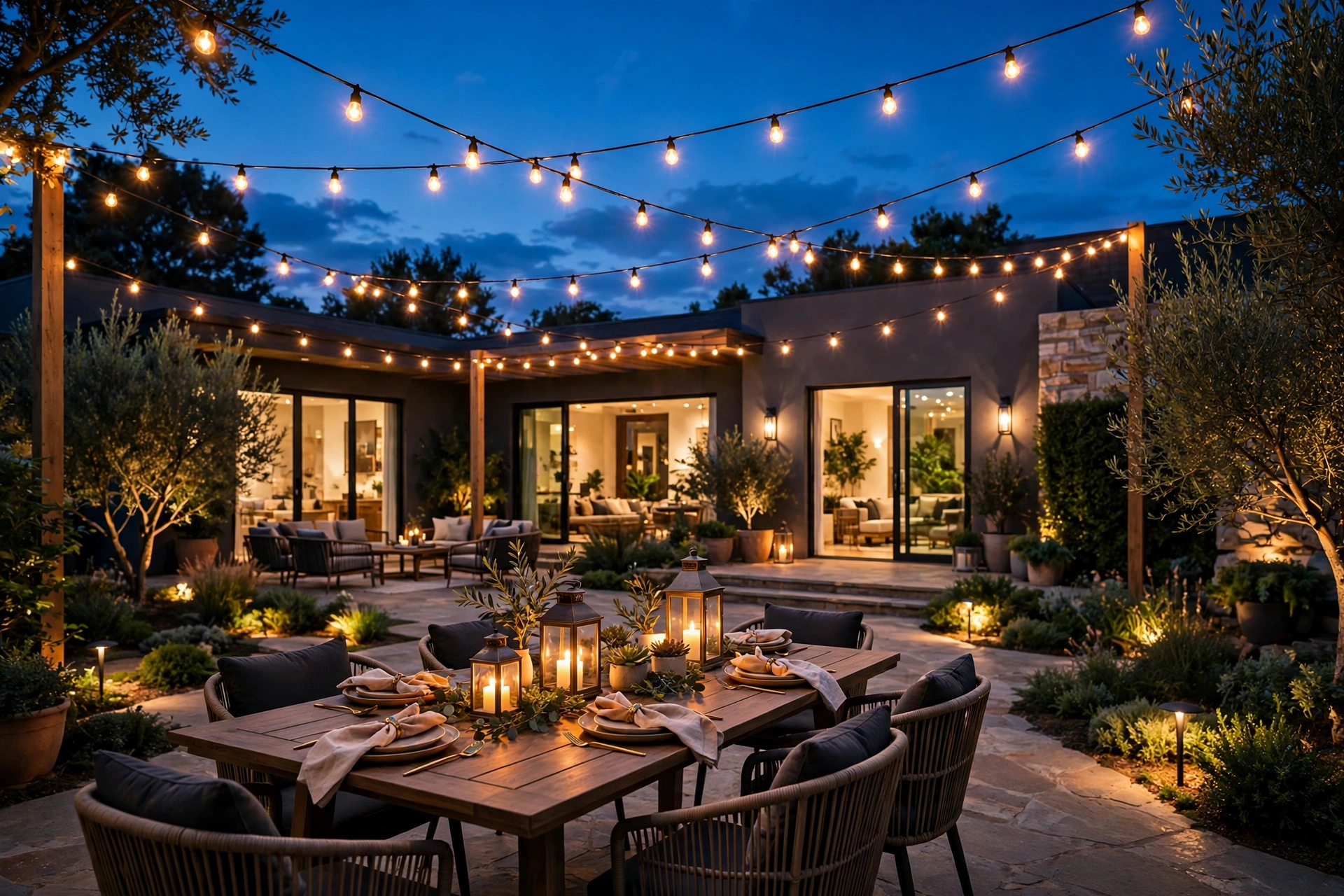
The most-pinned look in outdoor lighting, and it earns it: crisscross commercial-grade string lights 8–10 feet over the seating area in two gentle layers. Anchor to the house, a tree, or two steel poles set in planters — never to a fence panel that flexes. Shatterproof LED bulbs only; glass over a patio is a countdown.
10. A Fairy-Light Curtain on the Pergola
Hang vertical strands down one or two sides of a pergola and the structure becomes a glowing room divider that hides an ugly fence or a neighbor’s wall. Warm white keeps it elegant; save the colors for parties. Outdoor-rated curtain strands with a timer plug make it effortless.
11. An Outdoor Chandelier Over the Dining Table
A weather-rated chandelier centered over the table gives dinner-party light with none of the moth-to-bulb chaos of a floodlight. Hang it 30–36 inches above the tabletop and put it on a dimmer — full brightness for serving, low glow for lingering.
12. Lantern Clusters on the Table and Steps
Group candle lanterns in odd numbers and mixed heights on the dining table, the steps, and one dark corner. LED candles with timers have killed the last argument for real flame near upholstery. The trick is clustering: a lone lantern looks lost; three together look styled.
13. Oversized Floor Lanterns
Two big floor lanterns flanking the patio doors or the outdoor sofa create instant symmetry and movable light — carry them to wherever the evening migrates. Solar versions with warm LEDs mean no cord across the walkway. Buy the largest size you think you need, then go one bigger; scale is the whole point.
14. A Ring of Light Around the Fire Pit
Firelight alone leaves guests’ faces lit and their footing dark. Add a low ring of recessed ground lights or short path fixtures around the seating circle, aimed outward. Everyone sees the step down, nobody trips carrying a drink, and the fire stays the star.
15. LED Strip Lights Under the Deck Railing
A waterproof LED strip tucked under the top rail washes the deck floor in a soft line of light with no visible fixture. It’s the modern, hotel-terrace look, and it doubles as a step warning along the deck edge. Choose 2700–3000K — blue-white strips read as aquarium.
16. Recessed Deck and Step Lights
Small fixtures set into stair risers or deck boards mark every level change — the single best safety upgrade for a multi-level deck. They’re subtle at ankle height and make the whole structure look custom-built. Low-voltage kits are genuinely DIY-friendly; hardwired 120V is a pro job.
17. A Ceiling Fan With a Light on the Covered Patio
On a covered patio or porch, a wet-rated ceiling fan with an integrated light kit does double duty: air movement that also discourages mosquitoes, plus dimmable overhead light. It’s the upgrade that stretches patio season by weeks in hot climates.
18. Glowing Orb Lights in the Garden Beds
Spherical glow orbs scattered through planting beds or floating in a water bowl look startlingly high-end for something you simply set down and charge. Vary the sizes, cluster in threes, and let them read as moonlight that landed in the garden. The look from the photo that goes viral every spring — because it works.

Paths, Steps & Safety (Ideas 19–26)
19. Classic Solar Path Stakes
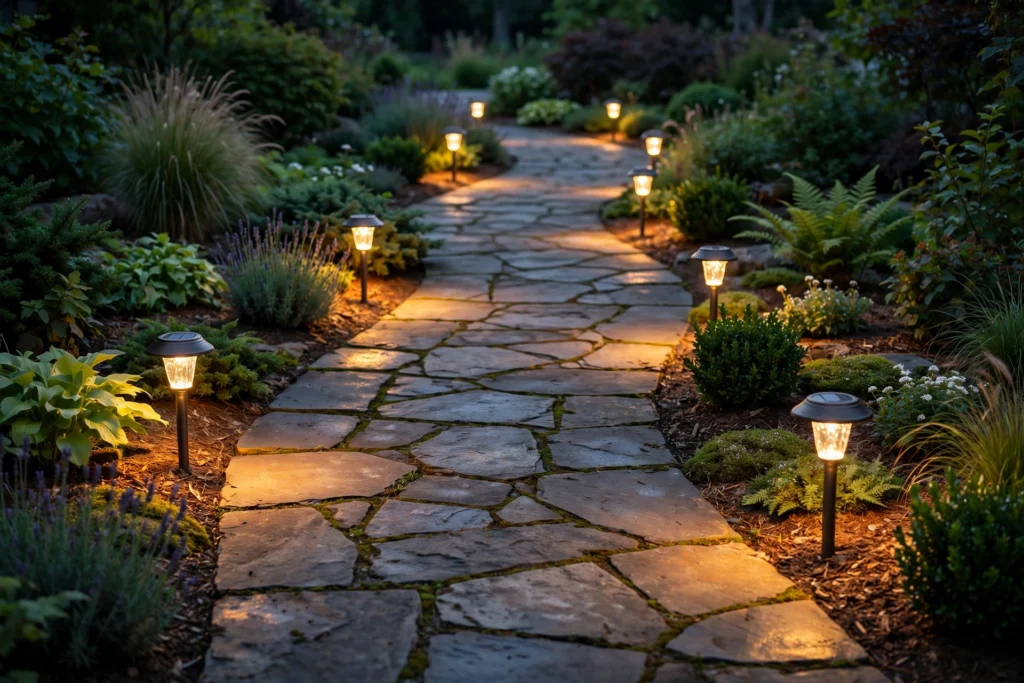
The entry-level move that still works: warm-white solar stakes along any path that lacks wiring. Space them closer than you think (every 5–6 feet) and stagger sides. The honest caveat: cheap sets dim by midnight, so buy replaceable-battery models from a real lighting brand.
20. Bollard Lights for a Modern Walkway
Where path stakes say “garden cottage,” bollards say “architecture.” Their shielded, downward light pools exactly on the walking surface — what lighting designers call dark-sky friendly, because nothing spills upward. Ideal for front walks on modern and mid-century homes.
21. Step Lights on Every Stair Run
Any outdoor stair used after dark deserves a light per tread — recessed into the riser or mounted on the stringer. Falls on unlit garden steps are one of the most common home injuries, and this is a $150 fix that also happens to look like a resort.
22. Motion-Sensor Floodlights, Placed With Restraint
Security lighting works best at corners and above garage doors, aimed into your own yard — not across the street. Choose shielded fixtures with adjustable sensitivity so a passing cat doesn’t trigger a light show, and warm the color temperature down from the prison-yard blue most default to.
23. Low Border Lights That Define the Edge
A continuous low glow along a patio edge or raised bed quietly tells feet where the level changes. Short fixtures or a hidden strip under a cap stone both work. This is the cheapest idea here per foot and the one guests unconsciously appreciate most.
24. Driveway Markers That Aren’t Reflector Poles
Swap the hardware-store reflectors for flush in-ground markers or low solar pucks along the drive. They guide backing-up drivers, survive the snowplow better when set flush, and look intentional rather than municipal.
25. Light the Gate and the Latch
The most-forgotten spot in the yard: the side gate everyone fumbles with at night. One small solar or battery fixture above the latch ends the phone-flashlight ritual. Do the same for the trash enclosure and the hose bib while you’re at it.
26. Shielded Fixtures Everywhere (Dark-Sky Manners)
Whatever you install, choose fixtures that aim down and shield the bulb. You’ll see your yard better (glare is what actually blinds you), your neighbors will see less of it, and night insects gather at the fixture instead of around your table.
Garden & Landscape Drama (Ideas 27–36)

27. Spotlight the Garden’s Best Feature
Every garden has one thing — a sculpture, a Japanese maple, a dry creek bed. Give it one dedicated spotlight and the whole bed organizes around it. Cross-light from two angles at low intensity rather than one blast from the front; shadows are what make it three-dimensional.
28. Moonlighting From the Branches
Mount a soft downlight high in a mature tree and it filters through the leaves like actual moonlight — dappled, gentle, and wide enough to cover a whole patio. It’s the most natural-looking technique in landscape lighting and the one guests can’t figure out. This is a pro install: climbing, aiming, and hiding wire in bark all take practice.
29. In-Ground Well Lights in the Beds
Well lights sit flush in the soil or lawn and vanish by day, then lift shrubs and ornamental grasses from below at night. Flush mounting means the mower passes over them. Choose fixtures with a slight tilt option so you’re not locked into straight-up beams.
30. Silhouette Lighting Against a Wall or Fence
Place a light behind a sculptural plant — an agave, a small palm, a clipped topiary — and aim it at the wall behind it. The plant becomes a dramatic black silhouette on a glowing backdrop. It works on any blank fence run and costs one fixture.
31. A Soft Wash Across Flower Beds
Wide-beam floods at low height wash seasonal color so the garden doesn’t disappear at 8 p.m. Aim across the bed from the side, not down from above — raking light catches petals and foliage texture that top light flattens.
32. Fairy Lights Woven Through Shrubs
A net or string of warm fairy lights through one or two foundation shrubs adds the sparkle layer at Christmas — and honestly, all year. Kept to one or two plants, it reads as magic; on every shrub in the yard, it reads as a casino. Restraint is the design.
33. Uplight Your Home’s Best Architectural Detail
A stone chimney, a gable, a column — every house has one feature worth a beam. One narrow-spot fixture aimed precisely at it (not the whole wall) creates the expensive, tailored look of designed landscape lighting. This is where a single $60 fixture outperforms a $600 kit.
34. Color-Changing Accent Lights for the Garden
One or two app-controlled color accents — uplighting a tree in soft amber for autumn, cool white for summer — give the garden a seasonal wardrobe. Keep the base of the garden warm white and let color be the accent, exactly like throw pillows indoors.
35. Shadow Play From a Pergola or Trellis
Aim a spotlight so a pergola, trellis, or lattice throws patterned shadows across a patio or lawn. The light becomes decoration twice over. It works with moonlight angles too — position seating where the pattern lands and the space feels designed from above.
36. Light a Garden Path’s Destination, Not Just the Path
Paths should lead the eye somewhere: a bench, a birdbath, an arch. One gentle light at the destination makes the path lighting make sense and invites the walk. Landscape designers call this “the borrowed view at night” — it’s the difference between lighting and composition.
Water & Pool Areas (Ideas 37–41)

37. Submersible Lights in the Pond or Fountain
A small submersible LED turns moving water into the yard’s evening centerpiece — the light catches every ripple. Warm white flatters koi and stone; keep fixtures near the water’s movement (falls, bubblers) where the effect multiplies. Use only fixtures rated for full submersion with low-voltage transformers.
38. Backlight the Waterfall
Tuck a light behind or beneath a waterfall sheet and the water glows from inside. It’s the single most photographed water-feature trick for a reason, and it takes one fixture. If your feature is a bubbling rock instead, aim upward from its base.
39. Floating Solar Orbs on the Pool
Battery or solar glow orbs floating on the pool or a large water bowl deliver the resort look with zero installation. Cluster three to five rather than scattering singles. Take them out for swimming — they’re ambiance, not toys — and store them shaded so the solar cells stay honest.
40. Poolside Path and Coping Lights
The walk from pool to door is where wet feet meet dark steps. Low markers along the coping or the path edge are a safety feature disguised as atmosphere. Near water, everything must be rated for the location and on GFCI protection — non-negotiable, and a pro conversation.
41. A Spotlight for the Fountain’s Spray
If a fountain is the garden’s daytime star, one aimed spotlight keeps it on stage at night — grazing the spray so droplets sparkle instead of a flat beam at the basin. Angle from the side, shield from seating sightlines, and let moving water do the work.
Solar, Smart & Budget DIY (Ideas 42–49)
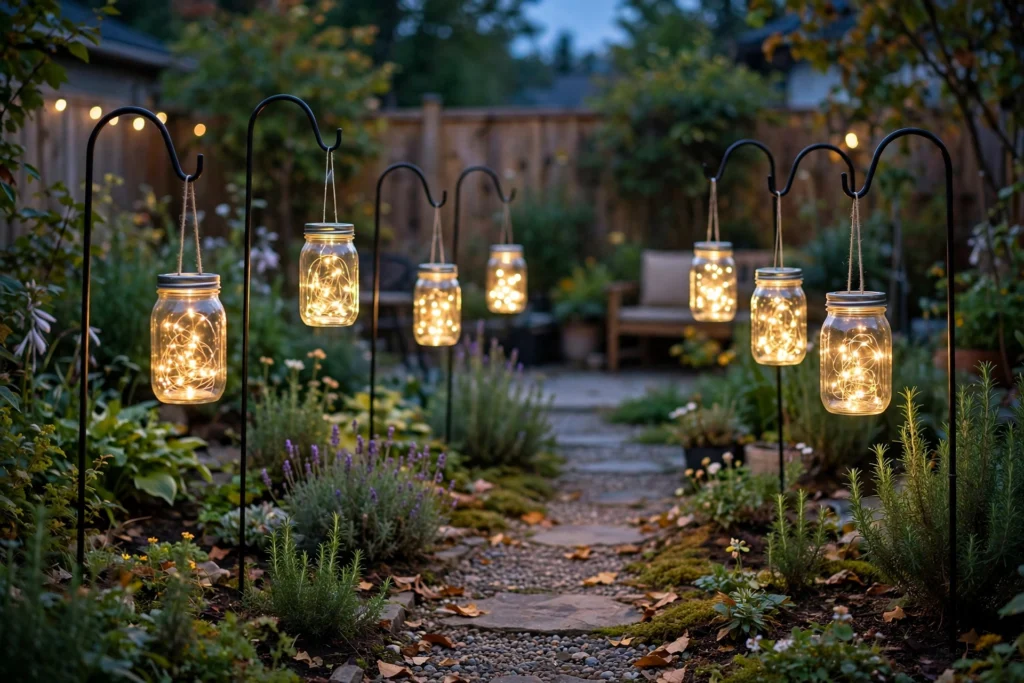
42. Mason Jar Lanterns With Fairy Lights
The DIY classic that refuses to die: battery fairy lights in mason jars, hung from shepherd’s hooks or lined down the table. Five minutes each, no wiring, and the glass makes cheap LEDs look artisanal. Swap in solar-lid jars and they charge themselves on the same hook.
43. Solar String Lights Where There’s No Outlet
Modern solar strings finally hold a charge for a full evening (6–8 hours from a good panel). Mount the panel in the sunniest spot — it doesn’t have to be where the lights hang — and remote spots like a back fence or a tree far from the house become fair game.
44. Illuminated Planters
Glow planters combine the pot and the lamp: plant them in the afternoon, and by evening the patio corners light themselves. Two flanking a door or a bench is the formula. Battery life is the spec that matters — look for 8+ hours and a timer mode.
45. Solar Rock Lights in the Beds
Faux-stone solar lights disappear into mulch by day and mark bed edges and feature rocks by night. They’re the least-committal idea on this list: push them in, move them until the composition works, done. Perfect for testing where permanent lights should eventually go.
46. Timers and Dusk-to-Dawn Sensors on Everything
The best lighting system is the one nobody has to remember. Put porch and path circuits on a timer or photocell, and string lights on a smart plug, and your yard performs every evening whether you’re home or not — which is also quietly good security.
47. Smart Bulbs and App Scenes
In existing fixtures, smart bulbs turn one porch light into scenes: warm white for weeknights, soft amber for dinner outside, color for game day. It’s the cheapest experiment in this entire list — one bulb — and it teaches you what color temperatures you actually like before you buy fixtures.
48. Battery Lanterns for Renters and No-Drill Zones
Renters can still layer light: battery lanterns, solar stakes that push into soil, and string lights on removable hooks need no landlord permission and leave with you. Focus the budget on two or three quality lanterns rather than a cart of dollar-store stakes.
49. Upcycled Tin-Can Lanterns
Punch a pattern in a tin can, add a candle or LED tea light, and hang a row along the fence — the cut-outs throw patterned light that looks genuinely crafted. An hour of DIY for a party backdrop that photographs beautifully. LED tea lights keep it safe around kids and dry foliage.
Seasonal & Year-Round (Ideas 50–54)

50. Permanent Lights That Change With Every Holiday
This is where permanent roofline lighting (idea 2) pays off all year: warm white for everyday elegance, red and green at Christmas, orange and purple at Halloween, red-white-and-blue in July — all from the app, nothing to hang. If the concept is new to you, our guide to installing permanent outdoor lights walks through the whole process.
51. Classic Warm-White Christmas Roofline
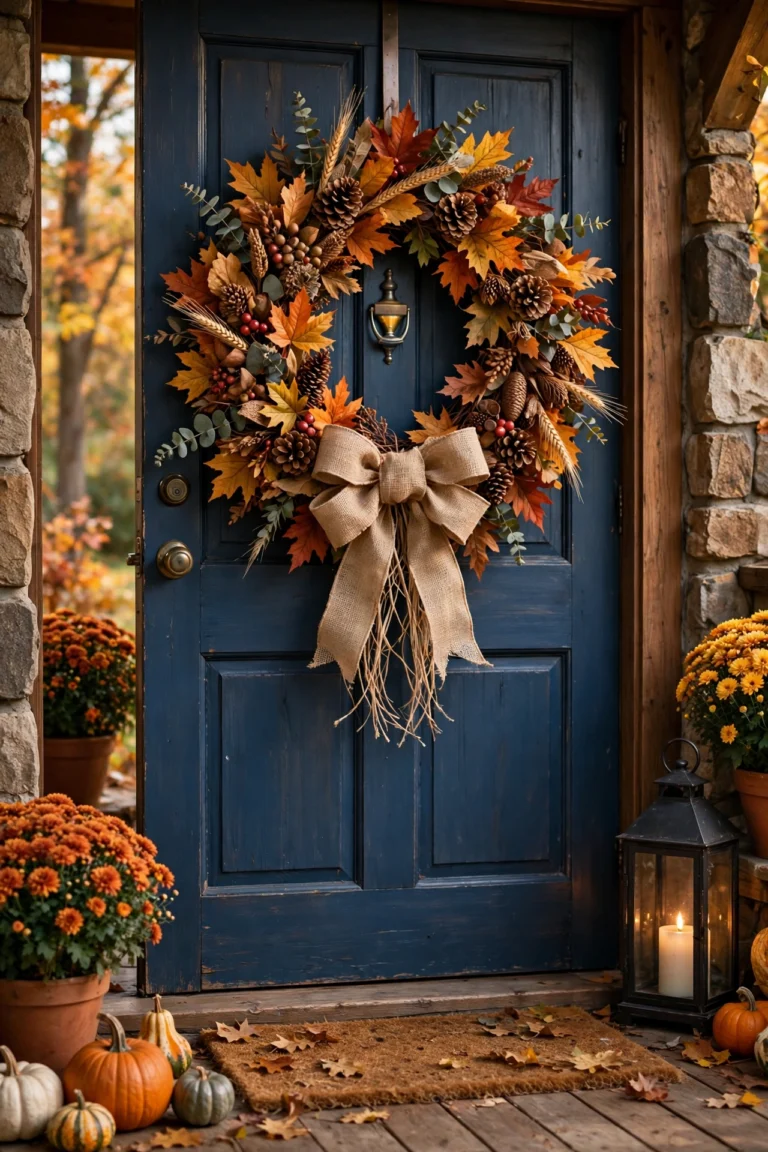
For December purists: a clean warm-white roofline outline, wreath on the door, window candles. Whether you hang strings for the season or run it as a scene on permanent lights, the rule is the same — one color temperature everywhere, and timers so the whole street’s favorite house switches on at dusk.
52. Halloween in Orange and Purple
Two colors, used sparingly, beat a yard of inflatables: orange uplights on the facade, purple in the shrubs, path lights steady. On permanent or smart systems it’s a five-minute scene change; with plug-in strings, one orange strand along the porch rail does most of the work.
53. A Patriotic July Porch
Red, white, and blue reads best as lighting, not clutter: white string lights as the base, red and blue accents at the door and flag. Keep the flag itself lit per flag code if it flies at night — a small dedicated spotlight is both respectful and required by etiquette.
54. Party Mode: Color and Music-Ready Patio Lights
For birthdays and game nights, color-changing strings or smart bulbs over the patio turn the everyday setup festive in seconds. Set the colors before guests arrive (mid-party app-fiddling kills the vibe), keep one zone warm white over the food, and let the rest play.
Bottom line
- Layer three heights: overhead, eye level, and ground — one source at each beats five at one.
- Start where people walk and sit: the front path (ideas 4, 19) and the patio canopy (idea 9) deliver 80% of the effect for 20% of the budget.
- Give the yard one star: a lit tree (5, 28), a water feature (37), or the facade (3) — a focal point makes everything else look intentional.
- Automate it: timers and smart controls (46, 47) are why some yards glow every night and others only when someone remembers.
- The forever upgrade: permanent roofline track lighting (2, 50) costs the most upfront and then removes ladders, storage bins, and seasonal work permanently.
Frequently Asked Questions
What is the cheapest way to light a yard?
Start with solar path stakes along the front walk (idea 19) and one string of commercial-grade lights over the patio (idea 9) — under $150 total for most homes, no wiring, and both moves land in an afternoon. Add a timer plug so they run themselves.
Are solar outdoor lights worth it?
For accents, paths, and anywhere wiring is impractical, yes — modern panels hold 6–8 hours of charge. For your main patio or security lighting, wired or low-voltage still wins on brightness and reliability, especially under trees or in cloudy climates where panels underperform.
How many outdoor lights do I actually need?
Fewer than the big-box display suggests. One focal light, path lighting for the main route, and one ambient layer over seating covers most yards — often 8–12 fixtures total. Add in zones (front, patio, garden) over seasons rather than all at once; you’ll place the second round far better.
Do outdoor lights increase home value?
Well-designed landscape lighting is consistently listed among the outdoor upgrades buyers notice most, and it photographs beautifully in listings — the front-yard ideas here (1–8) are essentially curb-appeal work. It rarely returns its full cost alone, but it makes the whole exterior look maintained and intentional.
What color temperature should outdoor lights be?
Warm white — 2700K to 3000K — for almost everything: it flatters skin, brick, wood, and foliage. Reserve cooler white for security fixtures if you must, and use color only as an accent (ideas 34, 54), never as the base layer.