How to Make a Thanksgiving Wreath: Fresh vs Faux, Step by Step
TL;DR
A thanksgiving wreath is the fastest way to make a front door feel like Thanksgiving: one wreath form, a few bunches of fall foliage, pinecones and berries, and a wired bow — about 30 to 60 minutes of work and $15–$60 in materials. Fresh greens smell wonderful but last 1–3 weeks; faux foliage lasts for years and survives sun and rain. This guide covers both, step by step, plus how to hang it without a single hole in your door.
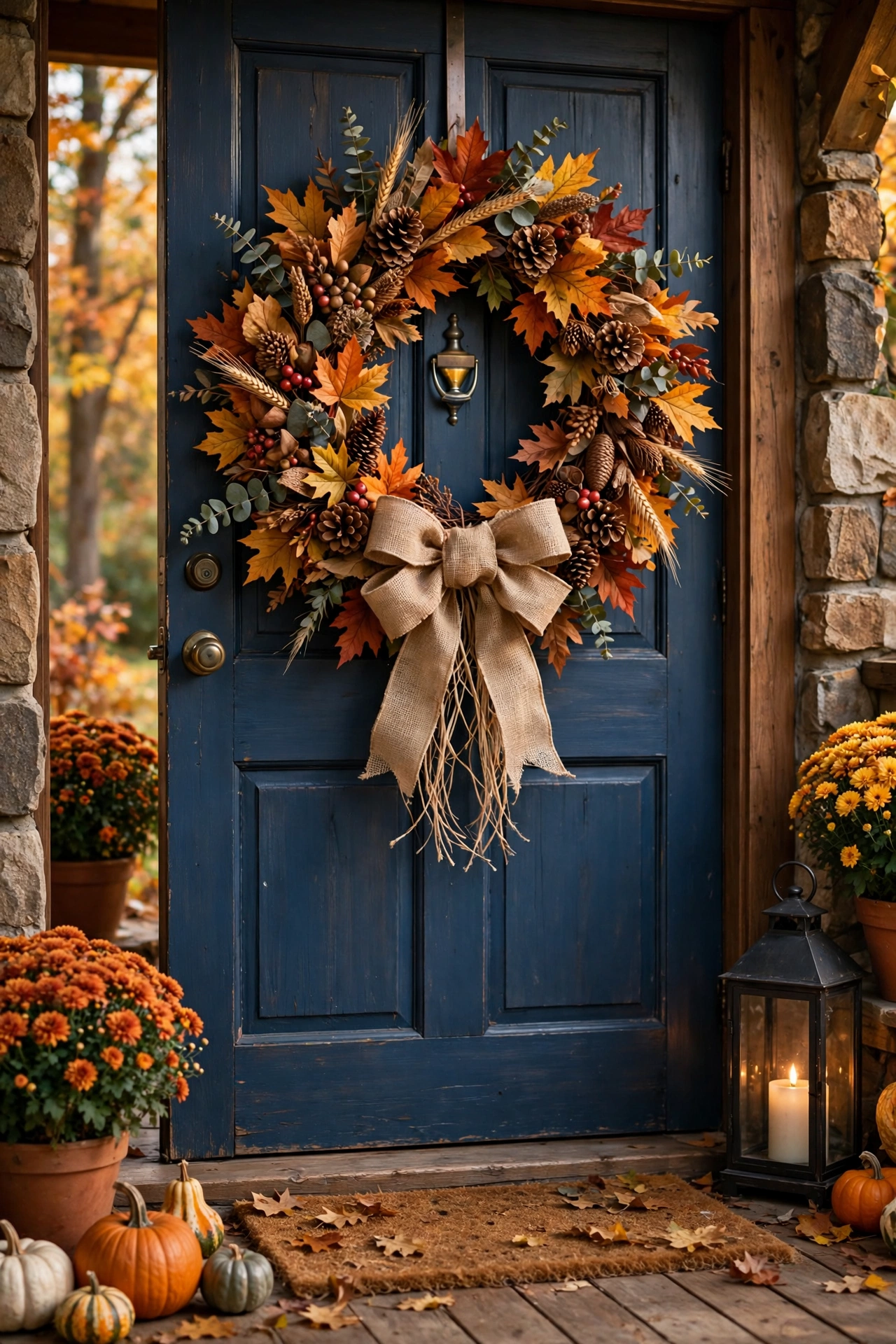
A thanksgiving wreath does more work than any other single piece of fall decor. It greets guests before they reach the door, it sets the color palette for the whole entryway, and it costs a fraction of a store-bought one when you make it yourself. Wreath-making is one of the easiest DIY projects in the house: no sewing, no power tools, and no skill you cannot learn in ten minutes. This guide covers the fresh-versus-faux choice, the materials, the build, hanging without holes, and keeping it fresh — and it pairs naturally with Thanksgiving entryway decor inside the door.
What Makes a Great Thanksgiving Wreath?
A great thanksgiving wreath has three things: a full base hiding the form, three color clusters for balance, and one clear focal point. The base is the greenery layer covering the form; the clusters are berries, pinecones, or mini pumpkins at 10, 2, and 6 o’clock; the focal point is one bow or pumpkin the eye lands on first.
The most common beginner mistake is scattering small pieces evenly all the way around, which looks busy and flat. Size matters too — the finished wreath should be about two-thirds the width of your door, so a 20-inch wreath suits a standard 36-inch front door.
Fresh or Faux: Which Should You Choose for a Thanksgiving Wreath?
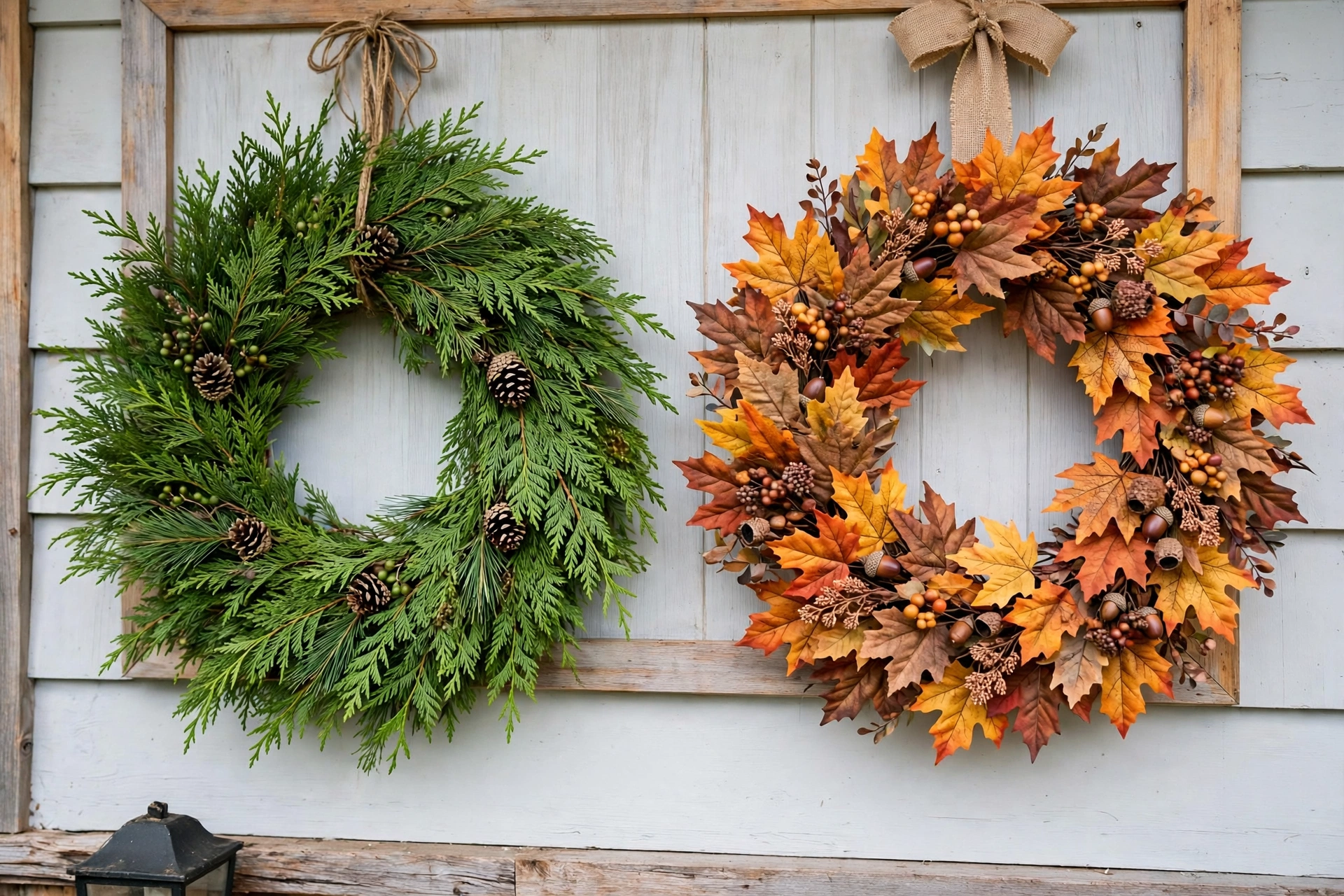
Choose fresh if you want scent and texture for a short display, and faux if you want the wreath to last for years. That one decision shapes everything else — the materials, the build, and where you hang it at home.
Fresh wreaths smell wonderful and look alive in a way plastic never quite matches, but they are living plant matter: they lose moisture from the moment they are cut, and a heated room dries them out in days. Faux wreaths cost more up front, but a good one looks convincing from the street, survives sun and rain, and comes back out of the box next November with a new ribbon.
| Factor | Fresh wreath | Faux wreath |
|---|---|---|
| Look and scent | Real texture, real scent | Convincing from a few feet, no scent |
| Lifespan | 1–3 weeks outdoors, 7–10 days indoors | Years, with storage |
| Weather tolerance | Fades fast in direct sun; needs shade | Handles sun and rain |
| Cost per season | $15–$30 in greens | $25–$60 once, reused yearly |
| Effort | Mist every 2–3 days | Dust and store |
| Best for | Covered porch, short display | Sunny door, mantel, reuse |
If your front door faces south or west and gets hard afternoon sun, choose faux — direct sun can cut a fresh wreath’s life by more than half. If your porch is covered and shaded, fresh is the better experience.
What Materials Do You Need to Make a Thanksgiving Wreath?
One wreath form, greenery, accents, wire, and a bow — that is the whole shopping list. Buy the form first, because everything else is sized to it. A grapevine form grips stems without glue, a wire frame is the lightest and cheapest, and foam is easiest to cover — pick the form and size everything else to it.
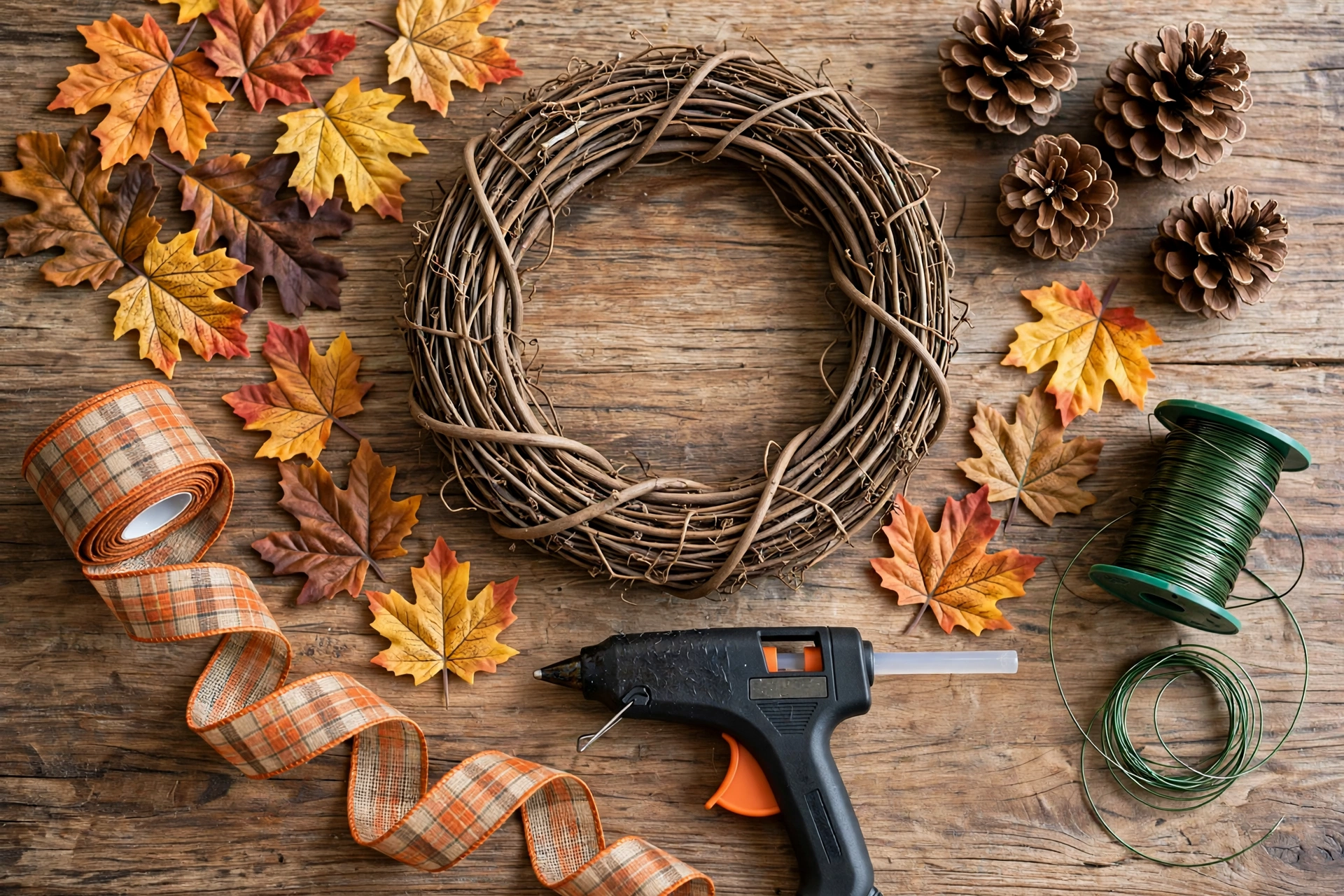
The form is the skeleton: grapevine gives a natural, rustic look and grips stems without glue; a wire frame is the lightest and cheapest; foam is the easiest to cover fully but needs wrapping first so it does not show through. For foliage, faux maple and oak leaves, eucalyptus, wheat stalks, and dried grasses add fullness; for fresh, cedar, fir, and boxwood hold up longest, while spruce and hemlock drop needles within days indoors. Accents are the harvest details: pinecones, acorns, mini pumpkins, berries, dried orange slices, cinnamon sticks, and seed pods. Wired ribbon holds its shape best for the bow — burlap for rustic, velvet for elegant, plaid for classic.
| Material | What to buy | Rough cost |
|---|---|---|
| Wreath form | 16–18 inch grapevine or wire form | $5–$12 |
| Foliage | 9–12 bunches faux leaves, or fresh cedar/fir bundles | $10–$25 |
| Accents | Pinecones, berries, mini pumpkins, orange slices | $5–$15 |
| Ribbon | 2.5-inch wired ribbon, 2–3 yards | $4–$8 |
| Tools | Floral wire, hot glue gun + sticks, wire cutters | $5–$10 |
| Total | About $15–$60 |
All prices are rough planning estimates, not quotes — craft-store sales and foraged pinecones move the total most. A 14-inch frame takes most first-timers 60–90 minutes; after that, under an hour.
How Do You Make a Thanksgiving Wreath Step by Step?
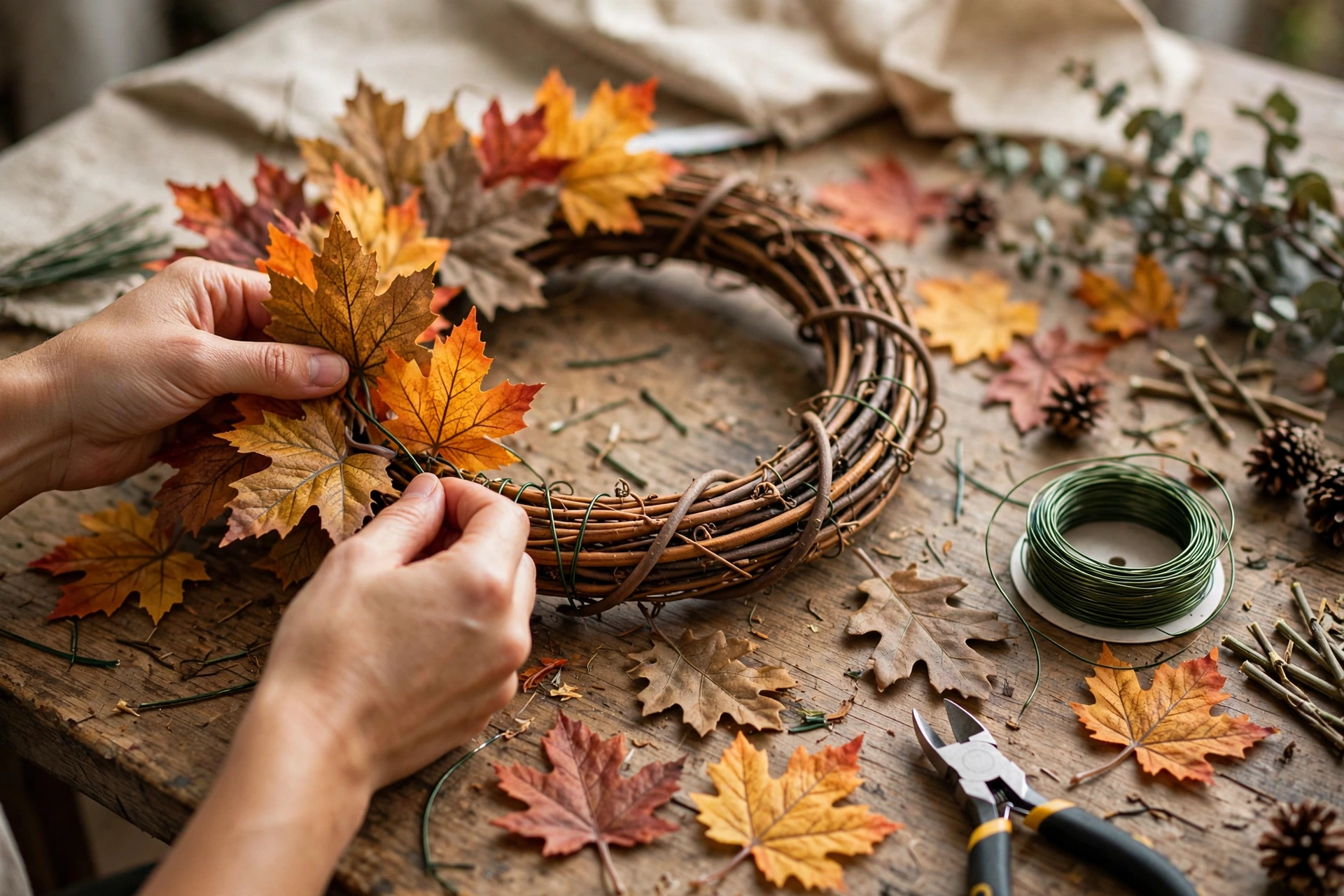
Work in layers, in one direction, and step back often — a wreath comes together best when you layer, look, and adjust as you go. The whole build takes about 30 to 60 minutes once the materials are on the table, and the numbered steps below cover the full process from prepping the form to hanging the finished wreath.
- Prep the form — tuck loose vines, wrap foam or straw so nothing shows through.
- Lay the greenery — work in one direction, stems angled, triangle pattern for faux.
- Add the first cluster — berries and leaves at 10 o’clock, wire or glue in place.
- Add the second cluster — pinecones and pumpkins at 2 o’clock, step back and check.
- Add the third cluster — orange slices and cinnamon at 6 o’clock for balance.
- Wire the bow — two loops, pinch the center, secure with floral wire.
- Fluff and trim — pull stems outward, trim anything poking past the edge.
- Hang and adjust — hang it, step back six feet, and nudge clusters until it reads evenly.
How Do You Hang a Wreath on a Front Door Without Holes?
Use an over-the-door hanger or a ribbon looped over the top of the door — no nails, no screws, no damage. A fresh evergreen wreath weighs 3–5 pounds, so the hanger must be rated for the weight, and adhesive hooks usually are not strong enough in cold weather.
The over-door hanger is the simplest option: a flat metal hook that slides over the top of the door and holds the wreath at eye level. Check that it fits your door’s thickness — most are made for standard doors up to 1.75 inches. The ribbon method is the prettiest: loop a long wired ribbon through the wreath, run it over the top of the door, and attach the end inside with an upside-down Command hook or two thumbtacks on the inside face, so nothing shows from the street. For a mirror or window, use a small Command hook and a short ribbon loop from the frame. Whatever you use, leave at least an inch of space between the back of the wreath and the door so air can move and the foliage does not press flat — use foam spacers behind the form.
Front Door or Mantel: Where Should a Thanksgiving Wreath Go?
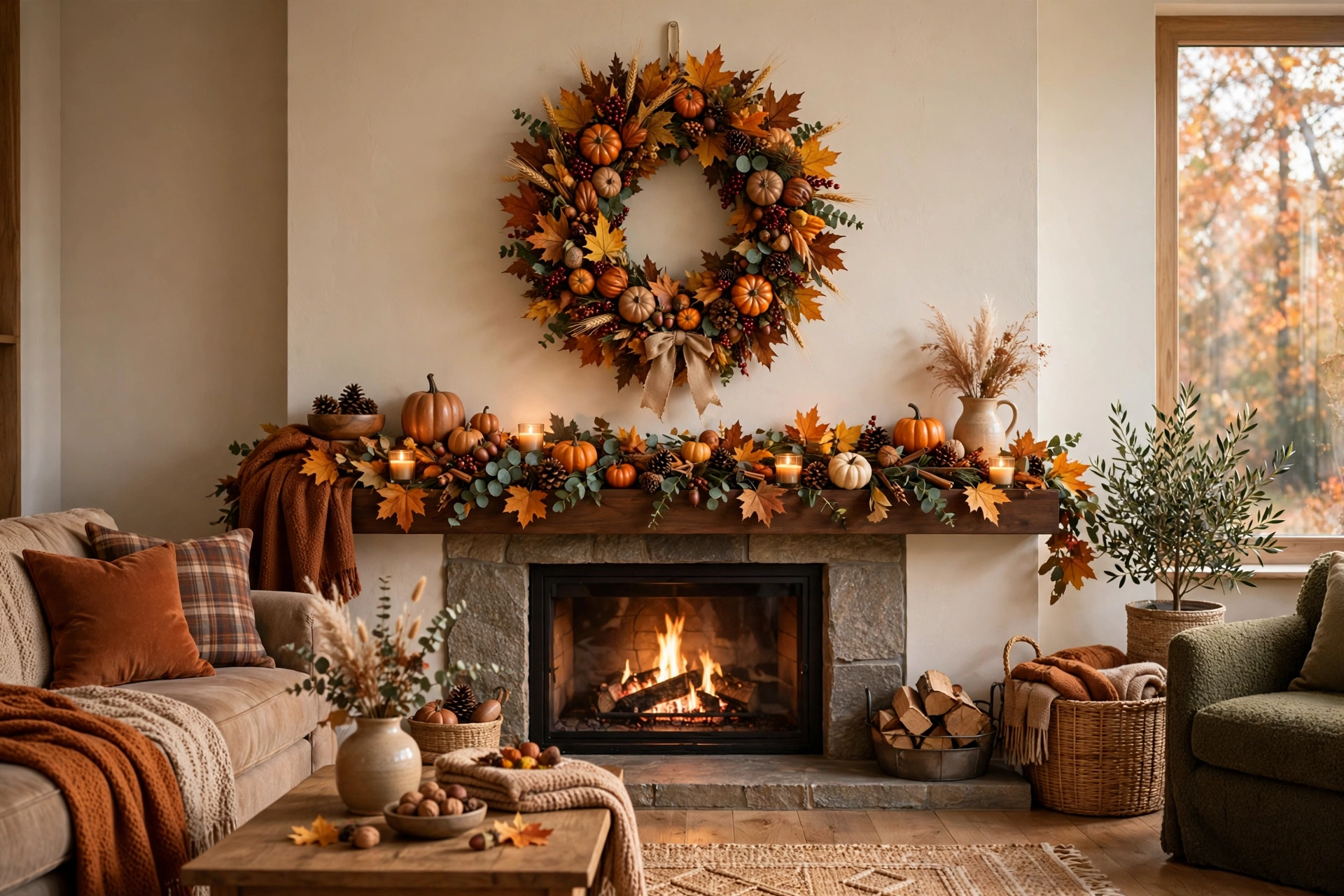
The front door is the classic spot, but the mantel is the better one for a fresh wreath. The decision comes down to sun, heat, and how long you need it to last. A sunny door or a lit fireplace dries fresh greens fast, while a shaded porch or a cool interior wall keeps them fresh for weeks.
But a sunny door is hard on fresh greens, and a wreath above a fireplace is worse: the heat from a fire can dry foliage three times faster than the same wreath in a cool hallway. A fresh wreath belongs on a covered, shaded porch or on an interior wall, door, or mirror where the temperature stays cool. A faux wreath can go anywhere — sunny door, mantel, above the fireplace, or on a window — because heat and sun do not hurt it. If you love the mantel look, hang the wreath centered above the fireplace on a nail or Command hook, and keep fresh greenery at least a foot above the shelf so rising heat does not reach it.
How Long Does a Fresh Thanksgiving Wreath Last?
A fresh wreath lasts 1–3 weeks outdoors in cool weather and 7–10 days in a heated room — and cedar lasts longest of all. The species you choose matters more than anything else you do to it. Mist it every two or three days, keep it out of direct sun, and it will hold its color far longer.
Cedar holds up 10–14 days outdoors and up to 3–4 weeks with care; boxwood lasts 3–6 weeks; fir about 12–18 days but hates heat; pine dries out in 5–10 days. To stretch the life, soak the greens in room-temperature water for a few hours before building, mist the finished wreath lightly every 2–3 days (a fine spray on the back, never a soak), and keep it out of direct sun and away from vents, radiators, and fireplaces. An anti-desiccant spray forms a breathable barrier on the foliage and can cut moisture loss by up to half — apply it before hanging and reapply every 2–3 weeks.
| Greenery | Outdoor lifespan | Indoor lifespan | Notes |
|---|---|---|---|
| Cedar | 2–4 weeks | 10–14 days | Longest lasting, tolerates dry air |
| Boxwood | 3–6 weeks | 2–3 weeks | Toughest outdoor choice |
| Fir | 2–3 weeks | 12–18 days | Sensitive to heat, mist often |
| Pine | 1–2 weeks | 5–10 days | Dries fast, best for short displays |
| Eucalyptus | Dries in place | Dries in place | Keeps its shape, no needle drop |
When the needles snap cleanly instead of bending, or the leaves turn gray and brittle, the wreath is done — compost the greens, save the form, and rebuild next year.
How Much Does a DIY Thanksgiving Wreath Cost?
A DIY thanksgiving wreath costs about $15–$60 in materials, and most makers land near $35. The form and the foliage are the two costs that matter; everything else is small. A grapevine form and a few bunches of faux leaves make a full wreath for under $20, and the form is reusable for years.
The cheapest route is a grapevine form from a craft store (about $5–$12) plus foraged pinecones and a few bunches of faux leaves — a full wreath for under $20, and the form is reusable for years. The mid-range route adds better faux foliage, a wired velvet bow, and dried orange slices, landing around $35–$45. A store-bought wreath of the same size runs $40–$90, so even the most generous DIY build saves money.
| Route | Materials | Rough cost |
|---|---|---|
| Budget DIY | Grapevine form, faux leaves, foraged pinecones | $15–$25 |
| Mid-range DIY | Better faux foliage, velvet bow, orange slices | $35–$45 |
| Fresh DIY | Fresh cedar or fir bundles, accents, ribbon | $15–$30 per season |
| Store-bought comparison | Similar size, ready-made | $40–$90 |
All prices are rough planning estimates, not quotes — craft-store sales and how much you forage move the total most. Store the finished faux wreath in a wreath bag or a box in a dry place, away from heavy items that could crush the bow, and it will come back next November with a new ribbon.
Frequently Asked Questions
What size wreath do I need for my front door?
About two-thirds the width of your door. A 20-inch finished wreath suits a standard 36-inch front door; a 24-inch wreath suits a wider or double door.
How long does a fresh wreath last outside?
About 1–3 weeks outdoors in cool, shaded weather, and up to 3–4 weeks for cedar with regular misting. Direct afternoon sun shortens that sharply, so a covered porch is the best spot.
Can I use one on my mantel?
Yes, and the mantel is one of the best spots for a faux wreath, because heat and sun do not hurt it. For a fresh wreath, hang it at least a foot above the mantel shelf and keep it away from the fire — heat from a fireplace dries foliage far faster than the same wreath in a cool hallway.
Should I choose fresh or faux for a sunny front door?
Faux. South- and west-facing doors get intense afternoon sun that wilts fresh greens within days. A faux wreath handles sun and rain, and a few fresh touches — dried orange slices or foraged pinecones — give it the same warmth.
How do I hang a wreath without putting holes in my door?
Use an over-the-door hanger rated for 3–5 pounds, or loop a long ribbon through the wreath, over the top of the door, and onto an upside-down Command hook on the inside face. Both methods leave no marks, and the ribbon method hides the hardware completely from the street.
How do I store a faux wreath?
Store it in a wreath bag or a box in a dry place, away from heavy items that could crush the bow or bend the foliage. With gentle storage, a faux or dried wreath refreshes next year with a new ribbon and a few updated accents, and the grapevine or wire form lasts for years.
Final Thought
It is the rare DIY project that is cheap, fast, and genuinely impressive: one form, a few bunches of foliage, three clusters of color, and a wired bow — about $15–$60 and an hour of your afternoon. Choose fresh for scent and a short, shaded display, or faux for a sunny door and years of reuse, hang it without a single hole, and mist it every few days if it is fresh. When the season ends, save the form — next November the rebuild costs almost nothing.