Why Won’t My Christmas Lights Turn On? 7 Fixes in 10 Minutes
You plug in the string, flip the switch — nothing. Before you declare the whole set dead and buy a replacement, know this: when people ask why won’t my Christmas lights turn on, the answer is a blown plug fuse or a loose bulb roughly eight times out of ten, and both fix in minutes with parts that are probably already in the plug. The trick is checking causes in the right order — cheapest and most likely first — instead of shaking the string and hoping.
Here’s the exact 10-minute diagnosis, plus the one symptom that means the string genuinely is finished.
TL;DR
Work in this order: (1) test the outlet with a phone charger; (2) check the timer/GFCI hasn’t cut power; (3) open the little door on the plug and inspect the two fuses — a darkened or broken fuse is the #1 cause of a completely dead string, and spares are usually stored in the same plug; (4) push every bulb firmly into its socket, starting near the plug; (5) swap the first few bulbs with known-good spares; (6) inspect the wire for nicks, chew marks, and green corrosion. If a fresh fuse blows instantly, the string has a short — retire it. Half the string out instead? That’s a different fault — see our half-out fix guide.
Why Won’t My Christmas Lights Turn On? The 10-Minute Diagnosis
Step 1: Prove the outlet works (1 minute)
Plug a phone charger or lamp into the same outlet. No power? Check three things: the GFCI (the test/reset buttons on outdoor and bathroom outlets — rain trips these constantly in December), the breaker panel, and any timer or smart plug in the chain — a timer set to “off” or a smart plug that lost Wi-Fi fools thousands of people every year. Outdoor strings should be on a GFCI-protected outlet for safety; if yours keeps tripping only when it rains, that’s a separate fault covered in our Christmas light safety tips.
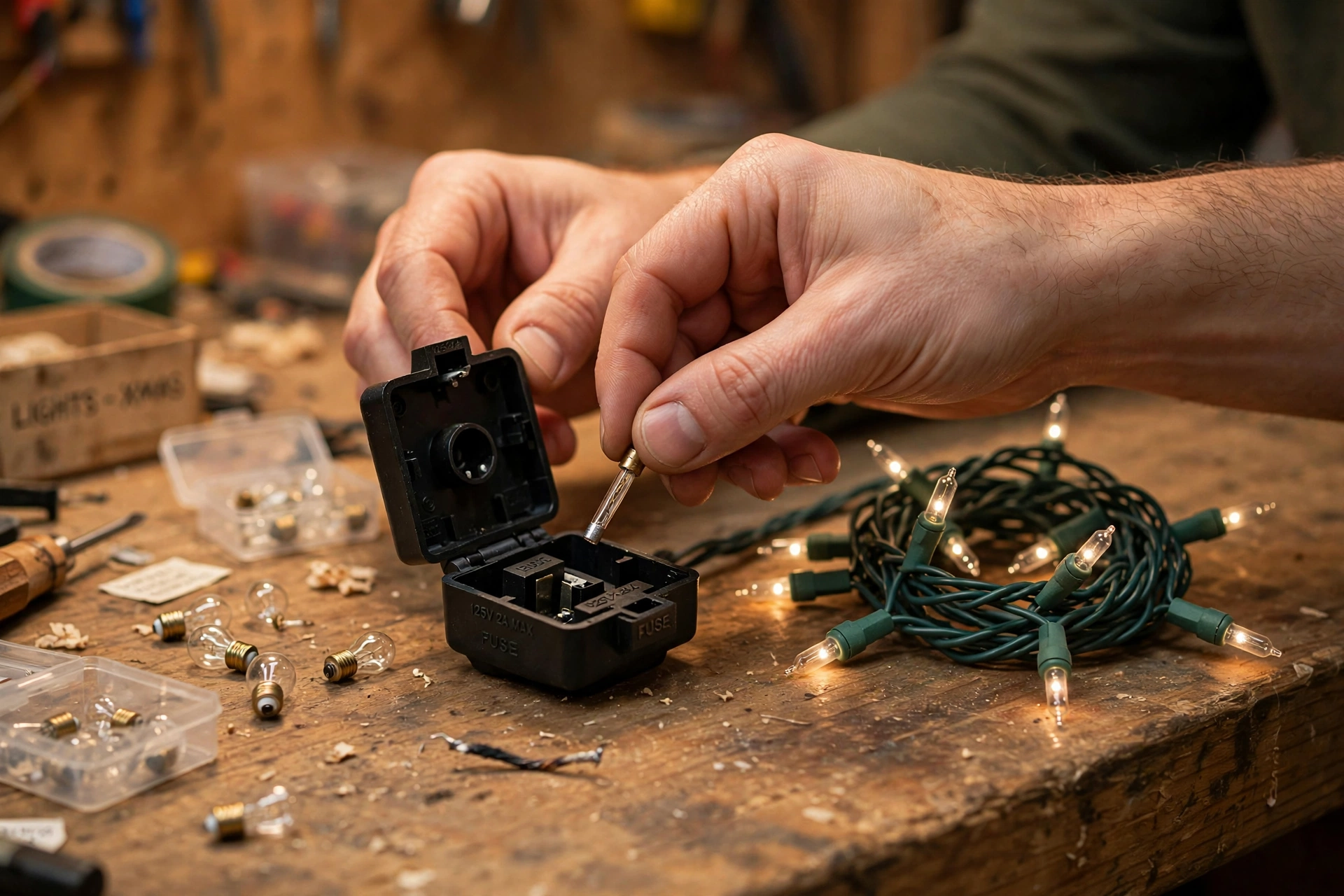
Step 2: Check the plug fuses (3 minutes) — the most likely culprit
Almost every incandescent mini-light string hides two small glass fuses inside the male plug, behind a sliding door you open with a fingernail or small screwdriver. They exist to kill power before an overloaded string overheats — and they sacrifice themselves for reasons as small as one string too many connected end-to-end.
- Slide the door open (unplug first — always)
- A blown fuse looks darkened/smoky or shows a broken filament inside the glass; hold it up to the light
- Replace with the identical rating (usually 3-amp, 125-volt — printed on the plug or the old fuse); most plugs store spare fuses in the same compartment, and strings ship with extras in the box
- Replace both if one is blown; if you have a multimeter, a good fuse reads near-zero resistance
Plug back in. Lights? You’re done — total cost, zero dollars. If the new fuse blows immediately, stop: the string has an internal short (pinched or chewed wire, water-damaged socket). Do not keep feeding it fuses; that string is retired.
Step 3: Reseat every bulb, plug end first (3 minutes)
Mini lights wire in series — one loose, missing, or poorly seated bulb can open the circuit and darken the whole string (or a 25/50-bulb section of it). Bulbs work loose in storage surprisingly often. Starting at the plug end, push each bulb firmly into its socket as you walk the string; then test. This unglamorous step revives more “dead” strings than every other fix combined.
Step 4: Swap the first bulbs with known-good spares (2 minutes)
If reseating didn’t do it, one bulb may be dead in a way that breaks the circuit. Modern incandescent bulbs contain a shunt — a tiny wire meant to keep the string lit when the filament burns out — but shunts fail too, especially on cheap strings. Replace the first few bulbs one at a time with the spares from the box (match the voltage: 2.5V and 3.5V bulbs are not interchangeable). If the string lights when bulb #3 is swapped, you’ve found it. A light-tester tool (the gun-shaped kind hardware stores sell) speeds this up on long strings and can even revive stuck shunts.
Step 5: Inspect the wire and sockets (1 minute)
Run the cord through your hands looking for: nicks and cuts (storage bins and staple guns are the usual suspects), chew marks from rodents or pets, crushed sections, and sockets with green or white corrosion. Corroded sockets can be cleaned with a toothpick and contact cleaner; damaged insulation cannot be safely repaired — tape is not a fix for a chewed cord. Retire damaged strings.
Special Cases
LED string completely dead? LED strings fail differently: the usual causes are a loose bulb (many LED strings are series-wired too), corrosion in a socket, or a failed inline driver/rectifier — the small sealed bulge in the cord. The first two are fixable (reseat, clean, dry the sockets thoroughly). A dead driver is not user-repairable; the string is done. Some LED plugs still carry fuses — check before you bin it.
Pre-lit tree section dark? Each section has its own plug and fuses, usually stacked at the tree’s center pole. Unplug the section, check its plug fuse, reseat its bulbs. Sections that connect via a central hub may just be loosely plugged — push every connector home first.
String works indoors but not outside? Almost always the outdoor outlet’s GFCI or a tripped breaker, not the string. Reset, dry the connections, and elevate plug connections off wet ground.
Brand-new string dead out of the box? Check the fuses anyway (they occasionally ship blown or unseated), reseat the bulbs, then exchange it — infant mortality happens, and it’s the store’s problem, not yours.
When the String Is Actually Dead
Replace — don’t repair — when you see any of these: a fresh fuse blows instantly (internal short); insulation is cracked, chewed, or conductors are exposed; sockets are melted or heat-warped; the cord is brittle with age. Christmas light strings are inexpensive; house fires are not. And when a string truly dies, recycle it properly rather than binning it — our guide to how to recycle old Christmas lights covers every option.
PRO TIP
Prevent next year’s mystery: before storing, plug every string in and fix problems then, coil loosely (tight winding loosens bulbs), and tape a note to each coil — “works, 2026” or “fuse blown — spares in plug.” The two minutes saves the exact evening you’re about to spend. Our guide to storing Christmas lights covers the full system.
Frequently Asked Questions
Where is the fuse in Christmas lights?
Inside the male plug, behind a small sliding door. Most strings have two fuses plus, often, spares stored in the same compartment. Unplug before opening it, and replace with the identical amperage rating (usually 3A).
Can one bad bulb make the whole string go out?
Yes. Series-wired strings need every bulb (or its internal shunt) conducting. A missing, loose, or shunt-failed bulb darkens the whole string or one section of it. Reseating and then swapping bulbs plug-end-first finds it fastest.
My Christmas lights have power but only some sections light — is that the fuse?
No — a blown fuse kills the whole string. A dark section means a series fault inside that section (one bad bulb or socket), which is the half-out fault, not a fuse fault.
Why do my new fuses keep blowing instantly?
A short circuit in the string — damaged wire, water in a socket, or a failed bulb socket arcing. Stop replacing fuses; continuing risks damaging the outlet. Retire the string.
Do LED Christmas lights have fuses?
Some do — check the plug the same way. But the most common whole-string LED failures are a loose bulb, corroded socket, or a dead inline driver, none of which a fuse fixes.
Is it worth repairing an old string, or should I just replace it?
Fuse and bulb fixes cost nothing and take minutes — always try them. Replace the string when the wiring itself is damaged or brittle, or after roughly 5+ seasons of heavy outdoor use on a budget string.
Key Takeaways
- Dead string ≠ dead lights: it’s the plug fuse or a loose bulb most of the time, and spares live in the plug.
- Diagnose in order — outlet/GFCI/timer → fuses → reseat bulbs → swap bulbs → inspect wire. Ten minutes, no tools beyond a fingernail.
- A fuse that blows instantly means a short: retire the string, don’t re-fuse it.
- LED strings fail by loose bulbs, corrosion, or dead drivers; pre-lit trees have a fuse per section.
- Fix strings before storing them and label each coil — next December you will be grateful.