Boho Wall Decor Ideas: One Anchor, Two Textures, One Mirror — Then Stop
TL;DR
The best boho wall decor follows a layer budget: one anchor, two textures, one mirror — then stop. Living room goes bold, with a large organic anchor above the sofa and stronger contrast in terracotta and ivory. Bedroom goes quiet, with one anchor and one texture sized to the headboard. Boho is a layering system, not a shopping list, and the stopping rule is what keeps it collected instead of cluttered.
Introduction
Boho wall decor goes wrong in one predictable way: it keeps growing. One macramé hanging becomes three, then baskets, then prints, then a mirror, then shelves — and a wall that started warm and collected ends up busy and tired. The style itself is not the problem. Boho wall decor is a layering system — macramé hangings, woven baskets, tapestries, sunburst mirrors, botanical prints and textured abstracts, layered with plants, rugs and soft light — and every guide on the search results will sell you the layers. Almost none of them tells you when to stop.
This boho wall decor guide gives you that stopping rule. Pick one anchor piece, add two textures, add one mirror, and stop. The rule bends by room — living room bold, bedroom quiet, entry-hallway in between — but it never disappears. You will also get the palette discipline, the sizing rule borrowed from the living-room and gallery posts (size art to the furniture, not to the wall), and rough planning prices for each element, not quotes, so you can plan a wall without overspending on it.
For the sizing and hanging basics, the full wall art for living room guide covers the two-thirds sofa-width rule and eye-level hanging in detail.
What Is the Layer Budget for Boho Wall Decor?
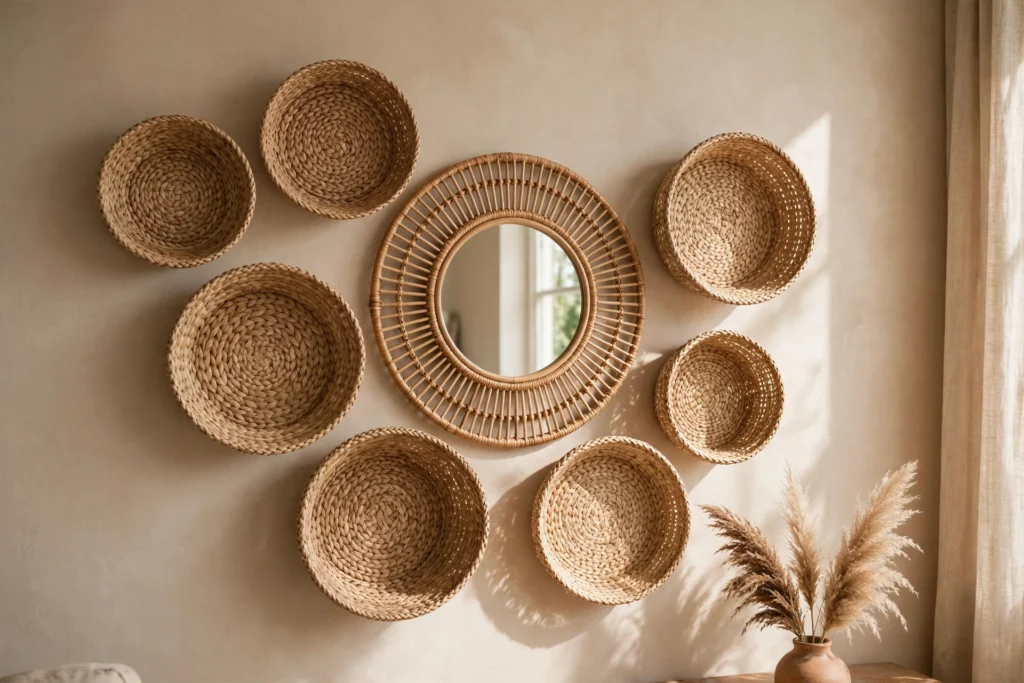
The best boho wall decor answers a counting question before a shopping question: how many layers does this wall already have? The budget is one anchor, two textures, one mirror — then stop. The anchor is the single large organic piece that sets the wall: a large macramé hanging, a big woven piece, or a tapestry. The textures are the supporting layers — baskets, a second textile, a print set. The mirror is the closer: it bounces light and opens the wall, and it replaces a fourth texture rather than sitting on top of one.
| Room | Anchor piece | Texture count | Mirror? | Palette |
|---|---|---|---|---|
| Living room | One large organic piece above the sofa | 2 textures | Yes, sunburst or round rattan | Terracotta + ivory, stronger contrast, one dark accent max |
| Bedroom | One softer anchor above the headboard | 1 texture | Optional, small and quiet | Cream + sage, lighter palette, more negative space |
| Entry / hallway | One medium anchor at eye level | 1 texture | Yes, if the hall is dark | Warm neutrals, cream + terracotta |

Living room takes the bold version because it is the room guests see and the sofa gives you a wide anchor line to work with. Bedroom takes the quiet version because you live with it at rest — softer shapes, a lighter palette, and empty wall left deliberately empty. If a wall already has its anchor, two textures and a mirror, the next piece does not make it more boho. It makes it cluttered, and clutter is the one thing this style cannot afford.
How Do You Pick Each Element Without Over-Buying?
Use the element chooser below, and buy only the row your wall is missing. Boho wall decor stays affordable when each element has one job: the anchor sets the scale, the textures add warmth, the mirror adds light, and nothing repeats another element’s job. A second large textile does not add a second layer — it fights the anchor for attention.
| Element | Best room | Weight / hanging method | Rough price tier |
|---|---|---|---|
| Large macramé wall hanging | Living room anchor | Light–medium, one nail or hook into a stud | Roughly $40–$120 |
| Woven basket wall set | Living room or hallway texture | Light, adhesive hooks or small nails | Roughly $25–$70 for a set |
| Tapestry | Bedroom or living room anchor | Light, rod or clips (see the tapestry hanging guide) | Roughly $30–$90 |
| Sunburst mirror | Living room or hallway closer | Medium, stud anchor for safety | Roughly $50–$140 |
| Botanical print set | Bedroom texture, or entry | Light, standard frames | Roughly $30–$80 for a set |
| Textured abstract | Living room, only if no tapestry anchor | Medium, picture hooks | Roughly $40–$110 |

For boho wall decor with a tapestry anchor, the tapestry wall hanging guide covers rods, clips and weight — a tapestry is one element in this system, not the whole wall, so hang it as an anchor and leave the textures to baskets and prints.
What Goes Above a Sofa, and What Goes Above a Bed?
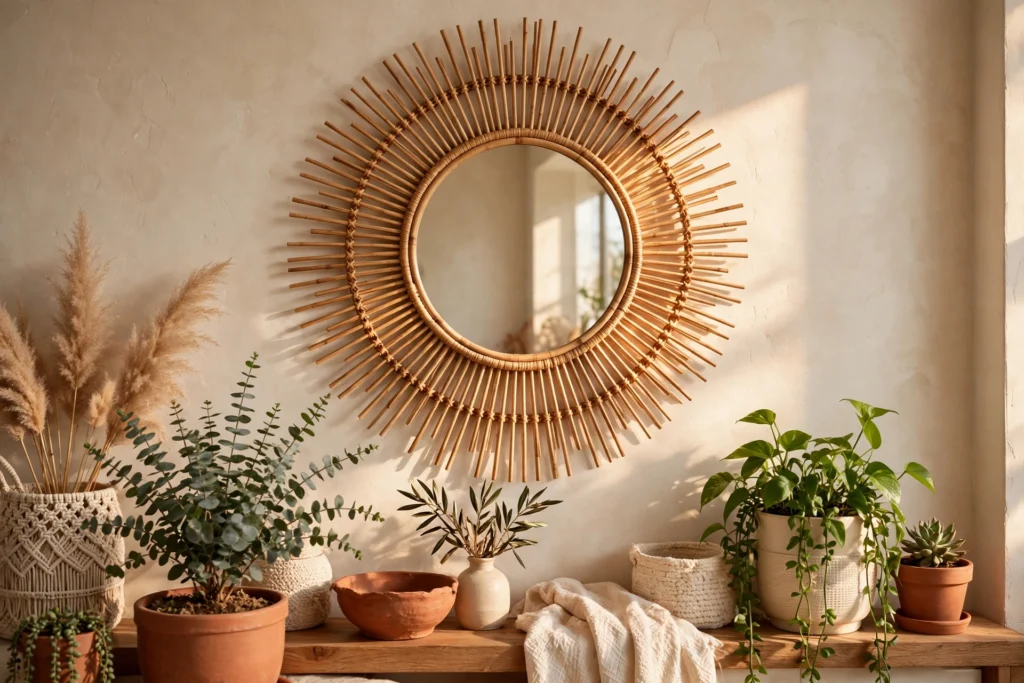
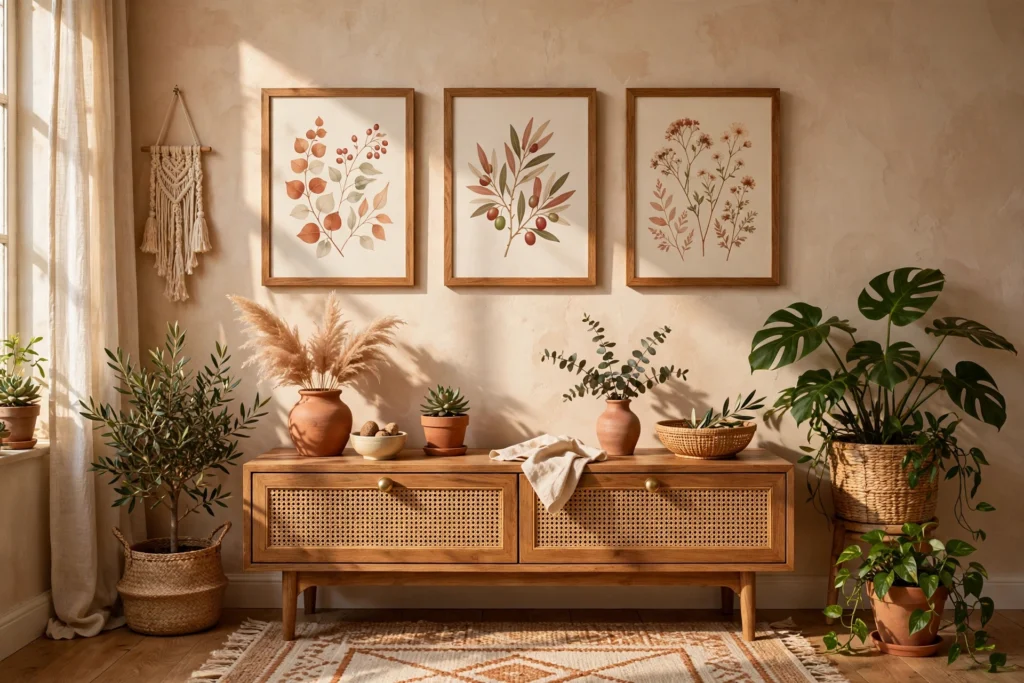
For boho wall decor above a sofa, the anchor should span about two-thirds of the sofa width and hang at eye level — the same furniture-first rule as the living-room pillar. A large macramé piece or a big woven work suits this spot because its organic shape softens a long, straight sofa line. Flank it with two textures at most: a basket grouping on one side, a botanical print on the other, or a gallery-style cluster treated as one texture. Finish with a sunburst mirror only if the wall still feels heavy after the textures are up.
For boho wall decor above a bed, shrink everything and leave more wall showing. The anchor should span about two-thirds of the headboard width, not the whole wall, and the palette should stay in cream and sage with one warm accent. One texture is enough — a small basket pair or a single print set — and the mirror is optional. A bedroom wall that follows the quiet budget looks restful on purpose; a bedroom wall that copies the living-room budget looks busy at exactly the hour you want it calm.
How Do You Keep Boho Wall Decor From Looking Cluttered?
This is the question no shopping-list guide answers properly, and it is the whole point of the layer budget. Boho wall decor looks cluttered for three fixable reasons: too many layers, too many dark accents, and matched sets that kill the collected look. Fix them in that order. First, count the layers — anchor, textures, mirror — and remove anything past the budget. Second, check the palette: cream, terracotta and sage as the base, one dark accent at most, and no neon or chrome-heavy pieces fighting the natural materials. Third, break up matched sets: a wall of identical baskets in identical sizes reads as a store display, not a collected home.
| Palette rule | Do | Avoid |
|---|---|---|
| Base | Cream + terracotta + sage | Neon colours, chrome-heavy finishes |
| Accent | One dark accent max (black, deep brown, muted green) | Two or more competing dark pieces |
| Collected look | Mixed sizes, odd-number groupings, one anchor | Matched sets that look bought in one box |
| Light | Warm light, plants nearby to soften edges | Harsh white light on natural textures |
The gallery wall ideas guide covers the layered-gallery variant if your anchor is a cluster rather than a single piece — treat the whole cluster as one anchor, then apply the same budget around it.
Can Boho Wall Decor Work in a Small Room?
Yes, and small rooms are where the budget matters most. In a small room, boho wall decor works when the anchor is medium rather than large, the texture count drops to one, and the mirror does real work bouncing light. A sunburst mirror opposite a window can make a small room feel twice as open, which is worth more than any second texture. Keep the palette light — cream and sage first, terracotta as the accent, not the base — and leave at least a third of the wall empty. Empty wall is not wasted space in boho; it is the breathing room that lets the textures read as collected rather than crowded.
Rough planning estimates, not quotes: a small-room boho wall can be finished for roughly $75–$200 in total — a medium macramé piece or print set as the anchor (roughly $30–$80), one basket or textile texture (roughly $25–$70), and a small mirror (roughly $30–$60) if the room needs light. A living-room boho wall decor wall with a large anchor runs higher, roughly $150–$350, and that is still one wall, not a whole-room redecoration.
What If You Already Own Too Many Boho Pieces?
Edit before you buy. Take everything off the wall, put the anchor back first, add textures one at a time, and stop the moment the wall feels finished — usually at two textures. Move the spare pieces to another room, where they become that room’s anchor or texture, instead of stacking them onto an already-finished wall. Boho wall decor rewards a collected home, not a crowded wall, and the pieces you already own are the cheapest way to start a second wall.
FAQ
How do I keep boho from looking cluttered?
Count the layers: one anchor, two textures, one mirror, then stop. Remove anything past the budget before buying anything new, keep one dark accent at most, and break up matched sets with mixed sizes and odd-number groupings.
What goes above a bed in boho style?
A softer anchor spanning about two-thirds of the headboard width, one texture, and a cream-and-sage palette with more empty wall than a living-room wall. Skip the second texture and keep the mirror optional.
Can boho work in a small room?
Yes — use a medium anchor, one texture, a light palette, and a mirror for light. Leave at least a third of the wall empty; empty wall is what keeps small-room boho from feeling crowded.
Do baskets, macramé and tapestries all belong on one wall?
Not all three as equals. Pick one as the anchor and let the others be textures, or the wall loses its focal point. A tapestry can be the anchor with baskets as texture; a macramé piece can be the anchor with prints as texture.
Final Word
Boho wall decor is at its best when it looks collected over time, not bought in one afternoon. Start your boho wall decor with one anchor you genuinely love, add two textures that warm it, close with a mirror that opens the room, and then stop — even when the next piece is tempting. That stopping rule is the difference between a wall that feels like home and a wall that feels like a shop, and it costs nothing at all.