Best Cabinet Refacing Materials: Laminate vs Wood Veneer vs Thermofoil
TL;DR
The best cabinet refacing materials are laminate, real wood veneer, and rigid thermofoil, and the right pick depends on your budget, your kitchen’s daily wear, and how much you care about a real-wood look. Laminate is the cheapest and toughest, veneer looks and ages like solid wood, and thermofoil gives a clean, seamless modern finish for about the same money.

Choosing the right finish is the biggest decision in a refacing project — it sets your price, your look, and how long the new doors last. Cabinet refacing materials all do the same job — new doors, drawer fronts, and veneer over your old boxes — but the wrong choice can leave you with peeling edges near the oven. All prices below are rough planning estimates, not quotes.
What Are the Three Main Cabinet Refacing Materials?
The three main cabinet refacing materials are laminate, real wood veneer, and rigid thermofoil (RTF), with solid-wood doors as a fourth, premium option. Laminate is a tough plastic surface, veneer is a thin slice of real wood, and thermofoil is vinyl vacuum-formed over MDF — and each one suits a different budget and kitchen.
Laminate is resin-impregnated paper layers bonded under heat and pressure, then glued over MDF or particleboard. Real wood veneer is a thin sheet of genuine wood, 1/16 to 1/8 inch thick, bonded to plywood or MDF — it can be stained, painted, and lightly sanded. Rigid thermofoil is vinyl vacuum-formed over an MDF door, wrapping the edges for a smooth, seamless look that mimics painted wood. Solid-wood doors sit above all three at around $5,000 in materials, and they are the only option you can refinish repeatedly. The real question is which one fits your kitchen: your budget, how hard it gets used, and whether the grain needs to be real.
Is Laminate Good for Cabinet Refacing?
Yes, laminate is a good choice for cabinet refacing when budget and durability matter most — it costs $1,000–$3,000 in materials for a typical kitchen, resists stains and moisture better than the other options, and wipes clean with almost no upkeep.
Laminate is the most impact-, stain-, and moisture-resistant of the three main cabinet refacing materials, which is why installers recommend it for heavy-use kitchens. Grease and fingerprints wipe off easily, and it comes in the widest range of looks for the lowest price: solid colours, wood grains, and matte or gloss finishes. The trade-offs are real, though. Up close, laminate reads as manufactured — the grain pattern repeats — and it cannot be refinished, so a chipped door usually has to be replaced. Peeling in cabinet refacing materials usually starts near heat or moisture, next to an older oven or a steamy dishwasher. On lifespan, sources disagree: JSB Home Solutions lists laminate at 5–10 years, while MeltedStories claims 20+ years. We lead with the conservative 5–10 year range — treat 20+ years as a best case, not a promise.
PRO TIP
Order samples and live with them for a week — a pattern that looks rich in a showroom can look flat in your kitchen light.
Is Wood Veneer Worth the Extra Cost?
Yes, wood veneer is worth the extra cost if you want a real-wood look — it runs $2,500–$6,000 in materials for a typical kitchen, and it is the only refacing option that is genuinely wood, so it can be stained, painted, and repaired like solid wood.
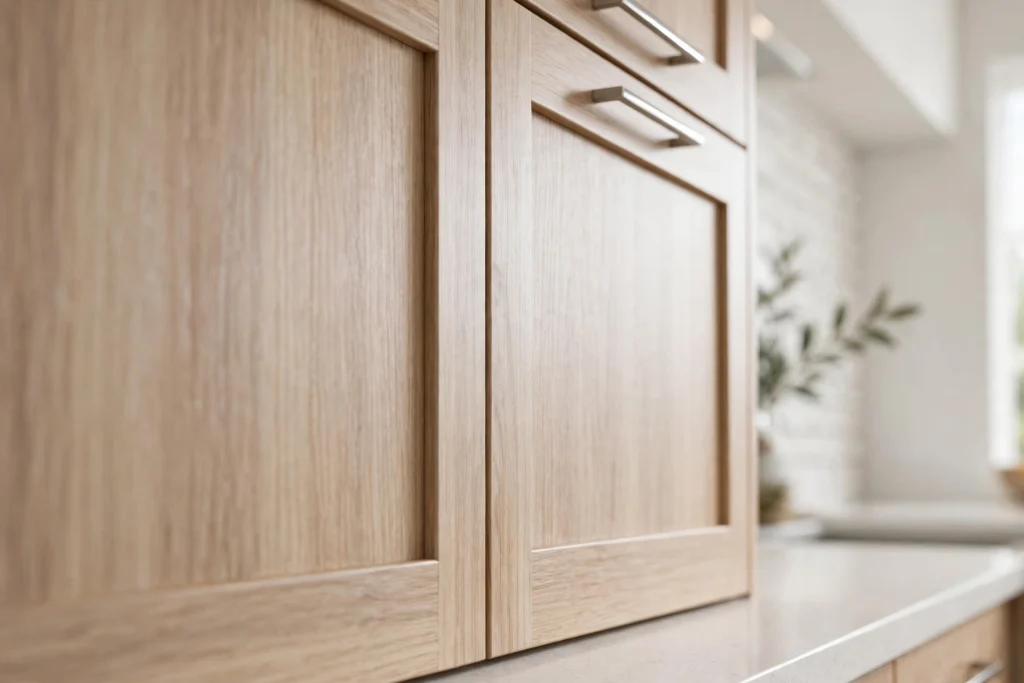
Veneer is a thin slice of real wood — oak, maple, cherry, walnut, or birch — bonded to a plywood or MDF core. No two doors look exactly alike, and it takes stain the way solid wood does. It is also the most repairable of the cabinet refacing materials: light scratches can be sanded out, worn areas restained, and a peeling edge reglued — fixes that laminate and thermofoil do not allow. Among the cabinet refacing materials, veneer is the one that makes guests ask whether you bought brand-new cabinets. The honest downside is the cost gap: at $2,500–$6,000 in materials, veneer costs roughly twice as much as laminate or thermofoil. It is also more sensitive to prolonged moisture, so wipe up water promptly. For DIYers, peel-and-stick sheets let a careful homeowner cover flat frames without contact cement. Weighing DIY against a pro? Read our diy cabinet refacing guide first — veneer rewards patience and precise measuring.

What Is Thermofoil and When Should You Choose It?
Rigid thermofoil (RTF) is a vinyl film vacuum-formed over an MDF door, and you should choose it when you want a smooth, seamless, painted-wood look on a budget — it costs $1,000–$3,000 in materials for a typical kitchen, about the same as laminate.
Thermofoil is often confused with laminate, but they are made differently. Laminate is a flat sheet glued onto a surface, with visible seams at the edges, while thermofoil is heated vinyl vacuum-formed around the whole door, wrapping over the edges and into any routed detail, so the finished door has no seams at all. The result looks like a freshly painted wood door — smooth, uniform, and clean — which is why, of the three cabinet refacing materials, thermofoil is the one most often chosen for white modern kitchens. The weakness is heat: the vinyl skin can bubble, peel, or yellow near a heat source, especially the doors right next to or above an oven. Steam is a second enemy: edges can lift in a poorly ventilated kitchen. Prevent it with a good range hood and a heat shield beside the oven, and repair a lifting edge promptly — small lifts can be reglued with a heat-resistant adhesive before they spread. Choose thermofoil for a clean modern style on a tight budget — but not beside a hot oven.
PRO TIP
If your oven runs hot, ask your installer about a heat shield or filler strip between the range and the nearest door — a $20–$50 shield can save a $200–$400 replacement.

Which Material Lasts the Longest?
Wood veneer lasts the longest of the three main cabinet refacing materials, at 10–15 years with proper care — and longer still, because unlike laminate it can be refinished when it starts to look tired — while thermofoil typically lasts 10–15 years and laminate 5–10 years in hard-used kitchens. Solid-wood doors can last 20+ years because they can be refinished.
Veneer lasts because it is durable and repairable — it can be refinished when it starts to look tired. A veneer door scratched in year eight can be sanded and restained; a laminate door with the same damage must be replaced. That repairability stretches veneer’s useful life past the other cabinet refacing materials, and it is why our lifespan guide puts veneer at the top. Laminate’s lifespan deserves honesty, since sources conflict: one table (JSB Home Solutions) lists 5–10 years, while another source (MeltedStories) claims 20+ years. We lead with the conservative 5–10 year range, matching what installers report for hard-used kitchens. Thermofoil sits in the middle at 10–15 years — doors far from the oven often look new at year twelve, while doors beside the range peel years earlier.
Which Material Looks Most Like Real Wood?
Wood veneer looks most like real wood of all the cabinet refacing materials because it is real wood — a thin slice of oak, maple, cherry, walnut, or birch — while laminate and thermofoil only imitate the grain with printed or moulded patterns.
Hold a veneer door next to a solid-oak door and the grain, colour variation, and play of light all match, because the surface is the same material. Laminate can be convincing from across the room, but up close the difference shows: the grain repeats, and its surface has a uniform sheen real wood never has. Thermofoil does not even try to be wood grain in most cases — its strength is a flawless painted look. Species matter: oak is the classic pick; maple is smoother and takes paint beautifully; cherry darkens with age; walnut is the premium dark choice; birch is the budget-friendly light option. Of all the cabinet refacing materials, veneer alone passes a close inspection as real wood — if that look is your priority and your budget stretches to $2,500–$6,000, veneer is the answer.
Which Refacing Material Is Best for Kitchens With Kids or Pets?
Laminate is the best refacing material for kitchens with kids or pets, because it is the hardest to scratch, the most resistant to stains and moisture, and the easiest to wipe clean after sticky hands, muddy paws, and daily spills.
A busy family kitchen is a durability test, and laminate passes it better than the other cabinet refacing materials. It shrugs off toy impacts, pet claws, juice splashes, and the constant wipe-down that family life demands. Veneer can be scratched by the same abuse — and repaired, but a family with small children may find themselves repairing often. Thermofoil holds up well to wiping but peels more easily if the kitchen runs hot and steamy from constant cooking. Wear is uneven: lower doors take the most abuse, so some families put laminate on the lowers and veneer or thermofoil on the uppers. In a humid kitchen, laminate has a second advantage over the other cabinet refacing materials: it holds up better in damp air than veneer or thermofoil.
Laminate vs Wood Veneer vs Thermofoil: Which Should You Pick?
Pick laminate for the lowest cost and toughest finish, wood veneer for the best real-wood look and longest life, and thermofoil for a clean, seamless modern finish on a budget — no single winner, only the best fit for your kitchen.
If two options tie, let your kitchen decide: a hot, steamy kitchen favours laminate; a calm kitchen lets veneer shine; a modern white kitchen is thermofoil’s home turf. The full installed cost is covered in our kitchen cabinet refacing cost guide. These cabinet refacing materials are only part of the project — installer, warranty, and measurements matter too.
Cabinet refacing materials: full comparison
All prices are rough planning estimates for materials, not quotes. A full pro refacing job typically lands at $4,000–$9,500 installed.
| Material | Materials cost | Look | Durability | Repairability | Best for |
|---|---|---|---|---|---|
| Laminate | $1,000–$3,000 | Wide colours and wood-look patterns; manufactured look up close | Most stain-, impact-, and moisture-resistant; 5–10 years (up to 20+ in light use) | Poor — cannot be refinished; replace damaged pieces | Budget jobs, busy families, humid kitchens |
| Wood veneer | $2,500–$6,000 | Real wood grain; most like solid wood | Strong; 10–15 years (longer with refinishing); sensitive to moisture | Best — sandable, stainable, repairable | Real-wood look, longest life |
| Thermofoil (RTF) | $1,000–$3,000 | Smooth, seamless painted-wood look; best in white | Good; 10–15 years; vulnerable to heat and steam near ovens | Fair — small lifts can be reglued; cannot be refinished | Clean modern finishes on a budget |
| Solid-wood doors | ~$5,000 | Genuine solid wood; richest look | Excellent; 20+ years; fully refinishable | Best — can be refinished repeatedly | Premium budgets, maximum longevity |

Before you order, compare the cabinet refacing materials in person: get samples of your top two choices and check them in your own kitchen light. If your oven runs hot, keep thermofoil away from the range. Count your doors, get an itemised quote, and ask about the warranty in writing. You can reface laminate or thermofoil cabinets later if the MDF or plywood underneath is still sound.
FAQ
What are the best cabinet refacing materials for a small kitchen?
The best cabinet refacing materials for a small kitchen are the same three, and the pick comes down to colour: white thermofoil or pale maple veneer make a small kitchen feel bigger.
Can you paint over laminate or thermofoil cabinets?
Yes, but only with a bonding or shellac primer — paint will not stick to the slick plastic or vinyl surface. Clean and lightly scuff first, and do not paint over thermofoil that is already bubbling.
Can you reface cabinets that are already laminate or thermofoil?
Yes, as long as the MDF or plywood underneath is still sound. The old doors come off, new doors go on, and fresh veneer covers the frames — once the boxes are checked for water damage, the old finish does not matter.
Is cabinet refacing worth it compared to replacing cabinets?
Yes, when your cabinet boxes are solid and you like your layout — it saves roughly 40–50% versus replacement, costs $4,000–$9,500 installed versus $15,000–$50,000+ to replace, and takes 3–5 days instead of 4–10 weeks. It is not worth it if the boxes are damaged or you want a new layout.
Which wood species is best for veneer — oak, maple, cherry, walnut, or birch?
Oak is the most popular all-round pick; maple is best for a smooth painted finish; cherry darkens richly with age; walnut is the premium dark choice; and birch is the budget-friendly light option. Order samples of two or three species first.
How much does cabinet refacing cost by material?
Materials-only planning estimates for cabinet refacing materials, not quotes: laminate $1,000–$3,000, rigid thermofoil $1,000–$3,000, wood veneer $2,500–$6,000, and solid-wood doors around $5,000. A full pro job typically runs $4,000–$9,500. See our kitchen cabinet refacing cost guide.
Final Thought
There is no bad choice among the three main cabinet refacing materials — only a bad match. Laminate wins on price and toughness, veneer on looks and longevity, thermofoil on a clean modern finish for the least money. Pick the one that fits your budget, your kitchen’s daily wear, and the look you will still love in ten years — and check the warranty. For the numbers, see our kitchen cabinet refacing cost guide, and for lifespan, read how long does cabinet refacing last.
— Carlos Mendez, Home Improvement