Christmas Tree Decorations: How to Decorate a Tree Like a Pro
TL;DR
Christmas tree decorations that look professional follow a five-step order: fluff, lights deep near the trunk, ribbon, large baubles inside, small ornaments on the tips, topper last. Pick one palette of two to three colors plus one metal, plan about 10 ornaments per foot of height, and budget roughly $75–$200 for the full tree.

A professionally decorated tree is not about spending more — it is about order. The trees that stop people in a doorway all follow the same five steps, and the ones that look messy usually skipped one. These Christmas tree decorations ideas cover the layering order, ten theme palettes, and the ornament counts and ribbon rules that make any tree — real or artificial, tall or slim — look like a designer did it.
Prices below are rough planning estimates, not quotes. If your tree is not up yet, start with our guide to when to put up your Christmas tree.
Christmas Tree Decorations: How Do You Choose a Theme?
Choose a Christmas tree decorations theme by picking one palette of two to three colors plus one metal, then repeating it in the baubles, the ribbon and the topper. Classic red and gold, frosted white and silver, and woodland pinecone are the easiest themes to get right. One palette keeps the tree calm; five colors make it noisy.
Start with the room, not the ornament box. A tree in a warm living room with wood floors suits red and gold or woodland; a cool grey room suits frosted white and silver or icy blue. Then pick the metal — gold, silver or copper — and use it in every layer: baubles, ribbon edge, topper and tree skirt. The metal is what ties the palette together, and mixing two metals is the fastest way to make a tree look accidental. The best Christmas tree decorations themes are the ones with the fewest colors, repeated the most times.
| Theme | Palette | Best for |
|---|---|---|
| Classic red and gold | Red, gold, cream | Warm rooms, traditional homes |
| Frosted white and silver | White, silver, icy blue | Cool rooms, modern homes |
| Woodland | Pinecone, dried orange, cinnamon, green | Rustic, cabin feel |
| Scandinavian | White, natural wood, soft grey | Minimal, small spaces |
| Vintage pastel | Blush, mint, soft gold | Children’s rooms, soft look |
| Midnight blue | Navy, silver, white | Bold, dramatic rooms |
| Candy cane | Red, white, silver | Family trees, playful |
| Champagne and ivory | Ivory, champagne gold, cream | Elegant, formal rooms |
| Rustic farmhouse | Burlap, plaid, red, wood | Farmhouse decor |
| Emerald and gold | Emerald, gold, cream | Rich, jewel-toned rooms |
What Order Do You Decorate a Christmas Tree In?
Decorate a Christmas tree in this order: fluff the branches, hang the lights deep near the trunk, add ribbon or garland, hang the largest baubles deep inside, then the medium ones, then the small showcase ornaments on the tips, and finish with the topper last. Skipping the order is why trees look lopsided.
Fluffing comes first and takes the longest — about 20–30 minutes for a 7-foot artificial tree. Spread every branch tip, alternating up and down, until no gaps show the trunk. Then the lights go in deep, near the trunk, working from the inside out: about 100 lights per foot of height, so a 7-foot tree takes roughly 700 lights. Lights buried deep make the whole tree glow; lights hung only on the tips make it look strung, not lit. Top-rated LED string lights in warm white are the safest pick for both real and artificial trees.
PRO TIP
Step back ten feet after every layer — lights, ribbon, large baubles — and look at the whole tree before adding the next one. Problems you cannot see from two feet away are obvious from across the room, and each layer is easy to fix before the next one goes on.
Next comes the ribbon, then the baubles in size order: largest deep inside the branches, medium ones in the middle, small showcase ornaments on the outer tips where they catch the light.
How Many Ornaments Does a Christmas Tree Need?
A Christmas tree needs about 10 ornaments per foot of height: a 6-foot tree takes around 60 ornaments, a 7-foot tree about 70, and an 8-foot tree about 80. Count large baubles, medium ornaments and small showcase pieces together. Fewer, larger ornaments look richer than a hundred tiny ones.
The count breaks down by layer. For a 7-foot tree, plan roughly 20 large baubles for the deep layer, 30 medium ornaments for the middle, and 20 small showcase pieces for the tips — 70 in total. Large baubles do the heavy work: they fill the gaps between branches and give the tree its color from across the room. Small ornaments are the jewelry, not the structure, and a tree covered only in small ornaments looks fussy and thin.

Buy the set in the right sizes rather than buying more ornaments. The best shatterproof bauble set for a 7-foot tree includes mixed sizes — roughly a third large, a third medium and a third small — for $20–$60. If your tree looks bare, add large baubles first; if it looks crowded, remove small ornaments before touching the large ones. Christmas tree decorations work on the same rule as a room: big pieces set the structure, small pieces finish it.
How Do You Hang Ornaments So They Don’t Fall?
Hang ornaments so they do not fall by using wire ornament hooks instead of the thin string that comes in the box, hooking deep into the branch, and placing heavy baubles on thick inner branches. Test each one with a gentle tug. Shatterproof baubles are the safest pick for homes with kids or pets.
Wire hooks beat string for two reasons: they grip the branch instead of sliding, and they let you hang the ornament at exactly the depth you want. Hook the wire around the branch, not just over it, and push the ornament’s cap firmly onto the hook. Heavy baubles — glass, ceramic or metal — go on the thick inner branches near the trunk, never on the thin tips, which bend and drop them. The best Christmas tree decorations habit is the tug test: a gentle pull on every ornament after hanging catches the loose ones before the cat does.
For homes with kids or pets, shatterproof ornaments are the practical choice, not the cheap one. A dropped glass bauble shatters into pieces a toddler or a dog can step on; a dropped shatterproof bauble bounces. Keep the three or four precious glass heirlooms high on the tree, out of reach, and fill the lower two feet — the grab zone — with shatterproof pieces.
PRO TIP
Hang the ornaments you love most at eye level and the fillers above and below it. Guests look at the middle third of the tree; the top third is for the topper’s supporting cast and the bottom third is for the big baubles that ground the tree.
What Ribbon Works Best on a Christmas Tree?
Wired ribbon works best on a Christmas tree because it holds its shape in loops and cascades instead of collapsing flat. Use ribbon 2.5 to 4 inches wide, cut it into 2-foot lengths, and tuck each piece deep into the branches. One 10-yard roll covers a 6-foot tree.
The cascade is the technique that makes ribbon look professional: cut the ribbon into 2-foot lengths, pinch each piece in the middle, and tuck it deep into the branches so the two ends spill out like a waterfall. Never wrap ribbon around the tree like a maypole — the spiral look is the giveaway of a rushed job. Affordable wired ribbon in your theme’s metal edge — gold edge on red ribbon, silver edge on white — costs $10–$25 a roll and is the single cheapest upgrade a tree can get.

Two rolls cover a 7-foot tree if you cascade generously; one roll is enough if you use ribbon only as an accent. Christmas tree decorations with ribbon tucked deep look layered and expensive; ribbon draped on the surface looks like an afterthought, however much you spent on it.
How Do You Decorate a Slim or Small Christmas Tree?
Decorate a slim or small Christmas tree by using fewer, smaller ornaments, vertical ribbon instead of horizontal garland, and lights wrapped close to the trunk. Keep the palette to two colors so the narrow shape reads as elegant, not bare. A slim tree needs about 40–50 ornaments, not 70.
A slim tree is a different shape, not a smaller version of a full tree — it is narrow all the way up, so the rules change. Horizontal garland makes it look banded; vertical ribbon, run in two or three straight cascades from top to bottom, lengthens it instead. Use smaller ornaments throughout, because a large bauble on a slim tree overwhelms the branch it hangs on. And keep the topper light and small: a big star on a slim tree bends the top branch within a day.
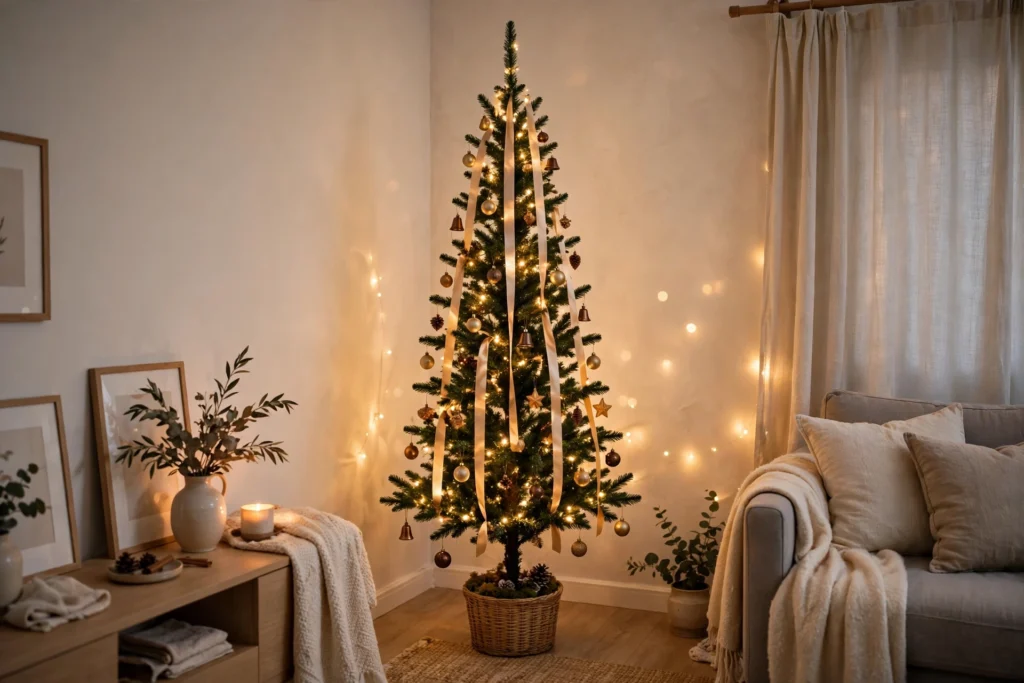
The palette rule matters more on a slim tree than a full one: two colors plus one metal is the maximum, because three colors on a narrow tree read as busy. Christmas tree decorations for small spaces should also mind the skirt: a slim tree needs a small tree skirt or a collar, not a full-size skirt that swallows the base — see our guide to Christmas tree skirts for the right size.
What Is the Best Christmas Tree Topper?
The best Christmas tree topper is a star for a classic tree, an angel for a traditional family tree, and a large bow for a modern or slim tree. Match the topper’s metal to the tree’s palette — gold star on red and gold, silver on frosted. Keep it light so the top branch does not bend.
The topper is the one piece everyone looks at first, so it should be the best piece on the tree, not an afterthought from the discount bin. A topper costs $15–$40 for a good one, and the difference shows: a well-made star holds its shape and catches the light, while a flimsy one sags by Christmas morning. Check the weight before buying — if the topper feels heavy in your hand, it will bend the top branch. A topper that tilts after a week is the most common complaint in Christmas tree decorations, and it is always a weight problem, never a tree problem.
Fit the topper last, once the tree is fully decorated, and secure it to the top branch with a twist tie or a small piece of floral wire rather than just balancing it on the tip. The best Christmas tree decorations finish with a topper that matches the palette, the metal and the scale of the tree beneath it.

How Much Do Christmas Tree Decorations Cost?
Christmas tree decorations cost roughly $75–$200 for a full tree, with a shatterproof bauble set at $20–$60, wired ribbon at $10–$25 and a topper at $15–$40. Buying one good set beats three cheap ones. Store everything in a divided box so the set lasts for years.
The full-tree budget breaks down simply: lights $20–$40, baubles $20–$60, ribbon $10–$25, topper $15–$40, and a storage box $15–$30. A first tree costs the most, because you buy everything at once; year two costs almost nothing, because the set is already in the box. That is the real economics of Christmas tree decorations — a $150 set used for five years costs $30 a year, while a $50 set that breaks and tangles costs $50 every single year.
| Item | Rough cost (planning estimate, not a quote) |
|---|---|
| LED string lights (700 for 7 ft) | $20–$40 |
| Shatterproof bauble set | $20–$60 |
| Wired ribbon (1–2 rolls) | $10–$25 |
| Tree topper | $15–$40 |
| Ornament storage box | $15–$30 |
| Full tree | $75–$200 |
Store the set in the divided box with tissue between the baubles, and the best Christmas tree decorations you buy this year will still be the best ones on the tree in five years.
Frequently Asked Questions
How many lights do you need on a Christmas tree?
About 100 lights per foot of height — a 7-foot tree takes roughly 700 lights. Hang them deep near the trunk, working inside out, so the tree glows from within. Christmas tree decorations with lights buried deep look professional; lights hung only on the tips look strung.
Should you put ribbon or ornaments on first?
Ribbon first, then ornaments. The order is fluff, lights, ribbon, large baubles, medium ornaments, small ornaments, topper last. Ribbon tucked deep first gives the ornaments something to sit against; ornaments hung first get buried by ribbon added later.
Can you decorate a real tree the same way as an artificial one?
Yes, with lighter ornaments. A real tree’s branches bend under heavy glass, so use shatterproof baubles on a real tree and keep the heavy pieces near the trunk. The layering order, palette and ribbon rules are exactly the same for both.
What is the best color scheme for Christmas tree decorations?
Classic red and gold is the easiest scheme to get right and suits most rooms. Frosted white and silver suits cool modern rooms, and woodland pinecone suits rustic homes. The best Christmas tree decorations scheme is the one with two to three colors plus one metal, repeated in every layer.
How do you store Christmas tree decorations?
Store baubles in a divided ornament box with tissue between them, wrap the ribbon around a cardboard tube, and coil the lights around your elbow to avoid tangles. A $15–$30 divided box keeps a $150 set safe for years.
When should you take Christmas tree decorations down?
Most families take the tree down between New Year’s Day and Epiphany on January 6th. A real tree should come down when the needles drop at a touch — a dry tree is a fire risk — while an artificial tree can stay up as long as you like.
Final Thought
A tree that looks professional is not a tree that cost the most — it is a tree with a plan. One palette, five steps in the right order, large baubles deep and small ones on the tips, and a topper that matches the metal. The best Christmas tree decorations are the ones you buy once, store well, and bring out next year already knowing exactly where each piece goes.