Signs of Voles in Yard: 5 Clues, and How to Tell Them From Moles
TL;DR
The signs of voles in yard are surface runways — narrow 1 to 2 inch paths of clipped grass — plus small round holes about 1 to 1.5 inches wide, gnaw marks on bark and roots, clipped stems and eaten bulbs, and small dark droppings along the paths. Voles are most active at dawn and dusk and stay active all winter under snow, so spring often reveals the damage. Two or more fresh signs together mean voles are living in your yard, not just passing through.
The signs of voles in yard are easy to mistake for something else, because voles work at ground level and mostly out of sight. They are small, mouse-like rodents that eat grass, roots, bulbs, and bark, and they travel along the same hidden paths day after day until those paths become visible. Most homeowners only notice them in spring, when the snow melts and reveals a lawn full of winding trails and chewed plants. Learning to read the signs earlier changes the outcome: you can protect trees and bulbs before winter, instead of discovering the damage months after it happened.
What Are the Signs of Voles in Yard?
The most reliable signs are surface runways, small round holes, gnaw marks on bark and roots, clipped stems and damaged bulbs, and small dark droppings. No single clue proves voles are present, but two or more together — especially fresh ones — mean voles are actively using your yard.
That last point matters. A single hole in a lawn could be made by almost anything. A hole next to a worn runway, with fresh gnaw marks on a nearby shrub and droppings along the path, tells a different story: voles are living there now. The sections below break down each clue, what it looks like, and how to judge whether it is fresh.
1. Surface runways in the grass
Surface runways are the single most recognizable vole sign. They look like narrow, winding paths about 1 to 2 inches wide, cut through the grass at ground level, where the grass is clipped short and the soil is slightly worn. Runways connect feeding areas to shelter — a woodpile, a dense shrub, a compost heap — and voles use the same routes daily, which is why the paths become visible.
Fresh runways show clipped green grass and clean, defined edges. Old or abandoned runways fill in with new growth and fade within a few weeks. After snow melts in spring, runways often appear suddenly across the whole lawn, sometimes with the grass chewed down to the soil — that is winter vole activity revealed all at once, not a new infestation. Look for runways along foundations, fences, and the edges of garden beds, where voles feel protected from hawks and owls.
2. Small round holes
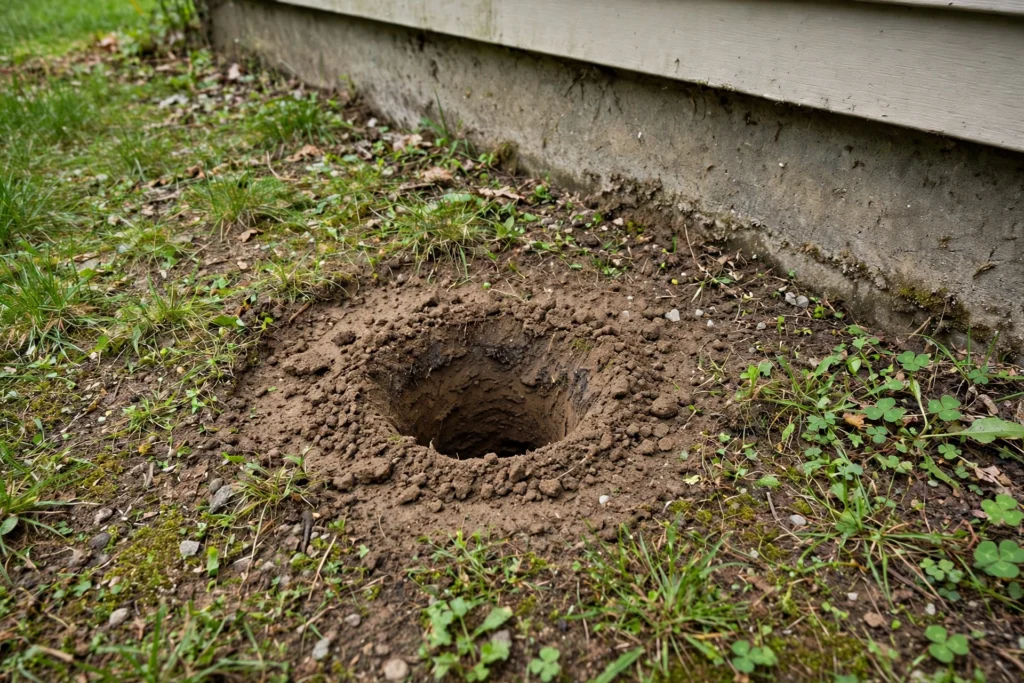
Vole holes are small, round, and about 1 to 1.5 inches wide, with no mound of soil around the entrance. You will find them at the ends of runways, near foundations, under dense groundcover, and at the base of shrubs and trees.
The lack of a soil mound is the key detail. Moles push up large mounds and raised ridges; voles dig small, clean holes and leave almost no excavated soil behind. A fresh hole has a clean opening and disturbed soil at the rim, sometimes with droppings nearby. A hole choked with leaves and cobwebs is more likely abandoned. Never reach into a hole to check — use a flashlight from outside, and keep children and pets away while you inspect.
3. Gnaw marks on bark and roots
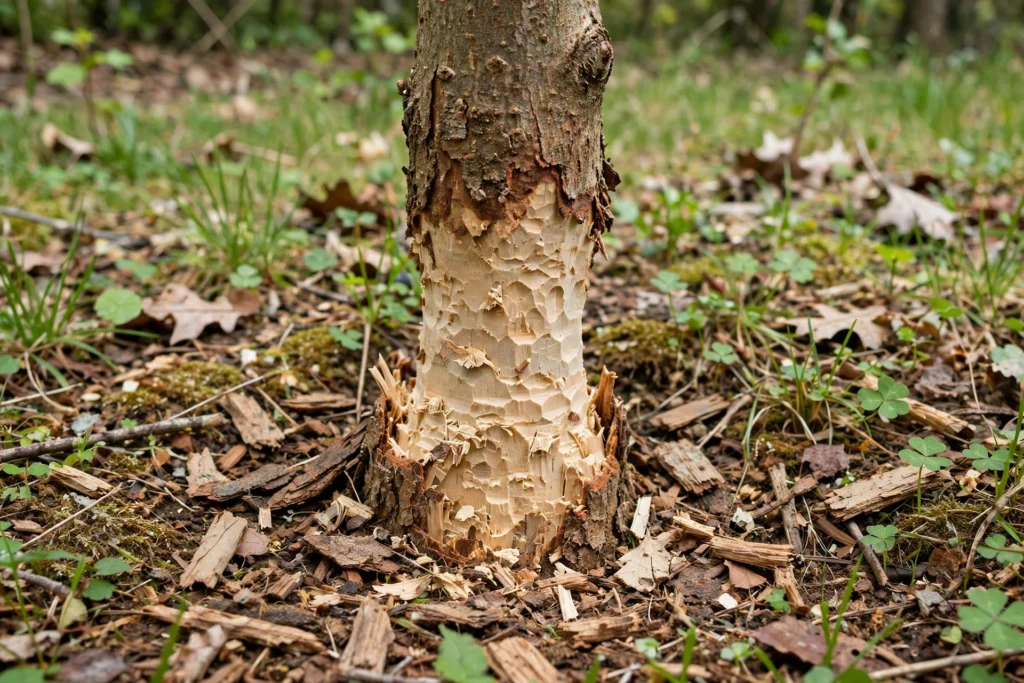
Voles gnaw the bark off young trees, shrubs, and vines, usually at or just below ground level, and they chew through roots and bulbs underground. Fresh gnaw marks show light-colored, exposed wood with small, irregular tooth marks about 1 to 2 millimeters wide.
This is the most expensive vole sign. A tree girdled all the way around — bark chewed off in a complete ring — cannot move water and nutrients past the damage and will often die, even if the top still looks healthy for a while. Check the base of young fruit trees, ornamental shrubs, and roses in late fall and again in early spring, when winter feeding under snow does the most damage. Gnawing on roots shows up differently: a plant that was healthy suddenly wilts, leans, or pulls out of the ground with almost no resistance, because its roots have been eaten away below the surface.
4. Clipped stems and damaged bulbs
Voles clip grass stems and garden plants at a sharp angle, leaving short, cleanly cut stems along their runways, and they eat bulbs from below, leaving hollowed shells or missing plants that never emerge in spring. Flower beds and vegetable gardens near dense cover are the most common targets.
This damage is often blamed on rabbits or deer, but the scale gives it away: rabbits clip stems higher up and leave larger, rounder droppings, while voles work at ground level along their paths. In a vegetable garden, look for carrots, beets, and potatoes with gnawed sides or hollowed centers, and for tulip and crocus bulbs that vanish entirely — voles prefer these bulbs and will dig them up in fall. A row of seedlings that disappears overnight, cut at the base, is a classic vole pattern.

5. Small dark droppings along runways
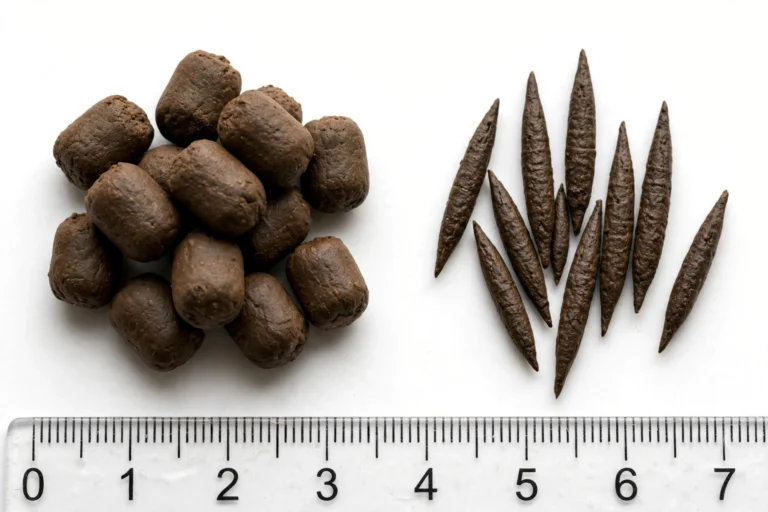
Vole droppings are small, dark, rice-shaped pellets, usually found in clusters along runways and near hole entrances. Fresh droppings look dark and moist; older ones dry out, turn grey, and crumble.
Droppings confirm what the runways suggest, but handle them with the same caution as any rodent droppings: never touch them with bare hands, use gloves and a sealed bag if you need to clear them, and wash your hands after. Droppings alone are the weakest clue on this list, because mice leave similar pellets — it is the combination of droppings plus runways and holes that points to voles specifically.
How Can You Tell How Fresh a Vole Sign Is?
Fresh runways show clipped green grass with clean edges, fresh gnaw marks expose light-colored wood, and fresh droppings are dark and moist. After rain or snowmelt, any crisp, clear sign is recent, because weather softens older marks quickly.
Freshness is what turns a curiosity into a decision. Old signs mean voles passed through at some point; fresh signs mean they are active now, and active voles near young trees and bulbs deserve a response before winter, when snow cover hides their feeding. The simplest freshness test is the grass test: part the grass along a runway and look at the cut ends. Bright green, freshly cut ends mean the runway was used in the last day or two. Brown, dried ends mean it has been quiet for a while.
| Sign | Fresh | Old |
|---|---|---|
| Runway | Clipped green grass, clean defined edges | Filling in with new growth, edges fading |
| Hole | Clean opening, disturbed soil at rim | Choked with leaves, webs, and debris |
| Gnaw marks | Light-colored exposed wood | Darkened, weathered wood |
| Droppings | Dark and moist | Grey, dry, crumbling |
| Clipped stems | Bright green cut ends | Brown, dried ends |
How Do You Tell Voles From Moles and Mice?
Voles make surface runways and small clean holes with no soil mound and eat plants, roots, and bark. Moles make raised tunnels and large soil mounds and eat grubs and worms, rarely touching plants. Mice leave droppings and gnaw marks too, but they mostly stay near buildings and enter homes, while voles stay outdoors in grass and garden cover.
Confusing voles with moles is the most common misidentification, and it matters, because the fixes are different. Mole control targets grubs and tunnels; vole control targets cover, runways, and plant protection. Use this table before choosing a response.
| Feature | Voles | Moles | Mice |
|---|---|---|---|
| Tunnels | Surface runways in grass | Raised ridges + large mounds | Rarely tunnel outdoors |
| Holes | Small, round, 1–1.5 in, no mound | Large mounds of pushed-up soil | Small holes near buildings |
| Diet | Grass, roots, bulbs, bark | Grubs, earthworms | Seeds, stored food, some plants |
| Damage | Chewed bark, eaten bulbs, clipped stems | Raised lawn ridges, mounds | Gnawing indoors, food contamination |
| Where they live | Grass, gardens, groundcover | Lawns, under soil | Near buildings, inside homes |
If you see raised ridges and volcano-shaped mounds, you have moles, not voles. If the damage is inside the house — chewed food packaging, droppings in cupboards — it is mice. Voles are the outdoor, plant-eating ones with the worn paths through the grass.
When Are Voles Most Active?
Voles are active year-round, with peaks at dawn and dusk, and they stay busy all winter under snow cover. Spring is when the damage becomes visible, because melting snow exposes the runways and chewed bark from months of hidden winter feeding.
Winter is the dangerous season for trees, not summer. Under snow, voles are protected from predators and cold, and they feed on bark and roots for months at a time, often girdling young trees completely before anyone sees a sign. That is why fall protection matters more than spring reaction: guards on young trees and cleared groundcover in October prevent damage that only shows up in March.
What Should You Do If You Find Vole Signs?
Remove the cover voles hide in first: mow regularly, clear dense groundcover near the house, move woodpiles and mulch away from foundations, and clean up fallen fruit. Then protect what they eat — wrap young tree trunks with hardware-cloth guards buried 2 to 3 inches deep — and place snap traps perpendicular to active runways if trapping is needed.
Start with habitat, because trapping alone never works while the yard still offers food and shelter. Short grass removes cover and exposes voles to predators, which is the single most effective change most homeowners can make. Keep a clear gap of a foot or more between dense plants and the house wall, and avoid thick mulch piled against tree trunks — mulch volcanoes are vole shelter.
For trees, a guard of quarter-inch hardware cloth, standing a few inches above the expected snow line and buried 2 to 3 inches into the soil, stops bark gnawing where it matters most. For bulbs, planting in wire mesh baskets keeps them out of reach. Snap traps, set perpendicular to a runway with the trigger in the path, catch voles effectively; check them daily. Avoid poison baits outdoors — they risk secondary poisoning for pets, owls, and other wildlife that eat poisoned voles.

When Should You Call a Professional?
Call a professional if vole damage is widespread across the lawn, if young trees or an orchard are being girdled, if voles are entering the home, or if trapping and habitat work have not reduced the signs after a few weeks. A licensed pest professional can assess the population, place traps at scale, and advise on habitat changes for your specific yard.
Widespread damage usually means a large population, and a large population means the yard is offering something — dense cover, abundant food, or both — that a professional can help identify. The same applies when voles keep returning to the same beds despite cleared cover: there may be a food source, like a compost heap or fallen fruit, that is easy to miss.
FAQ
Are voles dangerous to people or pets?
Voles are not aggressive and rarely carry diseases that affect people, but their droppings should still be handled with gloves, like any rodent droppings. The real risk is to plants and lawns, not to people. Keep pets from eating trapped or poisoned voles, and avoid poison baits for that reason.
Do voles come inside the house?
Rarely. Voles prefer grass, gardens, and groundcover and almost always stay outdoors. If you find small rodents inside, they are far more likely to be house mice. Voles may shelter in a garage or shed in cold weather, but they do not nest in homes the way mice do.
Will voles leave on their own?
No, not while the yard offers food and cover. Voles breed rapidly — several litters a year — so a small population becomes a large one quickly if nothing changes. Removing cover, mowing, and protecting trees are what make them move on, not waiting.
How do I protect my bulbs from voles?
Plant bulbs in wire mesh baskets or wrap the planting area with quarter-inch hardware cloth, and avoid planting tulips and crocuses — vole favorites — in unprotected beds. Daffodils are naturally resistant, because their bulbs taste bad to voles, so they make a safer choice for exposed beds.
Do cats help with voles?
Cats catch some voles, but they rarely control a population on their own, and they cannot protect tree bark in winter. Habitat work — short grass, cleared cover, tree guards — does far more than a cat, and it works even when the cat is asleep indoors.
What is the first thing to do if I see vole runways?
Mow the area short, clear dense groundcover around the runways, and check the base of nearby young trees for gnaw marks. If trees are unprotected, fit hardware-cloth guards before winter. Then watch the runways for a few days — fresh clipping means the voles are still active and trapping is worth adding.