Squirrel Poop vs Rat Poop: Size, Shape, and Where You Found It
TL;DR
Squirrel poop vs rat poop comes down to ends and location: squirrel pellets are 3/8-inch barrels with rounded ends, while rat pellets are 1/2- to 3/4-inch spindles with pointed ends. Squirrels scatter a few pellets in the attic; rats leave dozens packed along runways. Never dry-sweep droppings — wet-clean with gloves and a mask.
You found droppings in the attic, and now the whole plan depends on one question: squirrel or rat? The answer changes everything — the trap, the entry point, and whether you are dealing with a daytime visitor or a nighttime colony. Getting the squirrel poop vs rat poop question right in the first five minutes saves you from buying the wrong traps and sealing the wrong holes.
The short version is that the tell is ends plus location, not size alone, because the sizes overlap more than most guides admit. A single pellet rarely settles anything. What does settle it is a three-check test — length, ends, and where you found the pellets — plus one quantity test. If you want the fuller attic picture first, our squirrel droppings guide covers squirrel activity across the whole attic.
Squirrel Poop vs Rat Poop: What Is the Fastest Tell?
Look at the ends first: squirrel pellets have rounded ends, while rat pellets have pointed ends. That single check beats size alone, because the two overlap in length. Then check where you found them: scattered pellets near a chewed attic entry point to squirrels, while clumps along a wall runway point to rats.
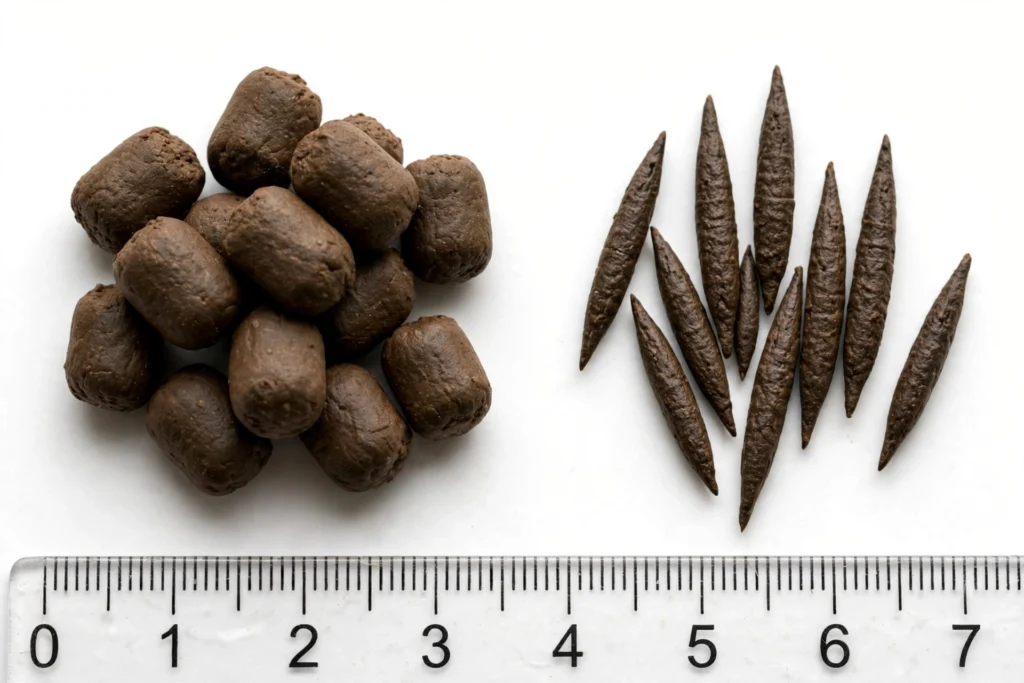
This is the fastest tell because it uses the one feature that does not overlap. Squirrel pellets are fat, oval barrels with both ends rounded, shaped a little like a coffee bean. Rat pellets taper to a point — roof rat pellets are slim spindles with pointed, often curved ends, and Norway rat pellets are thicker capsules with blunt ends. Location is the second half of the fast tell: squirrels scatter pellets across the attic floor near a chewed entry, while rats leave clumps along fixed runways, often in a low, hidden corner. In the squirrel poop vs rat poop test, check the ends first, then the location — when both point the same way, you have your answer. That two-step check is the whole squirrel poop vs rat poop method.
| Check | Squirrel | Roof rat | Norway rat |
|---|---|---|---|
| Length | About 3/8 inch | About 1/2 inch | About 3/4 inch |
| Ends | Rounded | Pointed, curved | Blunt |
| Shape | Fat barrel | Slim spindle | Thick capsule |
| Where found | Scattered in attic | Clumps along runways | Clumps, low level |
| Active | Daytime | Nighttime | Nighttime |
How Big Is Squirrel Poop Compared to Rat Poop?
Squirrel pellets run about 3/8 inch long, roof rat pellets about 1/2 inch, and Norway rat pellets about 3/4 inch. The sizes overlap enough that a single pellet cannot settle the question, so always pair length with shape and location. A pellet under 1/4 inch with pointed ends is more likely mouse than either squirrel or rat.
The numbers look clean on paper — 3/8, 1/2, 3/4 — but real droppings vary with the animal’s age, diet, and drying time. A young roof rat can leave pellets close to squirrel size, and a large squirrel can leave pellets approaching 1/2 inch. In the squirrel poop vs rat poop comparison, measure a dozen pellets, not one, and look at the average: most around 3/8 inch, fat and rounded, means squirrel. That average settles the squirrel poop vs rat poop size question. For scale, a squirrel pellet is roughly the length of a coffee bean; a roof rat pellet is closer to a grain of wild rice, slimmer, with a visible taper; a Norway rat pellet is the biggest, about the length of a small olive pit. Dried pellets shrink and darken, so the rounded ends matter more than the measurement on old deposits.
What Shape Gives It Away?
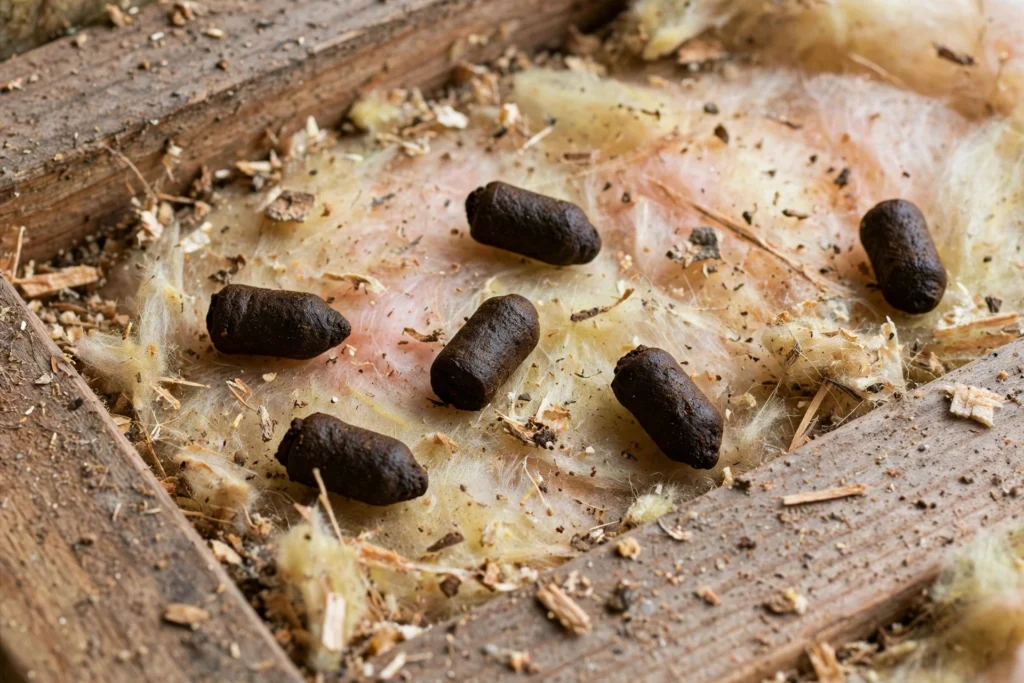
Shape is the most reliable clue: squirrel pellets are fat ovals or barrels with rounded ends, like a coffee bean, while roof rat pellets are slim spindles with pointed, often curved ends. Norway rat pellets are thicker capsules with blunt ends. If the ends are rounded, think squirrel; if they taper to points, think rat.
The reason shape wins is that it reflects the animal, not the meal. A squirrel’s digestive tract produces a short, fat pellet with rounded ends almost every time, whatever it ate that day. A roof rat’s longer, narrower gut produces a spindle that tapers at the ends and often carries a slight curve. Diet can change color, but rarely shape. Look closely at a small group of pellets rather than one: squirrel pellets keep the same fat barrel shape with both ends rounded and often look slightly glossy when fresh, while roof rat pellets are more uniform in their taper and often lie in a rough line along the runway. Norway rat pellets are the bluntest — thick capsules with squared-off ends. Shape is the heart of the squirrel poop vs rat poop identification. Ends first, shape second: that order never fails in a squirrel poop vs rat poop check.
Where You Found It: What Does Location Say?
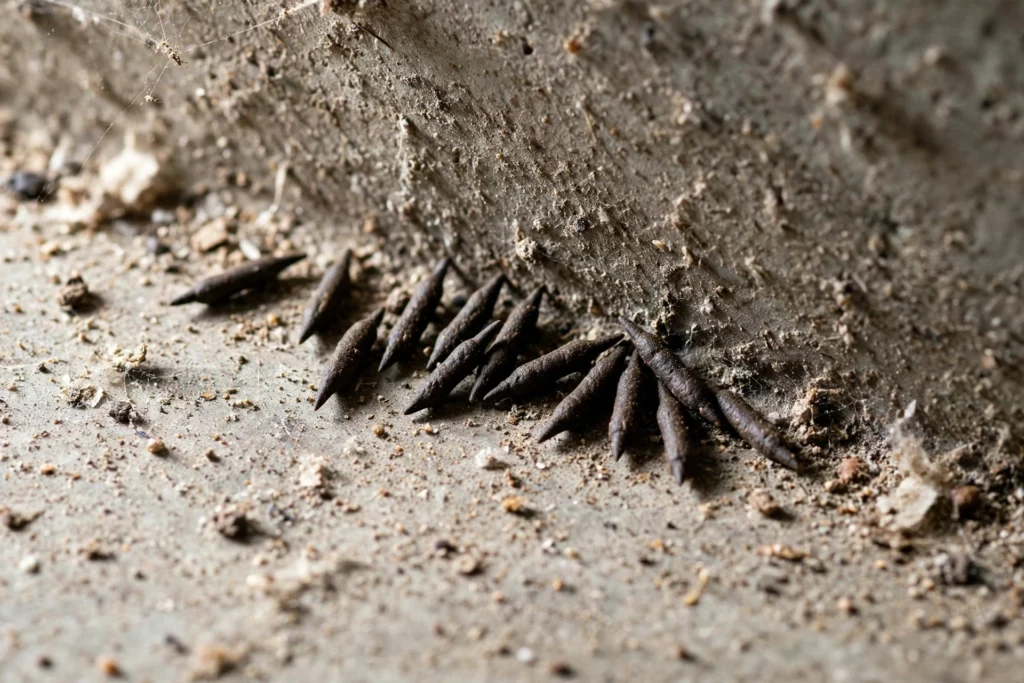
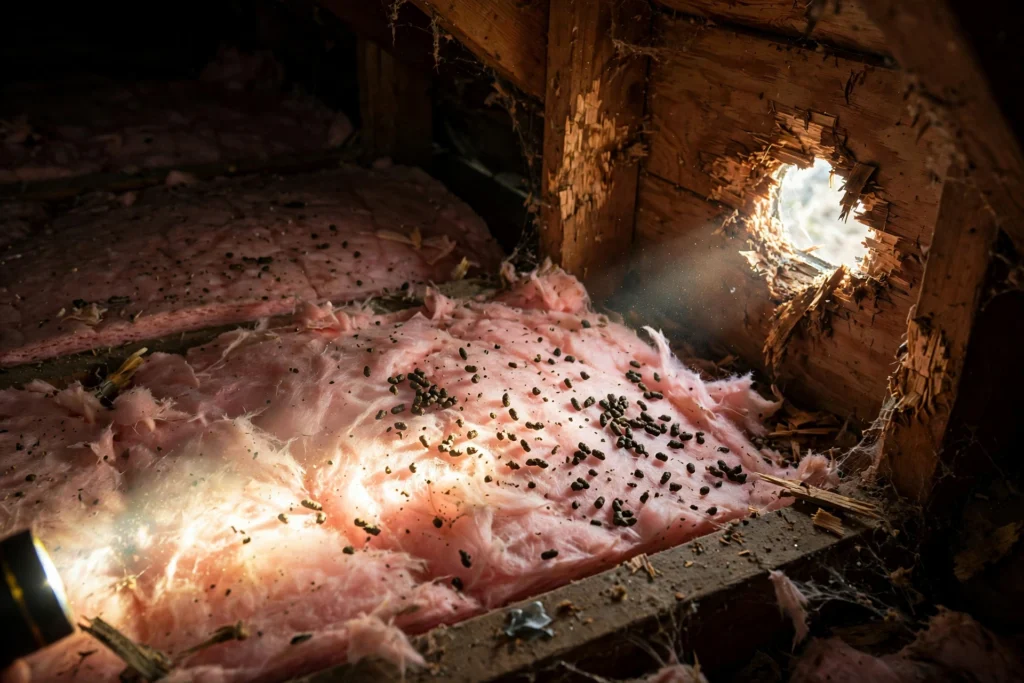
Location often settles what size cannot: squirrels leave scattered pellets in attics near a chewed entry hole, and you may hear daytime scurrying above you. Rats leave clumps along wall runways, in basements, and inside wall voids, and they are active at night. Pellets in a low, hidden corner almost always mean rats.
Start with height. Squirrels enter high — a chewed gap where the roofline meets the wall — and they live in the attic, so their pellets are up high, scattered across insulation near the entry. Rats enter low or travel low: gaps around foundation pipes, a broken basement window, a gap under a garage door. Pellets at ground level, in a basement, or inside a kitchen cabinet point strongly to rats, and that height check is one of the quickest parts of the squirrel poop vs rat poop test. Then look at the pattern: squirrel pellets are scattered across the attic floor, while rat pellets are concentrated — dozens in one hidden corner, a line along a wall — because rats use latrine areas and travel the same runway every night. Height plus pattern: that pair settles the squirrel poop vs rat poop location question.
How Many Pellets Mean Rats?
Quantity is a strong tell: one rat leaves 30 to 50 droppings a day, so dozens packed into one hidden corner mean rats. Squirrels leave far fewer pellets, spread out across an attic rather than piled in one spot. A handful of scattered pellets is a squirrel pattern; a dense pile is a rat pattern.
Do the math on a pile you find. A single roof rat produces 30 to 50 pellets every day, so a hundred pellets in one corner is two or three days of one rat. A squirrel leaves far fewer pellets and spreads them across the attic, so a dense mound under a storage box is nearly conclusive: no squirrel makes a pile like that, and the squirrel poop vs rat poop question answers itself. This quantity test also judges how big the problem is: a few scattered pellets with one chewed entry hole is usually one squirrel, fixed with a single entry repair, while dozens of pellets along every wall is a rat population. Our guide on how to get rid of roof rats walks through that plan step by step. Count first, then trap: that is the squirrel poop vs rat poop quantity rule.
PRO TIP
Photograph the pile before you touch it. The size, shape, and location in one photo tell a professional more in ten seconds than a description ever will.
Could It Be Mouse Poop Instead?
Mouse droppings are much smaller, about 1/8 to 1/4 inch, shaped like grains of rice with pointed ends at both sides. They turn up in kitchen drawers, pantries, and along counter edges, often in large numbers. If the pellets are tiny and everywhere in the kitchen, suspect mice before you suspect squirrels or rats.
Mice are the most common confusion in the squirrel poop vs rat poop comparison, because a mouse pellet looks like a miniature rat pellet, just half the size. The difference is scale. A mouse pellet is about 1/8 to 1/4 inch long — roughly the size of a grain of rice — while even the smallest roof rat pellet is close to 1/2 inch. Where you find them also points to mice: they live close to food, so their droppings show up in kitchens and pantries, often fifty in a single drawer. Squirrel pellets almost never show up in a kitchen drawer, because squirrels stay in the attic. If you are still unsure, the what is the difference between a mouse and a rat comparison covers body size, tail, tracks, and droppings. Do not assume a small pellet is harmless: mouse droppings carry the same kind of germs as rat droppings, and the cleanup rules in the next section apply to mice exactly as they apply to rats.
| Dropping | Length | Ends | Typical location |
|---|---|---|---|
| Squirrel | About 3/8 inch | Rounded | Scattered in attic |
| Roof rat | About 1/2 inch | Pointed, curved | Clumps along runways |
| Norway rat | About 3/4 inch | Blunt | Clumps, low level |
| Mouse | 1/8–1/4 inch | Pointed both ends | Kitchen drawers, pantry |
How Do You Clean Up Droppings Safely?
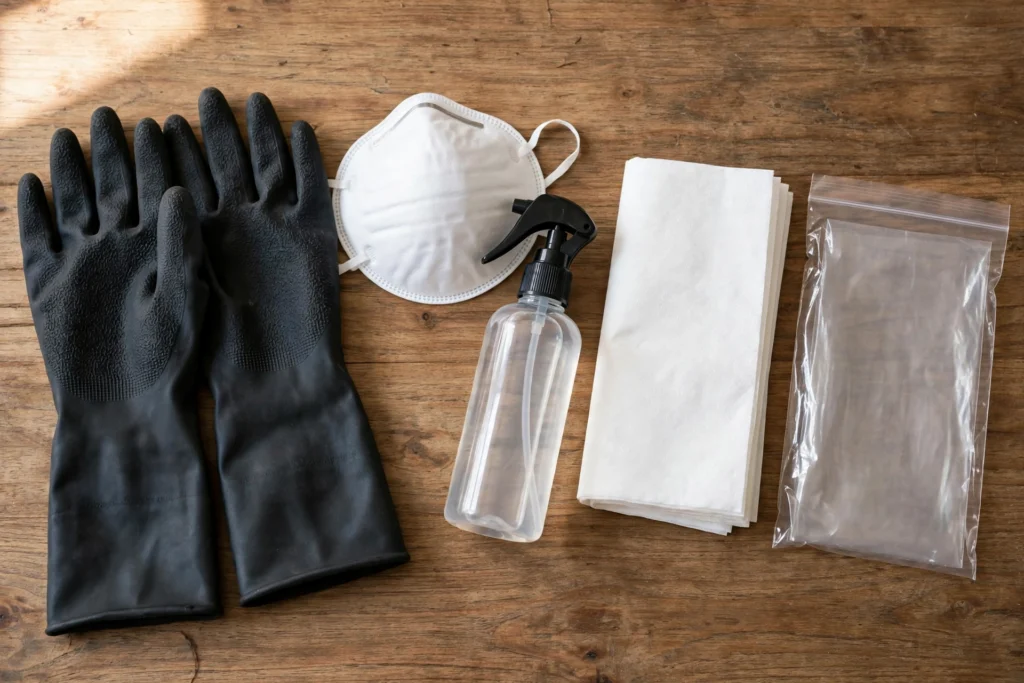
Never dry-sweep or vacuum droppings, because that can throw germs into the air. Put on gloves and an N95 mask, spray the area with disinfectant until damp, then wipe it up with paper towels and seal everything in a bag. The CDC warns that dry sweeping raises the risk of breathing in hantavirus from rodent droppings.
The CDC guidance is clear: do not sweep or vacuum rodent droppings, urine, or nesting material while they are dry. Dry sweeping can stir up dust that carries hantavirus and leptospirosis germs into the air, where they can be breathed in. Rat droppings carry the higher risk; squirrel droppings carry lower risk but need the same care. The safe routine takes five steps: open windows and air the area for thirty minutes; put on heavy-duty gloves and an N95 mask; spray the droppings with disinfectant until damp; wipe them up with paper towels and seal everything in a plastic bag; wash your hands and mop the area. A cleanup kit runs about $15–$25, a planning estimate, not a quote — cheap insurance after any squirrel poop vs rat poop find. Same routine, whatever the squirrel poop vs rat poop answer.
When Should You Call a Pro?
Call a professional when droppings keep appearing after cleanup, when you find large piles in several places, or when you cannot find the entry point. Pros can identify the animal, seal the entry, and set traps safely. If anyone in the home has breathing trouble after exposure, call a doctor first and a pest professional second.
Costs are modest for an inspection. A professional rodent inspection typically runs $100–$300, a planning estimate, not a quote, depending on home size. Trapping and exclusion cost more. For a single squirrel, the fix is often one visit; for rats, expect a multi-visit plan. A pro can confirm the animal from the droppings, tracks, and entry damage in one visit — the practical payoff of the squirrel poop vs rat poop check. If droppings are concentrated low, the comparison with signs of voles in yard can help rule out outdoor look-alikes, and if you are in the Pflugerville area, the team at rodentcontrolpflugerville.com can inspect, identify the animal, and seal the entry. Bring the pile photo for the technician.
PRO TIP
If droppings return within a week of a careful cleanup, the entry is still open. Stop cleaning the same corner and start hunting the hole instead — a returning pile is a map to the gap the animal is using.
Frequently Asked Questions
Check the ends: squirrel pellets are fat barrels with rounded ends, while rat pellets are slim spindles with pointed ends. Then check the location: scattered pellets in the attic mean squirrel, clumps along a wall runway mean rat. That is the whole squirrel poop vs rat poop test.
Less dangerous than rat droppings, but still handle it with care. Squirrel droppings can carry bacteria and parasites, so always wear gloves and a mask, wet-clean instead of dry-sweeping, and wash your hands after.
Roof rat pellets are about 1/2 inch long and slim with pointed ends; Norway rat pellets are about 3/4 inch long, thicker, and blunt-ended. Both are bigger than mouse droppings, only 1/8 to 1/4 inch long.
Yes, squirrels leave scattered pellets across the attic floor near their nest and the chewed entry hole. They leave far fewer pellets than rats, and the pellets are spread out rather than piled in one corner.
Yes. Rat droppings can carry hantavirus and leptospirosis, which is why the CDC warns against dry-sweeping or vacuuming them. Always wet-clean with gloves and an N95 mask, and call a doctor if anyone develops breathing trouble. That warning applies whatever the squirrel poop vs rat poop answer was.
Photograph the pile first, then clean it safely with gloves, a mask, and disinfectant — never dry-sweep. Then find the entry point and seal it, or call a professional if droppings return within a week. That is the right ending to any squirrel poop vs rat poop find.
Final Thought
The pellets in the attic are a message, and they are easier to read than they look: rounded ends and a scattered pattern mean squirrel, pointed ends and a packed pile mean rat, and tiny rice-grain pellets in the kitchen mean mouse. Check the ends, check the location, count the pile, and you will know which animal you are dealing with before you buy a single trap. That is the whole squirrel poop vs rat poop method. Clean it up safely, seal the entry, and the droppings will stop appearing — and if they come back within a week, the hole is still open, and that is the time to call a pro.