Common House Spiders in Texas: Which Ones Are Harmless?
TL;DR
Most of the common house spiders in texas are harmless, and the two that matter — the black widow and the brown recluse — are easy to recognise once you know what to look for. This guide identifies each spider by size, eyes, web and hiding place, and shows how to keep spiders out without panic.

Among the common house spiders in texas, the brown spider on your kitchen floor causes the most worry. If you have ever photographed it and wondered whether it was a recluse, you are not alone — that is the most-asked spider question in Texas. Like scorpions in Texas, spiders share our homes because Texas heat, clutter and insects give them food and shelter.
The good news is simple: most spiders in a Texas home are harmless helpers that eat flies and other pests. The common house spiders in texas include the cobweb spider in the ceiling corner, the fuzzy jumping spider on the windowsill and the big wolf spider that sprints across the floor at night. None of them is medically significant.
Which Common House Spiders in Texas Are Actually Dangerous?
Only two of the common house spiders in texas are medically significant: the black widow and the brown recluse. Every other spider you are likely to meet indoors — house spiders, wolf spiders, jumping spiders, orb weavers, cellar spiders and tarantulas — is harmless to people, even when it looks large or frightening at first glance.
Texas has only two medically significant spiders, and both are shy animals that bite only when trapped against skin — in clothing, bedding or a shoe. A bite from either deserves prompt medical attention, but neither spider roams the house looking for people. The common house spiders in texas that you see most often are the harmless ones.
| Spider | Size | Eyes | Web | Danger |
|---|---|---|---|---|
| Black widow | About 1/2 inch | 8 | Messy low tangle | Medically significant |
| Brown recluse | 1/4 to 1/2 inch | 6 in 3 pairs | None | Medically significant |
| American house spider | About 1/4 inch | 8 | Messy cobweb | Harmless |
| Wolf spider | Up to 1 inch | 8 | None, hunts on foot | Harmless |
| Jumping spider | About 1/2 inch | 8, two very large | None | Harmless |
| Cellar spider | Tiny body, very long legs | 8 | Loose tangle | Harmless |
Do not identify a spider by colour alone. Brown is the most common spider colour in Texas and tells you almost nothing. The common house spiders in texas are best sorted by eyes, legs, web and hiding place together, not by any single feature.
How Do You Tell a Wolf Spider From a Brown Recluse?
Count the eyes first. A brown recluse has six eyes in three pairs and plain tan legs with no bands or spines, while a wolf spider has eight eyes and often shows stripes or bands on its legs and body. A wolf spider also hunts on foot and is usually larger and hairier than a recluse.
This is the mix-up that fills Texas pest-control inboxes. A wolf spider is big, brown, hairy and fast, and it appears suddenly on the floor at night — exactly when a recluse is the first thing people think of. But the common house spiders in texas most often photographed as a suspected recluse turn out to be wolf spiders.
For the common house spiders in texas, eyes are the strongest clue: six eyes in three pairs means recluse, and eight eyes means it is not a recluse. Legs are the second clue: a recluse has plain, unbanded legs with no spines, while its lookalikes usually show bands, stripes or spines. Wolf spiders are larger and hairier; recluses are smaller and flatter.
| Feature | Brown recluse | Wolf spider | Southern house spider |
|---|---|---|---|
| Eyes | 6 in 3 pairs | 8 | 8 |
| Legs | Plain, no bands or spines | Banded or striped, spiny | Banded, hairy |
| Web | None | None, hunts on foot | Crevice web |
| Where you see it | Closets, boxes, shoes | Open floor at night | Cracks and window frames |
How Do You Identify a Black Widow?
A black widow is glossy black with a round abdomen and a red or orange hourglass marking underneath it. Look low: widows build messy, tangled webs close to the ground in woodpiles, meter boxes and garages, and they hang upside down in the web. A dull brown spider in a neat round web is not a widow.
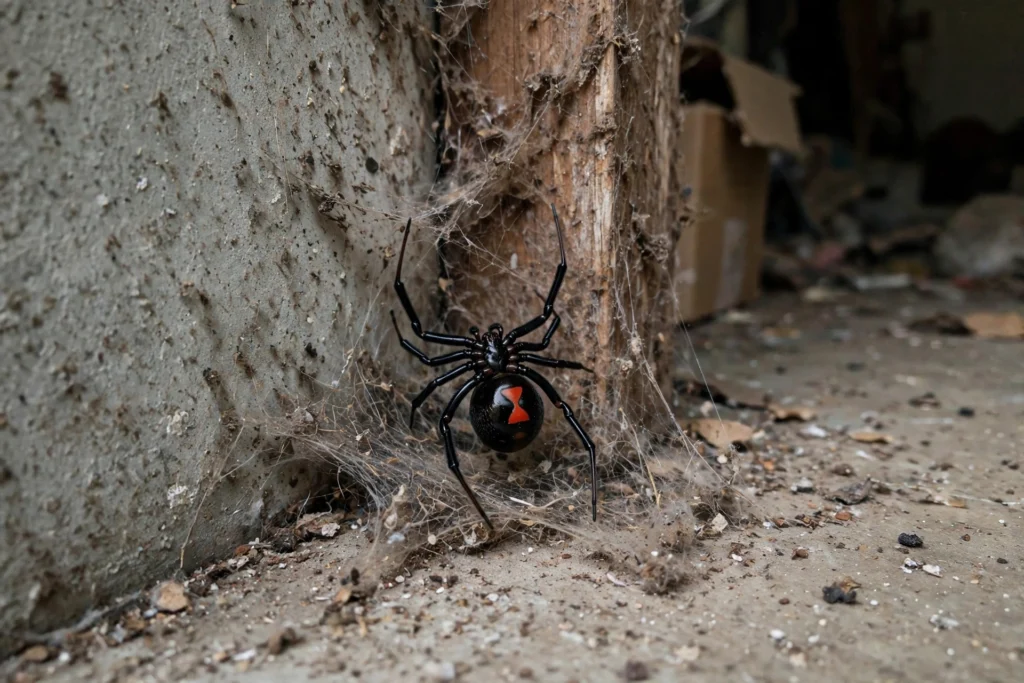
Widows are homebodies. They build their webs low — in a woodpile, a meter box, a garage corner or behind stored boxes — and they stay in the web, hanging upside down, waiting for insects. You will rarely see one of the common house spiders in texas out in the open, because a widow has no reason to leave its web.
The hourglass sits underneath the round abdomen, so you see it best when the spider hangs upside down in its web. On some widows it is broken into two red or orange spots. A glossy black spider in a neat, round, vertical web is not a widow — that web belongs to an orb weaver. Remove a widow web with a long-handled tool, wearing gloves, and clear the clutter around it.
What Does a Brown Recluse Look Like — and Where Does It Hide?
A brown recluse is plain tan with a dark violin-shaped marking on its back and six eyes in three pairs. Its legs have no bands, stripes or spines. It hides in undisturbed places — closets, attics, storage boxes, behind furniture and inside shoes or boots — and it avoids people, biting only when trapped against skin.

The recluse earns its name. It hides in places that stay dark and undisturbed for weeks: closets, attics, storage boxes, behind furniture, and inside shoes or boots that have sat unworn. Among the common house spiders in texas, it is the one found where you store things.
PRO TIP
Shake out shoes, boots and stored clothing before you put them on, and store out-of-season clothes in sealed plastic boxes, not cardboard. A recluse in a shoe bites only because a foot traps it there.
Check the eyes before anything else. A recluse has six eyes arranged in three pairs, while almost every lookalike has eight. The violin marking on its back helps, but it is faint on some spiders and easy to misread in a photo, so never use it as your only clue. Plain tan colour and unbanded legs complete the picture. A spider sitting in a tidy cobweb is not a recluse — recluses do not build webs to catch prey.
What Spider Is in the Corner of My Ceiling?
Usually an American house spider or a cellar spider. The American house spider is about a quarter inch long, mottled tan and brown, and builds a messy cobweb in a corner, often with papery egg sacs nearby. The cellar spider has a tiny body and very long thin legs and hangs upside down in a loose, tangled web.
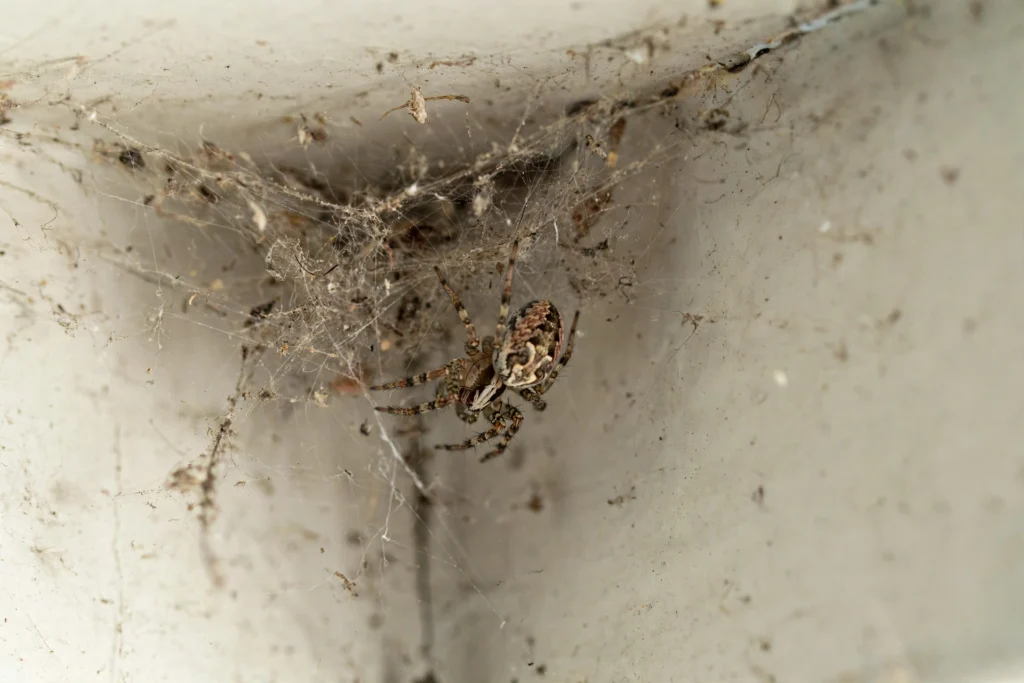
The spider in the ceiling corner is almost always one of two harmless animals, and the web tells you which. The common house spiders in texas that live in corners are the American house spider and the cellar spider, and both catch flies and other small insects for you.
The American house spider is about a quarter inch long, mottled tan and brown, and builds a messy cobweb with no clear pattern. Look nearby for papery, round egg sacs — a female can produce several. The cellar spider is easier to recognise: a tiny, pale body on very long, thin legs, hanging upside down in a loose tangle of silk. Neither is dangerous, and neither leaves its web to chase you — if a web keeps coming back, insects are coming in there too.
Are Jumping Spiders and Orb Weavers Dangerous?
No. Jumping spiders are fuzzy, harmless and useful — they hunt flies and other small insects and do not build webs. Orb weavers build neat round webs outdoors, usually between plants or across a porch, and stay in the web. Both avoid people, and neither is medically significant, so leave them alone or move them outside in a cup.
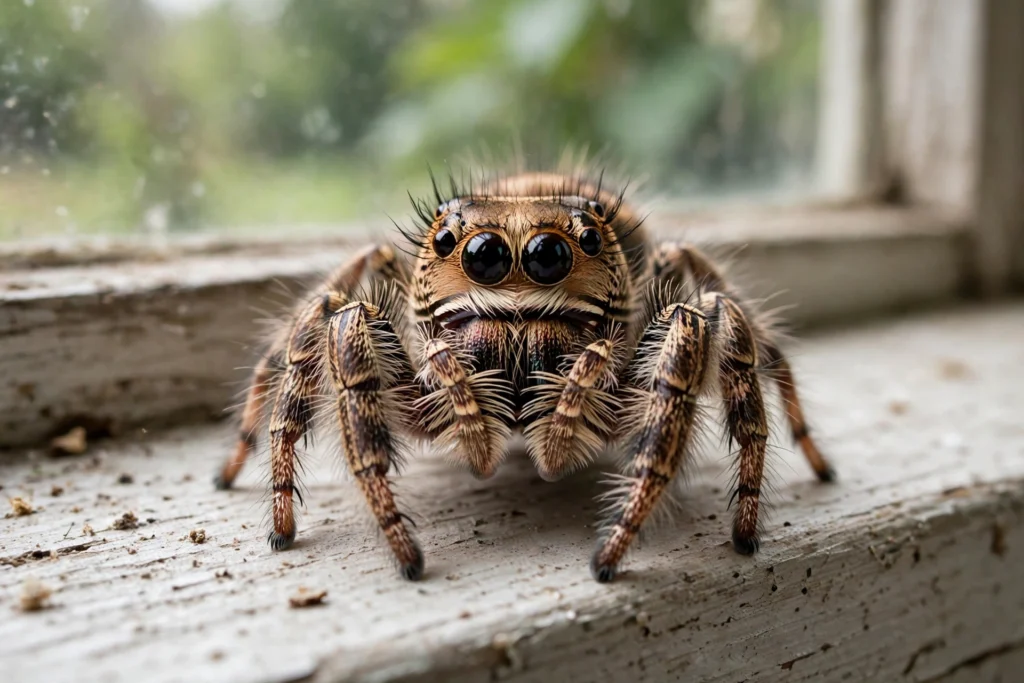
Jumping spiders are the friendliest spiders in the house. They are small, fuzzy and curious, with two very large front eyes, and they turn to watch you when you move. The common house spiders in texas include several jumping spider species, and every one is harmless.
Orb weavers build the classic round web — neat, vertical, with spokes like a wheel — between plants or under an eave, and sit in the middle of it, head down. If one builds across a doorway, move the web with a broom and it will rebuild elsewhere.
Tarantulas deserve a mention because they look alarming and are completely harmless. Texas tarantulas are large, hairy and slow, and live outdoors in burrows. A tarantula indoors is a lost visitor, not an infestation, and the common house spiders in texas list includes it only because people ask about it so often — catch it in a large container and release it outside.
What Should You Do If You Are Bitten?
Stay calm, wash the bite with soap and water, and get prompt medical attention if you think it was a widow or a recluse. Do not cut the bite, suck it or apply a tourniquet, and do not try to catch the spider with your hands. Note the time and your symptoms.
Most spider bites are not spider bites at all — they are insect bites, skin infections or scratches blamed on a spider nobody saw. A real bite from one of the common house spiders in texas that matters, a widow or a recluse, is uncommon, and it usually happens when the spider is trapped against skin.
Wash the bite with soap and water and apply a cool cloth. Mark the edge of any redness with a pen, and write down the time and your symptoms. Do not cut the bite or apply a tourniquet — neither helps.
Get prompt medical attention if you think the spider was a widow or a recluse, or if pain, cramping, nausea or spreading redness develops. Take a photo of the spider from a safe distance if you can — it helps a doctor confirm what bit you.
How Do You Keep Spiders Out of the House?
Seal the gaps, cut the food supply and clear the clutter. Caulk cracks around windows and doors, fit door sweeps, repair torn screens and move firewood and storage boxes away from the house. Vacuum corners and closets regularly, and fix the insect problem first — spiders follow the bugs, so fewer bugs means fewer spiders indoors.
Keeping spiders out is mostly housekeeping, not chemicals. The common house spiders in texas come indoors for the same three reasons every pest does: gaps to enter through, insects to eat, and dark, cluttered places to hide. Take away those three things and most spiders never settle.
- Seal cracks around windows, doors and pipe entries with caulk.
- Fit door sweeps on exterior doors and repair torn window screens.
- Vacuum corners and closets regularly, including webs and egg sacs.
A tube of caulk costs roughly $5–$10, a door sweep roughly $10–$25, and a pack of sticky traps roughly $8–$15. A professional pest-control visit in Texas typically runs roughly $100–$250 for a one-off treatment. All figures here are rough planning estimates, not quotes.
PRO TIP
Work from the outside in — seal the gaps and clear the clutter first, then vacuum the corners. Spraying first and sealing later just leaves new spiders a clean house to move into.
Fix the insect problem first, because spiders follow their food — our guide to how to get rid of German cockroaches covers a common indoor food source. Fewer insects means fewer spiders, and the common house spiders in texas that remain are harmless ones you can leave alone or move outside in a cup.
Frequently Asked Questions
How many dangerous spider species live in Texas?
Two medically significant species live in Texas: the black widow and the brown recluse. The common house spiders in texas include many other species — house spiders, wolf spiders, jumping spiders, orb weavers, cellar spiders and tarantulas — but none of those is medically significant.
Are tarantulas in Texas dangerous?
No. Texas tarantulas look alarming because they are large and hairy, but they are not medically significant and not aggressive. They live outdoors in burrows and only wander indoors by accident. Catch one in a large container and release it outside.
Do spiders come inside in the fall?
Yes — indoor sightings rise in the fall, when cooling nights and mating season push spiders to wander, and the common house spiders in texas are most often noticed from September to October. They are looking for warmth, shelter and insects, not people, and sealing gaps in late summer helps most.
What do spider egg sacs mean?
An egg sac means a female spider has settled there and laid eggs — a papery, round sac in a cobweb usually belongs to an American house spider. Vacuum the sac up, then check the corner again in a week. Repeated sacs usually mean insects are entering there and drawing spiders in.
DIY or pest control for spiders?
Try the DIY steps first: seal gaps, vacuum webs and egg sacs, clear clutter and cut the insect food supply. Call a professional if you keep finding widows or recluses, or if webs return within days. If you need a pro, Pest Expert Pro can help — a one-off visit typically runs roughly $100–$250, a rough planning estimate, not a quote.
Are house spiders dangerous to pets?
House spiders are not dangerous to pets. Dogs and cats sometimes eat a spider they catch, and the common house spiders in texas they meet indoors — house spiders, jumping spiders and cellar spiders — are harmless if eaten. Watch for a widow or recluse bite as you would for yourself, and call a vet if your pet shows pain or swelling.
Final Thought
Most spiders in a Texas home are harmless neighbours that eat the insects you do not want. Learn the two that matter, check eyes and legs before you panic, and keep the gaps sealed. The common house spiders in texas will mostly take care of themselves — the rest are easy to move outside in a cup.