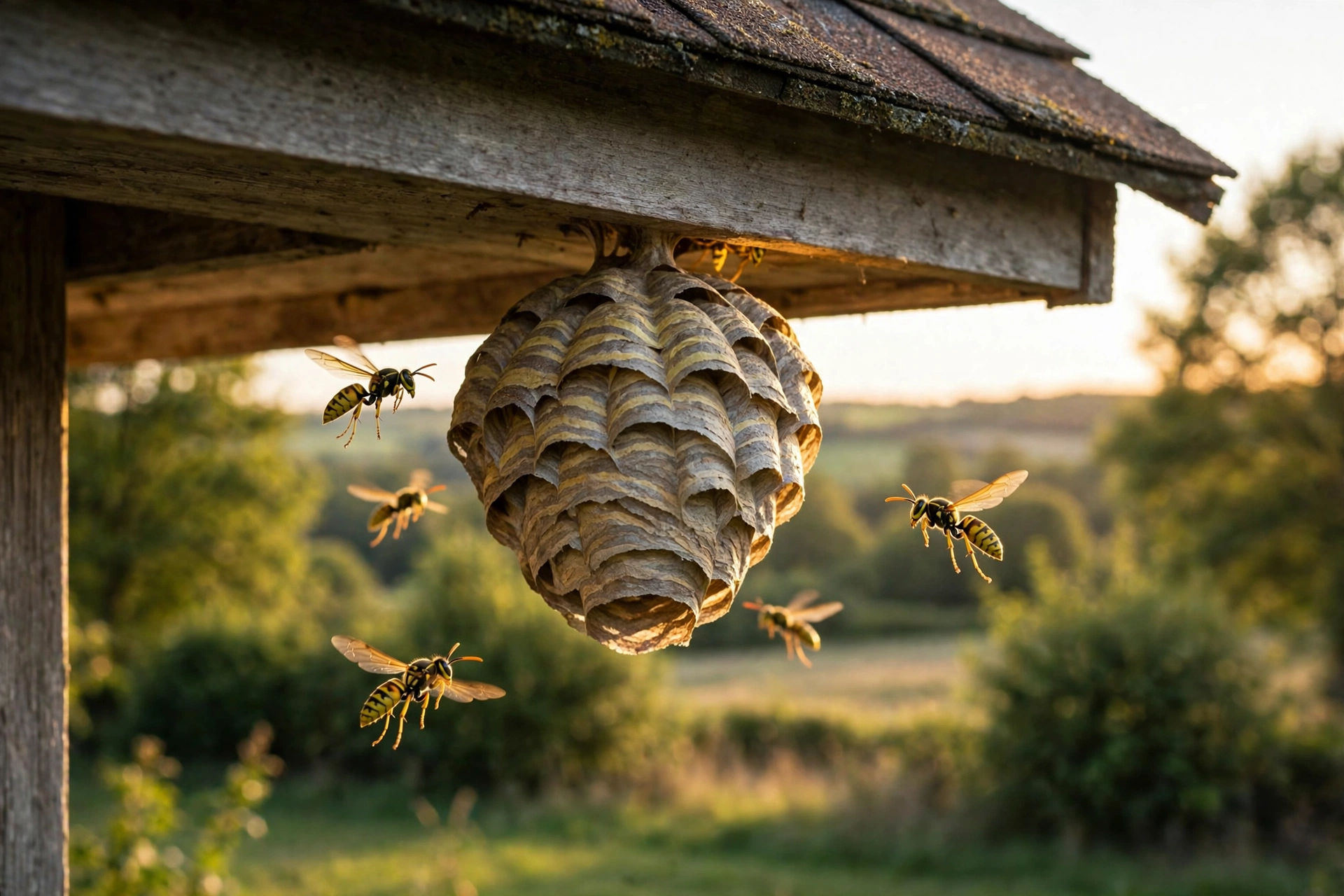
How to Safely Remove a Yellow Jacket Nest (Without Getting Stung)
Every August, the same scene plays out in backyards across the country: you’re grilling, the kids are playing, and then the yellow jackets arrive — aggressive, persistent, and utterly uninterested in sharing your hamburger. By late summer, their colonies are at peak population, sometimes numbering in the thousands, and the workers get bolder as natural food sources dry up. Finding the nest they came from feels like the obvious next step.
It can be done safely. But yellow jackets are not honeybees — they don’t lose their stingers, they sting repeatedly, and they release an alarm pheromone that summons nest-mates. Hundreds of thousands of Americans visit emergency rooms yearly from stinging-insect encounters, with yellow jackets behind a large share. So understand this first: nest removal is risk management, not a bravery test. Half of this guide is about knowing when to walk away and call a professional.
TL;DR: To remove a yellow jacket nest safely: confirm it’s actually yellow jackets (not bees), locate the nest entrance by watching flight paths from a distance, treat at dusk or after dark when foragers are home, wear full protective clothing, use a wasp spray with a 15–20 foot jet, keep an escape route planned, and keep kids and pets indoors. NEVER attempt removal if anyone nearby is allergic to stings, if the nest is high up or inside a wall, or if it’s very large — call a professional in those cases.
Step 0: Make Sure It’s Actually Yellow Jackets
Misidentification causes most DIY disasters. People spray honeybee colonies (which should be relocated by a beekeeper, not killed), or treat a docile paper wasp nest like a yellow jacket fortress. Get the ID right first:
| Feature | Yellow jacket | Paper wasp | Hornet (e.g., bald-faced) | Honeybee |
|---|---|---|---|---|
| Look | Bright yellow/black, smooth, ~½ inch, narrow waist | Slender, reddish-brown/yellow, long dangling legs | Larger (~¾ inch), white/black or brown/yellow | Fuzzy, golden-brown, ~⅗ inch |
| Nest | Enclosed papery ball — underground, in wall voids, or hanging | Open umbrella-shaped comb, visible cells | Large enclosed gray football, hanging in trees/eaves | Wax combs in hives or cavities |
| Temperament | Very aggressive near nest; attracted to food | Mild unless nest is disturbed | Very aggressive near nest | Defensive only near hive |
| Sting | Can sting repeatedly, no stinger loss | Can sting repeatedly | Can sting repeatedly, painful | Stings once, then dies |
The key test: yellow jackets are the ones harassing your picnic and crawling into soda cans. They’re scavengers as well as predators, which is why they show up wherever protein and sugar are. If the insects are fuzzy and focused on flowers, they’re probably bees — don’t spray them; call a beekeeper for relocation.
If you’re dealing with a general “what is this bug” question beyond stinging insects, our early signs of bed bugs guide covers the same identify-first principle for indoor pests.
Where Yellow Jacket Nests Hide (and How to Find Them)
Yellow jackets nest in more places than most people expect: underground (old rodent burrows, hollow stumps, mulch beds — the most common and most dangerous to stumble into), wall voids and attics (entering through siding gaps; you may hear buzzing or see streaming from one exterior crack), eaves, sheds, and play equipment (under rooflines, inside sheds, under decks), and hollow trees and woodpiles.
How to find the entrance safely: Around midday, when traffic is heaviest, stand 15–20 feet away and watch flight paths — yellow jackets fly in straight, purposeful lines to and from the entrance. Mark the spot from a distance and come back at dusk to treat. Never stand over a ground nest entrance while observing.
PRO TIP
Do your reconnaissance on a cool morning if possible. Yellow jackets are sluggish below about 50°F, which makes observation safer — and if you live somewhere with cold snaps, a late-fall nest may die out on its own over winter (only the queen overwinters, and she leaves to hibernate elsewhere). A nest that’s inactive by November often isn’t worth treating at all.
When You MUST NOT Do This Yourself — Call a Pro
Read this section before the how-to. If any of these apply, stop here and call a professional — these are the scenarios behind the worst sting incidents:
- Anyone in the household is allergic to insect stings. Absolute. Anaphylaxis can kill in minutes, and disturbing a nest endangers everyone nearby — not just the person spraying. If there’s an EpiPen in the house for sting allergy, you don’t DIY this. Ever.
- The nest is high up — in a tree, on a second-story eave, anywhere needing a ladder. Stings cause flinching; flinching on a ladder causes falls.
- The nest is inside a wall void or attic. Spraying one traps angry wasps inside your house — they chew through drywall to escape, often into bedrooms. Wall-void nests are professional-only, usually handled with dust formulations.
- The nest is very large (football-sized or bigger) or there are multiple nests.
- You can’t positively identify the species.
- The nest is near a high-traffic area you can’t clear — a playground, a neighbor’s yard, a public sidewalk.
A licensed pest professional handles these daily: full protective suits, commercial-grade products, and the judgment for structural-access jobs. For wall voids, heights, or allergy households, the typical $100–$300 service call is some of the cheapest insurance you’ll ever buy.
If You Proceed: The Safe DIY Method
Assuming none of the above applies — a visible, accessible, moderately-sized nest and no allergies in the household — here’s the method that minimizes risk. Treat at dusk or after dark, when foragers have returned and the colony is settled; never at midday when hundreds of workers are out. Cooler evenings are ideal.
Gear Up Like You Mean It
Minimum protective clothing — not optional:
- Long sleeves and pants, cuffs tucked into gloves and socks — no exposed skin, no loose openings
- Thick gloves (leather work gloves over latex is a solid combo)
- Hat with a veil, or a hat plus a scarf wrapped fully around neck and lower face
- Closed shoes. Avoid dark colors and floral scents — yellow jackets key on both
Plan Before You Spray
- Escape route first. Know exactly which direction you’ll walk (not run — running flails arms and attracts attention) if things go wrong. Clear the path of toys, hoses, and obstacles beforehand.
- Kids and pets indoors with doors and windows closed. No exceptions, no “they’ll stay back.”
- Light discipline at night. Don’t shine a flashlight directly at the nest — use indirect light or a red-filtered light, which disturbs them less.
- Buy two cans. One can of wasp/hornet spray per nest is the rule; the second is your backup. Choose an aerosol labeled for wasps and hornets with a 15–20 foot jet spray — the range keeps you at a safer distance.
PRO TIP
Read the product label fully before you go outside — at dusk, in protective gear, with adrenaline rising, is not the time to discover the 10-second shake requirement or the upwind positioning instruction. Know the spray pattern and range before you need them.
Treating an Exposed/Hanging Nest: Step by Step
- Approach calmly at dusk, from upwind, stopping at the spray’s maximum range.
- Aim the jet directly into the nest entrance — saturate it for several seconds so wasps contact the insecticide entering and exiting.
- Back away immediately along your planned route. Don’t linger.
- Wait 24 hours. Check from a distance the next evening — if activity remains, repeat.
- Once activity has fully stopped for 48 hours, bag and remove the nest if accessible. For ground nests, fill the entrance after confirmed inactivity to prevent re-use.
Ground Nests: A Special Case
Ground nests deserve extra respect — they’re the ones people step on or mow over. At night, puff an insecticidal dust formulation (labeled for wasps/yellow jackets) into the entrance with the product’s applicator, then leave. Dust clings to workers moving through the entrance and gets carried deep into the colony.
What NEVER to do: Do not pour gasoline into a ground nest and light it. This folk “remedy” causes fires, explosions, and groundwater contamination every year — and often fails anyway, since nest chambers can extend several feet from the entrance. Do not seal the entrance either; trapped yellow jackets chew new exits, frequently into your home.
After the Nest Is Dead
- Confirm 48 hours of zero activity before assuming success — watch the entrance from a distance at midday. Zero traffic means the colony is dead.
- Remove accessible nests (bag and trash; don’t compost) to prevent secondary pests and re-use.
- Seal entry points. Caulk gaps in siding and eaves, cover vents with fine mesh. An $8 tube of caulk prevents next year’s nest.
- Clean up attractants. Fallen fruit, open trash, uncovered compost, and pet food left outside all draw scouting queens in spring.
Keep Them From Coming Back Next Year
- Spring queen trapping. Set yellow jacket traps in early spring (March–April) when queens forage alone — each queen caught is one fewer August colony. Hang traps at the property perimeter, away from patios.
- Trash discipline. Keep outdoor bins tightly lidded and rinse recyclables. In late summer, this single habit prevents more problems than anything else.
- Seal and repair. Every gap they used this year is one a queen will investigate next spring.
- Cover food outdoors. Simple mesh food covers for picnics cut encounters dramatically.
Bottom Line
- Identify first — make sure they’re yellow jackets, not bees (bees get relocated, not sprayed).
- Never DIY if there’s a sting allergy in the household, the nest is high up, inside a wall, or very large — call a professional.
- Treat at dusk or after dark, in full protective clothing, with a wasp spray rated for 15–20 feet.
- Plan your escape route before you spray, keep kids and pets inside, and buy a backup can.
- Never pour gasoline or seal a ground nest entrance — fire risk, and trapped wasps chew into your house.
- Confirm 48 hours of zero activity before removing the nest, then seal entry points and trap queens next spring.
Frequently Asked Questions
Will yellow jackets sting unprovoked?
Away from the nest, usually not — they’re focused on food. Near the nest, absolutely: they defend a perimeter and their alarm pheromone recruits nest-mates. Vibrations (lawnmowers, footsteps over a ground nest) are the most common trigger.
How many times can a yellow jacket sting?
Unlike honeybees, they don’t lose their stingers — one wasp can sting repeatedly. That’s what makes disturbing a nest so dangerous.
Can I just wait for winter to kill the nest?
In cold climates, yes — the colony dies in late fall and only the queen overwinters elsewhere; old nests are never reused. But waiting isn’t an option if the nest threatens people or pets now, or where winters are mild.
What should I do if I get stung multiple times?
Move away first — more stings are worse than treating one. Wash with soap and water, apply cold, take an antihistamine for local reactions. Seek emergency care immediately for any anaphylaxis signs: difficulty breathing, throat tightness, dizziness, or swelling beyond the sting site.
Does soapy water really kill yellow jackets?
A strong dish-soap-and-water spray kills individual wasps on contact, and works for a stray wasp indoors. It’s not a nest treatment — you can’t deliver it into a colony safely.
Are yellow jacket traps enough to handle a nest?
No. Traps catch foraging workers but don’t touch the colony — the queen keeps producing replacements. Traps are prevention and suppression, not elimination.