Why Do Ants Keep Coming Back After Treatment? 7 Reasons and Fixes
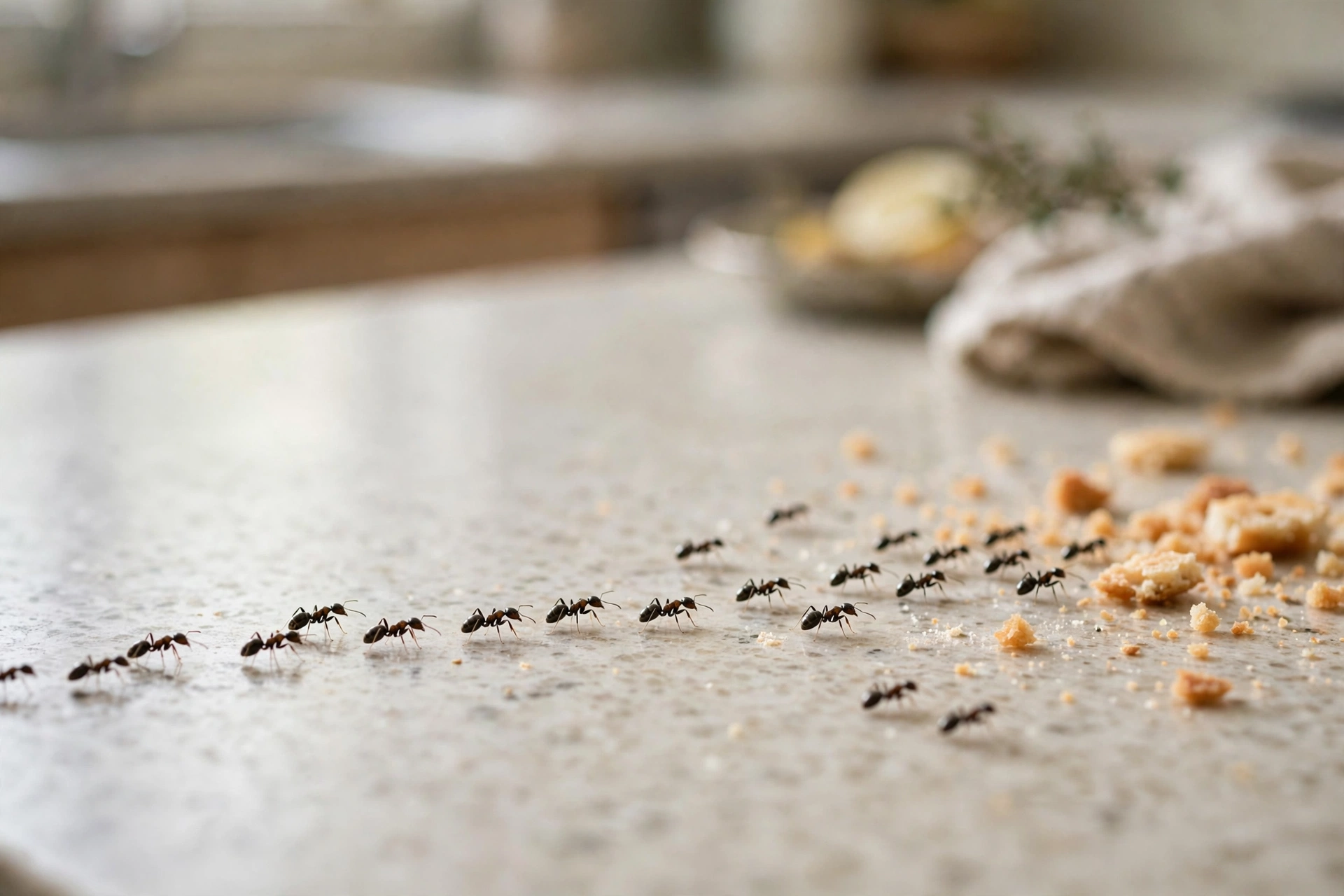
You sprayed. They died — hundreds of them, right there on the kitchen counter. Two quiet weeks later, a fresh line marches along the baseboard like the last month never happened.
This isn’t bad luck. Ant control fails in predictable ways, and the returning ants tell you exactly which mistake was made. Once you understand the colony — not the ants you see, but the 95% you never see — the fix becomes obvious.
TL;DR: The ants on your counter are ~5% of the colony; killing foragers never ends an infestation. Ants return because the queen and satellite nests survived, repellent sprays scattered the colony into new ones (budding), the bait didn’t match their current food preference, bait was contaminated by spray residue, or food and moisture were never removed. Fix it with a bait-first strategy: match the bait, place it fresh on active trails, spray nowhere near it, cut off food and water, and wait 2–4 weeks.
The Core Problem: You’re Fighting 5% of the Enemy
A typical ant colony is an iceberg: the foragers on your counter are often under 10% of the population. Deep in the nest, queens lay eggs continuously — some species produce hundreds of new workers a day — and the whole system is built to absorb losses.
Contact sprays, wiping trails, and vacuuming all remove foragers only. The colony replaces them within two to four weeks, and it feels like the treatment “wore off.” It never reached the part of the colony that matters.
Real ant control uses foragers as delivery drivers: slow-acting bait they carry home and share with the queen and brood before anyone dies. Almost every comeback story traces back to breaking one of this strategy’s rules.
The 7 Reasons Ants Return (and the Fix for Each)
1. You Killed the Foragers, Not the Colony
A can of contact spray feels productive — ants die, the trail goes quiet. But you’ve only removed the delivery crew; the queen, brood, and food stores are untouched, and replacements are already developing.
The fix: Lead with slow-acting baits (gel, liquid, or granular) that foragers eat and share. Expect the trail to stay active — even busier — for the first days. That’s the bait working, not failing.
2. The Colony Has Satellite Nests You Never Treated
Many of the worst house ants — odorous house ants, Argentine ants, pharaoh ants — are polydomous: one colony across multiple nests with multiple queens. Wipe out the nest behind the dishwasher while three more thrive in wall voids or under the slab, and the survivors simply redistribute.
The fix: Think in zones, not spots. Bait every active trail and entry point — indoors and outdoors — so all nest sites feed simultaneously. One kitchen bait station is a half-measure for these species.
3. Your Spray Made It Worse: Colony Budding
Most over-the-counter sprays are repellents (pyrethroids). When pharaoh or odorous house ants detect one, queens flee with workers — splintering one nest into several. Pros call this budding: one manageable colony becomes five. If your problem got worse after spraying, budding is the likely culprit.
The fix: No repellent sprays indoors, full stop. Outdoors only, as a perimeter barrier far from bait. Indoors, bait-only until collapse.
4. The Bait Didn’t Match What the Colony Wants Right Now
Ant food preferences shift: a colony raising brood craves protein and grease; weeks later the same colony may want only sugar. A sweet gel bait put out during a protein phase gets ignored while foragers march to the bacon grease on your stovetop. An ignored bait isn’t a failed product — it’s the wrong menu.
The fix: Run a 24-hour taste test — a pea-sized dab of sugar bait and a dab of protein bait near (not on) an active trail. Whichever gets mobbed is what the colony wants today; buy the matching bait and commit.
| Colony phase | What they crave | Bait to use |
|---|---|---|
| Brood-rearing (spring/early summer) | Protein, grease, fats | Protein-based gel or granular bait |
| Late summer / fall | Sugars, honeydew | Sweet liquid or gel bait |
| You don’t know | Test both | Whichever they mob in the taste test |
5. The Bait Was Contaminated or Poorly Placed
Even the right bait fails mishandled: placed where you recently sprayed (residue contaminates it), set inches off the trail, dried into a useless crust, or too little for foragers to carry home to the queen.
The fix: Fresh bait directly on active trails — foragers won’t detour. Never spray within several feet of bait. Refresh gels every few days, and put out more than you think you need.
PRO TIP
Never spray a repellent insecticide where you’ve placed bait — the two strategies cancel each other. Pick one per area: bait OR spray, never both. If you already sprayed the trail, wipe it down and wait 48 hours before baiting.
6. Food and Moisture Are Still on the Menu
A colony won’t die for your bait while the kitchen feeds it better. Unsealed cereal, the sticky honey jar, pet food left out overnight, crumbs under the toaster, lidless garbage — any of these outcompetes bait. Moisture matters too: a dripping trap or condensation gives them water to forage indefinitely.
The fix: Sanitation blitz the same day you bait — seal dry goods, wipe counters nightly, trash out daily, no overnight pet food, fix drips. Not spotless forever; just remove the competition for 2–3 weeks.
7. A New Colony Moved Into the Vacated Territory
Sometimes you win — then lose again. Outdoors, Argentine and pavement ants form vast supercolonies; eliminate the nest by your foundation and a neighbor colony expands into the empty territory within weeks. Same look, new colony.
The fix: After indoor activity stops, defend the exterior — bait around the foundation perimeter, caulk entry gaps, trim vegetation touching the house. Hold ground; it’s not a one-time battle.
PRO TIP
Follow trails at night with a flashlight. Many house ants forage hardest after dark, and a nighttime trail often leads straight to the entry point or an outdoor nest you’d never find at noon.
The Bait-First Playbook: What Actually Works
Put the fixes together and the whole strategy fits on an index card:
- Identify the ant — at minimum, sugar vs. grease feeder (big black ones? see how to get rid of carpenter ants).
- Run the taste test; buy the matching bait.
- Bait every active trail, indoors and out; refresh every few days.
- Don’t spray repellents near bait.
- Sanitize and dry out for 2–3 weeks.
- Wait 2–4 weeks. Sudden disappearance in 24 hours means rejection, not death.
- Seal entries once activity stops; keep exterior bait as a guard.
| Approach | What it kills | Colony impact | Best for |
|---|---|---|---|
| Contact spray | Foragers on the trail | None — colony rebounds in weeks | Knockdown only, never a solution |
| Repellent spray (indoor) | Foragers | Negative — causes budding | Avoid indoors entirely |
| Slow-acting bait | Queen and brood via sharing | Colony elimination in 2–4 weeks | Nearly all indoor ant problems |
| Sanitation + exclusion | Nothing directly | Removes reinfestation fuel | Every situation, alongside bait |
PRO TIP
If activity vanishes within a day of baiting, don’t celebrate — investigate. True bait-driven colony death is gradual: heavy feeding for several days, then a slow taper over 1–3 weeks. Instant disappearance means they found the bait unpalatable or found better food elsewhere.
When to Call a Professional
DIY baiting handles most ant problems, but call in help when:
- 4+ weeks of correct baiting with no real reduction — possible supercolony or misidentified species.
- Carpenter ants with suspected structural nesting — a different fight (carpenter ant guide); established structural infestations deserve a pro.
- Multi-unit buildings — pharaoh ants need coordinated treatment across units.
- Vulnerable household members or pets — a licensed pest professional can apply targeted, low-exposure treatments with proper precautions.
Safety: keep all pesticides — baits included — out of reach of kids and pets, use tamper-resistant stations, follow labels exactly. Never use total-release foggers for ants: they don’t reach nests and the repellent blast triggers budding.
Bottom Line
- You’re fighting 5% of the colony. Killing foragers never ends an infestation; only bait reaches the queen.
- Repellent sprays can make it worse by scattering the colony into multiple new nests (budding).
- Match the bait to the colony’s current appetite — run the sugar-vs-protein taste test first.
- Bait on the trail, never near spray. Contaminated or dried-out bait gets ignored.
- Remove competing food and moisture for 2–3 weeks while bait works.
- Give it 2–4 weeks. Gradual decline means success; instant disappearance means rejection.
- Defend the perimeter afterward so a neighboring colony doesn’t move in.
Frequently Asked Questions
How long does it take for ant bait to kill the whole colony?
Typically 2–4 weeks for common house ants. The bait must be carried back, shared through trophallaxis (mouth-to-mouth feeding), and reach the queen and brood — that distribution takes time. Pharaoh ant colonies can take longer because of their multi-nest structure.
Why are there MORE ants after I put out bait?
That’s recruitment, and it’s normal for the first 24–72 hours — foragers lay pheromone trails to a good food find, so traffic spikes. If heavy activity continues past 4–5 days with no taper, the bait is likely feeding them without killing the colony (wrong active ingredient speed or the colony is huge) — refresh and reassess.
Can I spray and use bait at the same time?
No. Repellent sprays contaminate bait and scatter colonies. Choose one strategy per area: bait indoors where the colony feeds, and if you want a spray barrier, keep it outside at the foundation, well away from bait placements.
Do natural remedies like vinegar or cinnamon kill the colony?
No. They disrupt pheromone trails temporarily (a repellent effect), which can actually trigger budding in sensitive species. They have a place as a short-term deterrent on a countertop, but they are not colony control.
Why do ants come back every spring even after successful treatment?
Outdoor colonies overwinter and reactivate; winged reproductives start new colonies nearby each swarm season. Spring is the time for exterior perimeter baiting and sealing entry points — prevention, not reaction.
Are ant baits safe around kids and pets?
When used as labeled — in tamper-resistant stations, placed out of reach, and never where food is prepared — the exposure risk is low. But “low” isn’t “zero”: keep stations away from curious toddlers and pets, and if anyone in the home is especially vulnerable, have a professional handle placement.