How to Get Rid of Chipmunks in Your Yard Without Harming Them
TL;DR
If you are wondering how do you get rid of chipmunks without harming them, start by removing the food and shelter, then block them out with buried hardware cloth and fill burrows with gravel and soil. Repellents and live traps help, and a wildlife professional is the right call when burrows threaten a foundation.
A chipmunk in the garden looks harmless enough — small, striped, and busy — until you notice dug-up bulbs, hollowed-out tomatoes, and neat little holes beside your foundation. If you are asking how do you get rid of chipmunks before the damage spreads, you can usually solve it without hurting the animal at all.
The approach that works best is a sequence, not a single trick: take away the food, tidy the shelter, seal the entry points, and only then consider trapping. If you are weighing how do you get rid of chipmunks against a bigger burrower, the same thinking applies — our guide to getting rid of moles in your yard follows the same remove, block, and monitor pattern.
This guide walks through the whole humane sequence step by step, with real costs, the methods that work, and the ones that waste your money. Everything here is safe around kids and pets when used as directed, and nothing requires poison, fumigants, or lethal traps.
How Do You Get Rid of Chipmunks Humanely?
When people ask how do you get rid of chipmunks humanely, the answer is to remove their food and shelter, block re-entry with buried hardware cloth, and use repellents or a live trap only for the animals that remain. Start with the yard cleanup, because chipmunks leave on their own once the easy meals and hiding places are gone.
Humane removal is not a single product — it is a sequence, and skipping steps is why most chipmunk fixes fail. Spraying repellent while a feeder still spills seed changes nothing about why the animal is there. Work in order: food first, shelter second, exclusion third, trapping last.
Check the legal point before you do anything hands-on. Chipmunks are wild animals, and the rules for trapping and relocating them vary by state. Some areas require a permit, and a few prohibit relocation entirely. Your state wildlife agency can confirm the rules in minutes. Never handle a chipmunk with bare hands — wild rodents can carry ticks and bacteria, and a frightened animal bites.
What Damage Do Chipmunks Actually Do to a Yard?
Chipmunks dig up flower bulbs, eat fruit and vegetables, and tunnel burrows up to 30 feet long and several feet deep. Homeowners asking how do you get rid of chipmunks should check the damage first, because those tunnels can undermine patios, retaining walls, steps, and foundations over time.
The first sign is usually a clean, round hole about the size of a quarter — that tidy entrance is what separates a chipmunk burrow from a mole tunnel. When homeowners ask how do you get rid of chipmunks after spotting these signs, walk the foundation and patio edges and mark every hole before you fill anything.
Most chipmunk damage is cosmetic, but burrows near structures are the exception, and that is when most people start asking how do you get rid of chipmunks for good. A tunnel system under a patio slab or along a foundation can wash out soil in heavy rain and cause settling. A single hole in an open lawn can wait a week; a cluster against the house should be handled within days.

What Attracts Chipmunks to Your Yard in the First Place?
Chipmunks come for easy food and safe cover: spilled birdseed, fallen fruit and acorns, pet food left outside, vegetable gardens, and dense ground cover or woodpiles to hide in. Take away two or three of those attractions and most chipmunks will move on to an easier yard without any trapping at all.
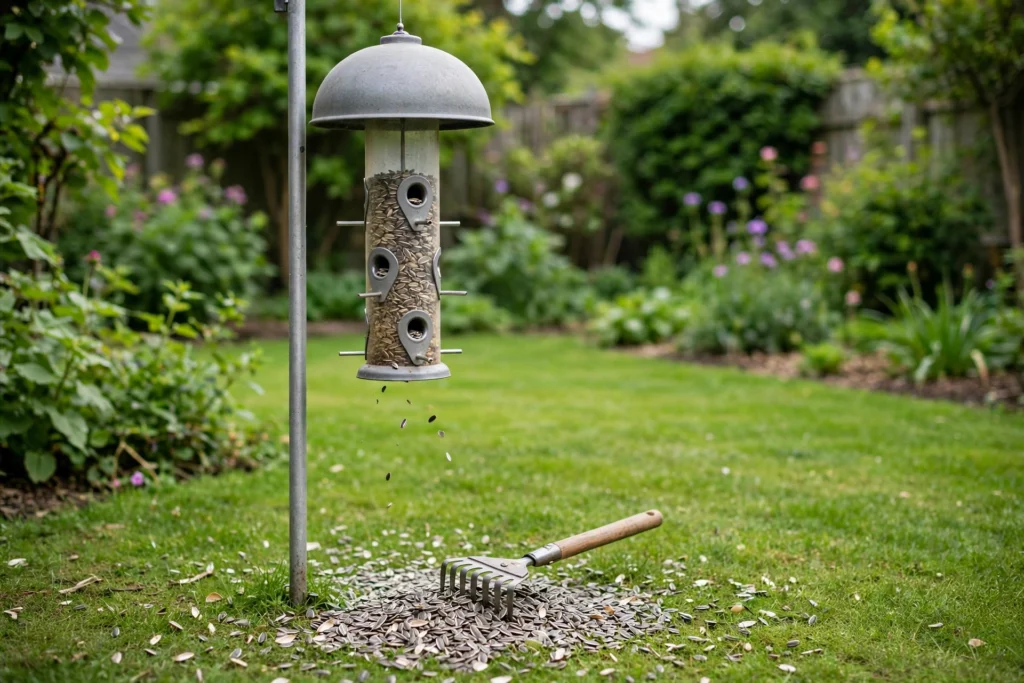
Bird feeders are the number-one draw, because one feeder can scatter enough seed to feed a chipmunk family for weeks. They harvest what falls. When you are working out how do you get rid of chipmunks that keep returning to the same corner, start by looking down: a carpet of seed hulls under the feeder is usually the answer.
Cover matters almost as much as food. Woodpiles, rock piles, dense ivy, and low shrubs give chipmunks cover between the burrow and the feeder. If you are still wondering how do you get rid of chipmunks that treat your yard like a pantry, cover is the missing piece: raise the woodpile and thin ground cover near the house.
PRO TIP
Rake up fallen seed and fruit every evening for one week and watch the chipmunk traffic. If visits drop by half, food was the main draw — keep the cleanup going and you may never need a trap.
How Do You Get Rid of Chipmunks From a Vegetable Garden?
Protect a vegetable garden with 1/4-inch hardware cloth buried 12 inches deep around the bed, bent outward at the bottom in an L-shape, and rising about 24 inches above the soil. Add bulb cages for tulips and cover ripening fruit with mesh bags, so the garden stops being the easiest meal on the block.
The L-shaped buried barrier is what wildlife agencies recommend, because chipmunks dig down, then sideways, when they hit an obstacle. Gardeners who ask how do you get rid of chipmunks from a bed already planted can retrofit it by trenching around the bed and sliding the mesh in. Use 1/4-inch hardware cloth, not chicken wire — chipmunks slip through chicken wire and chew through plastic mesh. A 25-foot roll runs about $25–$60 (rough planning estimate, not a quote).
Planting choices help too. Chipmunks avoid daffodils, lavender, marigolds, and alliums such as garlic, onion, and chives, so a border of those around a bed adds a layer of discouragement. A bed of tulips, crocus, and strawberries with no barrier is an open invitation.

Does Cayenne Pepper or Other Repellent Really Work?
Cayenne pepper spray, peppermint oil, garlic, and predator urine can push chipmunks away from a small area for a few days, but none of them is a permanent fix on its own. Repellents work best as a short-term push while you remove food and install exclusion — used alone, chipmunks usually return once the smell fades.
Homemade cayenne spray — a tablespoon of cayenne and a few drops of dish soap in a quart of water, sprayed around bulbs and bed edges — is the cheapest option. Reapply after rain, because the effect fades fast outdoors. If you are testing how do you get rid of chipmunks with repellents, treat one bed and leave another untreated for a week.
Commercial predator urine granules and peppermint-oil sprays cost roughly $10–$25 per bottle or bag and work for a week or two at best. Motion-activated sprinklers are the stronger option at about $35–$70. The honest limit for anyone asking how do you get rid of chipmunks with a spray bottle alone: ultrasonic stakes and owl decoys are ignored within days, and mothballs are poisonous if ingested.
| Repellent | Rough cost | How long it lasts | Best use |
|---|---|---|---|
| Cayenne pepper spray (homemade) | $3–$8 | A few days | Bulb beds, small areas |
| Peppermint or garlic spray | $10–$25 | About a week | Garden edges, planters |
| Predator urine granules | $15–$30 | 1–2 weeks | Perimeter, burrow entrances |
| Motion-activated sprinkler | $35–$70 | All season | High-traffic garden zones |
How Do You Fill a Chipmunk Burrow So They Stay Out?
Fill a burrow with gravel first, then pack soil on top and tamp it down firmly, so the tunnel is blocked solid instead of just capped. Fill only after you are sure the burrow is empty — stuff a loose ball of newspaper in the entrance for two days and refill only if it stays undisturbed.
The newspaper test is the step most people skip, and it matters most — and the first thing to check when you are figuring out how do you get rid of chipmunks living under a porch or patio. Filling an occupied burrow traps animals underground, and a trapped chipmunk will just dig a new exit. Push a crumpled ball of newspaper into each entrance and check it after 48 hours. If it is untouched, the burrow is empty and safe to fill.
Coarse gravel works better than soil alone because chipmunks struggle to dig through it. Pour gravel in until the tunnel stops taking more, then add soil and tamp it down. Then watch the spot for a week. A refilled hole means the animal is still active; if you are still asking how do you get rid of chipmunks after filling the same hole twice, the food or cover nearby needs attention.
PRO TIP
Mix a handful of coarse gravel into the top layer of soil whenever you fill a burrow near the foundation. Chipmunks dig through soft soil in minutes, but a gravel plug makes them look for an easier spot.
Should You Trap Chipmunks Yourself?
You can trap chipmunks yourself with a small live trap, about 20 inches long, baited with peanut butter or sunflower seeds — but only where local rules allow relocation, and only if you can check the trap at least once a day. Trapping without fixing the food and shelter problem just makes room for the next chipmunk.
Set the trap near a burrow entrance or along a wall they already travel, and bait it with peanut butter or sunflower seeds. Cover the trap with a towel, and check it morning and evening — a chipmunk left in a trap in summer heat or winter cold can die within hours. When people ask how do you get rid of chipmunks by trapping, the honest answer is that trapping is the last step, not the first.
Release the animal several miles away in suitable habitat, and follow your state’s release-distance rules. Wear gloves and never handle the animal directly. If you catch the same animal twice or the yard refills within a week, go back to the food and exclusion steps. The yard is still the attraction, and the real question is how do you get rid of chipmunks by changing the yard, not by trapping.
When Should You Call a Professional for Chipmunks?
Call a professional when burrows run under a foundation, patio, or retaining wall, when chipmunks have moved inside the house, or when DIY steps have failed for several weeks. A wildlife pro can trap, exclude, and repair entry points in one visit, and the job usually costs between $150 and $650.
Professional wildlife removal for chipmunks runs about $150–$650 according to Angi, with an inspection typically $75–$150 — rough planning estimates, not quotes, and the final price depends on the number of animals and the exclusion work needed. A good pro does more than trap: they find every entry point and install the mesh. When you are deciding how do you get rid of chipmunks that have already damaged a structure, that package is usually cheaper than paying for trapping alone.
If you are in the Dallas–Fort Worth area and the job is beyond DIY, get a local quote rather than living with a growing burrow system. Homeowners in Grand Prairie can reach out to Exterminator Grand Prairie for an assessment, and Pest Expert Pro is another Texas option — either way, ask any pro whether the quote includes exclusion and burrow repair, not just trapping.
| Option | Rough cost | What it covers |
|---|---|---|
| DIY cleanup + repellents | $10–$70 | Food removal, sprays, sprinkler |
| Hardware cloth + burrow fill | $25–$80 | Mesh, gravel, soil |
| Live trap (DIY) | $20–$45 | One trap, reusable |
| Pro inspection | $75–$150 | Assessment, entry-point survey |
| Pro removal + exclusion | $150–$650 | Trapping, mesh, burrow repair |

Frequently Asked Questions
How long does it take to get rid of chipmunks?
Most yards see a clear drop within one to two weeks of removing food and shelter, with full results in three to four weeks once exclusion is installed. If you are wondering how do you get rid of chipmunks faster, do all the steps at once — cleanup, mesh, and burrow filling together.
Are chipmunks dangerous to people or pets?
Chipmunks are shy and rarely bite, but they can carry ticks and bacteria, and their droppings can carry germs, so never handle one with bare hands. Keep pets away from burrows and trapped animals, and wash your hands after working near a burrow.
Do chipmunks come back after you remove them?
Yes, if the yard still offers food and cover — a new chipmunk will move into an empty burrow within days. Exclusion and cleanup matter more than trapping. Fill the burrows, bury the mesh, and keep the feeder area clean.
Will chipmunks dig under my house foundation?
They can, and burrows along a foundation are the one to take seriously. Deep tunnels can wash out soil in heavy rain and cause settling. If you find holes against the house, act fast — and if you are unsure how do you get rid of chipmunks nesting against a foundation, call a wildlife pro rather than filling holes blind.
What smells do chipmunks hate?
Cayenne pepper, peppermint oil, garlic, and predator urine push chipmunks away from a small area for a few days. Planting daffodils, lavender, marigolds, and alliums adds a mild deterrent. None replaces exclusion — smells fade, and a hungry chipmunk will test the boundary again.
Is it legal to trap and relocate chipmunks?
It depends on where you live. Some states allow homeowners to live-trap and relocate chipmunks, some require a permit, and a few prohibit relocation entirely. Check with your state wildlife agency before setting a trap, and follow its rules on release distance.
Final Thought
The best chipmunk plan is the boring one: clean up the food, open up the cover, bury the mesh, and fill the holes. Do those four things and most yards stay chipmunk-free without a trap. If the animals keep coming back, the burrow system is bigger than it looks, and a professional is the right next step. If you are still asking how do you get rid of chipmunks for good, remember the answer is the yard, not the animal.
The same exclusion-first thinking works for other yard pests too — our guide to getting rid of fire ants follows the same remove, block, and monitor pattern.