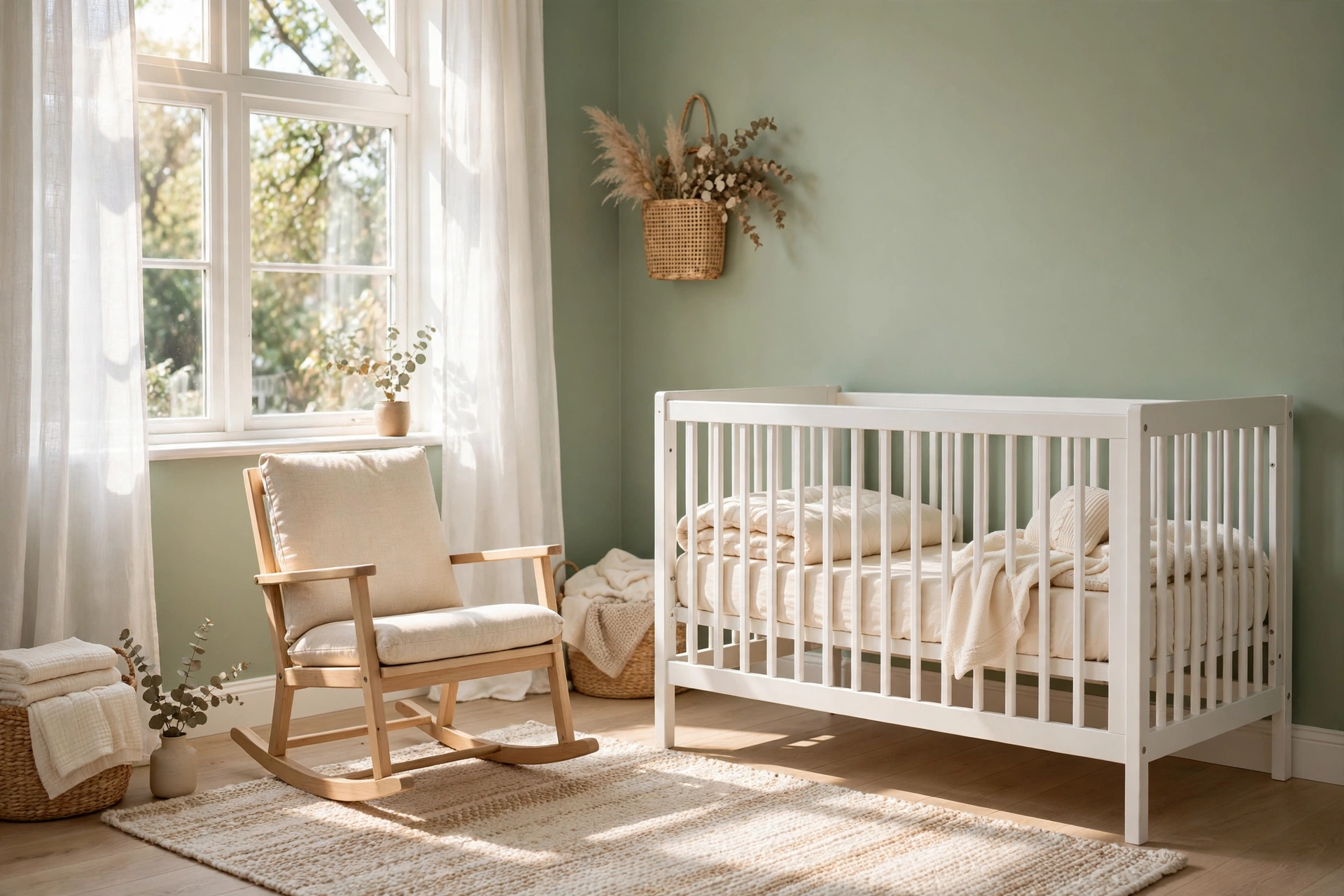
Painting the Nursery: Low-VOC Paint and the 8-Week Rule
Painting the nursery is the one paint job where the can matters more than the color. A newborn will spend 14–17 hours a day sleeping in that room, breathing faster relative to body weight than any adult, in a small space with one window and a closed door. The right paint choice — true zero-VOC or low-VOC, the right colorant, the right finish — plus the 8-week rule for timing, is what turns a weekend project into a room that is genuinely ready for a baby. This guide covers the paint, the tint trap most guides skip, the colors and finishes parents actually choose, and the step-by-step method.
TL;DR
Paint the nursery at least 8 weeks before your due date with true zero-VOC water-based paint (≤5 g/l). Pick a white or pastel tint — deep colorants add VOCs back into “zero-VOC” paint. Use an eggshell or washable matte finish on walls and semi-gloss on trim. Ventilate with a box fan blowing OUT for days after painting, and run the smell test before the crib goes back in. Dry in hours does not mean cured, and cured does not mean safe for a newborn.
Why Does Painting the Nursery With Low-VOC Paint Matter?
Painting the nursery with low-VOC paint matters because a baby’s room concentrates everything paint releases: volatile organic compounds (VOCs) are the solvents that evaporate out of paint as it dries, and the EPA lists paint among household VOC sources, linking exposure to eye, nose, and throat irritation, headaches, and nausea. A nursery is small, often has a single window, and holds a baby who sleeps there most of the day — so the same paint that is harmless in a big, airy living room is a bigger deal here.
The fix is not complicated, but it is specific. Low-VOC paint is not one product — it is a range of products with very different numbers behind the label, and “low odor” is not the same claim as “low VOC” at all. The rest of this post is about reading the label correctly, because the label is where the safety is decided, not at the paint counter.
A quick note on who holds the roller: this post is about choosing the paint. If someone in the household is pregnant, the painting itself should be delegated to a non-pregnant adult — the full safety plan for that situation is in our companion post on painting the nursery while pregnant.
What Is the 8-Week Rule for Painting the Nursery?
The 8-week rule for painting the nursery is simple: finish painting at least 8 weeks — two full months — before the baby arrives. Consumer Reports gives this as its guidance, and it is the timeline this post is built around. Eight weeks is not an arbitrary cushion; it covers the paint’s full cure plus the steepest part of the off-gassing curve, so the room is not just dry but genuinely aired out by the time a newborn sleeps in it.
Eight weeks is the ideal for zero-VOC paint. For anything with more VOCs, the wait is longer, not shorter. The table below is the backbone of this post — use it to plan your timeline, not just your paint purchase.
Wait times by paint type
| Paint type | Baby sleeps in the room after… | Notes |
|---|---|---|
| Zero-VOC water-based | 72 hours MINIMUM, 8 weeks ideal | The 8-week rule = Consumer Reports’ buffer for full cure + off-gassing |
| Low-VOC water-based | ~1 week minimum, 8 weeks ideal | Check the g/l on the can — “low” still means something |
| Standard water-based (latex) | ~1 week minimum | More off-gassing than low-VOC; ventilate harder |
| Oil-based / alkyd | 2–4 weeks minimum — better: don’t use it | Highest VOCs; no place in a nursery |
All times assume CONTINUOUS ventilation from the moment painting ends — windows open, fan running, air moving. If the room sits closed up, the clock barely moves. And finish with the smell test: close the room for an hour, then walk in. If it still smells like paint, add more time. One caution: odor is not the full story, because some VOCs are odorless, so a room that smells fine is not automatically proven safe — it is simply ready for the next check, which is time.
PRO TIP
Work backward from the due date, not forward from today. If the due date is 10 weeks out, painting the nursery happens this weekend — not “when the furniture arrives.” Paint first, furniture second, crib last. Everything else in the nursery can be assembled in a day; paint cannot be rushed.
What Do Low-VOC, Zero-VOC, and Low-Odor Actually Mean?
Low-VOC generally means under 50 g/l for flat paint and under 100 g/l for non-flat finishes, though there is no single federal consumer-label definition behind the phrase. Zero-VOC generally means under 5 g/l. Low-odor means the paint does not smell strongly — and that is a comfort claim, not a safety claim. A paint can be low-odor and still carry a meaningful VOC load, and some VOCs are odorless anyway, so your nose is not a measuring instrument.
What actually proves a paint is low-emission is third-party certification, not the marketing words on the front of the can. Look for these three:
- GREENGUARD Gold — tests the finished product against strict chemical-emission limits, with standards designed for sensitive spaces like nurseries, schools, and healthcare facilities.
- Green Seal (GS-11) — certifies low VOC content and bans certain hazardous ingredients.
- CDPH Standard Method v1.2 — the California chamber test that measures what a product actually emits into room air over 14 days, rather than what is in the can.
The number that matters most is grams per liter (g/l), printed on the technical data sheet or safety data sheet (SDS) — not on the front label. If the store cannot show you the SDS, pick a different paint. Conventional interior latex that is not marketed as low- or zero-VOC can run from 50 to several hundred g/l, so the gap between “regular paint” and “zero-VOC paint” is a 10x to 100x difference in what goes into the room’s air.
Is Zero-VOC Paint Really Zero-VOC? (The Tint Trap)
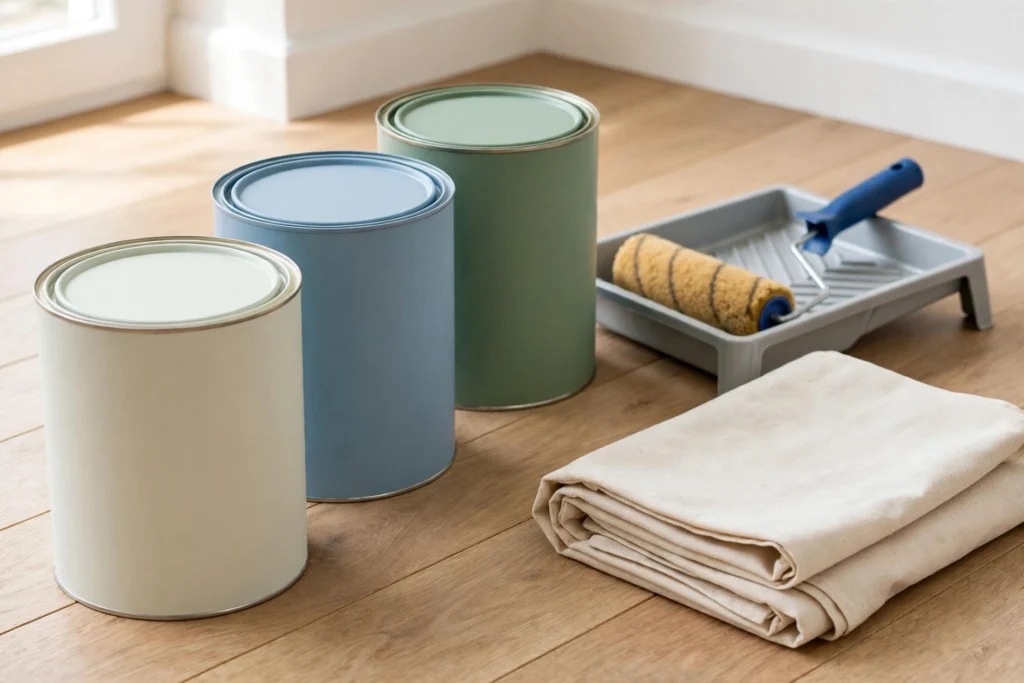
Here is the trap that undoes careful shoppers: a can labeled zero-VOC describes the base paint, not necessarily the paint you take home. True zero-VOC means ≤5 grams of VOCs per liter (g/l). But colorants — the tints mixed in at the store — add VOCs back. On average, tint adds about 10 g/l, and deep, saturated colors can add up to 100 g/l. At that point your “zero-VOC” paint is not zero-VOC anymore, and your wait time should stretch accordingly.
The tint trap
| Choice | VOC reality |
|---|---|
| Zero-VOC base, white/pastel tint | Stays near zero (≤5 g/l) |
| Zero-VOC base, deep/saturated color | Tint adds ~10 g/l average, up to 100 g/l — NOT zero-VOC anymore |
| Workaround for bold color | Neutral base coat + one small accent panel in the deep color; give the accent extra airing time |
The workaround is the practical answer for parents who want a bold nursery. Paint the room in a white or pastel zero-VOC base, then put the deep color on one small accent panel or a single feature wall. The bold color is contained, the total VOC load stays far lower, and you can give that one panel extra ventilation time. Before you buy, ask the store for the product’s safety data sheet (SDS) and check the VOC number for the tinted product, not just the base. If they cannot give it to you, pick a lighter color — or pick a brand whose colorants are themselves zero-VOC, so the tinted can tests the same as the base.
PRO TIP
Ask for the tinted-can VOC number in writing at the counter — “What is the g/l after this color is added?” If the answer is a shrug, that is your answer: go a shade lighter, or switch to a line with zero-VOC colorants. The five minutes this takes at the counter saves weeks of extra airing time at home.
Which Low-VOC Paint Should I Buy for the Nursery?
Which low-VOC paint you should buy for the nursery depends on how you want to shop: online-only specialist lines, or a tinted gallon from a local store the same afternoon. Every line below is zero-VOC at the base and GREENGUARD Gold certified; what differs is the tint story, the coverage, and the price.
Zero-VOC nursery paints compared
| Paint line | VOC after tinting | Coverage | Price tier | Best for |
|---|---|---|---|---|
| ECOS Paints (Lullaby line) | Under 2 g/l — VOC-free colorants | Up to ~560 sq ft/gal | $$$ | Parents who want the tint trap closed entirely; online order |
| Benjamin Moore Eco Spec | Zero-VOC base; standard colorant adds some VOCs back | ~400–450 sq ft/gal | $$ | Same-day tinting at a local store |
| Sherwin-Williams Harmony | Zero-VOC base + zero-VOC colorants | ~350–400 sq ft/gal | $$ | Odor-eliminating tech; frequent washing |
| Clare Paint | Zero-VOC base; low-VOC once tinted with standard colorant | ~350–400 sq ft/gal | $$ | Curated designer colors; peel-and-stick swatches |
| Behr Premium Plus (Zero VOC) | Zero-VOC base; darker tints can push above zero | ~400 sq ft/gal | $ | Budget pick; paint-and-primer-in-one |
A gallon of true zero-VOC interior paint typically runs about $45–$70 as a rough planning estimate, not a quote. For a standard nursery (roughly 100–150 sq ft of wall area per coat), two gallons usually cover two coats on four walls, so budget roughly $90–$140 for paint. That is a small premium over standard latex, and it buys you the shortest wait time on the table above.
A note on the specialist options: milk paint and chalk paint are generally low-VOC and popular for nursery furniture, but “natural” on the label does not automatically mean zero emissions — check the VOC number on the product data sheet. Use them for furniture and accent pieces, not for walls.
What Colors and Finishes Work Best in a Nursery?
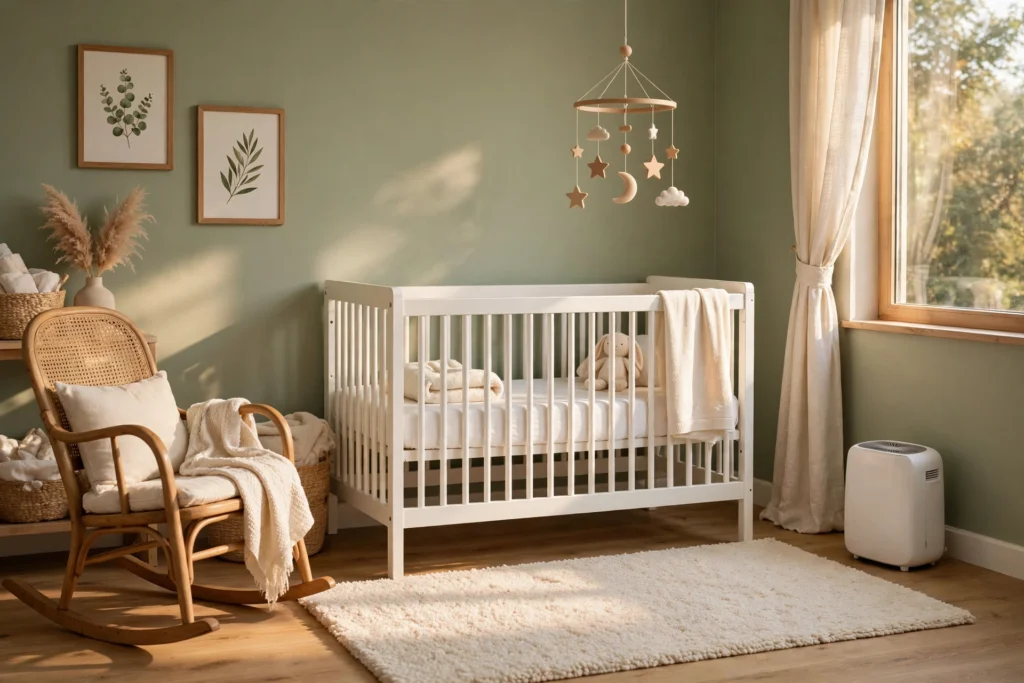
What colors and finishes work best in a nursery is a question parents ask on Pinterest more than anywhere else, and the saved-and-shared consensus is remarkably consistent: soft, restful, low-stimulation colors in a wipeable finish. Warm whites, soft sage greens, pale powder blues, dusty blush, and gentle gray-greens dominate the most-saved nursery palettes, because they read calm in both morning and evening light and they grow with the child into a toddler room without a repaint.
The palette that keeps getting saved
| Color family | Why it works | Watch out for |
|---|---|---|
| Warm white (creamy, never sterile) | Brightens small rooms; matches everything | Can read yellow under warm bulbs — test a swatch |
| Soft sage / muted green | Calming, gender-neutral, hides scuffs well | Deep olive belongs on one accent wall, not four |
| Pale blue / blue-green | Classic sleep cue; pairs with natural wood | Cold blues can feel chilly in north-facing rooms |
| Dusty blush / soft peach | Warm and soft without shouting “pink” | Keep it muted — saturated pink overstimulates |
| Deep navy / terracotta | Statement color with real personality | Accent wall only — the tint trap applies here |
On finishes, the rule is simple: eggshell or washable matte/satin on the walls, semi-gloss on trim, doors, and anything that gets touched. Matte and flat hide wall imperfections beautifully but are the hardest to clean; in a nursery, wipeability beats a perfect matte look within the first month. Eggshell is the sweet spot — low glare, soft on the eyes, and washable. Semi-gloss on trim survives fingerprints, drips, and the weekly wipe-down without going shiny or peeling.
Before committing to a color, order peel-and-stick swatches and check them in morning and evening light — soft blues and greens shift dramatically with the light through the day. Two coats of a lighter color also cover better than one coat of a dark one, which is another quiet reason pastels win in nurseries: fewer coats, less paint, lower total VOC load, faster cure.
How Do I Paint the Nursery Step by Step?
This is the painting-day choreography. Follow it in order, and do not skip the lead check — it is the one step that turns a routine refresh into a genuine hazard in older homes.
Painting-day choreography
| Step | Do this |
|---|---|
| Who paints | A non-pregnant adult (partner, family, pro) — see the pregnancy companion post for the full plan |
| Ventilation | Box fan in window blowing OUT; windows open on opposite sides; HVAC OFF or non-recirculating |
| Containment | Close supply vents in the room (fumes ride central air); paint ONE room at a time |
| Prep | Remove rugs, curtains, crib mattress, all fabrics; pre-1978 home = certified lead check FIRST, never sand old paint yourself |
| After | Keep ventilating for days–weeks; HEPA purifier with carbon filter helps (HEPA alone doesn’t catch gases); MERV-13 filter swap after |
A few details make the difference. The box fan must blow OUT, not in — you are exhausting fumes, not stirring them around the room. The HVAC stays off or on non-recirculating mode, and the nursery’s supply vents stay closed, because a running system pulls fumes through the ductwork and delivers them to the rest of the house. Paint one room at a time so the rest of the house stays a clean refuge.
Prep means stripping the room: rugs, curtains, crib mattress, and every fabric out before the first brushstroke, because fabrics absorb VOCs and release them later. And if your home was built before 1978, get a certified lead check before anyone sands, scrapes, or disturbs old paint. Lead paint is the one nursery hazard DIY cannot fix — never sand old paint yourself. A certified lead inspection typically costs about $300–$500 as a rough planning estimate, not a quote, and it is money well spent before a baby moves in.
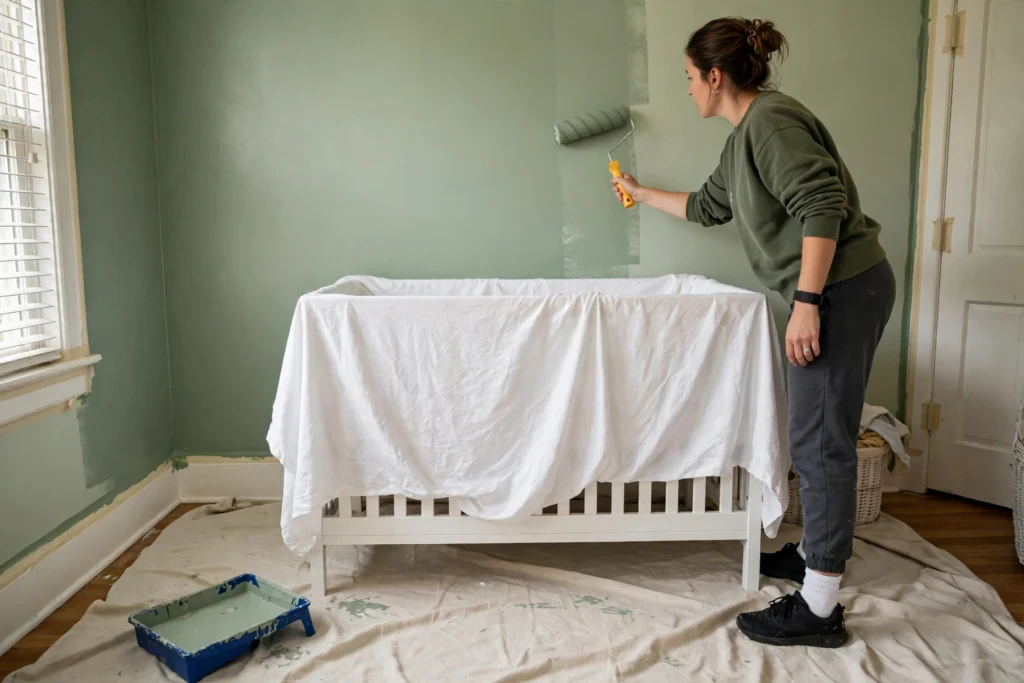
A tape-and-drop-cloth kit runs roughly $25–$45 as a rough planning estimate, not a quote. Canvas cloths beat plastic here: they stay put underfoot, absorb drips instead of pooling them, and can be washed and reused.
A half-face respirator with organic vapor cartridges costs about $30–$45 as a rough planning estimate, not a quote. Paper dust masks do not filter VOC gases, so if the painter is wearing one, they are protected from dust and nothing else. Fit matters: the respirator should seal around the nose and mouth, and cartridges should be fresh.
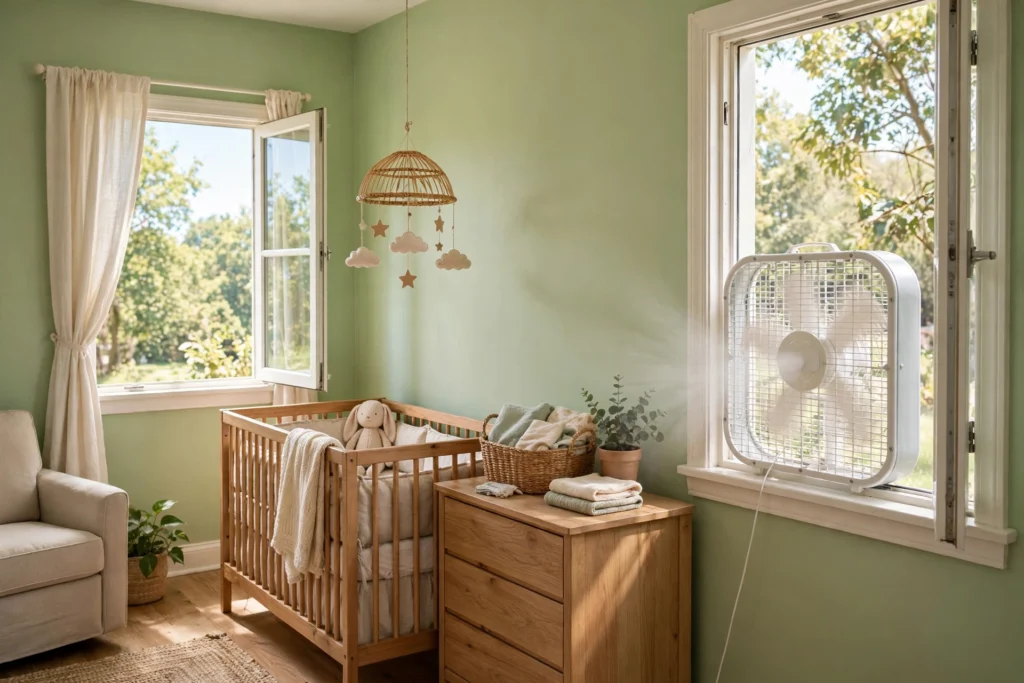
A sturdy box fan costs about $25–$40 as a rough planning estimate, not a quote. Set it in the window blowing outward, open a window on the opposite side of the room for intake, and keep it running continuously for days after painting, not just during the work.
How Long After Painting the Nursery Is It Safe for the Baby?
How long after painting the nursery it is safe for the baby depends on the paint type and the ventilation, and the honest answer has three milestones, not one. Dry means dry to the touch — usually 1–4 hours for water-based paint, and it means almost nothing for safety. Cured means the paint has reached full hardness — roughly 2–4 weeks for water-based paint. Safe for a newborn means off-gassing has dropped to a level where a baby can sleep in the room night after night — and that point comes after curing, not with it, which is why the 8-week buffer exists. Dry in hours, cured in weeks, safe in two months: three milestones, one timeline. Plan around the third one.
Use the wait-time table as your answer, then add the smell test and the sleeping plan. The minimum for zero-VOC paint is 72 hours of continuous ventilation, and the ideal is the full 8 weeks. For low-VOC and standard latex, plan on at least a week minimum and 8 weeks ideal. For oil-based or alkyd paint, 2–4 weeks minimum — but honestly, skip oil-based paint in a nursery entirely.
While the room airs out, where does the baby sleep? Work down this ladder: out of the home entirely is best, then the farthest room from the nursery, then a room with its supply vents closed. Do not put the crib in the next room with the vents open and call it done — fumes travel through ductwork.
One honest note on air purifiers: a HEPA filter catches particles, not gases, and VOCs are gases — so a HEPA-only purifier does not remove them. You need an activated carbon filter for VOCs. Run the purifier in the nursery during the airing period, and swap the home’s HVAC filter to MERV-13 after painting.
A room-size purifier with a genuine activated carbon filter typically costs about $120–$250 as a rough planning estimate, not a quote. Check that the carbon filter is a substantial bed of carbon, not a thin carbon-coated sheet, and budget for replacement filters every 6–12 months.
What About the Rest of the Non-Toxic Nursery?
Paint is only the first layer of the nursery air story. Furniture off-gasses too, and pressed wood and MDF are the worst offenders because of the formaldehyde in their adhesives. Solid wood furniture costs more but off-gasses far less — if MDF is what the budget allows, buy it early, unwrap it in a ventilated room, and let it air out on the same 8-week timeline as the paint. Look for GREENGUARD Gold certification on furniture and mattresses as well as paint. Go fragrance-free on everything else in the room — no plug-in air fresheners, no scented laundry products on crib sheets. Fragrance is just VOCs with better marketing.
Once the paint has cured and the room has aired, the next job is the post-paint cleanup: dust every surface, wash the floors, and swap that HVAC filter before the crib goes back in. That full cleanup routine is covered in our deep-cleaning checklist before baby, and the ventilation and air-quality side of the finished room — including carbon filters and safe humidity — is covered in our guide to nursery temperature and air quality.
The Budget, Honestly
Hiring the painting out is a fair option, and it fits this project well — the paint choice matters more than who holds the roller, as long as the painter uses the zero-VOC product you picked. A professional paint job for one nursery room typically runs about $400–$900 including labor and paint, as a rough planning estimate, not a quote. DIY with zero-VOC paint, tape, cloths, a respirator, and a box fan lands roughly around $200–$300 all-in, again as a rough planning estimate, not a quote. Either way, the 8-week clock starts the day the last coat goes on, so book the painter early — and if you are hiring it out, write “zero-VOC paint, zero-VOC colorant, GREENGUARD Gold” into the quote itself, so the crew cannot substitute a standard latex on the day.
All dollar figures in this post are rough planning estimates to help you budget, not quotes — actual prices vary by region, room size, and product.
True zero-VOC water-based paint (≤5 g/l) with GREENGUARD Gold certification is the safest default for a nursery. Check the VOC number for the tinted can, not just the base, and pair it with the 8-week airing rule. Low-VOC paint is the fallback when zero-VOC is not available, with a longer minimum wait.
Paint the nursery at least 8 weeks before your due date — Consumer Reports’ guidance, and the rule this post follows. That covers full cure plus the steepest part of off-gassing. If you are inside 4 weeks of the due date, the safest play is to skip painting until after the baby arrives and use a transition space for the first weeks home.
Not always — and that is the tint trap. Standard colorants add about 10 g/l on average and up to 100 g/l for deep, saturated colors. Ask for the tinted product’s VOC number on its safety data sheet, choose zero-VOC colorants where available, or keep bold colors to one accent wall.
Eggshell or a washable matte/satin finish on walls, and semi-gloss on trim, doors, and anything that gets touched. Eggshell is the sweet spot: low glare, soft on the eyes, and washable enough for the weekly wipe-down a nursery actually gets. Flat/matte hides imperfections best but is the hardest to clean.
Three checks: the calendar (8 weeks since painting for zero-VOC, longer for anything else), the smell test (close the room for an hour — no paint smell when you walk in), and the ventilation record (continuous airflow since painting, not a closed-up room). When all three pass, the room is ready for the crib.
Milk and chalk paints are generally low-VOC, which is a good starting point, but “natural” on the label does not automatically mean zero emissions — check the VOC number on the product data sheet. The trade-off is durability: these finishes scuff and mark more easily than standard latex. Use them for furniture and accent pieces, and give them the same cure time before the baby uses the room.
The same rules apply, plus cure time before the baby touches it. Paint furniture outdoors or in a ventilated garage, never in the nursery itself, and let each piece cure fully — 2–4 weeks for water-based paint — before it goes into the room. If you are repainting an older piece, check for lead paint first if it predates 1978, and never sand it yourself.
Final Thought
Painting the nursery is a small project with an outsized payoff: one weekend of work, done eight weeks early, with the right can, gives your baby the cleanest air in the house from night one. Pick true zero-VOC paint, keep the color light or the bold color small, ventilate like you mean it, and let the calendar do the last part of the job. The nursery does not need to be perfect. It needs to be painted early, painted safe, and aired out — and then you can spend the last weeks before the baby arrives on everything else, instead of watching paint dry.