Heat Pump Freezing Up in Winter: What’s Normal and What’s Not
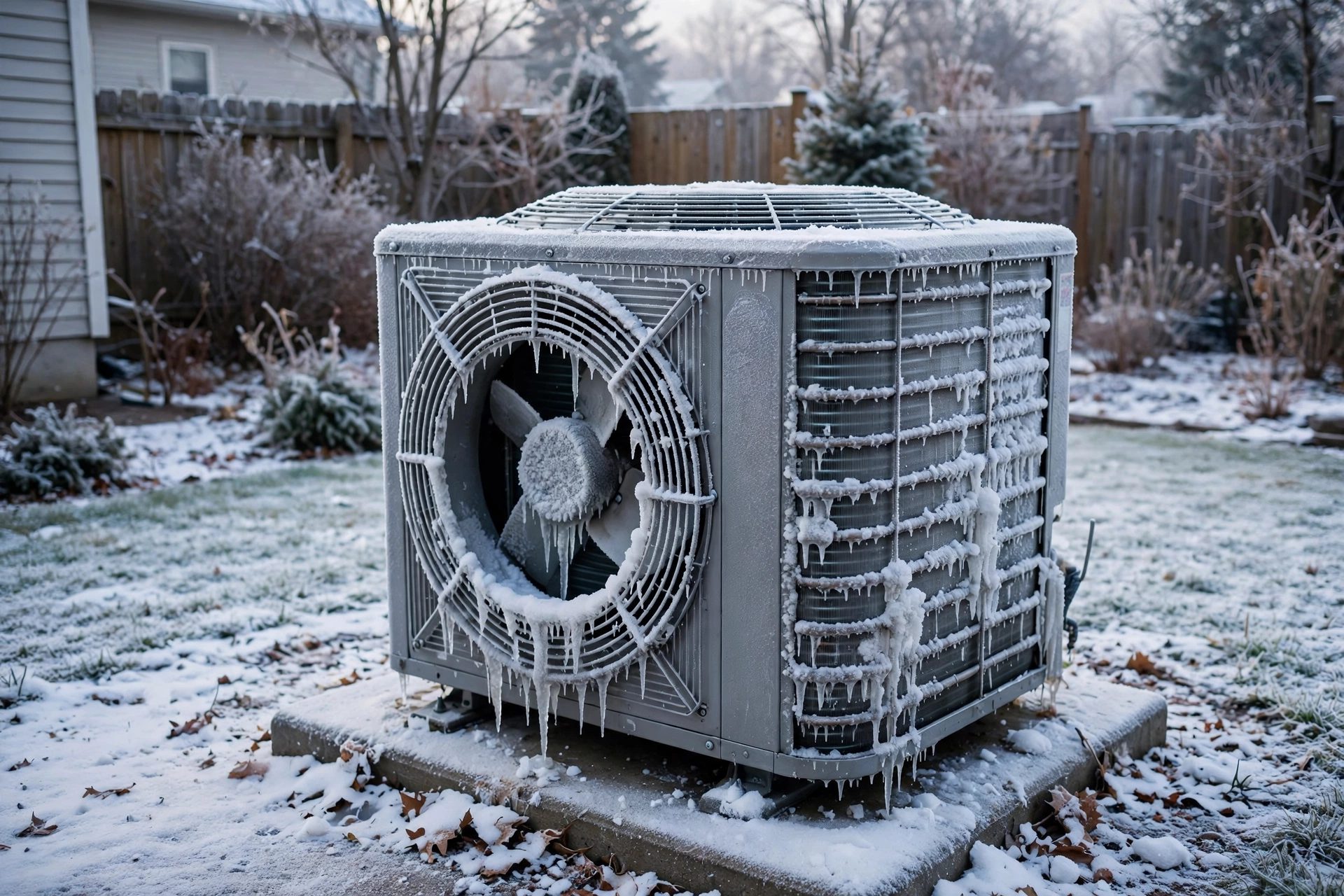
It’s 6:40 on a January morning, still dark, and the house feels wrong — that chill seeping through the blankets that says the heat isn’t keeping up. You step onto the back porch and there it is: your heat pump freezing up like a sculpture, frost feathered across the coils, icicles on the fan grille. Your stomach drops. Is it dying? Is it safe to keep running?
Take a breath. A frosted-over heat pump is often doing exactly what it was designed to do — including fixing itself. But not always. Once you know what to look for, you can read that ice like a diagnostic report.
TL;DR
Light, even frost on your heat pump’s outdoor coil in cold weather is normal — the unit runs a defrost cycle every 30–90 minutes to melt it off, and you may see steam and hear a whooshing sound while it does. What’s NOT normal: thick ice that never clears, ice caked on the top or fan, the unit encased after a full day, or ice forming when temperatures are mild. Safe DIY steps: keep 2 feet of clearance around the unit, clear snow and leaves, and check that gutters aren’t dripping onto it. Never chip ice off with tools or pour hot water on the coils. If the ice won’t clear on its own, the defrost cycle never kicks in, or your house keeps losing heat — that’s a failed sensor, low refrigerant, or a bad defrost board, and it needs a licensed technician.
Heat Pump Freezing Up: Why It Happens in the First Place
A heat pump doesn’t create heat the way a furnace does — it moves it. In winter, refrigerant in the outdoor coil runs colder than the outside air, absorbs heat from it, and the system pumps that heat indoors. (Our heat pump vs. furnace guide compares the two approaches in detail.)
Here’s the catch: when temperatures drop into the 30s, that super-cold coil pulls moisture from the air, which freezes on contact — like frost on a cold windshield. Damp 35°F air frosts a coil far faster than dry 20°F air.
That’s why every modern heat pump has a built-in defrost cycle. Frost isn’t a malfunction — it’s an expected condition the machine was engineered to handle.
What’s Normal: The Defrost Cycle in Action
Every 30 to 90 minutes of runtime, your heat pump briefly reverses into cooling mode for 5 to 15 minutes, sending hot refrigerant to melt frost off the outdoor coil. First-time owners find the following alarming, but it’s all normal:
- The outdoor fan stops. The unit goes quiet outside while the compressor keeps running.
- Steam rises from the unit. Melting frost turns to vapor in cold air. It looks dramatic — like the unit is smoking — but it’s just steam.
- A whooshing or groaning sound when the reversing valve shifts modes. Some units are louder than others; a brief swoosh is normal.
- The air from your vents feels cooler for a few minutes. The system is temporarily borrowing indoor heat to defrost. Most systems kick on backup heat strips during defrost so you barely notice.
Then the fan restarts, the steam clears, and the coil is clean. In very cold, damp stretches you might catch the unit mid-defrost with a thin, even layer of white frost — also fine, as long as it clears on the next cycle.
PRO TIP
The easiest way to learn your unit’s rhythm is to watch one full defrost cycle. Next time you see frost building, set a timer. If the frost melts off within 90 minutes and the cycle repeats, your system is healthy. If two hours pass and the ice is thicker than before, you’ve got your answer — something’s wrong.
Normal vs. Not Normal: Read the Ice
Here’s how to tell at a glance whether what you’re seeing is routine or a red flag:
| What you see | Normal | Not normal |
|---|---|---|
| Thin, even white frost on the coil | ✅ Clears during defrost | — |
| Steam rising during a cycle | ✅ Just melting frost | — |
| Brief whoosh when modes switch | ✅ Reversing valve | — |
| Thick ice that never melts off | — | ❌ Defrost isn’t working |
| Ice caked on the top, fan, or sides of the cabinet | — | ❌ Airflow blocked or drainage issue |
| Entire unit encased after a full day of running | — | ❌ System fault |
| Ice forming when it’s above ~40°F outside | — | ❌ Low refrigerant likely |
| Unit short-cycling or house losing heat | — | ❌ Get it checked |
The pattern to watch is persistence. Frost that comes and goes with the defrost cycle is the system breathing. Ice that only ever accumulates is the system suffocating.
What Causes Abnormal Freezing
When ice won’t clear, one of these is usually behind it:
Low refrigerant. This is the big one. A slow leak (refrigerant doesn’t get “used up”) makes the coil run colder than designed, freezing faster than the defrost cycle can handle. Icing in mild 40-degree weather is the classic symptom. Strictly a technician job — handling refrigerant requires EPA certification, and the leak must be found and repaired, not just topped off.
Failed defrost control. A temperature sensor triggers the cycle and a control board manages it. If either fails, the unit never defrosts — or defrosts constantly. Diagnosing it requires electrical testing inside the unit.
Blocked airflow. Leaves packed against the coil, a snowdrift buried against the cabinet, shrubs grown tight around the unit — anything that chokes airflow makes the coil colder and wetter. This is the most common cause and the easiest to fix yourself.
Dirty coils or a clogged indoor filter. Restricted airflow on either side throws off the heat-exchange balance — a filter unchanged since October can contribute to a January freeze-up. (It’s why a fall furnace maintenance checklist matters even for heat pump homes.)
Water dripping onto the unit. A gutter leaking directly above the heat pump, or a downspout discharging next to it, feeds a constant supply of water that freezes on contact. If the ice is worst on the top panel or one side, look up.
Stuck reversing valve. Rare, but if the valve that switches the unit into defrost sticks, the cycle can’t run and ice just builds.
What You Can Safely Do Yourself
Before calling anyone, work through this checklist — none of it requires opening the unit or touching anything electrical:
- Clear 2 feet of space on all sides. Pull back shrubs, rake away leaves, shovel snow drifts away from the cabinet. Do the same above — no overhanging branches dumping snow onto the top.
- Check your indoor air filter. A gray, clogged filter restricts indoor airflow — a silent contributor to outdoor icing.
- Look up. Is a gutter or roof meltwater dripping onto the unit? Redirect it if you can do so safely from the ground.
- Make sure water drains away from the base. Defrost meltwater must drain off — if the pad has settled and water pools underneath, it refreezes into ice that creeps upward.
- Give it one full cycle. After clearing obstructions, let the unit run for two hours and watch. If a defrost cycle kicks in and clears the coil, you likely solved it.
PRO TIP
Never chip ice off a heat pump with a screwdriver, hammer, or any tool. The coil fins are thin aluminum — one slip punctures the refrigerant line, turning a $0 fix into a $1,500+ repair. And never pour hot water on the unit: the thermal shock can crack components, and the water just refreezes into a worse block of ice.
Emergency heat works as a short-term bridge while you troubleshoot — but don’t live on it. It’s electric resistance heating at two to three times the hourly cost of the heat pump. Use it for a day, not the season.
When to Call a Professional
Call a licensed HVAC technician if any of these are true:
- Ice persists through multiple defrost cycles after you’ve cleared all obstructions
- The outdoor fan never stops for a defrost cycle (or you never hear the reversing valve switch)
- Ice forms when outdoor temperatures are mild (above ~40°F)
- Your home can’t hold temperature even with the system running constantly
- You suspect low refrigerant (ice plus weak heating is the classic pair)
Refrigerant work, defrost board replacement, sensor calibration, and reversing valve service all require a licensed tech — this isn’t a YouTube-and-a-wrench situation. If the simple fixes haven’t cleared it, call (380) 273-8167 or have a qualified HVAC technician diagnose it before ice damages the compressor: a $200 service call now beats a $2,000 compressor later.
Frequently Asked Questions
Is it normal for my heat pump to be covered in ice?
A thin, even frost layer that melts during the defrost cycle is normal. A thick encasement that never clears is not — that signals defrost failure, low refrigerant, or blocked airflow.
Why is steam coming out of my heat pump?
That’s the defrost cycle doing its job. Hot refrigerant melts frost off the outdoor coil, and the meltwater vaporizes into steam in the cold air. It looks alarming but it’s routine, and it should stop within 5–15 minutes.
Can I pour hot water on my frozen heat pump?
Don’t. The sudden temperature change can damage components, and the water refreezes — often into a thicker, worse ice block than you started with. Clear snow and debris around the unit instead, and let the defrost cycle do the melting.
How long should a defrost cycle take?
Typically 5 to 15 minutes, every 30 to 90 minutes of heating runtime. If your unit runs for hours in freezing weather without ever entering defrost, the control or sensor needs professional attention.
Should I turn off my heat pump if it’s frozen?
If ice is severe enough that the fan can’t turn or the coil is fully blocked, turn the system off and switch to emergency heat temporarily to prevent compressor damage — then get it serviced. Light frost that cycles normally is no reason to shut anything down.
Will running a frozen heat pump damage it?
Running with heavy ice restricts airflow and forces the compressor to work harder, which can overheat it and shorten its life. A frosted unit in normal defrost rhythm is fine; an ice-encased unit grinding away for days is asking for a compressor failure.
Key Takeaways
- Light, even frost that melts off every 30–90 minutes is a normal part of heat pump operation in winter.
- Steam, a stopped outdoor fan, and a brief whooshing sound mean the defrost cycle is running — all normal.
- Thick, persistent ice, ice on the cabinet top or fan, or icing in mild weather are warning signs of low refrigerant, defrost control failure, or blocked airflow.
- Safe DIY: clear 2 feet around the unit, replace a dirty filter, redirect dripping water, and give it one full cycle to recover.
- Never chip ice with tools or pour hot water on the coils — you’ll cause expensive damage.
- Persistent icing after the basics needs a licensed technician; refrigerant and electrical repairs aren’t DIY territory.