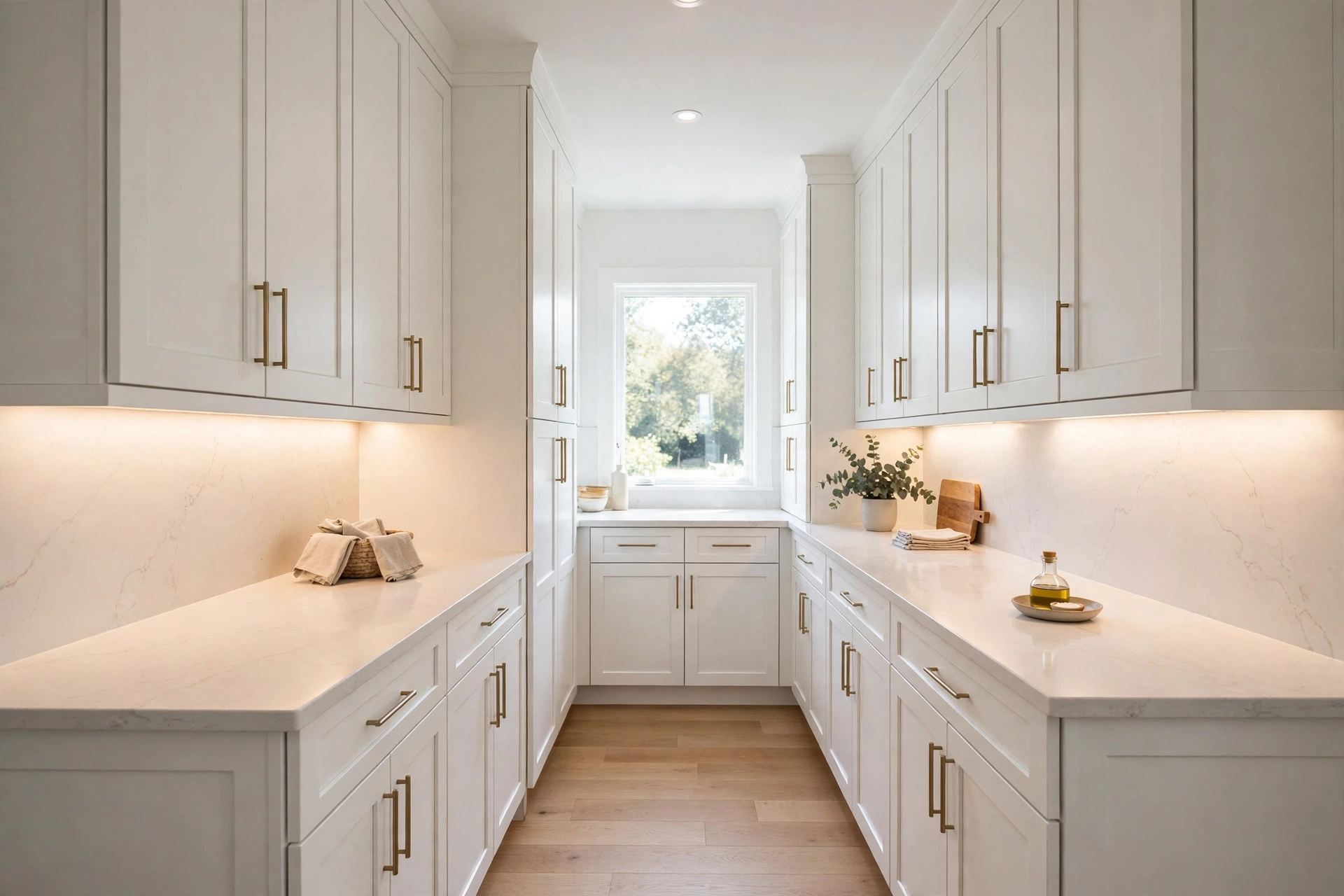
Cabinet Refacing for Small Kitchens: Make a Tiny Kitchen Feel Bigger
TL;DR
Cabinet refacing for small kitchens makes a tiny kitchen feel bigger without moving walls: light colors, glass uppers, slim bar pulls and under-cabinet lighting, all fitted to the existing boxes. A small-kitchen reface costs $3,000–$7,000 against $10,000–$25,000 for replacement, and takes 3–7 days.
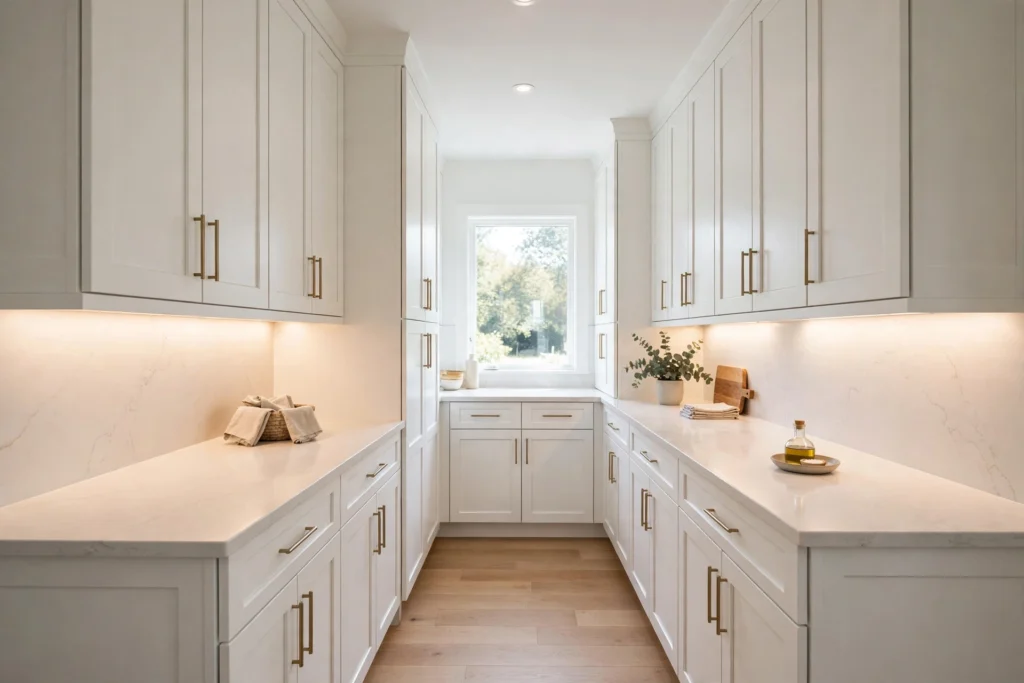
A small kitchen does not need more square feet — it needs better surfaces. Cabinet refacing for small kitchens swaps the doors, drawer fronts and veneer for light, reflective finishes while the boxes stay put, and the room feels bigger the same week. Prices below are rough planning estimates, not quotes. For the money side first, start with our guide to kitchen cabinet refacing cost.
Is Cabinet Refacing for Small Kitchens Worth It?
Yes — cabinet refacing for small kitchens is worth it when the boxes are sound, because it changes every visible surface for $3,000–$7,000 instead of $10,000–$25,000 for replacement. Light colors, glass uppers and slim hardware make the room feel bigger without moving a single wall. It takes 3–7 days, not weeks.
Refacing wins in a small kitchen because the surfaces are everything: in a galley kitchen, the cabinets are the whole room. Cabinet refacing for small kitchens replaces the entire visible skin — doors, drawer fronts, veneer, hardware —
while the layout stays put. See the transformations in our cabinet refacing before and after gallery.
What Colors Make a Small Kitchen Look Bigger?
Light colors make a small kitchen look bigger: whites, warm whites, light greige and pale sage reflect light and push the walls back visually. Houzz 2026 data shows 28% of kitchens choose white cabinets. Two-tone works too — white uppers with darker lowers keep the room bright while grounding it.
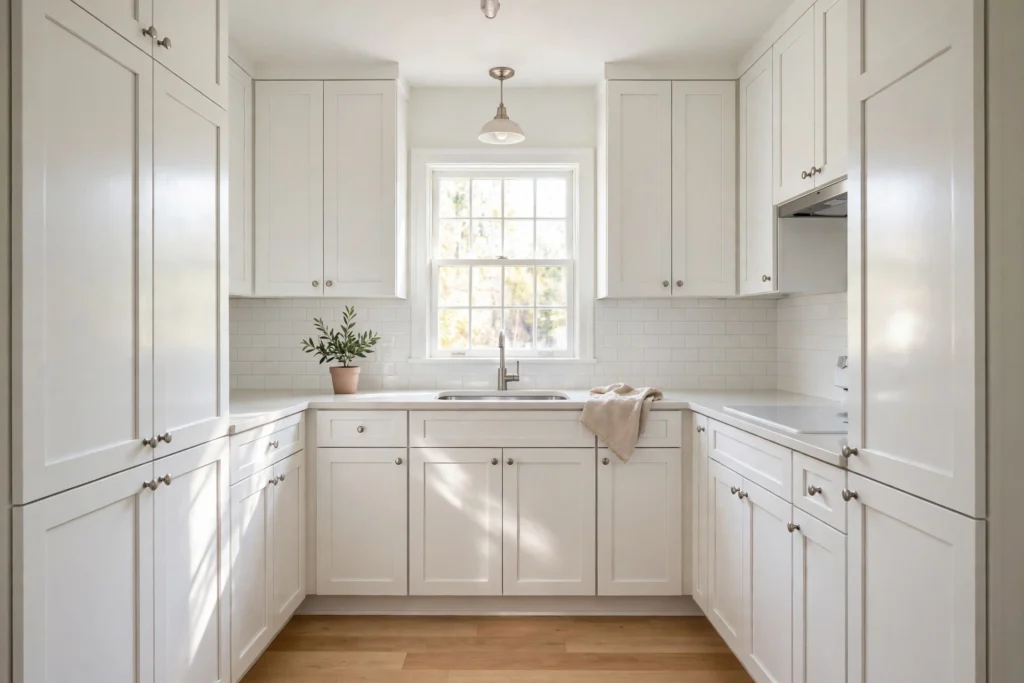
White is the default for a reason: it reflects the most light and makes the walls read as farther away than they are. Warm white — a white with a hint of cream — suits most homes better than a cold blue-white, which can feel clinical under LED light. Light greige hides fingerprints better than pure white, and pale sage adds color without darkening the room. Cabinet refacing for small kitchens leans on these light shades because the color is doing structural work: it is the light in the room, not just the decoration.
| Color | Feel | Best for |
|---|---|---|
| Warm white | Bright, clean, timeless | Any small kitchen |
| Light greige | Warm, hides fingerprints | Family kitchens |
| Pale sage | Soft color, calm | Natural, rustic homes |
| White uppers + navy lowers | Bright top, grounded base | Two-tone fans |
| White uppers + greige lowers | Bright top, warm base | Small galley kitchens |
Cabinet refacing for small kitchens with a two-tone scheme gets the depth of a colored kitchen without giving up the brightness a small room needs.
Should Small Kitchens Use Glass-Front Upper Cabinets?
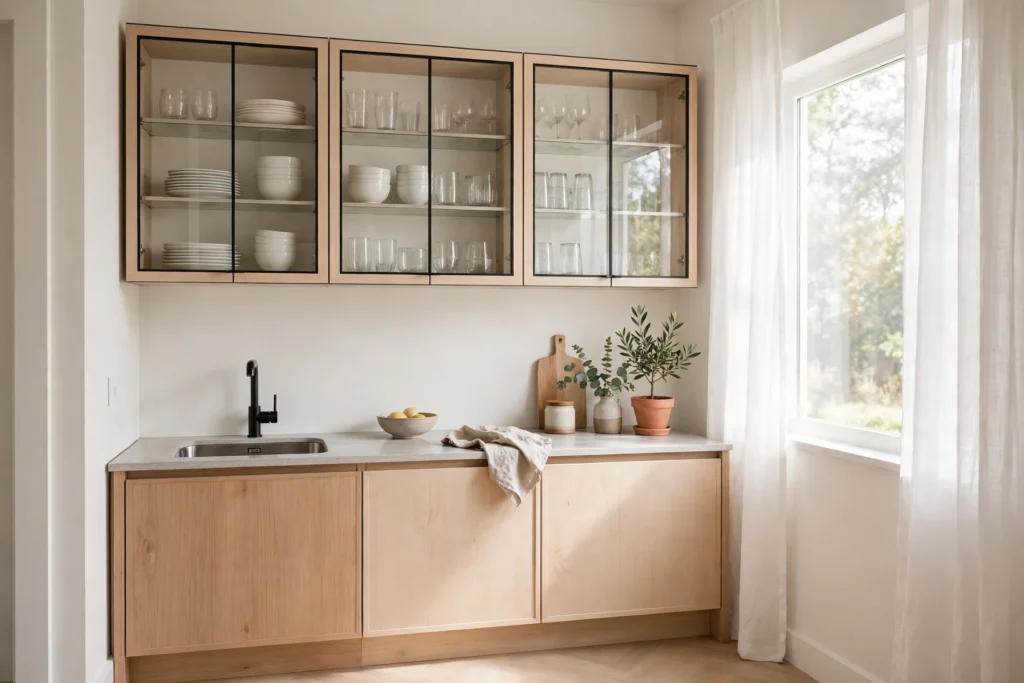
Yes — glass-front upper cabinets make a small kitchen feel larger by breaking up a solid wall of doors and letting the eye travel deeper. Use them on one or two uppers, not every cabinet, and keep the shelves neat. Frosted glass hides clutter while keeping the open feel.
A solid wall of upper cabinets is the heaviest thing in a small kitchen: it is a flat, unbroken surface that stops the eye at the wall. Glass fronts break that wall open — the eye travels past the door into the cabinet, and the room reads as deeper than it is. Cabinet refacing for small kitchens uses glass on the uppers for exactly this reason, and the effect is strongest in a galley kitchen, where the two walls face each other across a narrow gap.
PRO TIP
Put glass fronts on the uppers farthest from the stove, not above it. Grease and steam cloud glass fast, and the cabinet over the stove is the hardest to keep clean — save the glass for the display end of the kitchen, where it stays clear.
What Door Style Works Best in a Small Kitchen?
Flat-panel or Shaker doors work best in a small kitchen because their clean, simple lines do not fight for attention and they reflect light well. Avoid raised panels and heavy ornament, which make small rooms feel busy. A satin or semi-gloss finish reflects more light than matte.
Shaker is the default small-kitchen door for good reason: a square frame, a flat center panel, and nothing else. It suits almost any home, it takes paint well, and it never dates the way ornate styles do. Flat-panel doors are the modern alternative — completely smooth, with no frame at all — and they make the smallest kitchens look the most open, because there is nothing for the eye to catch on. Cabinet refacing for small kitchens should pick one of these two and stop there; the door style is not the place to be adventurous in a small room.
Finish matters as much as style: a satin or semi-gloss finish reflects light around the room and wipes clean easily. Read our guide to cabinet refacing materials before choosing a finish.
How Do You Add Storage While Refacing a Small Kitchen?
Add storage while refacing a small kitchen with pull-out organizers, a lazy Susan in the corner, tray dividers, and a pull-out spice rack — each costs $25–$80 and fits inside the existing boxes. Deep drawers beat deep cabinets, because you can see and reach everything without kneeling.
The boxes stay, but the insides can change completely — and that is the hidden win of refacing a small kitchen. A pull-out organizer turns a deep base cabinet from a dark cave into a drawer you can see into; a lazy Susan rescues the corner cabinet that currently holds nothing; tray dividers stand baking sheets upright instead of stacked. Each organizer costs $25–$80, and three or four of them transform how the kitchen works without adding a single square foot. Cabinet refacing for small kitchens is the right moment to add them, because the doors are already off and the insides are already accessible.
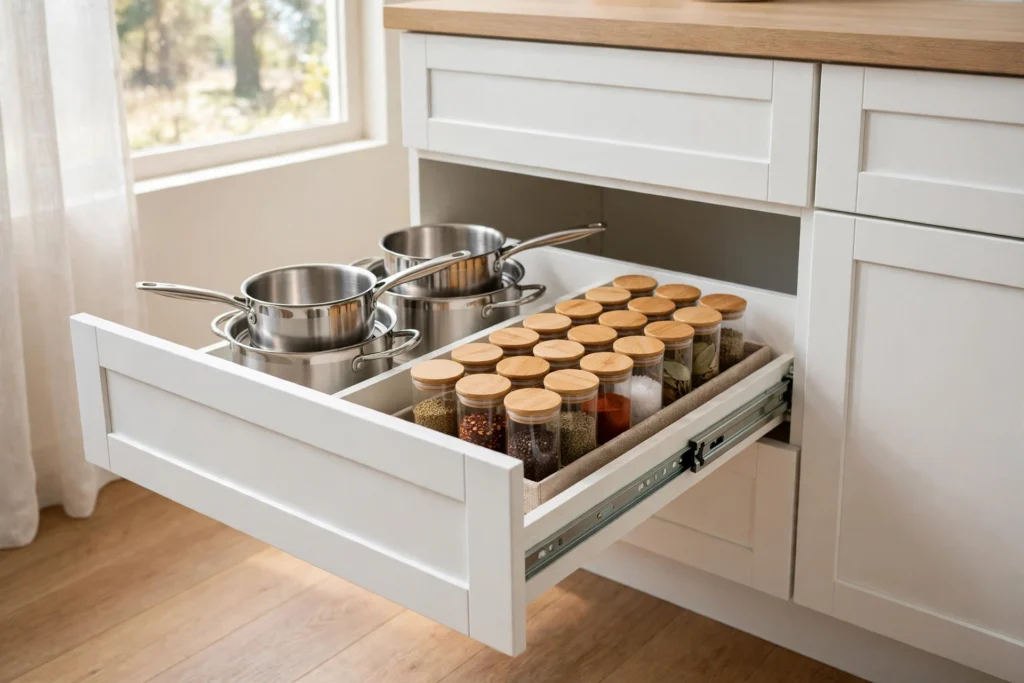
Deep drawers are the other upgrade worth the money: a deep drawer full of pots beats a deep cabinet, because you pull it out and see everything at once. Cabinet refacing for small kitchens that adds storage in the same job gets two upgrades for one disruption.
What Hardware Makes a Small Kitchen Feel Larger?
Slim bar pulls make a small kitchen feel larger because their long, clean lines draw the eye horizontally and make the cabinets look wider. Choose one finish — brass, matte black or brushed nickel — and use it on every door and drawer. Small knobs make the cabinets look smaller.
Hardware is the highest-return change in a small kitchen: it costs little, it goes on last, and it changes how every door reads. Slim bar pulls — long, thin bars mounted horizontally on drawers and vertically on doors — stretch the eye sideways and make a narrow cabinet look wider. Match the finish to your faucet and keep one finish throughout; the right veneer keeps new hardware sitting flush. Cabinet refacing for small kitchens with slim bar pulls reads as intentional and modern, while the small round knobs that came with the original cabinets read as an afterthought.
PRO TIP
Fit the hardware last, after the new doors are hung and adjusted. Doors shift slightly as hinges settle in the first week, and hardware fitted too early ends up out of line — a crooked pull is the first thing the eye catches in a small kitchen.
Under-cabinet lighting is the other half of the hardware story: warm LED strips under the uppers wash light down the backsplash and make pale doors glow. LED strips cost $20–$50 and fit during the reface.
How Much Does Refacing a Small Kitchen Cost?
Refacing a small kitchen costs $3,000–$7,000, against $10,000–$25,000 for full replacement — a saving of roughly 50–70%. Pull-out organizers add $25–$80 each and under-cabinet LED strips add $20–$50. Get two quotes and compare them line by line before you commit.
The small size is what keeps the price down: fewer doors and drawer fronts mean less material and fewer days of labor. A galley kitchen with 10–12 doors refaces for $3,000–$5,000, while an L-shaped small kitchen with 15–18 doors runs $5,000–$7,000. Compare that with replacement at $10,000–$25,000 and weeks of disruption — the reface is the value play, and the saving is what pays for the organizers and the lighting. For the full cost picture, see our guide to kitchen cabinet refacing cost before you call anyone for a quote.
| Option | Rough cost (planning estimate, not a quote) | Time |
|---|---|---|
| Refacing (small kitchen) | $3,000–$7,000 | 3–7 days |
| Refinishing | $1,500–$5,000 | 2–4 days |
| Full replacement | $10,000–$25,000 | 3–6 weeks |
| Pull-out organizers (each) | $25–$80 | Fitted during reface |
| Under-cabinet LED strips | $20–$50 | Fitted during reface |
Get at least two quotes and compare them line by line, and ask whether the quote covers the inside edges of the face frames. Cabinet refacing for small kitchens is a small job, so a bad quote stands out fast.
What Mistakes Make a Small Kitchen Feel Smaller After Refacing?
The mistakes that make a small kitchen feel smaller after refacing are dark colors on every cabinet, heavy ornate doors, mixed hardware finishes, and skipping the lighting. Dark lowers are fine, but dark uppers close the room in. One finish, one palette, and light on every work surface.
Dark uppers are the biggest mistake: a small kitchen with navy or charcoal on every cabinet feels like a box, however fashionable the color is. Dark lowers are fine — they ground the room and hide scuffs — but the uppers must stay light. Cabinet refacing for small kitchens needs one finish, one palette, and one door style, repeated everywhere.
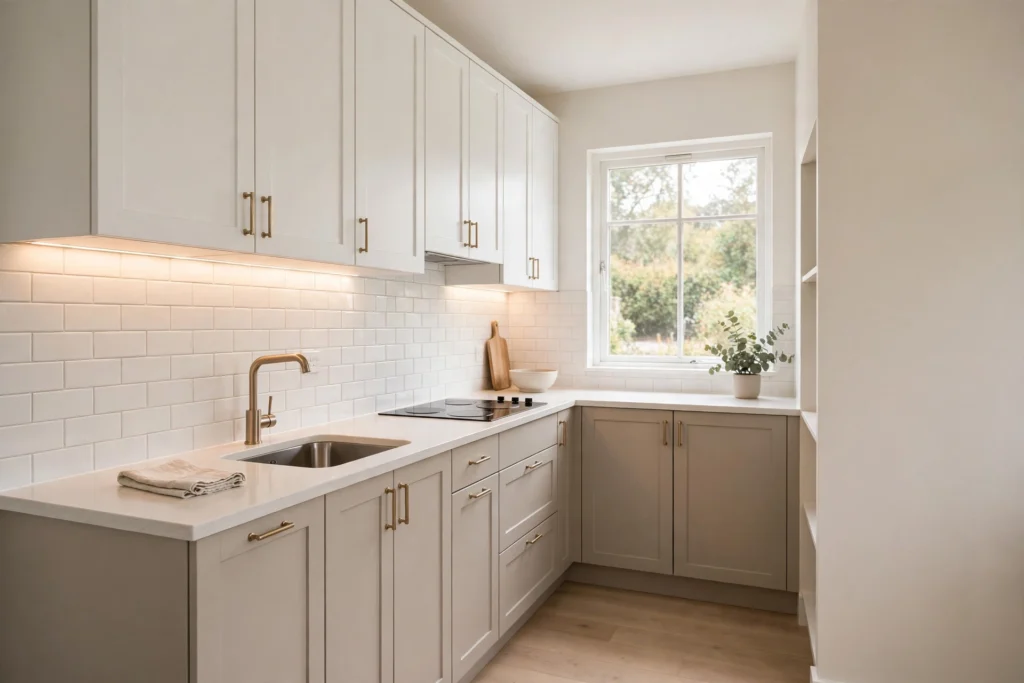
Skipping the lighting is the third mistake: a small kitchen with new pale doors and no under-cabinet light still looks dim. Leave the counters clear, keep the glass uppers neat, and let the light colors do the work.
Frequently Asked Questions
Is cabinet refacing good for a very small kitchen?
Yes — cabinet refacing for small kitchens is often the best value upgrade, because the room is small so the cost stays low while the visual change is total. It works when the boxes are sound, square and dry; warped or water-damaged boxes need repair or replacement first.
What is the best color for a small kitchen?
Warm white is the safest pick: it reflects the most light, suits any home, and never dates. Light greige hides fingerprints better, and pale sage adds gentle color.
Can you reface cabinets yourself in a small kitchen?
You can replace doors and hardware yourself, but veneer is a pro job — it needs clean adhesion and trimming that shows every mistake. Cabinet refacing for small kitchens is a tempting DIY, but the veneer makes or breaks the result.
How long does cabinet refacing take in a small kitchen?
A small-kitchen reface takes 3–5 days, against 3–7 days for a full-size kitchen. Cabinet refacing for small kitchens is faster because there are fewer doors — a galley kitchen with 10–12 doors is often done in three days, and you can usually keep using the kitchen throughout.
Does refacing add value to a small kitchen?
Yes — refacing makes the kitchen look new for roughly half the price of replacement, and in a small kitchen the return is stronger because the reface cost is lower.
What should I avoid when refacing a small kitchen?
Avoid dark uppers, heavy ornate doors, mixed hardware finishes, and skipping under-cabinet lighting. Keep one finish, one palette and one door style throughout, leave the counters clear, and let the light colors and the lighting do the work.
Final Thought
A small kitchen does not need a bigger footprint — it needs lighter surfaces, cleaner lines and smarter storage, and refacing delivers all three in under a week. Pick warm white or light greige, add glass to one or two uppers, fit slim pulls and LED strips, and keep the counters clear. Cabinet refacing for small kitchens is the rare upgrade that makes the room feel bigger, work better and cost half of replacement — all without moving a single wall.