Cabinet Refacing vs Replacement
TL;DR
Cabinet refacing vs replacement comes down to one question: are your boxes solid and your layout good? Refacing keeps the boxes and swaps only the doors, drawer fronts, and veneer — $4,000–$9,500, done in 3–5 days. Replacement tears everything out and installs brand-new cabinets — $15,000–$50,000+, taking 4–10 weeks. Reface when the boxes are sound and you like the layout; replace when the boxes are damaged, the layout is wrong, or you are remodeling anyway. Refacing typically recovers 70–80% of its cost at resale.
Cabinet refacing vs replacement is the decision that decides whether your kitchen project costs $6,000 or $30,000 — and most homeowners make it backwards, starting with the look they want instead of the condition of the boxes they already own. The boxes are the whole decision. If they are solid and the layout works, refacing delivers a visibly new kitchen in under a week for 30–50% less than replacement. If they are water-damaged or the layout fights you every day, no amount of new doors fixes the problem, and replacement is the honest answer. This guide compares the two on cost, timeline, value, and disruption, then gives you a five-question test that points to the right one for your kitchen.
Cabinet Refacing vs Replacement: What Is the Difference?
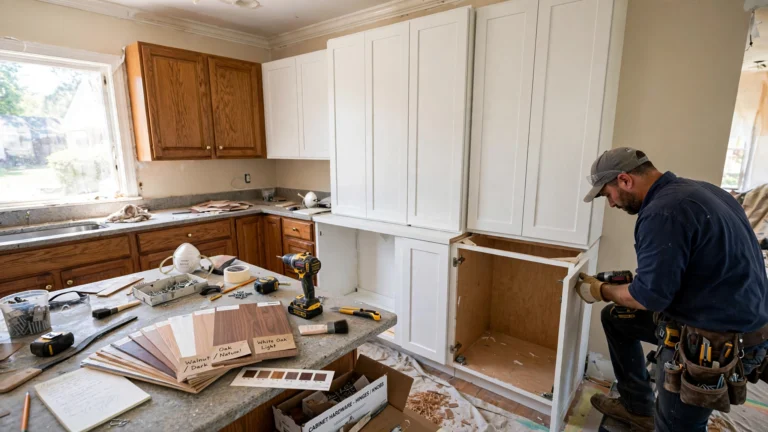
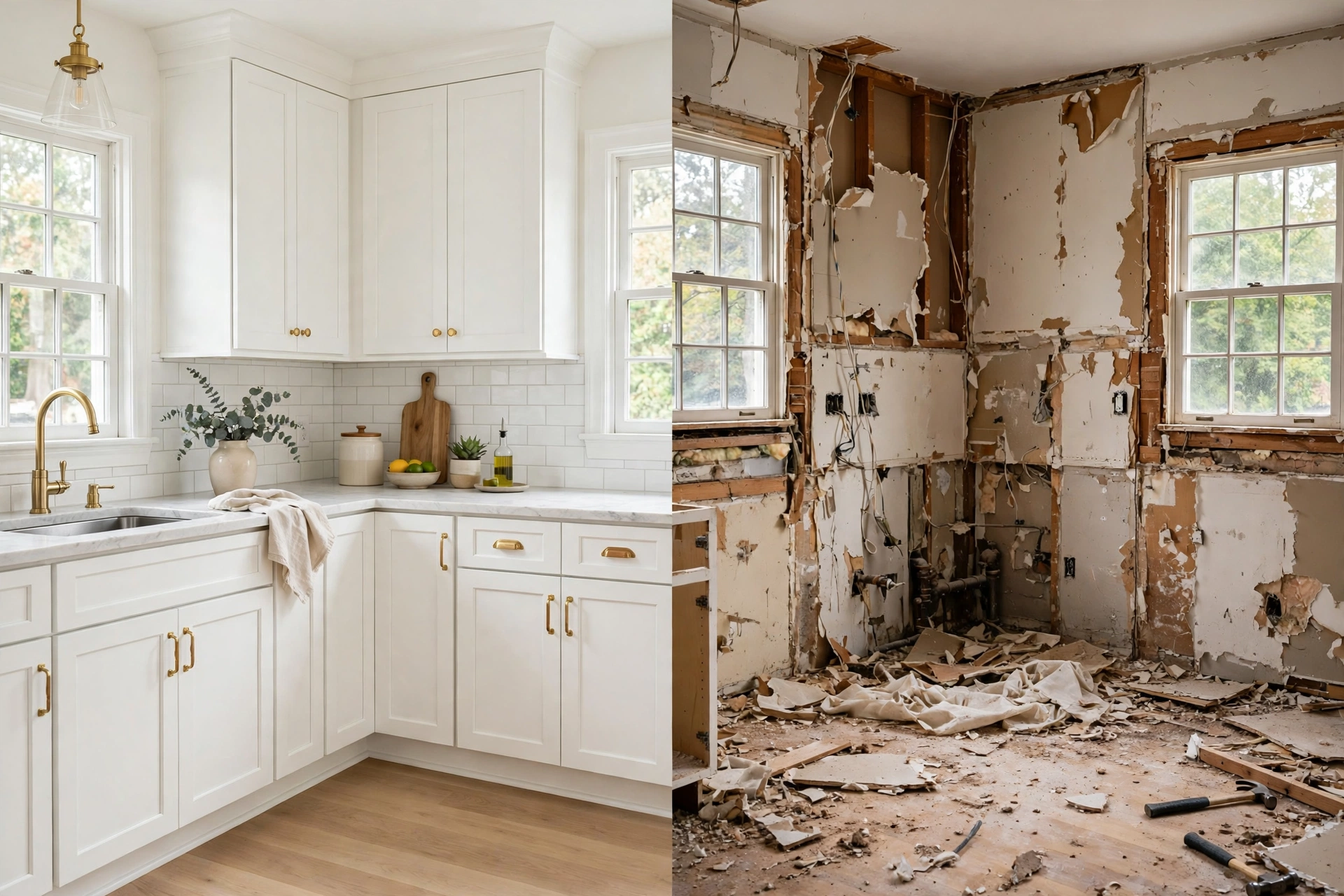
Cabinet refacing vs replacement starts with a simple physical difference: refacing keeps your cabinet boxes and swaps only the doors, drawer fronts, and a matching veneer skin over the exposed frames; replacement tears out everything — boxes, doors, hardware, and often the counters — and installs brand-new cabinets in their place.

Refacing is a surface transformation. The crew removes the doors and drawer fronts, sands and veneers the face frames and end panels, hangs new doors with new hinges, and adds new pulls. The boxes, the layout, the plumbing, and the counters stay exactly where they are. Replacement is a construction project: demolition, possible wall and plumbing changes, new boxes ordered to size, installation, and then counters, backsplash, and flooring touch-ups. The difference shows up in every number that follows — cost, timeline, mess, and what you can change.
How Much Does Cabinet Refacing Cost Compared to Replacement?
Cabinet refacing vs replacement on cost is not close: refacing runs $4,000–$9,500 for a typical kitchen (national average about $8,250), while replacement runs $15,000–$50,000+, making refacing roughly 30–50% cheaper for a comparable look.
The gap is the boxes. Refacing reuses them, so you are paying for doors, veneer, hardware, and a few days of labor. Replacement buys new boxes, pays for demolition and disposal, and usually triggers counter and backsplash work that is not in the cabinet quote at all. A homeowner who paid $38,000 for a refacing quote from a franchise sales pitch — later discounted to $24,000 — was quoted replacement money for a refacing job; at that price, brand-new semi-custom cabinets cost the same, and refacing has lost its only advantage. The full breakdown of what a fair reface costs is in the kitchen cabinet refacing cost guide, which prices the same job by size, material, and region.
| Factor | Refacing | Replacement |
|---|---|---|
| Typical cost | $4,000–$9,500 | $15,000–$50,000+ |
| National average | ~$8,250 | ~$25,000+ (semi-custom) |
| What you pay for | Doors, veneer, hardware, labor | New boxes, demolition, install, counters |
| Timeline | 3–5 days | 4–10 weeks |
| Kitchen usable during work | Yes, mostly | No — often weeks without a kitchen |
| Layout change possible | No | Yes — walls, plumbing, appliances |
| Resale recovery | 70–80% of cost | 50–70% of a full remodel |
| Best for | Solid boxes, good layout | Damaged boxes, bad layout, full remodel |
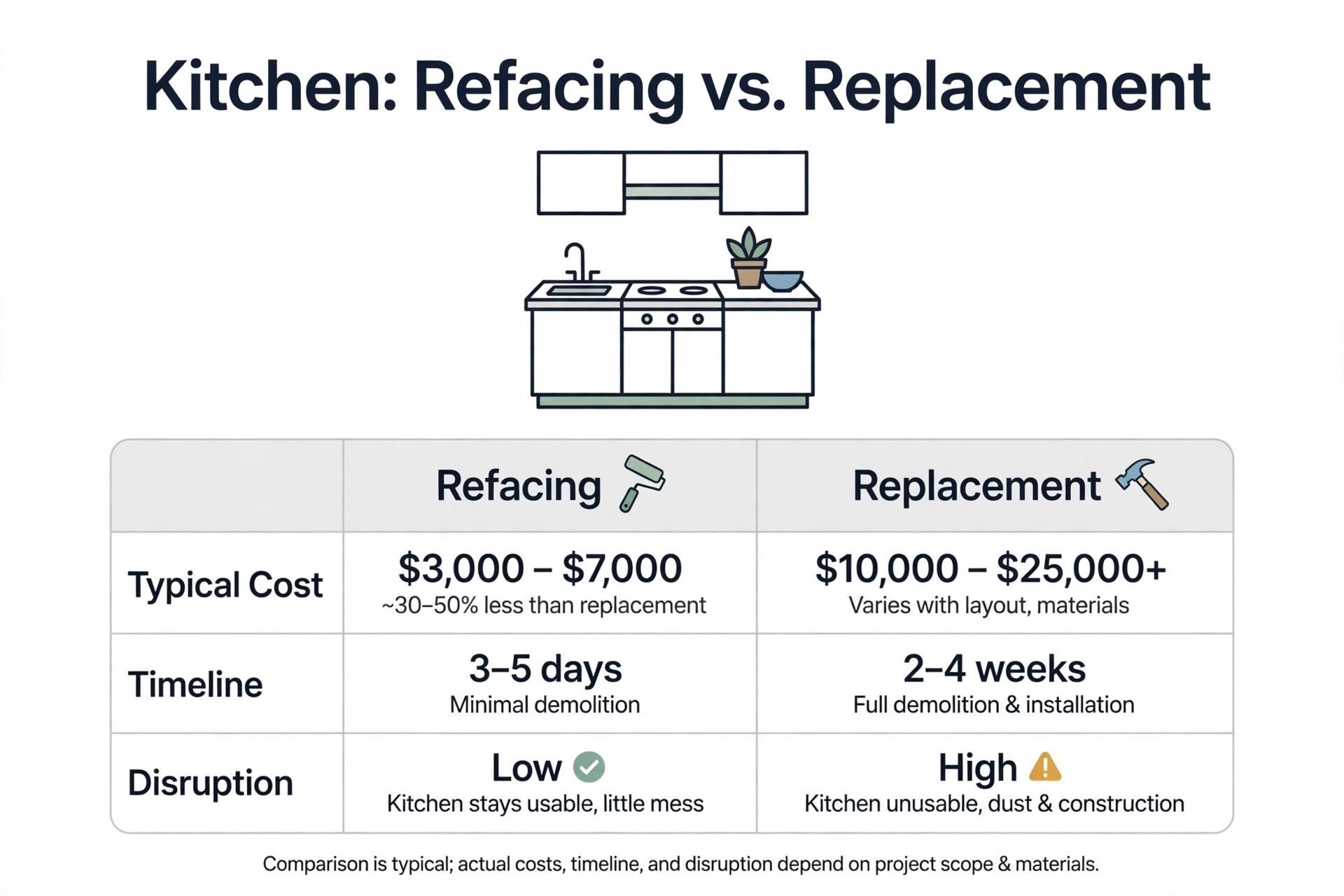
All prices are rough planning estimates, not quotes — get three itemized quotes before deciding, and compare them line by line.
How Long Does Each Option Take?
Refacing takes 3–5 days; replacement takes 4–10 weeks including demolition, ordering, and install — and the difference is not just the calendar, it is how long you live without a working kitchen.
A reface runs like this: day one, doors come off and frames are prepped; days two to four, veneer goes on and new doors are hung; day five, hardware and touch-ups. Your counters stay on, your sink works, and you can cook most nights. Replacement runs like this: demolition (1–2 days), a wait for new cabinets to be built and shipped (2–6 weeks), installation (1–2 weeks), then counters templated and installed (another 1–2 weeks after that). Most families eat out or live on a microwave for a month. If you work from home or have small children, that disruption is a real cost that never appears in the quote — budget it honestly before you choose.
Is Cabinet Refacing Worth It?
Yes — cabinet refacing is worth it if your boxes are solid and the layout works; no, if the boxes are water-damaged, warped, or you need a new layout. The worth-it test is the boxes, not the doors.
Reface when the boxes are structurally sound — solid wood or 3/4-inch plywood, no sagging, no water damage under the sink — and the layout genuinely works for how you cook. You get a visibly new kitchen in under a week for 40–50% less than comparable new cabinets, and buyers at resale see new doors, not old boxes. Do not reface when the boxes are swollen MDF, the drawers are broken, or the quote climbs into replacement territory. A Facebook thread from August 2026 put it bluntly: a master cabinet maker’s spouse warned that refacing “costs nearly as much as new cabinets and can reveal structural problems” — and that is exactly what happens when the boxes are bad. The reface exposes the damage instead of fixing it, and you have paid refacing money for a kitchen that still needs replacing.
When Is Replacement the Better Choice?
Replacement is the better choice when the boxes are damaged, the layout has to change, or a full remodel is happening anyway and demolition is already on the schedule. Those are the three cases where refacing cannot do the job.

Damaged boxes are the clearest case: water damage under the sink, swollen MDF, warped sides, or drawers that will not stay on their runners. Veneer covers faces; it does not repair structure. Layout changes are the second: if you want an island, a moved sink, or a wall taken down, only replacement moves plumbing and appliances. And the third is the full remodel: if counters, flooring, and appliances are being replaced anyway, the marginal cost of new boxes is small, and keeping old boxes inside a brand-new kitchen is false economy. In all three cases, get the replacement quote first — it is the honest baseline, and it stops a refacing salesperson from selling you a surface fix for a structural problem.
Does Refacing Add the Same Home Value as Replacement?
Refacing typically recovers 70–80% of its cost at resale, often beating major remodels on return — and it reads as “new cabinets” to buyers, which is precisely the point. Replacement of a whole kitchen recovers less as a percentage, because the spend is so much larger.
Appraisers and buyers do not open a cabinet door and check whether the box is original. They see new doors, new hardware, and a modern finish, and they price the kitchen accordingly. A $7,000 reface that recovers 70–80% returns $4,900–$5,600 at sale; a $30,000 replacement that recovers 50–60% returns $15,000–$18,000 but cost four times as much to get there. The percentage favors refacing; the absolute dollars favor replacement only if the kitchen was genuinely failing. Do not expect a dollar-for-dollar return from either one — kitchen updates typically recoup a portion of cost at sale, and the best return comes from the smallest spend that fixes what buyers actually notice.
Can You Change Your Kitchen Layout With Refacing?
No — refacing keeps your existing footprint; only replacement moves walls, plumbing, and appliances. This is the hard limit of refacing, and it is the question that decides the most projects.
Refacing changes what the kitchen looks like. It cannot change where the sink is, whether the fridge opens into a wall, or whether two people can work in the kitchen at once. If the layout is the problem — the workflow, the storage, the traffic — new doors will not fix it, and a year later you will be looking at the same frustrating kitchen with prettier doors. Be honest about this before you sign: stand in the kitchen and cook a real meal in your head. If the frustration is the look, reface. If the frustration is the layout, replace. No veneer in the world moves a sink.
Which Option Should You Choose? A 5-Question Test
Answer these five questions honestly, and the right option picks itself — three or more answers pointing one way is your decision.
1. Are the boxes solid? Open every cabinet. Look for water damage under the sink, swollen MDF, sagging shelves, and drawers that stick. Solid boxes point to refacing; damaged boxes point to replacement.
2. Does the layout work? Cook a meal in your head, start to finish. If the workflow is fine and only the look is dated, reface. If the layout fights you, replace.
3. What is the budget? Under $10,000 points to refacing; $15,000–$50,000 is replacement territory. A refacing quote above $13,000 should trigger a replacement quote before you sign anything.
4. How much disruption can you live with? A few days of light work points to refacing; a month without a kitchen is the price of replacement, and it is a real cost for families with small children or home offices.
5. What are the resale plans? Selling in the next few years points to refacing — 70–80% recovery on a small spend beats a big remodel’s percentage. Staying for decades and remodeling once points to replacement, done properly, once.
Score it simply: mostly refacing answers, reface. Mostly replacement answers, replace. Split down the middle, get three itemized quotes for each option and let the numbers decide — and refuse any “today-only” price on principle, because a real price survives a night’s sleep.

Frequently Asked Questions
Is it cheaper to reface or replace cabinets?
Refacing is cheaper — $4,000–$9,500 for a typical kitchen versus $15,000–$50,000+ for replacement, roughly 30–50% less. The gap is the boxes: refacing reuses them, replacement buys new ones and pays for demolition. A refacing quote above $13,000–$16,000 should trigger a replacement quote, because at that level new cabinets often cost the same.
How long do refaced cabinets last compared to new cabinets?
About the same — 15–20 years with quality materials and professional installation, because lifespan depends on the doors and veneer, not the old boxes. The weak point is cheap thermofoil or vinyl veneer, which can start peeling in about 5 years near heat and moisture; real wood veneer and solid wood doors age far better.
Can refacing fix water-damaged cabinets?
No. Veneer covers faces; it does not repair structure. Water-damaged, swollen, or warped boxes need replacement — refacing them exposes the damage instead of fixing it, and you pay refacing money for a kitchen that still needs replacing.
Does refacing increase home value as much as replacement?
As a percentage, refacing usually does better — 70–80% cost recovery versus 50–70% for a full remodel — because the spend is so much smaller. Buyers see new doors and price the kitchen accordingly. In absolute dollars, replacement returns more, but it costs four times as much to get there.
Should I reface or replace if I am remodeling the whole kitchen?
Replace. If counters, flooring, and appliances are being replaced anyway, the marginal cost of new boxes is small, and keeping old boxes inside a brand-new kitchen is false economy. Refacing makes sense as a standalone project, not as one trade inside a full remodel.
How do I get a fair price for either option?
Get three itemized quotes for the option you are considering — doors, veneer, hardware, and labor listed separately — and always get one quote for the other option as a baseline. Refuse sign-today pricing, ask who actually does the install, and get the warranty in writing before you sign.
Final Thought
Cabinet refacing vs replacement is not a style choice — it is a boxes choice. Solid boxes and a good layout mean refacing: $4,000–$9,500, 3–5 days, 70–80% back at resale. Damaged boxes or a bad layout mean replacement: $15,000–$50,000+, 4–10 weeks, and a kitchen that actually works differently when it is done. Run the five-question test, get three quotes for the winner, and one quote for the loser as a baseline — then decide with numbers, not with a sales pitch. For the numbers behind the reface side of that decision, the kitchen cabinet refacing cost guide breaks down the same job by size, material, and region.