Pet Safe Ant Killer
TL;DR
A pet safe ant killer is one that kills the colony without letting your pet reach the active ingredient: enclosed tamper-resistant bait stations placed where pets cannot reach, gel baits deep in cracks, and food-grade diatomaceous earth in dry, out-of-reach spots. What is NOT safe: homemade borax/sugar bait, and essential oils like peppermint, tea tree, and eucalyptus — all toxic to pets, especially cats. Sprays are safe only after they dry fully (1–2 hours). If a pet eats any bait, call your vet immediately with the product label in hand.
Ants in a house with a dog or a cat turn a simple pest problem into a safety calculation — and finding a pet safe ant killer that actually works is the hard part. The ant killer that works fastest is usually the one you should not use — a dog will eat a bait whole, a cat cannot clear pyrethroids the way a dog can, and a curious pet will lick a freshly sprayed baseboard before it dries. This guide covers what actually works around pets, what to avoid entirely, how dogs and cats differ, and what to do if a pet eats bait. It is safety guidance, not veterinary advice — when in doubt, the vet call comes first.
Pet Safe Ant Killer: Which Products Are Actually Safe?
A pet safe ant killer is one that kills the colony without letting your pet reach the active ingredient — and only three approaches reliably meet that test: enclosed tamper-resistant bait stations placed where pets cannot reach, gel baits applied deep in cracks and voids, and food-grade diatomaceous earth in dry, out-of-reach spots. Everything else is either unsafe or does not kill the colony.
Enclosed bait stations are the top pick because the design does the safety work: the bait sits inside a tamper-resistant case with entry holes sized for ants, not paws or snouts. Place them along ant trails but behind appliances, inside cabinets, or under furniture where a pet cannot reach them — and check them weekly, because a station a dog can drag out is not a safe station.

Gel baits work the same way by placement: a pea-sized bead deep in a crack or behind a baseboard is reachable by ants and invisible to pets.

Food-grade diatomaceous earth is the non-chemical option — a fine powder that damages an ant’s exoskeleton on contact. It is non-toxic to pets if eaten in small amounts, but the dust itself is an irritant: apply it in thin lines in dry spots pets do not walk through, and do not puff it into the air where anyone breathes it. It only works when dry, so it is useless in damp basements and kitchens with condensation.
What Ant Killers Are NOT Safe for Pets?
Homemade borax and sugar bait is NOT safe for pets — borax can harm or kill a dog or cat that eats it, and a shallow dish of sweet bait is exactly what a pet will find first. Essential oils are NOT safe either: peppermint, tea tree, eucalyptus, cinnamon, lemon, orange, pine, and lavender oils are toxic to pets, especially cats, and the “natural” label on a spray bottle does not change that.
The most common mistake is the DIY borax recipe passed around online. It works on ants, and it works on pets for the same reason — borax is a slow poison, and a pet that eats a cotton ball soaked in borax water is getting a dose sized for an insect colony, not a 40-pound dog. If you have already put borax bait out, pick it up now and switch to an enclosed station. The same rule applies to loose granules scattered on a patio: a dog will eat them, and a cat will walk through them and groom them off later.
Essential oils deserve a special warning because they feel safe. Texas A&M Veterinary guidance lists tea tree, peppermint, and eucalyptus among the oils toxic to pets, and cats are the most vulnerable because their livers cannot process the compounds. A diffuser running near a cat, or an oil spray on a baseboard a cat rubs against, is a real exposure — not a hypothetical one.
Are Ant Killers Safe for Dogs and Cats the Same Way?
No — dogs and cats are not the same risk, because cats cannot clear pyrethroids and dogs tend to eat baits whole. A product that is low-risk for a dog can be dangerous for a cat, and a dose that barely affects a large dog can sicken a small one.

Cats lack a liver enzyme that breaks down pyrethroids, the active ingredient in most ant sprays and many bait formulations. A cat that walks across a freshly sprayed floor and grooms its paws is ingesting pyrethroid directly, and the symptoms — drooling, twitching, tremors — can start within hours. Dogs are less sensitive to pyrethroids but more likely to eat the bait itself: a dog that finds a bait station will often chew it open and swallow the whole thing, which turns a slow-release dose into a single large one. Smaller dogs show stronger symptoms at the same dose, because the dose is larger relative to body weight.
Birds and fish are the highest-risk pets of all: aerosol sprays and airborne powders can kill fish through tank water and birds through their sensitive lungs, so never spray near a cage or an aquarium, and never use a fogger in a room with either. If you keep birds or fish, enclosed stations and diatomaceous earth in closed spaces are the only approaches worth using — and even then, keep the powder far from the tank or cage.
Are Ant Sprays Safe Once They Dry?
Ant sprays are safe for pets only after they dry fully — 1 to 2 hours — and only if you wipe any spots a pet may lick. A wet spray is an exposure; a dry, wiped surface is not.
The routine is simple: spray, leave the room, keep pets out for at least 1–2 hours, then wipe the baseboards and floor edges where a pet’s tongue or paws will go. Do not spray a pet’s bedding, food bowl, or favorite sleeping spot, and never spray while a pet is in the room — the mist itself is the exposure, not just the residue. If you cannot keep a pet out of a room for two hours, do not use a spray in that room; use an enclosed station instead.
What Actually Kills the Colony — Not Just the Ants You See?
Bait kills the colony because worker ants carry it back to the nest and feed it to the queen; sprays and vinegar kill only the ants you see, and the colony replaces them within days. If the goal is to stop the ants, bait is the method — everything else is crowd control.
Vinegar mixed 1:1 with water erases the scent trail ants follow, which stops the line of ants across your counter today. It does not kill the colony, and the ants will find a new route tomorrow. Baking soda mixed with powdered sugar is a lower-risk homemade bait — the sugar attracts, the baking soda disrupts — but it still has to be placed out of a pet’s reach, and it works slower than a commercial gel bait. A pet-food moat — the food bowl set inside a shallow tray of water — stops ants at the bowl without any chemical at all, and it costs nothing.
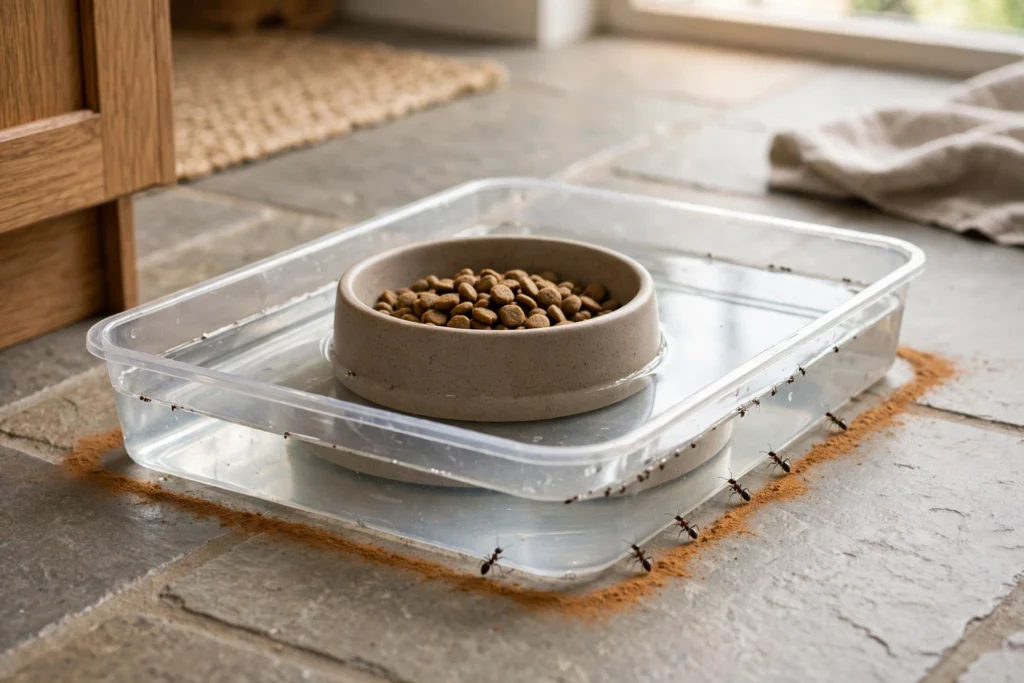
The honest ranking for a pet household is: enclosed bait stations first, gel baits in cracks second, diatomaceous earth in dry hidden spots third, and vinegar plus a food-bowl moat as the daily maintenance that keeps new trails from forming. Sprays are the last resort, used only when you can keep pets out until the surface is dry and wiped.
| Method | Kills the colony? | Pet risk | Where to use it |
|---|---|---|---|
| Enclosed bait stations | Yes | Low, if out of reach | Behind appliances, in cabinets |
| Gel bait in cracks | Yes | Low, if deep in cracks | Baseboards, voids, wall gaps |
| Diatomaceous earth (food-grade) | Slowly | Low, if dry and out of the way | Dry hidden spots, never airborne |
| Vinegar 1:1 spray | No — erases trails only | Very low | Countertops, trail routes |
| Baking soda + sugar paste | Slowly | Medium — keep out of reach | Inside bait-safe containers only |
| Borax bait | Yes | High — do not use | Nowhere in a pet home |
| Essential-oil sprays | No | High, especially cats | Nowhere in a pet home |
| Ant spray (pyrethroid) | No — kills on contact only | Medium until dry + wiped | Only with pets out 1–2 hrs |
What Should You Do If Your Pet Eats Ant Bait?
Call your vet immediately with the product label in hand — do not wait for symptoms, and do not try to make your pet vomit unless the vet tells you to. The label is the single most useful thing you can bring to that call, because the active ingredient and concentration decide the treatment.
While you wait for the vet, note three things: what the product was, how much is missing, and when the pet ate it. A photo of the label and the chewed packaging saves minutes that matter. Do not give food, water, or home remedies first — some ingested baits are safer left in the stomach until a vet decides, and the wrong home remedy can make the exposure worse. If it is after hours, call the nearest emergency vet or a pet poison helpline rather than waiting until morning.
Prevention is cheaper than that call. Store every ant product in a closed cabinet a pet cannot open, check bait stations weekly for chew marks or dragging, and replace any station a pet has moved. If a pet has gotten into bait once, it will do it again — the next station goes behind a screwed-shut cabinet or inside an appliance gap, not on the open floor.
Frequently Asked Questions
Which ant killer is safe for pets?
Enclosed tamper-resistant bait stations placed where pets cannot reach are the safest effective option, followed by gel baits applied deep in cracks and food-grade diatomaceous earth in dry, out-of-reach spots. All three kill ants without letting a pet reach the active ingredient.
Is borax ant bait safe around dogs and cats?
No. Borax can harm or kill a pet that eats it, and a shallow dish of sweet borax bait is exactly what a pet will find first. Use an enclosed commercial bait station instead, and pick up any borax bait already in the house.
Are essential oils safe as ant repellents with pets?
No — peppermint, tea tree, eucalyptus, cinnamon, lemon, orange, pine, and lavender oils are toxic to pets, especially cats, whose livers cannot process them. The “natural” label does not make an oil spray safe around animals.
How long after spraying ant killer is it safe for pets?
One to two hours, until the surface is fully dry — then wipe any spots a pet may lick. Keep pets out of the room while you spray and until it dries, and never spray near a birdcage or fish tank.
Does vinegar kill ants?
Vinegar mixed 1:1 with water erases the scent trail ants follow, so the line across your counter stops — but it does not kill the colony. Use it for daily trail control alongside bait, which is what actually stops the ants.
What should I do if my dog eats ant bait?
Call your vet immediately with the product label in hand. Note what was eaten, how much is missing, and when it happened. Do not induce vomiting unless the vet tells you to, and do not wait for symptoms to appear.
Final Thought
A pet safe ant killer is a placement problem before it is a product problem — the right bait in the wrong place is still a risk, and the safest product in the world is useless if your dog can drag it out from behind the fridge. Start with enclosed stations where pets cannot reach, add gel bait in the cracks, and use vinegar and a food-bowl moat for daily control. And if the ants keep coming back after treatment, the colony may be bigger than a DIY approach can reach — in that case, ask a licensed pest professional to inspect it, and read the ants keep coming back after treatment guide to see what a pro looks for that a homeowner usually misses.