Why Is My Furnace Blowing Cold Air? 6 Causes and Quick Fixes
You wake up freezing, walk to the vent, and hold your hand over it — cold air. The furnace is clearly running, you can hear it, but the air coming out feels like air conditioning in January. If your furnace blowing cold air has you wondering whether something broke overnight or it’s a five-minute fix, here’s the good news first: the most common cause is a thermostat setting you can fix in ten seconds.
The bad news: cold air can also mean your furnace tried to light, failed, and locked itself out for safety — and telling those two apart matters. This guide walks through all six causes in order of likelihood, the exact startup sequence to watch, and how to read your furnace’s own error codes like a technician.
TL;DR
A furnace blowing cold air is most often caused by (1) the thermostat fan set to ON instead of AUTO, (2) a clogged filter tripping the high-limit switch, (3) a dirty flame sensor shutting burners down seconds after lighting, (4) burners not fully lighting because flame can’t travel across rusted crossover channels, (5) a bad gas valve or igniter, or (6) a control board lockout. Quick checks: set fan to AUTO, replace the filter, then watch one full startup cycle — inducer starts, igniter glows, gas valve clicks, burners light, flame spreads across ALL burners, blower starts. Note exactly where the sequence fails; that tells you (and your tech) what’s wrong. Never ignore cold air paired with a gas smell or a CO alarm.
First — Is It Actually Broken? (The Normal-Cold-Air Cases)
Not every blast of cool air is a malfunction. Rule these out before troubleshooting:
- The first 30–60 seconds of a cycle. When the furnace kicks on, the blower often starts before the heat exchanger is fully hot, pushing out room-temperature air briefly. If it turns warm within a couple of minutes, that’s normal operation.
- Thermostat fan set to ON. This is the #1 real cause and the #1 false alarm combined: with the fan ON, the blower circulates air continuously — including between heating cycles, when there’s no heat to circulate. It feels like the furnace is “blowing cold air” when it’s just moving room air.
- A heat pump in defrost mode. If you have a heat pump (not a gas furnace), it briefly blows cooler air during its defrost cycle every 30–90 minutes. Our guide to heat pump freezing up in winter explains what’s normal there.
If the air stays cold for several minutes with the heat calling, you have a real problem. Work through the six causes below. A surprising number of “broken furnace” calls end at this step.
1. Thermostat Fan Set to ON Instead of AUTO (The 10-Second Fix)
This is the most common cause, full stop — and the fix takes ten seconds. On your thermostat, the fan has two modes: AUTO (blower runs only during heating cycles) and ON (blower runs 24/7). On ON, you’ll feel air from the vents constantly, and between cycles that air is unheated room air.
Check it now: set the thermostat to HEAT mode and the fan to AUTO. Wait one full cycle. If warm air returns, you’re done — and you’ve just saved a service call.
While you’re there, confirm the thermostat is actually set to HEAT (not COOL or FAN-only), the setpoint is above room temperature, and the batteries aren’t dead. A surprising number of service calls end at this step.
2. Clogged Air Filter Tripping the High-Limit Switch
Here’s the chain reaction technicians see constantly: a filthy filter chokes airflow across the heat exchanger → it overheats → the high-limit safety switch trips → burners cut out but the blower keeps running → you feel cold air.
The telltale pattern: the furnace runs, blows warm briefly, then cold — cycling over and over. One homeowner’s 25-year-old unit did exactly this rinse and repeat for weeks before the real culprit (a dying blower motor, same airflow effect) was found.
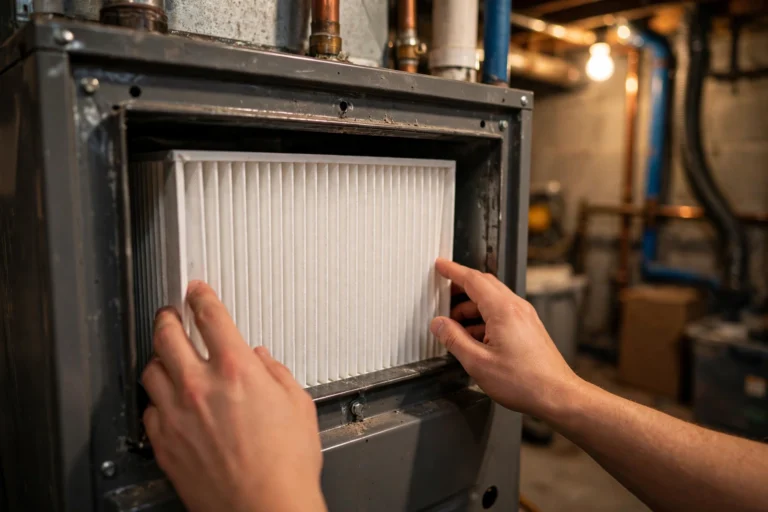
Check it now: pull the filter. If it’s gray and packed with dust, replace it — then turn the system off for 30 minutes to let the limit switch reset itself. Many limit switches reset automatically once temperatures normalize. If cold air persists after a fresh filter and a reset, the switch itself may have failed, or something else is restricting airflow (blocked return vents, closed registers, or a failing blower motor).
PRO TIP
After changing the filter, don’t just restart — give it a full 30 minutes off. High-limit switches need cooldown time to reset. Restarting immediately can lock you into the same cold-air loop and convince you the filter wasn’t the problem when it was.
3. Dirty or Failed Flame Sensor (The Reddit #1 Answer)
Across dozens of homeowner threads, working techs give the same most-upvoted answer for burners light then die: the flame sensor. Here’s what happens: the igniter sparks, burners light, but the flame sensor — a small metal rod sitting in the flame path — is coated in carbon and can’t confirm the flame to the control board. The board, seeing no flame, shuts the gas off as a safety measure. Burners die after 5–10 seconds. The furnace retries, fails again, and eventually locks out — blower running, blowing cold.
The telltale pattern: flames kick on, die after a few seconds, repeat 3–5 times, then the system gives up and just blows cold air. An LED blink code often reads ignition failure or lockout due to retries.
The DIY fix (genuinely homeowner-safe): turn the furnace power OFF at the switch/breaker. Locate the flame sensor — a thin metal rod (usually with a single wire) mounted near the burners. Remove its screw, slide it out, and clean it gently with a dollar bill or fine steel wool alternative — techs specifically warn against coarse sandpaper, which damages the sensor’s coating. Don’t touch the rod with bare hands (skin oils cause hot spots); wear gloves. Reinstall, restore power, and test. If cleaning doesn’t work, the sensor itself (~$15 part, $100–$150 installed) needs replacing.
4. Burners Not Fully Lighting (Rusted Crossover Channels)
This one is sneaky and increasingly common on aging furnaces: only one or two burners light, because the flame can’t travel across rusted or corroded crossover channels to reach the rest — including the burner where the flame sensor sits. The sensor never sees flame, the board shuts everything down, and you get cold air.
The telltale pattern: you can see through the sight glass that only the leftmost burner (or one section) is lit blue while the others stay dark. One tech diagnosed this as a known issue on certain Trane models where condensation drips from the fresh-air intake onto the burners.
What to do: burner removal and cleaning is a pro job where the gas line must be disconnected — but it’s typically a sub-$200 repair, not a furnace replacement. Don’t let anyone sell you a new system for dirty burners without a heat-exchanger inspection to back it up.
5. Bad Gas Valve or Igniter
If you watch the startup sequence and the igniter glows but you never hear the gas valve click open — no flame at all, not even for a second — the gas valve (or its solenoid) is the prime suspect. One homeowner confirmed the diagnosis elegantly: the gas stove worked fine, so gas supply to the house was good — the problem was isolated to the furnace’s valve.
The telltale pattern: igniter glows orange, silence where the gas-valve click should be, no flame ever. An error code may indicate ignition failure.
What to do: gas valve replacement is strictly professional work ($400–$600). As a temporary diagnostic some techs tap the valve body — if it fires, the solenoid is sticking and replacement is a matter of time, not if. Order the part; don’t rely on the tap.
6. Control Board Lockout
Modern furnaces protect themselves: after several failed ignition attempts, the control board “locks out” and runs the blower continuously — deliberately, as a fire-hazard precaution to clear any unburned gas. So the cold air that won’t stop is actually the furnace doing its safety job.
The telltale pattern: cold air blowing nonstop and the furnace won’t shut off even with the thermostat off; power-cycling the furnace (off 30 seconds, back on) restores heat for a few days, then it happens again. The LED blink code reads ignition lockout due to retries.
What to do: a lockout is a symptom, not the disease — resetting without fixing the underlying cause (causes 2–5 above) just restarts the countdown. Read the blink code (next section), fix the root cause, and if lockouts persist with everything else ruled out, the board’s relays themselves may be failing — a pro replacement.
The Startup Sequence Test: Find the Failure in 3 Minutes
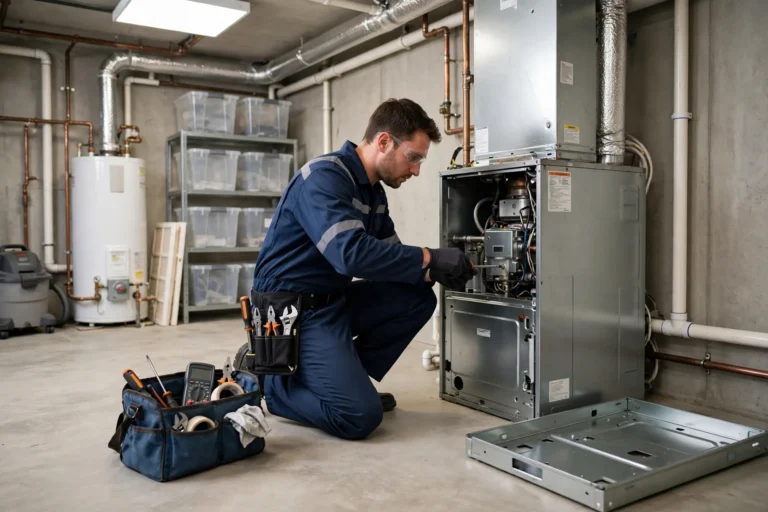
This is the diagnostic working techs recommend first, and it pinpoints the cause better than any article list. Stand where you can see and hear the furnace (sight glass helps), have someone call for heat, and watch the sequence:
- Inducer motor starts (small fan whirs) — if nothing happens at all, check power, thermostat, and door-panel switch.
- Igniter glows (orange glow through the sight glass) — no glow means bad igniter or board issue.
- Gas valve clicks open — no click after the glow means gas valve problem (cause #5).
- Burners light — flames should spread across ALL burners within seconds. Partial lighting means crossover/rust issues (cause #4).
- Flames stay lit past 10 seconds — flames dying at 5–10 seconds means flame sensor (cause #3).
- Blower starts, warm air follows — blower running with no flame ever means lockout or limit trip (causes #2, #6).
Note exactly which step fails. When you call a technician, lead with it fails at step 4 — burners light but only two of five and you’ll get a faster, cheaper, more accurate repair.
PRO TIP
Read the LED blink code before you call anyone. Every modern furnace has a small sight glass or removable panel revealing a blinking LED on the control board — and the error-code chart is printed on the inside of the access door. Matching the blink count to that chart turns a vague it’s blowing cold air into a specific diagnosis the tech can quote against.
Quick Diagnostic Table
| Symptom pattern | Most likely cause | Your move |
|---|---|---|
| Cold air constantly, fan never stops | Thermostat fan set to ON | Set fan to AUTO (10 seconds) |
| Warm briefly, then cold, cycling | Clogged filter — limit switch trip | Replace filter, wait 30 min, restart |
| Flames light, die in 5–10 sec, repeat | Dirty flame sensor | Clean sensor (power off, gloves) |
| Only some burners light | Rusted crossover channels | Pro burner cleaning (<$200) |
| Igniter glows, no click, no flame ever | Bad gas valve/solenoid | Pro replacement ($400–$600) |
| Cold air won’t stop, reset fixes for days | Board lockout (underlying cause) | Fix root cause; check blink code |
| Cold air right after filter change | Filter installed backwards or wrong size | Check arrow direction and dimensions |
When to Turn It Off and Call a Pro
Most cold-air causes are fix today problems, not emergencies. Shut the system down and call immediately if:
- You smell gas — leave the house and call the gas company from outside. Don’t troubleshoot.
- The CO alarm sounds — leave and call emergency services.
- The furnace keeps tripping the limit switch after a fresh filter — repeated overheating cycles stress the heat exchanger, and a cracked heat exchanger is a carbon monoxide risk. Don’t let it keep cycling.
- Anything involving the gas valve, control board relays, or heat exchanger inspection — these need licensed hands and, for electrical diagnosis, a multimeter.
For persistent cold air after the DIY checks — or any blink code you can’t resolve — call (380) 273-8167 or have a licensed HVAC technician diagnose it. A $75–$150 diagnostic visit (often credited toward the repair) beats replacing parts by guesswork.
What a Technician Will Do (and What It Costs)
A good tech starts exactly where you did: the startup sequence and the blink code. Then: thermostat and wiring check, filter and airflow inspection, flame sensor cleaning/replacement, burner inspection and cleaning, gas pressure test, heat exchanger inspection (visual + combustion analysis), and control board diagnostics.
Typical costs: service/diagnostic visit $75–$150; flame sensor replacement $100–$150; burner cleaning $100–$200; igniter $150–$250; capacitor $150–$300; gas valve $400–$600; blower motor $400–$700; control board $300–$600. On a furnace past 20 years with a cracked heat exchanger or obsolete board, techs will often recommend replacement ($3,500–$7,500) over repair — 25 years of service is a full life, and sinking $800 into a unit that old rarely pays.
Frequently Asked Questions
How do you fix a furnace that blows cold air?
Work in order: (1) set the thermostat fan to AUTO, (2) replace a dirty filter and wait 30 minutes, (3) watch the startup sequence to find the failing step, (4) clean the flame sensor if flames die after seconds, (5) read the LED blink code. Those five steps resolve the majority of cases; the rest need a technician.
Should I turn my furnace off if it’s blowing cold air?
If it’s blowing cold air because of a lockout or repeated limit trips, turning it off for 30 minutes lets safety switches reset — that’s fine and often helpful. But don’t just keep resetting it indefinitely; repeated trips signal an underlying problem (usually airflow or ignition) that needs fixing. Turn it off permanently and call a pro if you smell gas or the CO alarm sounds.
Why is my furnace blowing cool air when the heat is on?
Cool but not cold usually means weak heating rather than no heating: a partially clogged filter, one or two burners not lighting, low gas pressure, or — on a heat pump — normal defrost operation. If it’s truly cold (room temperature), work through the six causes above starting with the thermostat fan setting.
How do I reset my furnace?
Turn the thermostat to OFF, then switch the furnace power off at the unit’s power switch (or the breaker) for 30 seconds to 5 minutes, then restore power. This clears soft lockouts. If the furnace immediately returns to blowing cold air, the underlying fault is still present — resetting again won’t fix it.
Why is my furnace blowing cold air after I changed the filter?
Almost always an installation issue: the filter is backwards (the airflow arrow must point toward the furnace), it’s the wrong size and air is bypassing around it, or it’s a much higher MERV rating than your system can handle, choking airflow worse than the old dirty filter did.
My furnace blows cold air and won’t shut off — is that dangerous?
The nonstop blower is usually the control board’s safety response after failed ignition attempts — it’s clearing the cabinet, which is protective, not dangerous in itself. But the underlying ignition failure needs diagnosis. Power-cycle once; if it recurs within days, get a technician before the repeated cycling stresses the heat exchanger.
Key Takeaways
- Check the thermostat fan setting first — ON instead of AUTO is the most common cause and a 10-second fix.
- A clogged filter overheats the furnace and trips the limit switch: burners cut out, blower keeps running, you feel cold air.
- Flames that light then die in seconds point to a dirty flame sensor — the single most-repeated tech answer, and a safe DIY clean.
- Watch the startup sequence (inducer — igniter — gas click — all burners — blower) and note exactly which step fails — that’s your diagnosis.
- Read the LED blink code against the chart inside the access door before calling anyone.
- Cold air with a gas smell or CO alarm means leave the house and call emergency services — not your HVAC tech first.