How to Remove Scratches From Stainless Steel: 4 Fixes That Work
To remove scratches from stainless steel, first find the grain — the faint parallel lines running across the metal — then match the fix to the scratch: buff light scratches with a baking soda paste or a non-abrasive cleaner, use a scratch-removal kit or wet sanding for deep ones, and always rub with the grain, never across it or in circles. Most scratches are surface marks that blend away in minutes; only deep gouges that catch your fingernail need sanding or a professional refinish.
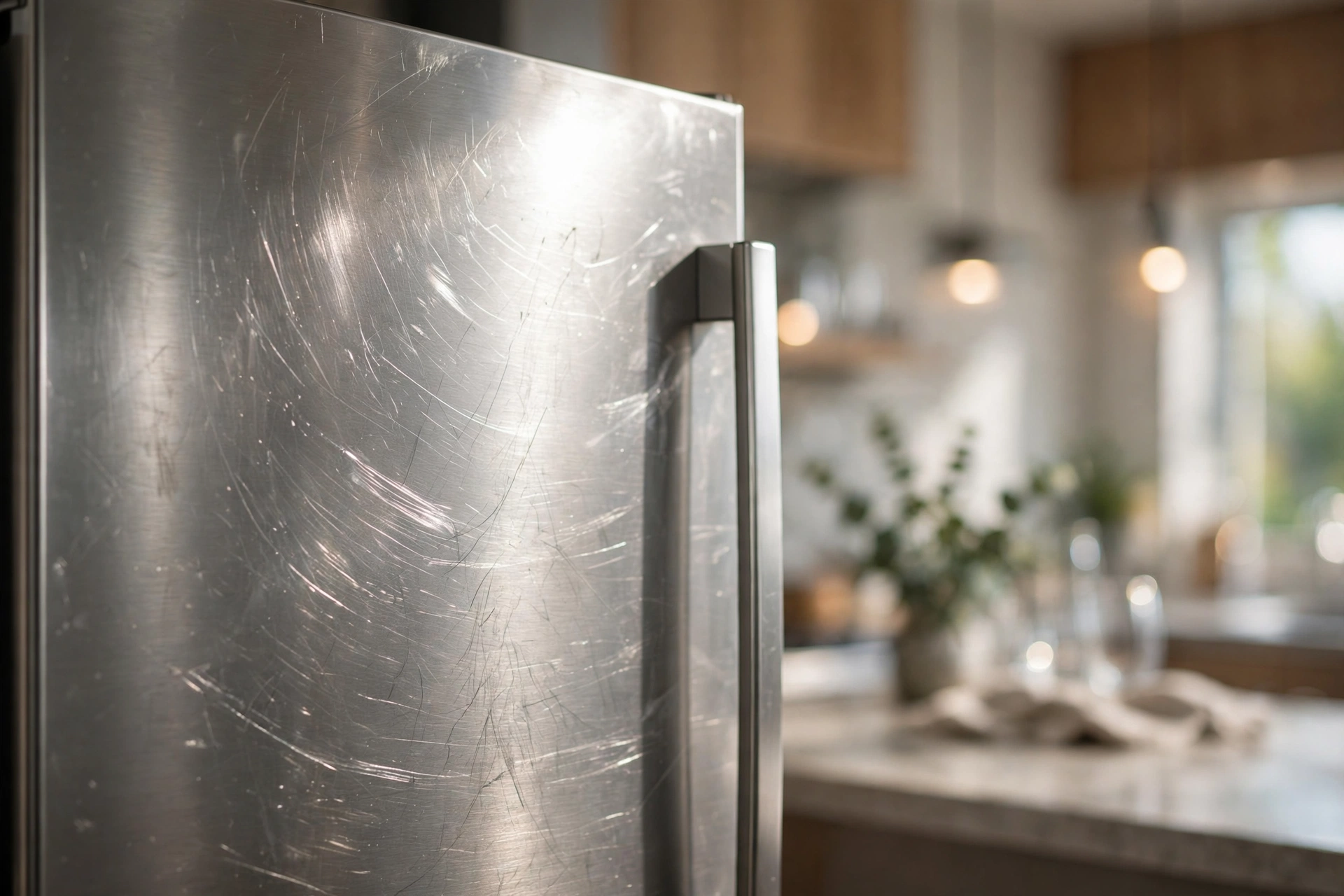
Stainless steel scratches easily because it is softer than it looks: a pan dragged across a cooktop, a scouring pad, a pet’s claws on a fridge door, or a knife slipped in the sink all leave marks. The good news is that stainless steel does not scratch the way paint does — the metal is the same all the way through, so a scratch is a groove in the surface, not a missing layer, and it can be blended back into the surrounding grain. The bad news is that the wrong fix makes it worse: rubbing across the grain carves a new set of scratches over the old one, and steel wool embeds iron particles that rust within days. This guide to how to remove scratches from stainless steel covers the grain test, the four fixes in order of strength, what never to do, and when to call a professional.
TL;DR — How to Remove Scratches From Stainless Steel in 30 Seconds
1. Find the grain: look closely under angled light for faint parallel lines — usually horizontal on fridges, vertical on dishwashers. Every step below follows that direction.
2. Light scratches: baking soda paste (2 tablespoons baking soda + 1 tablespoon water), rubbed gently with a microfiber cloth along the grain, then rinsed and dried.
3. Still visible: a non-abrasive cleaner like Bar Keepers Friend, or whitening toothpaste, applied the same way along the grain.
4. Deep scratches: a stainless steel scratch-removal kit, or wet sanding from 400 grit up to 2,000 grit, always with the grain, then polish.
5. Never: steel wool, scouring pads, chlorine cleaners, or circular rubbing — all of them make the damage worse.
That is the short version — the sections below explain each fix in full.
Can Scratches Be Removed From Stainless Steel?
Light and moderate scratches can be removed from stainless steel — or more precisely, blended until they disappear — because the metal is uniform all the way through and the scratch is only a groove in the surface. Rubbing a mild abrasive along the grain levels the edges of the groove until light stops catching it, and the scratch seems to vanish. Deep gouges are different: a scratch deep enough to catch your fingernail has displaced metal, and it cannot be buffed out — it can only be sanded level and re-polished, which is a bigger job, or refinished by a professional.
Run the fingernail test before you start: drag a fingernail lightly across the scratch. If the nail glides over it, the scratch is light and the baking soda or cleaner fix will handle it. If the nail catches, the scratch is deep and you need the kit or wet-sanding method. If the scratch is a dent or a groove you can see from across the room, no home method will remove it — a professional refinish or a replacement panel is the honest answer, and the last section of this guide covers the cost.
How Do I Find the Grain on Stainless Steel?
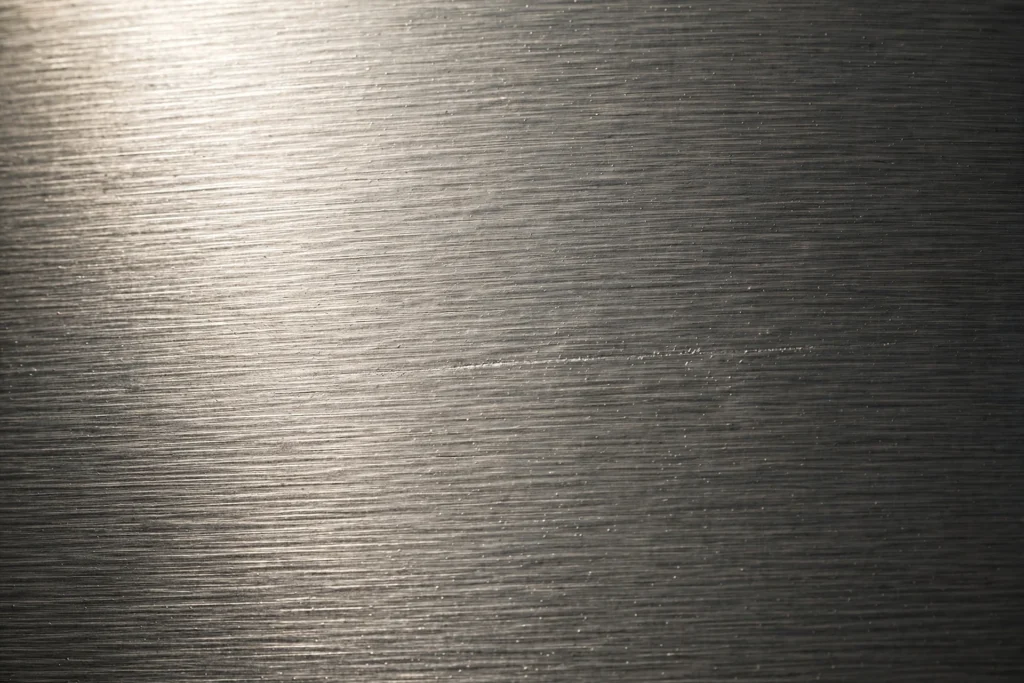
Finding the grain on stainless steel takes ten seconds: look closely at the surface under angled light and find the faint parallel lines running across the metal. On most fridge doors the grain runs horizontally, side to side; on dishwashers and ovens it often runs vertically, top to bottom; on sinks it usually runs front to back. The grain is the direction the steel was brushed at the factory, and it is the direction every rubbing step in this guide follows.
Working with the grain matters because stainless steel’s brushed finish is a set of microscopic parallel grooves. Rubbing along them blends a scratch into the existing pattern; rubbing across them cuts a new set of grooves at right angles, which shows up as a cloudy patch or a visible swirl that is harder to fix than the original scratch. Circular rubbing is the worst of all — it carves swirl marks in every direction. If you cannot see the grain, wipe the surface with a damp cloth and look at the wet streaks: the water follows the grain lines and makes them visible.
Fix 1: How Do I Remove Light Scratches With Baking Soda Paste?
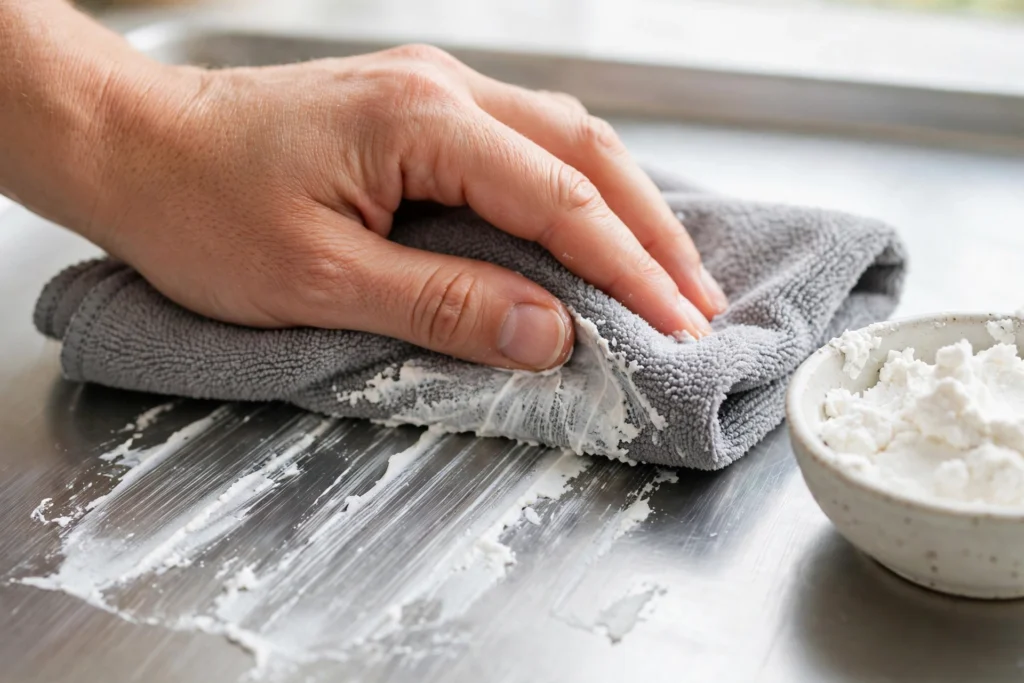
Light scratches come out with a baking soda paste, and it is the fix to try first because it costs almost nothing and cannot damage the steel. Mix 2 tablespoons of baking soda with 1 tablespoon of water until you have a thick paste about the consistency of toothpaste. If your tap water is hard, use distilled water — minerals in hard water can leave spots that interfere with the result.
Clean the surface first with mild dish soap and water so no grit is sitting on the steel, then dry it. Put a small amount of paste on a soft microfiber cloth and rub it gently into the scratch, moving only in the direction of the grain, for 30–60 seconds per section. Do not press hard — pressure does not speed the fix, it deforms the surface and widens the scratch. Rinse the area with clean water, dry it immediately with a fresh microfiber cloth, and look at the scratch under angled light. Repeat once a day for up to three days for a stubborn mark, letting the surface rest between rounds. Baking soda is pH-neutral and mildly abrasive, so it levels the scratch without etching the steel or damaging the thin chromium oxide layer that keeps stainless steel from rusting.
This method works on fridges, dishwashers, sinks, cooktops and cookware, and it is the safest fix for a sink: our guide to how to clean stainless steel sink covers the full sink-cleaning routine, and the paste method here is the scratch step that belongs with it.
Fix 2: How Do I Remove Scratches With a Non-Abrasive Cleaner or Toothpaste?
If the baking soda paste fades the scratch but does not remove it, step up to a non-abrasive cleaner or whitening toothpaste. Bar Keepers Friend is the most recommended cleaner for this job: it is a non-abrasive powder or cream that fills and smooths fine lines without cutting into the steel. Whitening toothpaste works the same way — it is mildly abrasive, which is why it polishes teeth, and it polishes a scratch the same way.
For a powdered cleaner, mix a tablespoon of powder with a few drops of water into a paste the consistency of toothpaste. For a cream or toothpaste, use it straight from the tube. Apply a small amount to a damp microfiber cloth and rub gently along the grain, never in circles, until the scratch diminishes. Wipe the surface clean with a fresh damp cloth, again along the grain, then dry it and finish with a light coat of stainless steel polish or a few drops of mineral oil on a clean cloth to restore the shine.
Test first in an inconspicuous spot: cleaners vary, and a product that is gentle on one finish can be too aggressive on another — especially on stainless steel with a protective clear coat or a synthetic surface, where any abrasive can do more damage than the scratch. If the steel has a clear coat, stop here and call a professional; the methods below are for bare stainless steel only.
Test in
the Corner Nobody Sees
Before any paste, cleaner or sandpaper touches the visible scratch, test it on the same surface in a spot nobody sees — the side of the fridge, the back edge of the sink, the bottom of the panel. Rub for 30 seconds along the grain and check the result. If the test spot looks worse, you have learned that on a hidden corner instead of in the middle of the fridge door.
Fix 3: How Do I Remove Deep Scratches With a Scratch-Removal Kit?
Deep scratches — the ones that catch your fingernail — need a stainless steel scratch-removal kit, which is a set of abrasive pads, a buffing compound and a blending agent made for exactly this job. Kits like Scratch-B-Gone are the ones professionals and guides recommend, and they cost roughly $25–$50, which is far less than a professional refinish.
Start with the coarsest pad in the kit, wet it with the kit’s lubricant or polishing compound, and rub along the grain with steady, even pressure — never across it. Work the whole panel, not just the scratch, because spot-sanding leaves a visible patch where the finish differs from the surrounding steel. Move to the next finer pad, then the next, until the scratch has blended into the grain. Finish with the buffing compound and a microfiber cloth, again along the grain, then wipe clean and polish. The kit works by removing a microscopic layer of steel evenly across the panel, so the scratch disappears into a uniform finish rather than being filled in.
The honest limit: a kit can handle a deep scratch, but it cannot fix a gouge, a dent or a scratch through a clear coat. If the scratch is still visible after the finest pad, stop — more sanding will only thin the panel and change the finish. That is the point to call a professional.
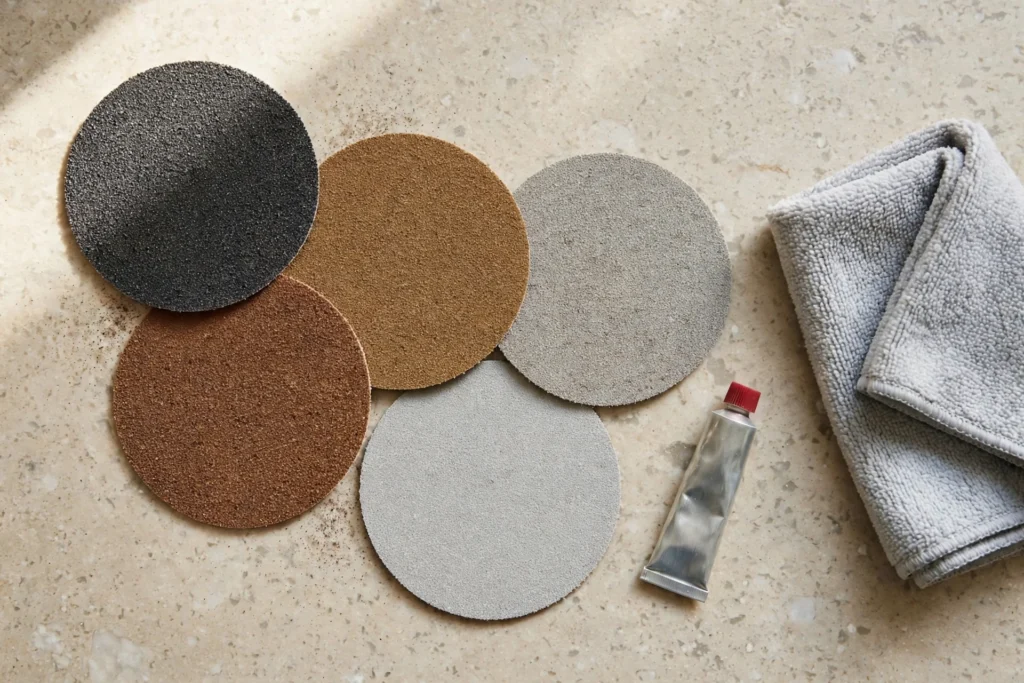
Fix 4: How Do I Wet-Sand Deep Scratches From Stainless Steel?
Wet sanding is the strongest home fix for deep scratches, and it is the one to attempt only after the kit has failed or if you are comfortable with abrasives. Soak 400-grit wet/dry sandpaper in a bowl of water for a few minutes, add a few drops of olive oil or the kit’s lubricant to the surface, and sand along the grain with moderate, even pressure. Keep the surface wet throughout — dry sanding heats the steel and leaves new scratches. Work up through the grits: 400, then 600, then 800, then 1,000, then 2,000, spending a few minutes with each and sanding the whole panel so the finish stays uniform.
After the finest grit, polish the panel with a metal polishing compound and a microfiber cloth, rubbing along the grain until the shine returns. Rinse, dry, and inspect under angled light. The full process takes 30–60 minutes for a fridge door, and the materials cost roughly $10–$20 for sandpaper and compound.
Wet sanding removes metal, so it is not reversible: sand too aggressively and the panel’s finish changes permanently. Never sand a small spot in isolation, never sand across the grain, and never use a grit coarser than 400 unless the scratch is a genuine gouge — and a gouge belongs to a professional, not to sandpaper.
What Should You NEVER Do to Scratched Stainless Steel?
Four things make a stainless steel scratch worse, and they are all common. Never use steel wool — it is the single worst tool for stainless steel, because it leaves behind tiny iron particles that rust within days, and it carves deep new scratches across the grain. Never use a green scouring pad or any abrasive pad unless it is part of a scratch-removal kit and you are sanding along the grain. Never use chlorine-based cleaners or bleach — chlorine attacks the chromium oxide layer that protects the steel, and the damage shows up as pitting and rust. And never rub in circles: circular rubbing creates swirl marks that are visible from every angle and far harder to blend out than the straight scratch you started with.
Two more cautions: do not use vinegar soaks on a scratch you are trying to fix — acidic cleaners increase pitting risk on freshly sanded steel — and do not press harder when a gentle pass does not work. More pressure widens the scratch channel and embeds abrasive particles deeper. If a light pass does not fade the mark, step up to a stronger method, not a stronger arm.
More Pressure Makes It Worse
The most common mistake with stainless steel scratches is pressing harder when the scratch does not fade. Excessive force deforms the surface, widens the scratch and drives abrasive particles deeper into the metal. Gentle, repeated passes along the grain — with a stronger product, not a stronger arm — are what actually remove a scratch.
How Do I Prevent Scratches on Stainless Steel?
Prevention is mostly about what touches the steel. Use microfiber cloths, never scouring pads or steel wool, for everyday cleaning. Do not drag pans, knives or metal utensils across a stainless steel cooktop or sink — lift them instead. Keep a rubber mat or a sink grid in the sink to catch dropped cookware before it scores the basin. Wipe with the grain even for routine cleaning, because years of circular wiping leave a haze of micro-scratches that dull the whole surface. And dry the steel after cleaning: water spots are not scratches, but the mineral deposits they leave behind invite the kind of scrubbing that causes scratches.
For the kitchen as a whole, the same gentle habits protect the rest of the room: our guide to how to clean grout covers the tile around the steel without the harsh chemicals that would damage it.
When Should I Call a Professional to Refinish Stainless Steel?
Call a professional when the scratch is a deep gouge or a dent, when the scratch runs through a clear coat, when wet sanding has not removed it, or when the panel is a large visible surface — a fridge door, a range hood — and you cannot risk an uneven finish. A professional refinish involves sanding the whole panel with a machine, re-graining it to match the factory finish, and re-passivating the surface so it resists rust. Professional stainless steel refinishing costs roughly $200–$500 per panel, as a rough planning estimate, not a quote, depending on the size of the panel and the depth of the damage.
Compare that against replacement before you book: a new fridge door panel can run roughly $300–$800, and a new sink roughly $200–$600 installed. If the appliance is old and the scratch is one of several problems, replacement may be the better spend. But for a single deep scratch on an otherwise good appliance, a refinish is usually the cheaper fix — and it restores the factory finish in a way no home method can match.

FAQ — How to Remove Scratches From Stainless Steel
Does baking soda really remove scratches from stainless steel?
Yes, for light scratches. Baking soda is a mild abrasive that levels the edges of a fine scratch when rubbed along the grain with a microfiber cloth. Mix 2 tablespoons of baking soda with 1 tablespoon of water into a paste, rub gently along the grain for 30–60 seconds, rinse and dry. It will not fix a deep scratch that catches your fingernail.
Can you use steel wool on stainless steel?
No — never use steel wool on stainless steel. It leaves tiny iron particles embedded in the surface that rust within days, and it carves deep new scratches across the grain. Use a microfiber cloth, a non-abrasive cleaner, or a scratch-removal kit pad instead.
Does toothpaste remove scratches from stainless steel?
Whitening toothpaste can fade light scratches, because it is mildly abrasive. Apply a small amount to a microfiber cloth and rub gently along the grain, then wipe clean and dry. It works best on fine surface marks; for deeper scratches, use a non-abrasive cleaner or a scratch-removal kit.
How do I remove scratches from a stainless steel sink?
Use the same grain-first method: find the grain (usually front to back in a sink), clean the basin, then buff light scratches with a baking soda paste or Bar Keepers Friend along the grain. For deeper scratches, wet-sand from 400 grit up to 2,000 grit, always with the grain. Our guide to how to clean stainless steel sink covers the full sink routine around the scratch repair.
Will scratches on stainless steel rust?
A scratch itself does not rust, because stainless steel’s chromium oxide layer re-forms in air — but a scratch made worse by steel wool or chlorine cleaners can rust, because those leave iron particles or damage the protective layer. After any sanding, rinse the surface and let it dry fully so the oxide layer can re-form.
Can a professional remove deep scratches from stainless steel?
Yes — a professional refinish sands the whole panel, re-grains it to match the factory finish and re-passivates the surface. It costs roughly $200–$500 per panel as a rough planning estimate, not a quote, and it is the right call for deep gouges, scratches through a clear coat, or large visible panels where an uneven home repair would show.