Kitchen Wall Decor: Ideas That Survive Steam and Grease
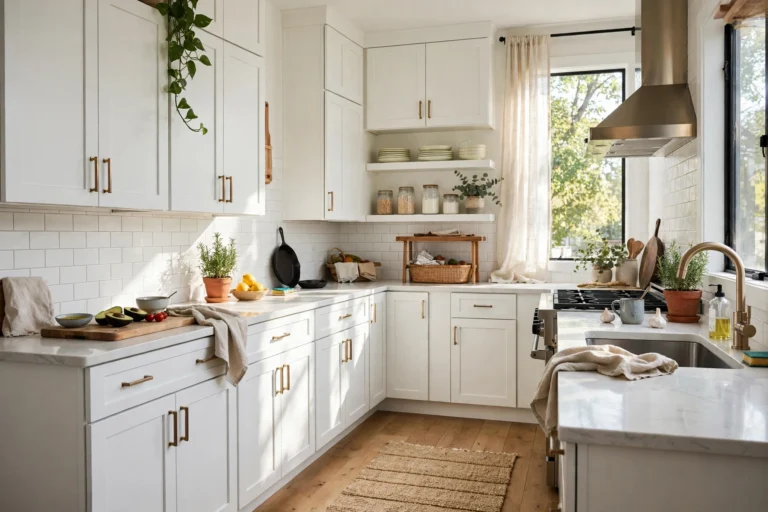
The best kitchen wall decor is wipe-clean, heat-tolerant and hung where cooking steam and grease cannot reach it. Choose ceramic, metal, glass or sealed prints near the stove, save paper art for dry walls, and hang pieces at eye level, 57 to 60 inches from the floor.
A kitchen wall looks like a living room wall, but it lives a harder life: every fry, boil and bake sends steam and grease across it, and a print that would last twenty years in a hallway can look tired here within a year. The trick is to choose kitchen wall decor the way a cook would — by asking what each piece is made of, where it will hang, and how you will clean it. A ceramic plate, a metal sign, a sealed print behind glass and a wooden cutting board all belong here; an unframed paper poster above the stove does not. The same eye for balance in our living room wall decor guide applies here, with one extra test: can it survive steam and grease?
TL;DR — Kitchen Wall Decor at a Glance
- The golden rule: only wipe-clean materials near cooking zones — ceramic, metal, glass and sealed or laminated prints.
- Best all-rounders for kitchen wall decor: open shelves on side walls, plate walls, cutting-board displays, chalkboards and framed art behind glass.
- Never above the cooktop: open shelves and paper art collect grease there; keep that wall for tile or a hood.
- Hang at eye level: the centre of a piece should sit 57 to 60 inches from the floor, or 6 to 8 inches above a countertop.
- Small kitchens: choose kitchen wall decor that also stores — shelves, rails, hooks and pegboards earn their wall space twice.
- Renters: removable strips, decals, lean-to boards and tension-rod shelves give you the look with zero holes.
- Budget: most walls in this guide cost roughly $30 to $250 to finish (planning estimates, not quotes).
Kitchen Wall Decor: What Survives Steam and Grease?
Kitchen wall decor survives steam and grease when it is made from a wipe-clean material — ceramic, glazed tile, metal, glass or a sealed print — and hung away from the direct path of cooking vapour. Paper, raw canvas and unsealed wood absorb moisture and grease, so they yellow, warp or stain, while glazed and sealed surfaces simply wipe clean with a damp cloth.
This is the one rule that decides every kitchen wall decor choice in this guide. A kitchen has three zones, and each one has different rules. The hot zone is the wall behind and above the stove: only tile, metal, glass and stone belong here. The splash zone is the wall behind the sink and along the counters, roughly the first 18 inches above the worktop, where glazed ceramic, glass, sealed prints, metal signs and vinyl wallpaper cope fine. The dry zone is every other wall, where framed prints, chalkboards, plate walls, clocks and mirrors live happily, as long as they are sealed or glazed.
The material test is simple: run your finger across the surface. Smooth, glazed or coated means it will wipe clean; porous or chalky means it will absorb whatever the kitchen throws at it. When in doubt, seal it — clear varnish or an acrylic sheet turns a fragile piece into kitchen-safe kitchen wall decor for roughly $10 to $25 (planning estimate, not a quote).
The Wipe Test
Wipe the back of a piece with a damp cloth before hanging it: if the cloth picks up colour, the piece needs sealing or a spot further from the stove.
Where Should Open Shelves Go in a Kitchen?
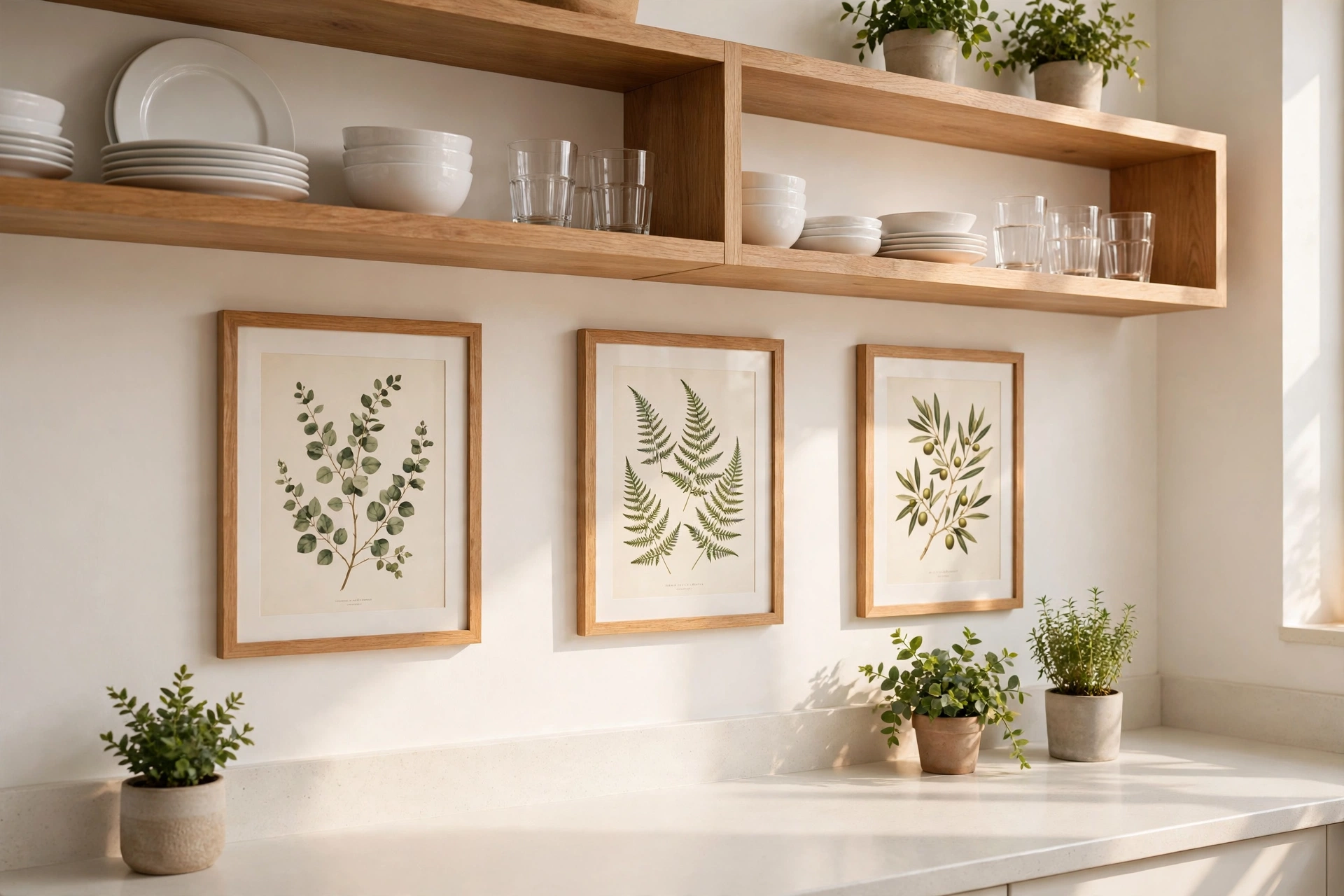
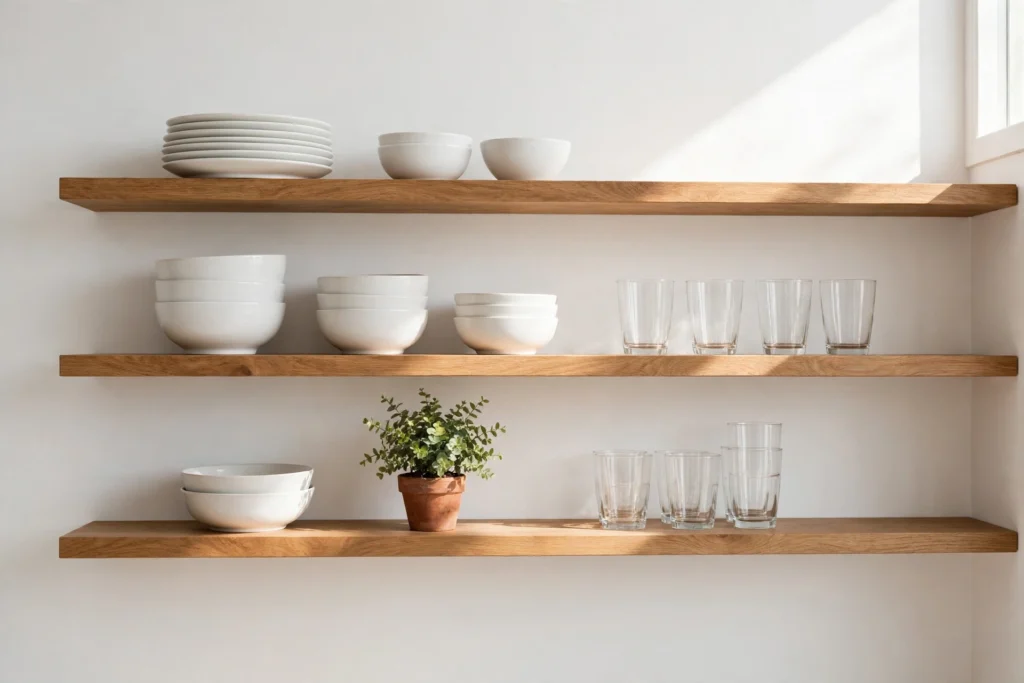
Open shelves belong on side walls and dry walls, never directly above the cooktop, where rising grease coats every dish and the shelf itself. Fix them into wall studs, keep the lowest shelf 18 to 20 inches above the counter, and load them with everyday dishes you actually use, so nothing sits long enough to gather dust.
Open shelves are the most popular kitchen wall decor idea for good reason: they display your prettiest dishes, free up cabinet space and make a small kitchen feel bigger. They are also the idea most often hung in the wrong place — a shelf above the stove looks wonderful in a photograph and terrible after a month of frying.
Mounting matters more here than anywhere, because dishes are heavy: a loaded shelf can weigh 30 to 50 pounds, so drywall anchors alone are not enough. Find the studs and drive at least two screws per bracket into solid wood, or use heavy-duty toggle bolts rated for 50 pounds or more. Leave 18 to 20 inches between the countertop and the lowest shelf, and 12 to 15 inches between shelves.
What you put on the shelves decides whether they look styled or cluttered. Everyday dishes go on the bottom shelf, prettier pieces in the middle, light items on top. Leave breathing room: a packed shelf reads as storage, one with air between groups reads as decor. Expect roughly $40 to $180 for a pair of solid wood shelves with brackets (planning estimate, not a quote). A weekly wipe stops the film build-up that makes open shelving feel like a chore.
Studs First, Style Second
Mark your studs before you buy the shelves: shelf length should match your stud spacing — usually 16 inches apart — so every bracket lands in solid wood.
How Do You Build a Plate Wall That Looks Collected, Not Cluttered?
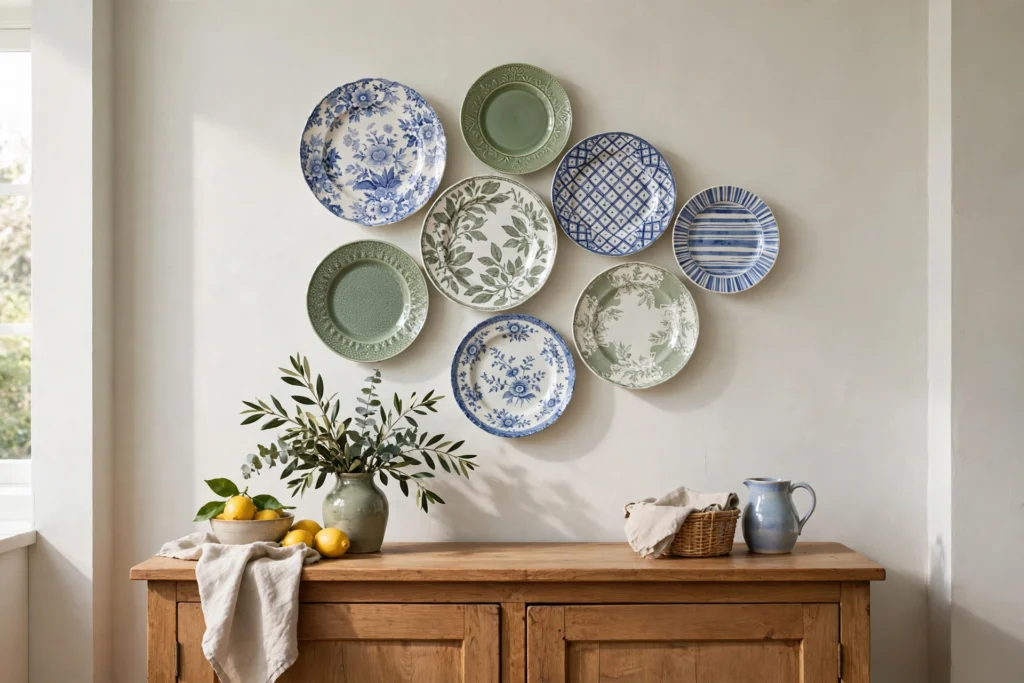
A plate wall looks collected, not cluttered, when you limit it to one colour family, mix three to five plate sizes, and lay the arrangement out on the floor first. Hang the largest plate slightly off-centre, space pieces 2 to 3 inches apart, and use proper plate hangers so every plate sits flat and safe.
Plate walls are the classic kitchen wall decor because they are made for this room: glazed ceramic laughs at steam, wipes clean in seconds and comes in every colour you could want. The difference between a curated collection and a jumble sale is restraint. Pick one colour family — blues, sage greens, warm creams — and let two or three patterns play inside it.
Mix dinner, salad and dessert plates, and let one large plate anchor the arrangement. Lay everything on the floor first and shuffle until the shape pleases you. Paper templates taped to the wall let you check the layout at full scale first.
Use spring-wire or adhesive disc hangers rated above each plate’s weight, and hang heavier plates on a nail in a stud or a proper wall anchor — a falling plate is a hazard on a hard floor. Mix old and new — a thrifted floral plate beside a plain modern one. A starter plate wall of six to eight plates typically costs roughly $25 to $120, plus $10 to $20 for hangers (planning estimates, not quotes).
One Colour, Many Patterns
Photograph your plates as a group: the camera shows instantly whether one plate is fighting the rest. Swap the outlier for a plainer plate in the same colour family.
What Is the Best Way to Display Cutting Boards and Utensils?
The best way to display cutting boards and utensils is a wall rail with S-hooks or a pegboard on a dry side wall, hung where you can reach everything without stretching. Keep boards off the wall directly behind the stove, oil wooden boards monthly so they do not dry out, and group utensils by use so the display stays practical.
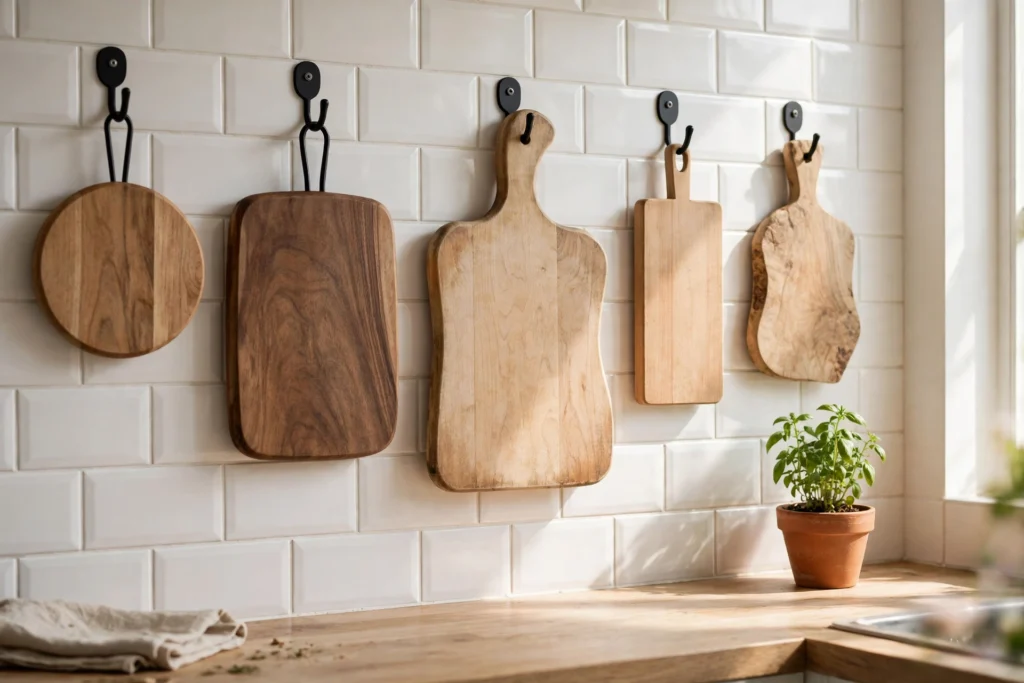
Cutting boards are the rare piece of kitchen wall decor that is also a tool you use every day. A row of wooden boards in different shapes and tones — a round one, a long paddle, a thick butcher block — turns a blank wall into a warm, textured display, and every piece earns its place because you cook with it. Hang them from hooks or a slim rail with S-hooks, largest in the middle.
A stainless steel or matte black rail, roughly $15 to $40, mounts with two screws and takes S-hooks for boards, ladles, whisks and small baskets. A 2-by-4-foot pegboard panel costs roughly $20 to $50 (planning estimate, not a quote), paints to match any kitchen, and holds hooks, shelves and baskets.
Hang boards and utensils on the wall beside your main prep counter, not behind the stove, where steam and grease will coat them and reaching over a hot pan to grab a ladle is a burn waiting to happen. Keep the lowest board at least 6 inches above the counter, and oil wooden boards monthly with food-safe mineral oil — never vegetable oil, which turns rancid. Keep everyday tools at the front of the rail; a rail with eight well-chosen tools is practical kitchen wall decor at its best.
Are Chalkboards and Menu Boards Worth the Wall Space?
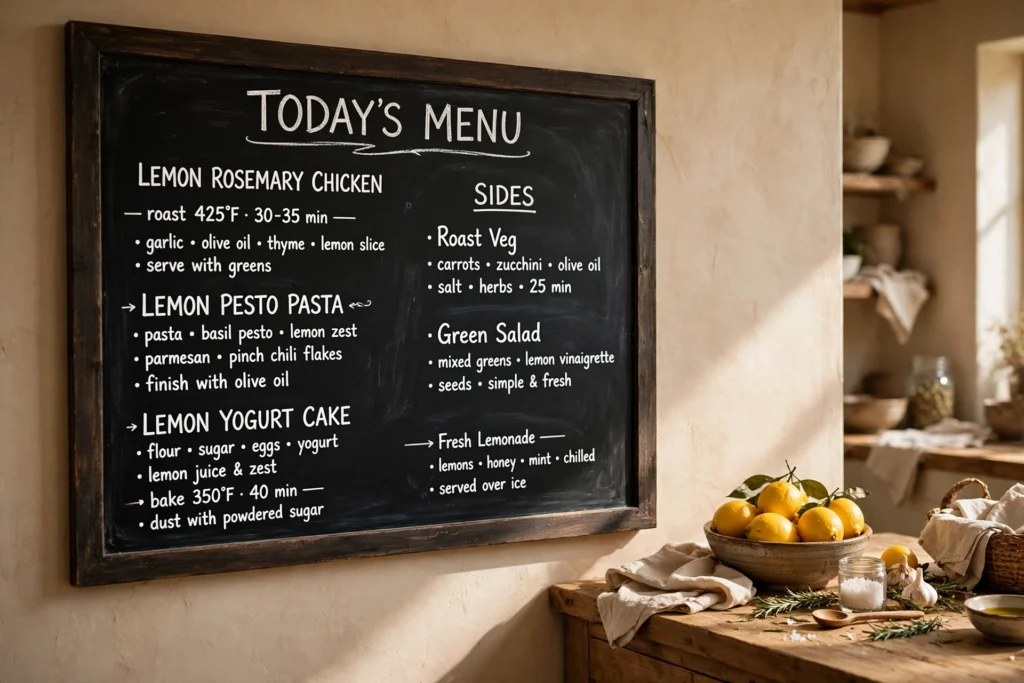
Chalkboards and menu boards are worth the wall space in a busy kitchen because they do three jobs at once: they hold the week’s menu, the shopping list and a note for the family, while adding a warm, cafe-style focal point. Choose a sealed or framed board, hang it on a dry wall away from steam, and use chalk markers for writing that stays legible.
A chalkboard is the hardest-working piece of kitchen wall decor you can hang. It is a menu planner, a shopping list, a birthday message and a piece of art in between. A board 24 by 36 inches hits the sweet spot for most kitchens: big enough for a week of meals and a shopping list. A framed board that size costs roughly $30 to $90 (planning estimate, not a quote).
Steam is the chalkboard’s only enemy: a board beside the stove fogs, and chalk dust plus moisture makes a grey smear. Hang it on a dry wall — by the table, near the door, on the side of a pantry — and it will stay crisp. Near the sink, choose a sealed board and liquid chalk markers; marker ink resists smudging and wipes off cleanly. Erase it every Sunday and start fresh.
Chalk Markers Beat Stick Chalk
Liquid chalk markers write brighter, smudge less and survive kitchen humidity better than stick chalk.
How Do You Hang Framed Art in a Kitchen Without Ruining It?
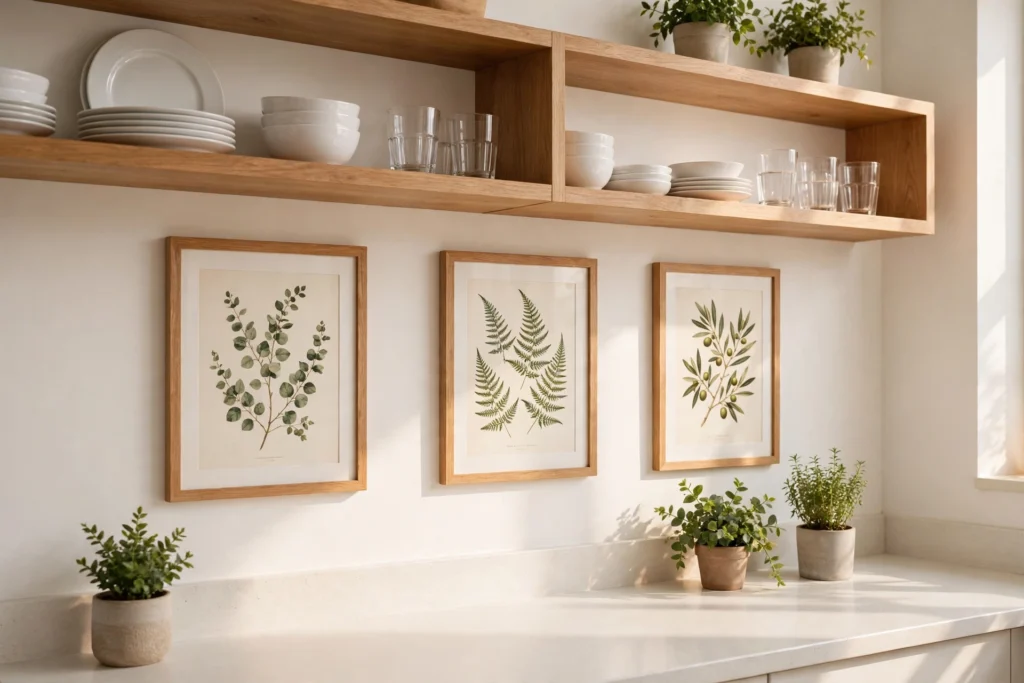
Framed art survives a kitchen when it sits behind glass or acrylic, hangs on a dry wall away from the stove, and leaves a small air gap behind the frame. Use sealed or laminated prints, wipe the glass monthly, and hang the centre at 57 to 60 inches from the floor, or 6 to 8 inches above a countertop.
Framed art is where most kitchen wall decor goes wrong, because people hang a beloved print the way they would in a bedroom — unframed, or in an open frame — and then wonder why it cockles and yellows. The fix is not to avoid art in the kitchen; it is to give the art a shield. Glass or acrylic over the front keeps steam and grease off the print itself.
Sealed, laminated or metal prints are the safest bets near moisture, because their surface is already non-porous. A standard paper print works only behind a sealed frame on a dry wall — never beside the stove, and never without glazing. Skip canvas prints: the fabric absorbs moisture and grease and cannot be cleaned once stained.
Do not skip the air gap behind the frame: a frame pressed flat against a kitchen wall traps humid air, which breeds mould and warps the backing board. Two small felt pads on the bottom corners hold it a few millimetres off the wall so moisture can escape.
Hang the centre of the piece at eye level, 57 to 60 inches from the floor; above a countertop, the bottom of the frame should sit 6 to 8 inches above the surface. For a group, centre the whole group, not each frame. Our step-by-step guide to how to hang pictures on wall covers measuring and levelling, and the grouping method in how to hang a gallery wall works just as well in a kitchen — as long as every frame in the group is glazed. A framed print typically costs roughly $20 to $80, or $40 to $150 for a metal print (planning estimates, not quotes).
Should You Hang Clocks, Mirrors and Signs in a Kitchen?
Clocks, mirrors and signs belong in a kitchen when they hang on a dry wall away from the stove: a large clock is the most-used piece of kitchen wall decor, a mirror doubles light in a dark kitchen, and a simple metal or wooden sign adds personality without collecting grease. Choose sealed, glazed or metal versions, and keep every piece out of the steam zone.
A big, readable clock is the most-used piece of kitchen wall decor in any home — you glance at it a dozen times a day while cooking. Pick one with a sealed face and a wipe-clean frame, and hang it where you can see it from the stove and the table. A clock 12 to 16 inches across suits most kitchens, and one with a glass face stays readable through steam.
A mirror works the same way a window does, bouncing light into the darkest corner of a kitchen. A mirror opposite a window doubles the daylight and makes a small kitchen feel twice as big. But a mirror beside the stove fogs constantly, so hang it on the wall opposite the cooking zone.
Metal and wooden signs — a simple “EAT”, a vintage coffee sign, a family name — add warmth fast, and they clean with a single wipe. Keep the wording short: one word or one short phrase, not a paragraph. A sign above a doorway or over a coffee station works well; avoid signs above the stove, where grease will coat the letters. As with the rest of our above sofa wall decor ideas, grouping a sign with a clock or a small print makes the display feel finished rather than random.
Mirror Opposite the Window
Hang a mirror on the wall directly opposite the window: it reflects the daylight straight back into the room and makes a small kitchen feel twice as big.
Can a Kitchen Have an Accent Wall?
A kitchen can have an accent wall, and the best one is a painted wall in a deep, washable colour, a peel-and-stick wallpaper panel, or a tile or beadboard feature wall on a dry side wall. Choose a washable finish, keep the accent wall away from the stove’s grease zone, and let it carry one or two pieces of kitchen wall decor, not a full gallery.
An accent wall gives a kitchen a focal point without a full renovation, and it works best on the wall you see first when you walk in. Deep sage, navy or terracotta in a washable eggshell or satin finish holds up to splashes and wipes clean. One wall is enough — two competing accent walls make a small kitchen feel busy rather than bold.
Peel-and-stick wallpaper is the renter-friendly route, and it comes off cleanly when you move. Avoid fabric-backed or uncoated paper: it absorbs moisture and grease and cannot be cleaned. Tile and beadboard cost more but last longer — a beadboard panel wall costs roughly $80 to $250 (planning estimate, not a quote), and a simple tile feature wall costs roughly $200 to $600 (planning estimate, not a quote).
An accent wall is not a gallery wall: one large piece — a big clock, a mirror, or one framed print — reads better than a crowded cluster. Keep the rest of the wall clear, so the colour and the piece carry the room. If the accent wall sits near the sink, seal it with a wipe-clean topcoat so splashes wipe off.
Which Wall Gets Which Decor?
Not every wall in a kitchen can take the same decor, so match the piece to the wall: hot walls take only tile, metal and glass; splash walls take glazed and sealed pieces; dry walls take everything. Use this quick table to check any piece before you hang it.
| Wall | What survives here | Best kitchen wall decor ideas | Avoid |
|---|---|---|---|
| Behind the stove (hot zone) | Tile, metal, glass, stone | Tile mural, metal sign, glass art | Paper art, open shelves, chalkboard, canvas |
| Behind the sink (splash zone) | Glazed ceramic, glass, sealed prints, metal | Plate wall, sealed print, mirror, small shelves | Unsealed wood, raw canvas, paper, chalkboard |
| Side wall by the prep counter | Sealed wood, ceramic, metal, glass | Open shelves, cutting-board rail, pegboard | Heavy items without studs, paper art |
| Dining-side wall (dry zone) | Everything | Framed art, gallery wall, clock, mirror, sign, chalkboard | Nothing — but seal paper prints |
| Wall opposite the window | Everything | Mirror, large clock, framed art | Mirror facing the stove (fogs) |
| Narrow wall by the door | Sealed, light pieces | Slim sign, small clock, hooks | Heavy shelves, deep frames |
| Wall above cabinets | Sealed, dust-tolerant pieces | Baskets, signs, metal art | Paper art, anything you cannot reach to clean |
When in doubt, ask one question: can I wipe this clean with a damp cloth? If the answer is yes, it belongs in a kitchen. If the answer is no, move it to a drier wall or seal it first — and when a piece has a sealed frame and sits away from the stove, almost anything works.
What Materials Actually Last in a Kitchen?
The materials that last in a kitchen are the ones that shrug off moisture and grease: glazed ceramic, sealed wood, stainless steel, glass and metal. Unsealed wood, raw canvas, paper and fabric fade, stain and warp, while the wipe-clean materials in this table keep looking new with a damp cloth.
| Material | Kitchen-safe? | Best use | Care |
|---|---|---|---|
| Glazed ceramic | Yes — the best all-rounder | Plate walls, tiles, vases | Wipe with a damp cloth |
| Sealed wood | Yes, when sealed | Cutting boards, shelves, signs | Oil monthly; reseal yearly |
| Stainless steel | Yes | Rails, signs, clocks, shelves | Wipe; polish occasionally |
| Glass | Yes | Framed art, mirrors, shelves | Wipe; watch for streaks |
| Sealed metal | Yes | Signs, clocks, hooks | Wipe; dry after cleaning |
| Laminated print | Yes | Framed art, menu boards | Wipe the laminate surface |
| Unsealed wood | No — absorbs grease | Not recommended | Would need sealing first |
| Raw canvas / paper | No | Not recommended | Cockles, yellows and stains |
Sealing is the move that turns a borderline material into kitchen-safe kitchen wall decor: a coat of clear polyurethane on wood, an acrylic sheet over a print, or a layer of laminate over a poster all create the wipe-clean surface a kitchen demands. Sealed pieces last for years, while unsealed ones show damage within months. Budget roughly $10 to $25 for a tin of clear sealant (planning estimate, not a quote) — the cheapest insurance in this guide.
Seal It Before You Hang It
Seal wood, paper and canvas pieces with clear polyurethane or an acrylic sheet before hanging them: a $10 tin of sealant is the cheapest insurance in this guide.
How Do You Decorate a Small or Galley Kitchen Wall?
A small or galley kitchen wall works best with one focal piece and storage that doubles as decor: a single mirror or clock, a slim shelf with everyday dishes, and a rail with hooks for tools. Keep the palette light, leave breathing room between pieces, and never crowd the wall you cook against.
Small kitchens punish clutter more than any other room, because every extra object competes with the cooking itself. The rule for a galley kitchen is one focal piece per wall: a mirror on the long wall, a clock on the short wall, a shelf above the counter. Three focal pieces on three walls reads as intentional; three focal pieces on one wall reads as a mess.
Use vertical space: a tall, narrow shelf or a rail with hooks uses the wall above the counter without eating into the room. A mirror opposite the window is the single best trick for a dark galley kitchen, and a light colour palette — white, pale sage, soft grey — bounces what little light there is.
Keep the counter clear and let the wall do the work: a rail with S-hooks holds the tools you use daily, a slim shelf holds the dishes you reach for, and one framed print gives the room its personality. A small-kitchen wall typically costs roughly $30 to $120 to finish (planning estimate, not a quote), and the result feels bigger, not busier.
One Focal Piece Per Wall
One focal piece per wall: a mirror on the long wall, a clock on the short wall, a shelf above the counter. Three focal pieces on one wall reads as a mess.
Can Renters Hang Kitchen Wall Decor Without Holes?
Renters can hang kitchen wall decor without holes using removable adhesive strips, peel-and-stick wallpaper, lean-to boards and tension-rod shelves — all of which come off cleanly when you move. Keep pieces light, check the strip’s weight limit, and never hang a heavy shelf on adhesive alone.
Renting does not mean living with blank walls, but it does mean choosing kitchen wall decor that comes off cleanly. Removable adhesive strips hold up to 7 pounds per pair, which covers most clocks, signs, small frames and lightweight shelves — but never hang a loaded shelf on adhesive alone. For anything heavier, use a freestanding shelf or a lean-to board that rests on the floor.
Peel-and-stick wallpaper turns a plain wall into an accent wall for roughly $30 to $80 per roll (planning estimate, not a quote), and it peels off without damage. A lean-to chalkboard or a large framed print propped on the counter gives you a focal point with zero holes. Tension-rod shelves fit between two walls or inside a cabinet opening, and they hold light dishes and plants.
The five no-hole ideas that work best in a rental kitchen:
- Removable adhesive strips — clocks, signs and light frames up to 7 pounds per pair.
- Peel-and-stick wallpaper — one accent wall, peels off cleanly.
- Lean-to boards and prints — prop a large chalkboard or framed print on the counter.
- Tension-rod shelves — light dishes and plants between two walls.
- Magnetic strips and hooks — utensils and small tools on the fridge or a metal rail.
Check your lease first: most landlords allow removable strips and decals but not nails or screws, and a quick photo of the wall before you move in protects your deposit. When in doubt, choose the lightest option — a peel-and-stick decal costs roughly $10 to $30 (planning estimate, not a quote) and changes the whole room.
Frequently Asked Questions
What is the best kitchen wall decor?
The best kitchen wall decor is wipe-clean, heat-tolerant and hung on the right wall: glazed ceramic plates, metal signs, glass-framed prints, open shelves on side walls and cutting-board rails. Choose sealed materials near cooking zones and save paper art for dry walls.
What should you not hang in a kitchen?
Do not hang unframed paper art, raw canvas or unsealed wood near the stove or sink: steam and grease will yellow, warp and stain them within months. Keep paper art behind sealed glass on dry walls, and never hang open shelves directly above the cooktop.
How high should you hang kitchen wall decor?
Hang the centre of a piece 57 to 60 inches from the floor, or 6 to 8 inches above a countertop. Open shelves should sit 18 to 20 inches above the counter, with 12 to 15 inches between shelves.
Can you hang pictures in a kitchen?
Yes — hang framed pictures behind glass or acrylic on a dry wall away from the stove, leave a small air gap behind the frame, and choose sealed, laminated or metal prints. Skip canvas prints, which absorb moisture and grease.
What is the cheapest kitchen wall decor?
The cheapest kitchen wall decor is a plate wall (roughly $25 to $120 for six to eight plates), a peel-and-stick decal (roughly $10 to $30), or a cutting-board rail (roughly $15 to $40) — all planning estimates, not quotes. Thrifted plates and boards keep costs lowest.
How do you decorate a small kitchen wall?
Decorate a small kitchen wall with one focal piece per wall — a mirror, a clock or a single shelf — plus storage that doubles as decor, like a rail with hooks. Keep the palette light and leave breathing room between pieces.
Can renters hang kitchen wall decor?
Yes — use removable adhesive strips (up to 7 pounds per pair), peel-and-stick wallpaper, lean-to boards and tension-rod shelves, which all come off cleanly. Check your lease first, and never hang a heavy shelf on adhesive alone.
What materials last longest on kitchen walls?
Glazed ceramic, sealed wood, stainless steel, glass and sealed metal last longest on kitchen walls because they wipe clean and resist moisture and grease. Seal any wood, paper or canvas piece before hanging it.
Final Thought
Kitchen wall decor is not about filling every blank wall — it is about choosing a few pieces that can live with steam, grease and daily cooking, and hanging them where they belong. Pick wipe-clean materials, respect the hot, splash and dry zones, and let one strong piece carry each wall. Do that, and your kitchen will look finished for years, not tired in six months.