Living Room Wall Decor: How to Arrange, Size, and Style Your Walls
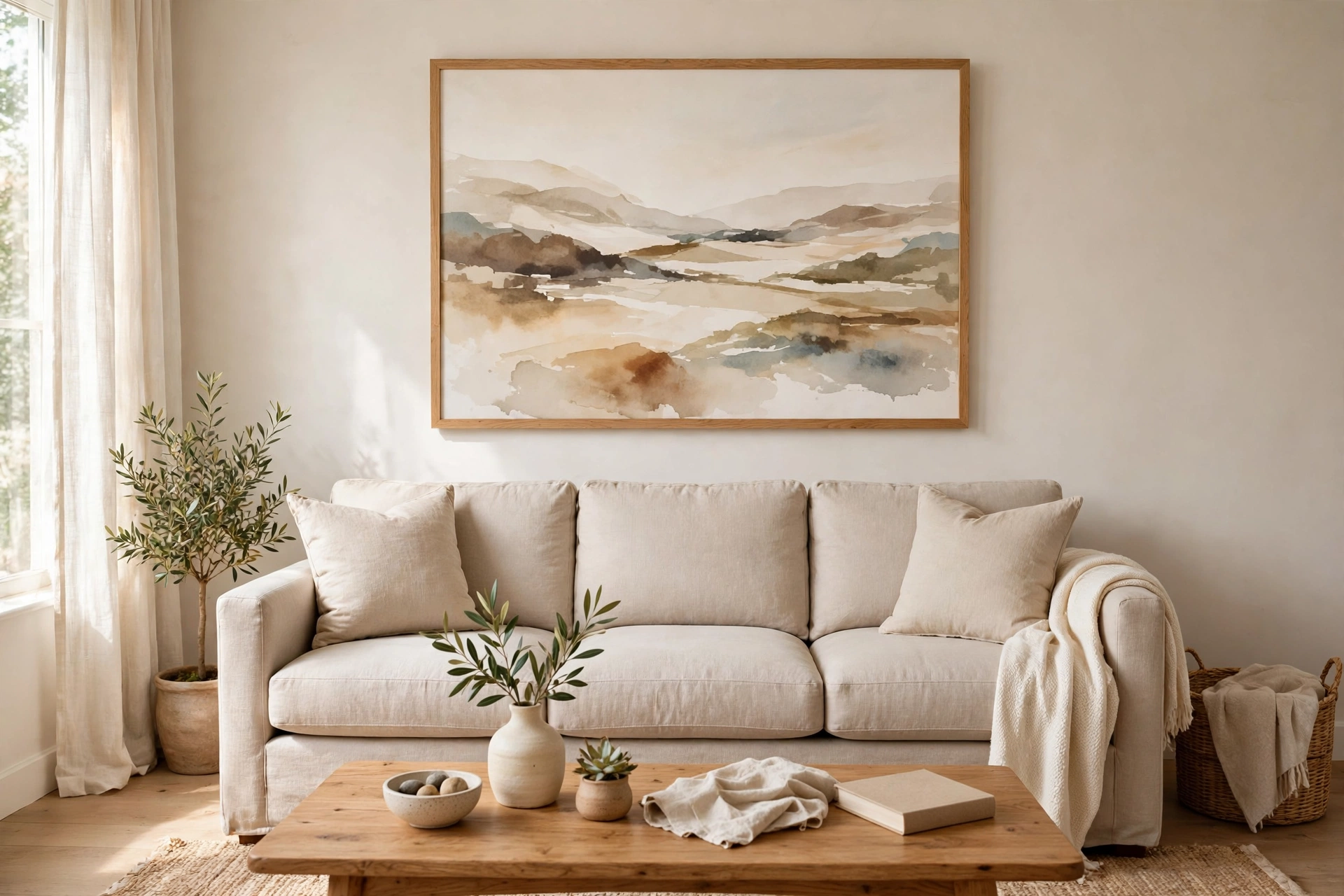
Living room wall decor works when three numbers are right: the piece spans about two-thirds of the sofa’s width, its centre sits 57 to 60 inches from the floor, and it hangs 6 to 10 inches above the sofa back. Get those right and any style — one big canvas, a gallery wall, a mirror, or shelves — looks intentional.
A bare wall behind the sofa makes the whole room feel unfinished, even when the sofa, rug, and coffee table are perfect, and a wall crowded with small, scattered frames feels restless.
The good news is that living room wall decor is the cheapest room transformation in the house: one large print or a mirror costs far less than a new sofa and changes the room just as much. You need a tape measure, a clear plan for each wall, and the sizing rules in this guide. This post covers the decor side — arranging, sizing, hanging, and styling walls — rather than choosing which artwork to buy; if you are still picking the art itself, our guide to wall art for living room covers styles, subjects, and colours.
TL;DR
• Size: Art above a sofa should span about two-thirds (60–75%) of the sofa’s width. An 84-inch sofa wants 56–63 inches of art.
• Height: On an open wall, centre art 57–60 inches from the floor. Above a sofa, leave 6–10 inches (8 inches is the safe default) between the sofa back and the bottom of the frame.
• One wall, one job: Give each wall a single focal treatment — one big piece, one gallery, one mirror, or one set of shelves.
• Spacing: Keep 2–3 inches between frames so the group reads as one block.
• Renters: Adhesive strips, leaning art, picture ledges, and peel-and-stick wallpaper decorate without a single nail hole.
• Budget: A finished sofa wall costs roughly $60–$600 depending on the route (see the cost table below; prices are rough planning estimates, not quotes).
What Size Should Living Room Wall Decor Be Above a Sofa?
Art above a sofa should span about two-thirds of the sofa’s width — between 60 and 75 percent — so the art and the furniture read as one arrangement. Anything narrower than half the sofa looks stranded, and anything wider than the sofa competes with the furniture instead of complementing it.
This is the most useful rule in living room wall decor, and the most broken: a 30-inch print above an 84-inch sofa covers barely a third of its width, which is why the wall still feels empty. Measure the sofa first, multiply by two-thirds, and shop with that number.
| Sofa width | Target art width (⅔–¾) | What fits |
|---|---|---|
| 60 in (loveseat) | 40–45 in | One 36×24 in landscape, or three 12×18 in portraits |
| 72 in (small sofa) | 48–54 in | One 48×32 in canvas, or a pair of 24×36 in portraits |
| 84 in (standard sofa) | 56–63 in | One 60×40 in canvas, or three 18×24 in portraits |
| 96 in (large sofa) | 64–72 in | One 72×48 in canvas, or a triptych |
| 108 in+ (sectional) | 72–81 in | Triptych, or a gallery grouping treated as one block |
Treat a grouping as one rectangle: add up the full width of the frames plus the gaps, and apply the two-thirds rule to that total. A gallery of six frames with 2-inch gaps can span 60 inches — perfect above a standard sofa — even though no single frame is wider than 16 inches.
On a bare wall with no furniture beneath it, fill 60–75 percent of the wall’s width with one focal treatment — a 10-foot wall wants 6 to 7.5 feet of decor, whether that is one oversized piece, a salon gallery, or a leaning mirror with a console.
PRO TIP
Before you buy anything, cut kraft paper to the size of the piece and tape it to the wall for 24 hours. It costs nothing, and it stops the most expensive mistake in living room wall decor — buying art that is too small and discovering it only once the nail is in the wall.
How High Should You Hang Living Room Wall Decor?
Hang living room wall decor so its centre sits 57 to 60 inches from the floor on an open wall, which is average adult eye level and the gallery standard. Above a sofa, ignore the floor measurement and leave 6 to 10 inches between the top of the sofa back and the bottom of the frame instead.
The two rules serve different walls: on an open wall your eyes set the height; above furniture, the furniture sets it, and when they disagree the sofa gap wins. A tall-backed sofa can push the centre above 60 inches, and that is fine.
The most common hanging error is measuring to the hook instead of to the centre of the piece. The hardware sits above the centre, and a hanging wire sags once loaded, so art hung “at 57 inches” by the hook often lands at 62 or 63 inches on the wall. Measure the artwork’s height, divide by two, and mark the centre point on the wall first.
Mark the spot with painter’s tape and check it from the doorway you usually enter through — that view is how guests see the wall.
High ceilings tempt people to hang art higher — resist it, and fill the height with a taller piece instead, keeping the group’s centre near 60 inches.
PRO TIP
Hang art slightly lower than you think it should go — almost everyone hangs it too high on the first try. If the centre is at 57 inches and it feels low, live with it for a week; your eye is calibrated to the old, too-high position.
Gallery Wall or One Big Piece: Which Works Better for Living Room Wall Decor?
One big piece of living room wall decor works better when you want a calm, finished wall fast, while a gallery wall works better when you want personality and a display that grows over time. Choose one big piece for a formal room, and a gallery wall for a collected, family-centred room — never both on the same wall.
The one-big-piece route is the easiest win: a single canvas of 40 inches or wider fills a sofa wall in one afternoon with one hanging point. It suits rooms where the sofa, rug, and cushions already carry plenty of pattern, because the wall stays quiet — and go landscape, since a wide, low shape echoes the wide, low sofa.
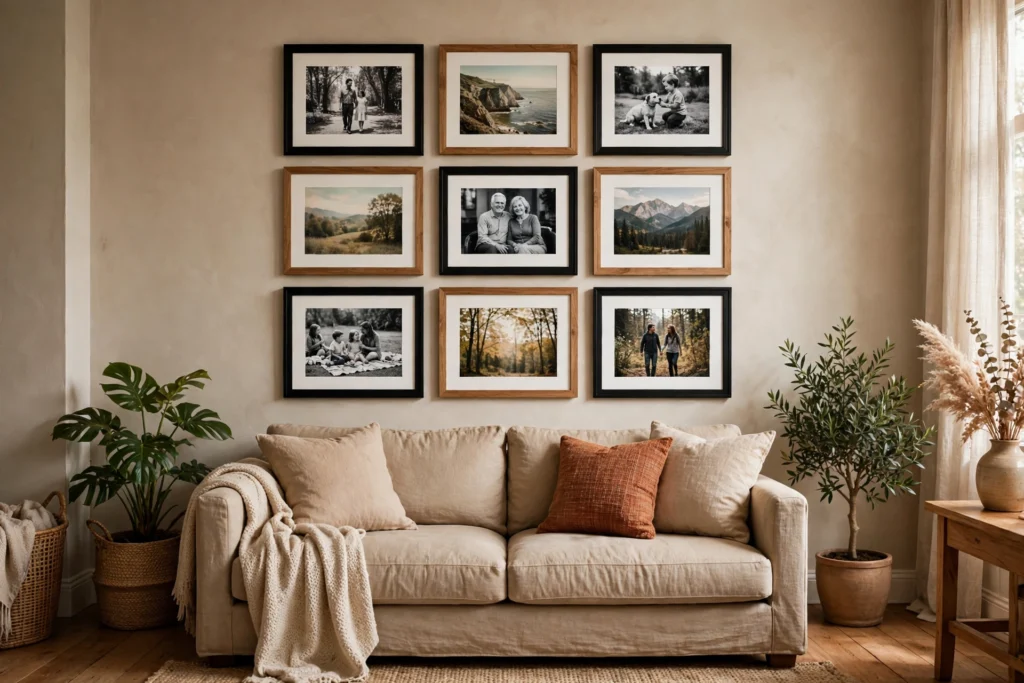
A gallery wall mixes framed prints, family photos, and small paintings hung close together so the whole arrangement reads as one block. The rules that keep it from looking like a jumble:
- Start with an anchor. Place the biggest frame first, slightly off-centre or dead centre, then build outward around it.
- Keep gaps tight and consistent. Two to 3 inches between frames for a cohesive block; up to 4 inches for larger pieces. Uneven gaps are the fastest way to make a gallery look accidental.
- Share one element. The same frame colour, the same mat colour, or the same palette across all pieces ties mismatched frames together.
- Plan on the floor first. Lay the whole arrangement on the floor, or trace each frame onto kraft paper and tape the paper to the wall before you drill a single hole. Our step-by-step layout guide to how to hang a gallery wall walks through the paper-template method.
- Treat the group as one piece. Apply the two-thirds rule and the 6–10 inch sofa gap to the outer edges of the whole group, not to any single frame.
A tight grid gallery — six or nine identical frames in even rows — is the most forgiving layout for beginners. A salon-style gallery with mixed sizes looks more collected but needs the paper-template step.
How Do Mirrors Work as Living Room Wall Decor?
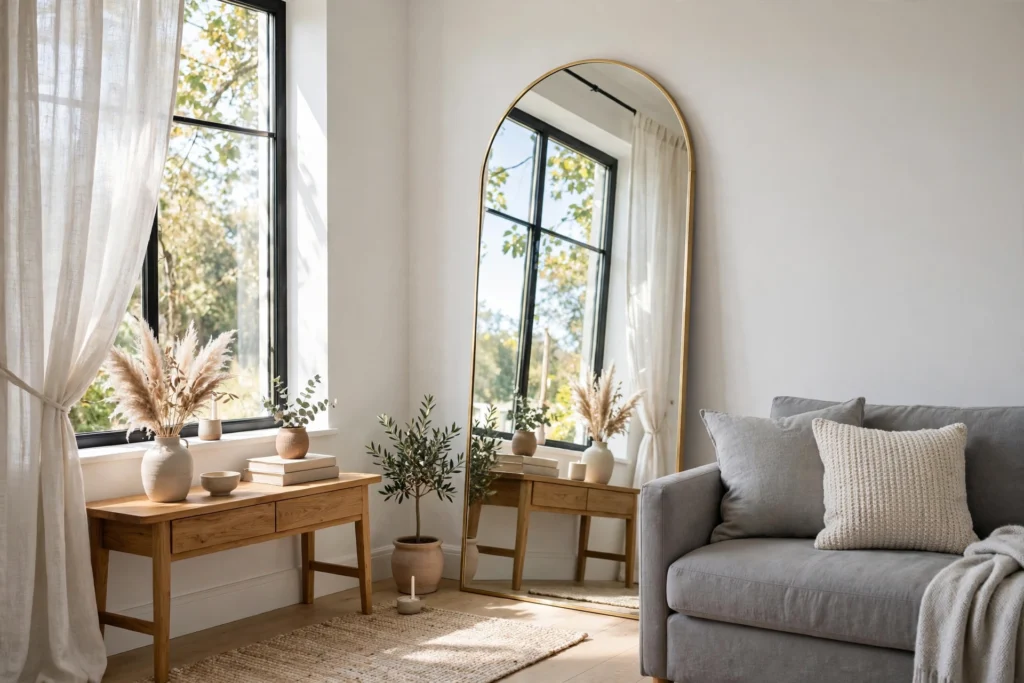
Mirrors work as living room wall decor by bouncing light and doubling the sense of space — one large mirror hung opposite a window can make a small or dark living room feel noticeably brighter and bigger. Hang one big mirror rather than three small ones, and never hang a mirror where it reflects clutter.
A 36-by-48-inch mirror reads as architecture; three small mirrors read as clutter. Before you hang one, check what it will reflect: a window, a garden view, or a pretty lamp is ideal — a television, a messy shelf, or a blank ceiling is not.
Best placements for mirrors in a living room:
- Opposite a window: Doubles the daylight and the view — the single highest-impact mirror placement in most homes.
- On the darkest wall: A large mirror on the wall that gets the least light borrows brightness from the rest of the room.
- In a small living room: A tall arched mirror leaning against the wall adds height and light without a single hole — and leaning is renter-friendly too.
Arched mirrors are the current favourite shape, and for good reason: the curve breaks up the straight lines of the sofa, rug, and coffee table, and a tall arch draws the eye upward without raising the hanging height. Round mirrors do similar work on a smaller scale, and rectangular mirrors suit rooms where everything else is already rectangular.
What Are the Best Shelves and Ledges for Living Room Wall Decor?
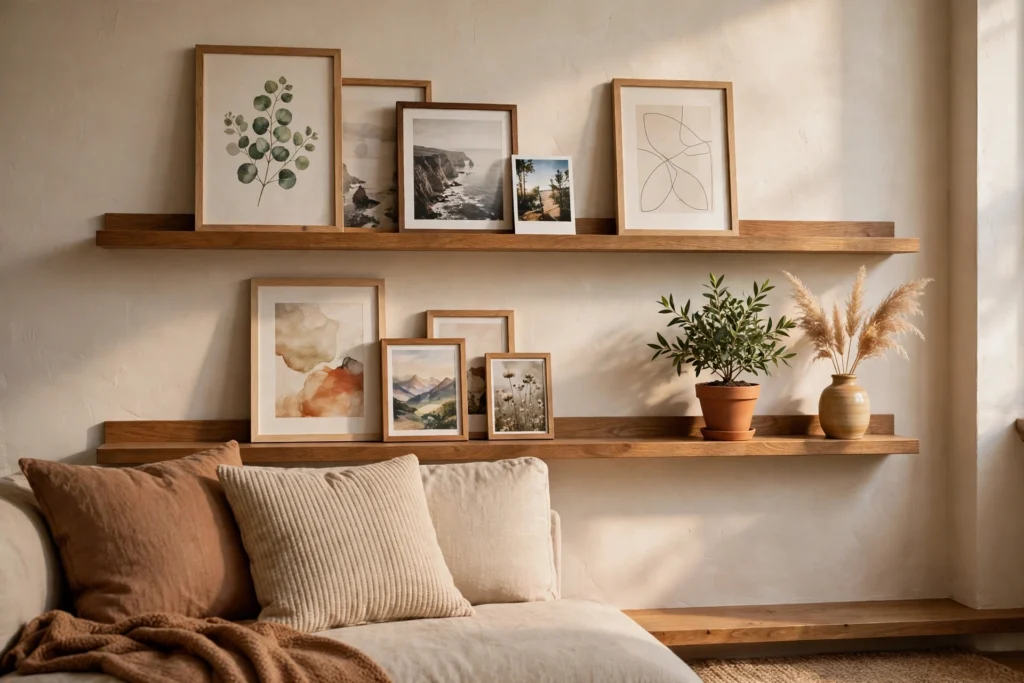
The best shelves for living room wall decor are two or three floating shelves styled in groups of three, or one or two long picture ledges that let you lean and swap frames without new holes. Shelves earn their place by doing two jobs at once — display and storage — while ledges win on flexibility, because rearranging takes seconds.
Floating shelves fill a wall without a large purchase and suit rooms where the decor changes often. Style them with the rule of three — one tall, one short, one in between — and leave shelves about two-thirds full; a shelf packed edge to edge reads as storage, not decor.
Picture ledges are the most forgiving wall decor there is: frames lean on a narrow shelf with a lip instead of hanging from it, so you can swap art in seconds without new holes. Hang two ledges above the sofa, or one long ledge along the longest wall, layering frames — a large one at the back, a smaller one in front, a small plant at the end.
Shelving rules that keep the look intentional:
- Hang shelves at art height. The centre of the display should sit near the same 57–60 inch eye-level band as framed art.
- Vary heights within each group. Books stacked horizontally, a tall vase, a low trailing plant — the mix is what makes a shelf look styled rather than stored.
- Mind the weight. A floating shelf loaded with books needs studs or proper wall anchors; a shelf held by two small screws will sag and eventually fail.
How Can You Add Texture with Living Room Wall Decor?
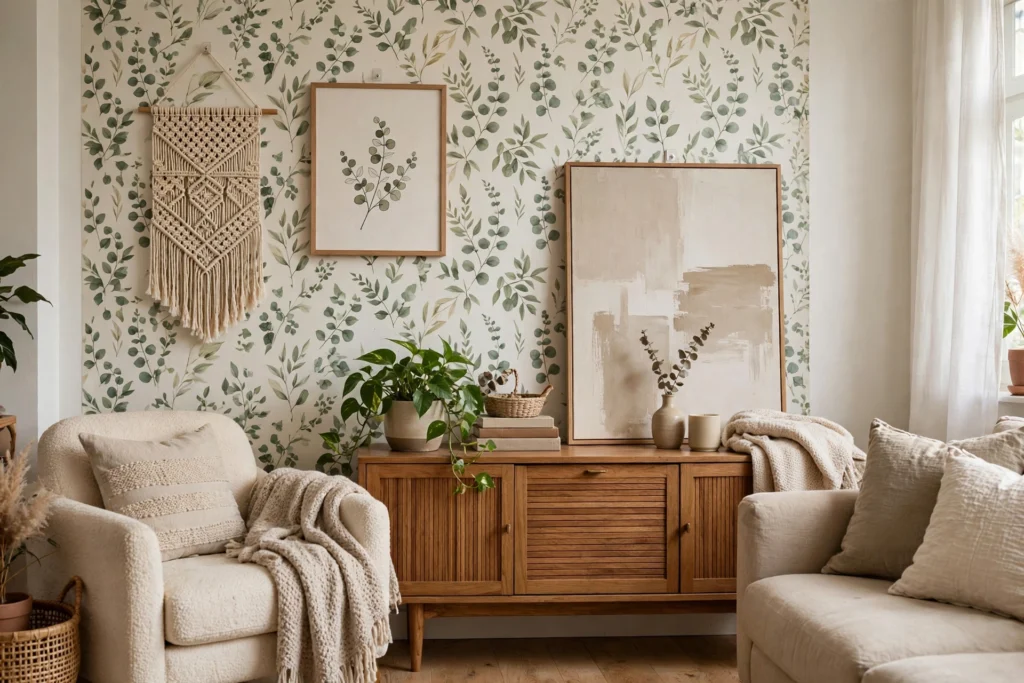
You can add texture to living room wall decor with wood slats, woven hangings, metal sculpture, fabric panels, or panel molding — each one adds warmth and dimension that flat art alone cannot. Texture is the fix for a room that has the right furniture and the right art but still feels flat and echoey.
Texture works because living rooms are full of hard, flat surfaces — drywall, glass, screens, hardwood floors. A soft or three-dimensional treatment breaks up that flatness and absorbs sound, which is why textile hangings are popular in echoey rooms.
| Texture option | Best for | Rough cost* | Effort |
|---|---|---|---|
| Woven wall hanging / macramé | Boho, soft, echoey rooms | $25–$120 | Low — one or two hooks |
| Wood slat accent panel | Modern, warm, architectural | $150–$500 | Medium — weekend DIY |
| Metal wall sculpture | Contemporary, industrial | $60–$300 | Low — one or two anchors |
| Fabric tapestry / quilt | Rentals, big blank walls | $30–$150 | Low — adhesive hooks or rod |
| Panel molding / wainscoting | Plain builder-grade walls | $200–$800 | Medium to pro |
| Peel-and-stick wallpaper panel | Feature wall, renters | $40–$150 | Low — weekend DIY |
| Basket or plate collection | Collected, global style | $40–$180 | Low — small hooks |
*Prices are rough planning estimates for typical US sizes and materials, not quotes — actual costs vary by size, material, and retailer.
Mix textures in your living room wall decor rather than stacking the same one: a wood slat panel beside a woven hanging reads richer than two wood treatments side by side. And keep texture to one wall per room.
How Do You Hang Living Room Wall Decor Without Nails?
You can hang living room wall decor without nails using adhesive picture-hanging strips, leaning art and mirrors, picture ledges on furniture, peel-and-stick wallpaper, and tapestries on adhesive hooks. Large picture-hanging strips hold frames up to 16 lbs and sizes up to 24×36 inches, which covers most living-room art.
Renters ask this question more than any other, and the answers are consistent: in a Hometalk community Q&A on decorating without nails or paint, the most repeated advice was removable wallpaper, adhesive strips, and leaning art — several renters reported adhesive hooks holding for years without wall damage.
The no-nail toolkit, ranked by how much weight each option safely carries:
- Adhesive picture-hanging strips: The workhorse. Use four pairs per frame, press firmly for 30 seconds, and wait an hour before hanging. Large strips are typically rated to 16 lbs — use lightweight frames with acrylic instead of glass to stay well under the limit.
- Leaning art and mirrors: The zero-hole option. A large canvas or mirror leaned on a sideboard or console reads as deliberate, not unfinished, especially with a small plant or vase in front of it.
- Picture ledges on furniture: A ledge does not have to be wall-mounted. A narrow ledge sitting on a console or sideboard holds leaning frames just as well.
- Peel-and-stick wallpaper: One accent panel transforms a blank wall for $40–$150, peels off cleanly, and needs no tools at all.
- Tapestries and fabric hangings: Hang from adhesive hooks or a tension rod. A large tapestry covers an expansive blank wall for less than a framed print of the same size, and it softens echo at the same time.
- Magnetic poster hangers: A wooden top-and-bottom magnetic hanger for 12×16 to 12×24 inch prints — a clean, frameless look with one small hook.
Two cautions: read your lease first — some ban adhesive hangers outright, while others allow small nail holes if you patch them — and test strips on a hidden patch of wall, especially on fresh paint, where removal can lift paint.
How Do You Swap Living Room Wall Decor for the Seasons?
Swap living room wall decor for the seasons by changing what sits on picture ledges and shelves, not what is nailed to the wall — keep the large anchor piece year-round and rotate smaller frames, textiles, and shelf objects four times a year. Ledges make seasonal swaps a ten-minute job instead of a re-hanging project.
Seasonal living room wall decor swaps work best with a permanent anchor — one big canvas, a mirror, or a gallery grid — and a changeable layer of ledge frames, shelf vases, and textiles. That split is what makes the change cheap and fast.
Rotate ledge frames and shelf objects by season: botanical prints and pale textiles in spring, bright airy pieces in summer, warm tones and dried grasses in autumn, evergreen garland and metallic frames in winter.
For more seasonal ideas, our guide to above sofa wall decor covers sofa-wall arrangements that adapt well to seasonal changes.
What Are the Most Common Living Room Wall Decor Mistakes?
The most common living room wall decor mistakes are hanging art too small, hanging it too high, scattering small pieces across every wall, and matching the art exactly to the cushions. Each one is fixable in an afternoon with a tape measure, not new purchases.
- Art that is too small. The number one mistake, by a wide margin. A single small print above a three-seater sofa looks like a postage stamp on a duvet. Fix: size to two-thirds of the sofa’s width, or group frames into a block that reaches it.
- Art hung too high. The second most common mistake, and the one that makes a wall feel cold and disconnected. Fix: 6–10 inches above the sofa back, centre 57–60 inches from the floor on open walls.
- Scattered small pieces. A dozen small frames spread across every wall reads as clutter, while one focal treatment per wall reads as design. Fix: pick one job per wall and leave the rest of it alone.
- Matching the art to the cushions. Art in the exact colour of the cushions looks like a furniture showroom. Fix: pull one colour from the room and let the art introduce a second one.
- Ignoring the doorway view. Walls are judged from the doorway, not from in front of them. Fix: check every arrangement from the entrance you use most.
- Uneven gallery gaps. Gaps of 1 inch here and 5 inches there make good frames look accidental. Fix: use a 2–3 inch cardboard spacer between every frame.
- Hanging a mirror that reflects clutter. A mirror doubles whatever it faces. Fix: check the reflection before you drill — window or garden good, television or messy shelf bad.
- Forgetting scale on tall walls. On a wall over 10 feet, two-thirds of the sofa can still look small. Fix: go to the top of the band (three-quarters), choose the tallest size the ratio allows, or stack two pieces vertically.
Living Room Wall Decor Options Compared
| Option | Best wall | Rough cost* | Holes needed | Swap-friendly? |
|---|---|---|---|---|
| One large canvas | Sofa wall, big blank wall | $80–$400 | 1–2 | No |
| Gallery wall (6–9 frames) | Large wall, hallway | $60–$350 | 6–12 | No |
| Large mirror | Small/dark room, opposite window | $100–$600 | 2–4 | No |
| Floating shelves (2–3) | Any wall, display + storage | $50–$250 | 4–8 | Yes |
| Picture ledges (1–2) | Sofa wall, longest wall | $40–$180 | 2–4 | Yes — best for swaps |
| Wood slat panel | Feature wall | $150–$500 | Several | No |
| Woven hanging / tapestry | Rentals, echoey rooms | $25–$150 | 1–2 | Yes |
| Peel-and-stick wallpaper | Feature wall, rentals | $40–$150 | 0 | Yes |
*Prices are rough planning estimates for typical US sizes and materials, not quotes — actual costs vary by size, material, and retailer.
PRO TIP
If you can only afford one thing this month, buy the mirror — or the biggest single piece you can afford. One confident, correctly sized piece changes a room more than five small, cheap ones.
Frequently Asked Questions About Living Room Wall Decor
Fill 60–75 percent of the wall’s width with one focal treatment: one oversized artwork, a salon gallery wall of 6–10 frames, panel molding, or a leaning arched mirror with a console. One strong element beats a scattering of small pieces.
About 56–63 inches wide — roughly two-thirds of the sofa. A single 60×40 inch canvas works, as do three 18×24 inch portraits hung with 2–3 inch gaps between them. Hang the bottom of the frame 6–10 inches above the sofa back.
On an open wall, hang pictures so the centre of the piece sits 57–60 inches from the floor. Above a sofa or other furniture, leave 6–10 inches between the top of the furniture and the bottom of the frame, and let the centre drift above 60 inches if the sofa is tall.
No — match one colour from the room, not the sofa itself. Art in the exact colour of the cushions looks like a furniture showroom. Let the art introduce a second colour, and repeat one small accent (a cushion, a throw, a vase) to tie it together.
One oversized artwork above the sofa: one hanging point, one measurement (two-thirds of the sofa’s width), one afternoon. For flexibility instead, two picture ledges with leaning frames let you rearrange the wall in seconds without new holes.
Use adhesive picture-hanging strips (large strips hold frames up to 16 lbs), lean large art and mirrors on furniture, hang tapestries from adhesive hooks, or apply one peel-and-stick wallpaper panel. Check your lease first — some leases ban adhesive hangers, while others allow small nail holes if you patch them.
Yes, if one of them is clearly the anchor. A large mirror flanked by two small frames works, and a gallery wall with one small mirror adds light. Two equal-sized focal pieces competing — a big mirror beside a big canvas — splits the wall in half.
Change the swap layer — ledge frames, shelf objects, textiles — with the seasons, about four times a year. Keep the anchor piece for years; a full re-hang is only needed when the furniture changes or the room gets repainted.
Final Thought
Good living room wall decor is not about buying more things — it is about giving the things you already have the right size, the right height, and the right wall. Measure the sofa, mark 57 inches on the open wall, leave 8 inches above the sofa back, and pick one job for each wall. Most bare walls are not a shopping problem but a measuring problem, and a tape measure is the cheapest decorating tool you will ever own.
Start with the sofa wall this weekend: paper-template the size, live with it for a day, and hang one piece at the right height.