How to Get Rid of Silverfish
If you have ever switched on the bathroom light at night and watched a silvery, fish-shaped insect dart for the nearest crack, you already know the question: how to get rid of silverfish before they chew through your books, wallpaper, and favourite clothes. The short answer is that silverfish are a moisture problem first and a bug problem second — dry your home out, take away their starchy food, seal their hiding places, and trap the stragglers, and they have nowhere left to live. This guide walks you through all seven steps, with real costs, safety notes for homes with kids and pets, and the exact point where calling a professional makes more sense than another DIY round.
Silverfish are stubborn for a simple reason: your home gives them everything they need — warmth, darkness, damp air, and a buffet of paper, glue, and starch. They do not bite, spread disease, or eat your house like termites do. What they do is quiet, slow damage: a chewed photo album corner, yellow stains on a stored dress, a book nibbled away one night at a time. Because they are nocturnal, most people only ever see one or two — and by then, dozens more are hiding.
The good news is that silverfish are very beatable, because they have one weakness: they cannot survive in dry air. Get your indoor humidity below 50%, and you have already won half the battle. The rest of this guide finishes the job and makes sure they never come back.
TL;DR — How to Get Rid of Silverfish in 7 Steps
1. Drop the humidity below 50% with a dehumidifier and better ventilation — silverfish thrive at 75–95% humidity and struggle to survive below 50%.
2. Remove their food — move pantry goods, books, and papers into sealed containers and clear out cardboard boxes.
3. Seal cracks and gaps around baseboards, pipes, windows, and doors with caulk.
4. Dust food-grade diatomaceous earth in cracks and behind appliances (keep it dry).
5. Use boric acid sparingly in hidden voids only — never where kids or pets can reach it.
6. Set sticky traps and DIY jar traps where you have seen activity, and check them weekly.
7. Monitor for 6–8 weeks. If you still see them daily after two months of dry conditions, call a professional — roughly $150–$400 per visit (planning estimate, not a quote).
What Are Silverfish — and How Do You Know You Have Them?
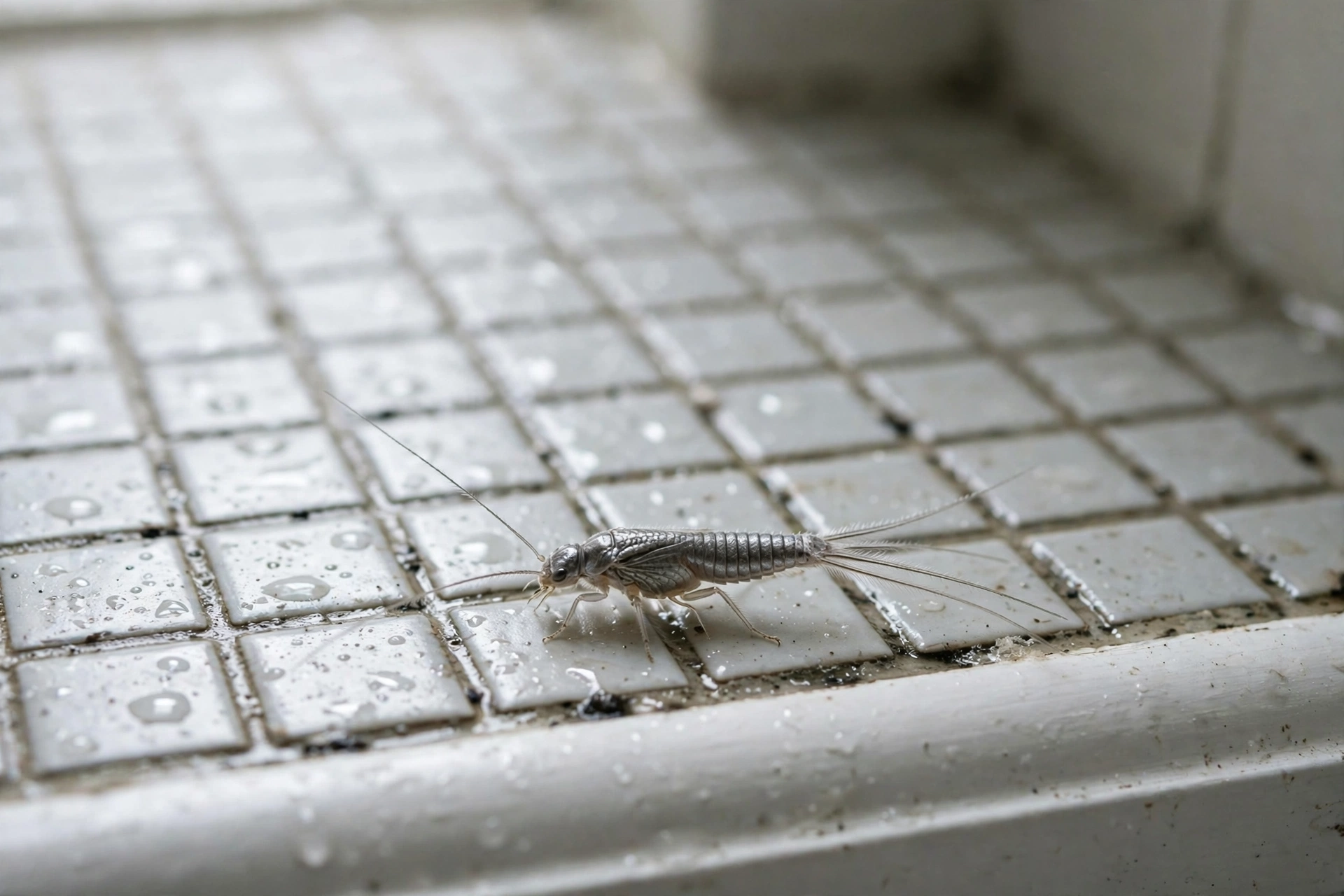
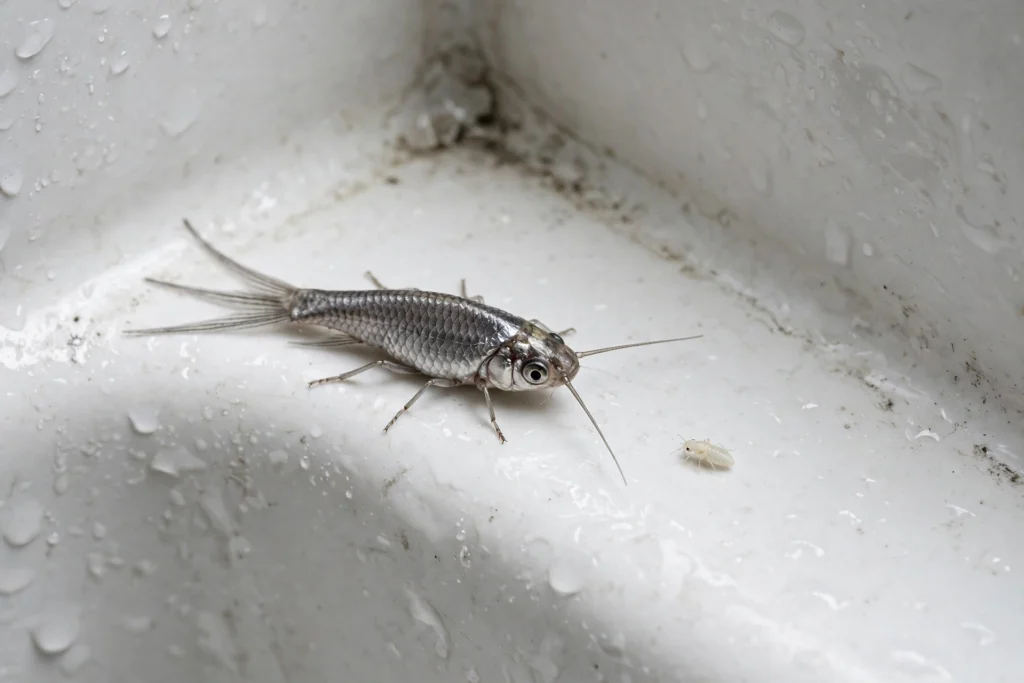
Silverfish are small, wingless insects about ½ to 1 inch long, with a silvery-gray, carrot-shaped body that tapers toward the back, two long antennae at the front, and three long tail filaments at the rear — and knowing how to get rid of silverfish starts with recognising them correctly.
They move in a quick, wiggling, fish-like dart — which is how they got their name — and they love dark, damp bathrooms, basements, laundry rooms, and kitchens. The scientific name is Lepisma saccharina, and they feed on starches and sugars: paper, book bindings, wallpaper paste, glue, cereal, flour, and pet food.
You may have silverfish for months before you see one. They hide in cracks by day, and a single insect in the bathtub does not always mean an infestation. The signs of a real problem are damage, not sightings: irregular holes or surface grazing on book pages, yellow stains on paper or clothing, tiny pepper-like droppings in corners, and shed skins near baseboards. If you find them every night, or in the daytime when they should be hiding, act now.
Silverfish vs. Firebrats vs. Booklice — How to Tell Them Apart
Silverfish are often confused with two look-alikes. Firebrats are close cousins that look almost identical but prefer heat — you will find them near furnaces, water heaters, and hot attics above 90°F, while silverfish prefer cool, damp rooms. Booklice (psocids) are much smaller, pale, and soft-bodied, with no tail filaments at all, and they feed on mold rather than starch. If the insect has three tail filaments and a silvery, scaly body, it is a silverfish or a firebrat; the room it is in usually settles the question.
| Insect | Size | Key features | Where you find it | Main food |
|---|---|---|---|---|
| Silverfish | ½–1 inch | Silvery-gray, tapered body, 3 tail filaments | Bathrooms, basements, kitchens | Paper, glue, starch, fabric |
| Firebrat | ½–1 inch | Mottled gray-brown, 3 tail filaments | Near furnaces, water heaters, hot attics | Same as silverfish, but loves heat |
| Booklouse | 1/16–1/8 inch | Pale, soft, no tail filaments | Damp books, moldy walls | Mold and mildew |
PRO TIP
Before you spend a dollar on treatment, do a 5-minute night check. Turn off the lights in the bathroom and kitchen for two hours after dark, then switch them on suddenly and watch where the silverfish run. Their escape routes point straight at their hiding places — usually a gap behind the baseboard, under the sink, or around a pipe. Treat those exact spots first.
Why Do Silverfish Show Up in Your Home?
Silverfish show up in your home for two reasons: moisture and food. They need 75–95% relative humidity to thrive, which is why they cluster in poorly ventilated bathrooms, seeping basements, damp laundry rooms, and kitchens with slow leaks under the sink.
Their presence is, in the words of the National Pesticide Information Center, a sign of too much moisture — so if you keep seeing them, look for the water first: a dripping pipe, an unvented shower, a clogged gutter, or a damp crawl space.
The second reason is food. Silverfish eat the starch in wallpaper paste, book bindings, cardboard boxes, paper bags, cereal, flour, sugar, and the sizing in cotton and linen clothing. A basement full of cardboard boxes is a silverfish hotel with a free buffet. They can survive for weeks without food and live about 2 to 8 years, but they breed slowly — so a small population can be cleared in weeks once the moisture is gone.
Silverfish activity peaks in warm, humid months; the same damp conditions attract other pests too — see our German cockroaches guide for the damp-loving pests that share their habitat.
What Do Silverfish Eat — and What Damage Do They Cause?
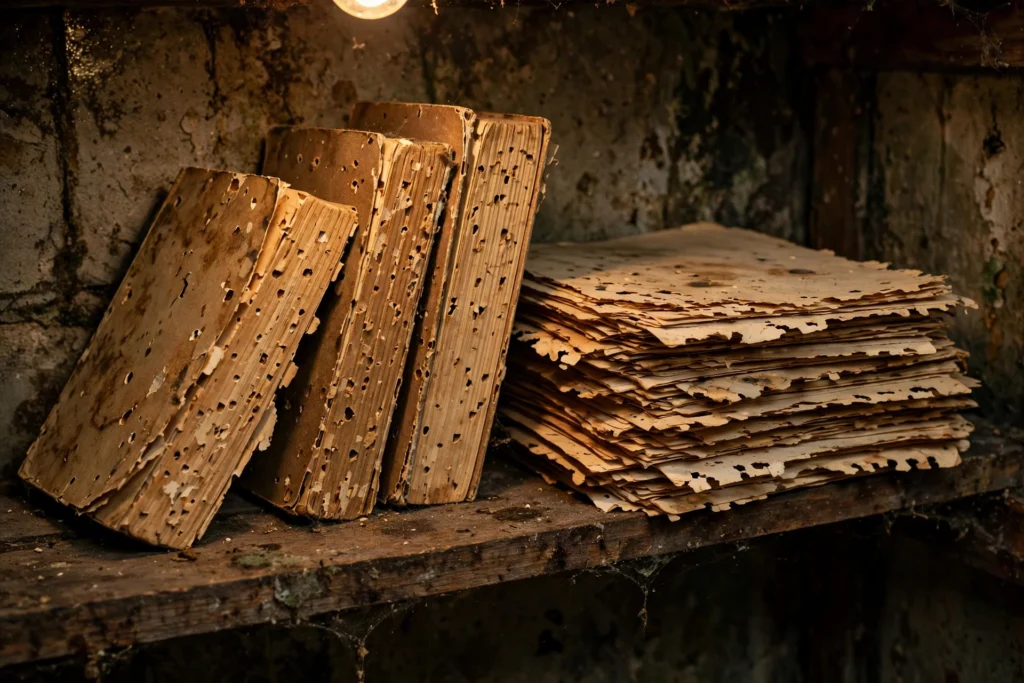
Silverfish eat almost anything that contains starch or sugar, and the damage they cause is slow, quiet, and easy to miss until it is done. Their menu includes book pages and bindings, wallpaper and the paste behind it, photographs, important documents, cardboard boxes, cereal, flour, rice, sugar, pet food, and starched or natural-fiber clothing like cotton, linen, and silk.
They graze the surface rather than chewing clean holes, so damage often looks like a scraped patch, a yellow stain, or a ragged, thin page edge.
The items most at risk are the ones you store and forget: photo albums and wedding dresses in a damp basement, old tax records in cardboard boxes, books on a ground-floor shelf. Silverfish do not damage wood framing, wiring, or insulation, and they do not contaminate food like cockroaches — but they will get into open pantry goods, and anything they have walked over should be thrown out. The real cost is sentimental: a chewed family Bible or a stained silk blouse cannot be replaced. Move anything irreplaceable into sealed plastic bins now — that one move alone stops the worst of the damage overnight.
How to Get Rid of Silverfish in 7 Steps
Learning how to get rid of silverfish comes down to one system, done in order: dry the space, remove the food, seal the gaps, treat the cracks, and trap what is left. No single step works alone — traps without dehumidifying just catch the next generation, and powder without sealing leaves new silverfish a way in.
Follow the steps in order and give them 6–8 weeks.
Step 1: Drop the Humidity Below 50%
Silverfish cannot live in dry air, so this is the single most important step in how to get rid of silverfish. Run a dehumidifier where you have seen them, and aim for indoor humidity below 50% — a cheap hygrometer (about $10–$15) tells you where you stand. Run the bathroom exhaust fan during every shower and for 30 minutes after, fix dripping taps and slow leaks under sinks, and improve airflow in rooms that stay shut up.
In a basement, also check outside: gutters and downspouts should carry water at least 4–6 feet from the foundation, and woodpiles, mulch, and leaf litter should not touch the house. If the walls seep every time it rains, a dehumidifier treats the symptom — the long-term fix is grading and gutter work.

Step 2: Remove Their Food and Hiding Places
Once the air is drying out, take away the buffet. Move cereal, flour, rice, sugar, and pet food into sealed glass or hard plastic containers — silverfish chew through paper bags and thin cardboard with ease. Recycle old newspapers, magazines, and cardboard boxes, and replace cardboard storage boxes with sealed plastic bins. Store important papers, photos, and books in airtight containers, off the floor and away from exterior walls.
Then vacuum along baseboards, behind furniture, inside closet corners, under sinks, and behind the bookshelf — this removes crumbs, dead insects, and tiny white silverfish eggs laid in cracks. Vacuum the hot spots weekly for the first month, and wash stored clothing that shows yellow stains or grazing.
Step 3: Seal Every Crack and Gap
Silverfish travel between rooms through cracks along baseboards, window frames, door frames, and gaps where pipes pass through walls. Walk the affected rooms with a caulk gun and fill every gap, paying special attention to the bathroom and kitchen: around the tub, behind the toilet, under the sink, and where plumbing enters the wall. Add weatherstripping to exterior doors that show daylight at the base, and seal gaps around attic and basement windows.
Sealing does two jobs at once: it locks silverfish out of wall voids where they breed, and it locks them into the rooms where your traps and treatments are waiting. It is cheap and permanent — and it is the step people skip most often when learning how to get rid of silverfish.
Step 4: Dust Food-Grade Diatomaceous Earth in the Cracks
Food-grade diatomaceous earth (DE) is a fine powder made from fossilised algae that kills silverfish by damaging the waxy coating on their exoskeletons, so they dehydrate and die. Dust a thin, barely visible line along baseboards, inside cabinet edges, behind appliances, under sinks, and in the cracks you found in Step 3. A little goes a long way — thick piles just get avoided. DE only works while it stays dry, so reapply after vacuuming or if it gets damp. Wear a mask while applying, and do not use pool-grade DE, which is a different product and not safe for home use. Expect results in 1–2 weeks: DE is slow but reliable, and it keeps working as long as it stays dry — which is why it belongs in almost every plan for how to get rid of silverfish.
Step 5: Use Boric Acid Sparingly — and Only Where Kids and Pets Cannot Reach
Boric acid is one of the most effective silverfish killers available to homeowners: it works as both a contact and a stomach poison. Dust a very thin layer into deep cracks, wall voids, behind baseboards, and under appliances — the places silverfish travel but people and pets never touch.
Safety first: boric acid is harmful if swallowed or inhaled, so never use it in open areas, on countertops, or anywhere children or pets can reach it. If you have toddlers, cats, or dogs that lick floors, skip boric acid and stick with diatomaceous earth and traps. The Old Farmer’s Almanac also warns that pyrethrin and permethrin sprays are extremely toxic to cats — never use those in a home with cats. Always read the label, wear gloves and a mask, and wash your hands after applying. A light dusting in a hidden void is effective; a heavy pile in an open room is dangerous and no more effective.
Step 6: Set Traps Where You Have Seen Activity
Traps do two jobs: they reduce the adult population, and they show where activity is heaviest. Place commercial sticky traps along baseboards, under sinks, in closets, and behind bookshelves — anywhere you have seen silverfish.
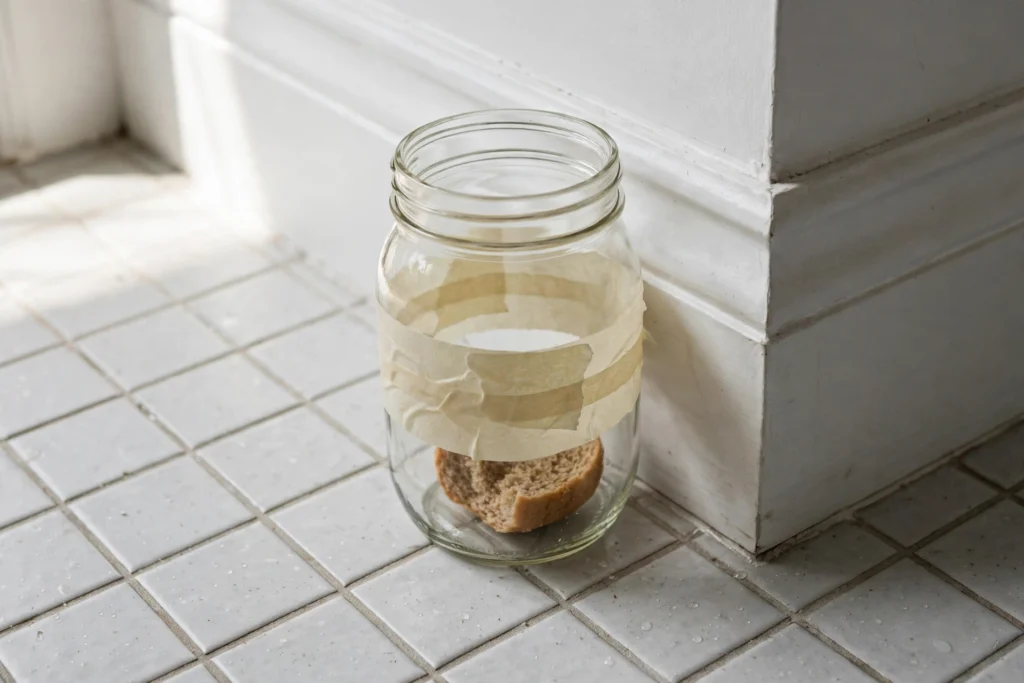
Or make the classic DIY jar trap for free: wrap the outside of a glass jar with masking tape, drop a small piece of bread or a spoonful of flour inside, and set it against a baseboard overnight. Silverfish climb the rough tape, drop in for the bait, and cannot climb the smooth glass back out. Check traps every morning and replace sticky traps every 2–3 weeks. If a trap in one corner keeps filling up while the others stay empty, that corner is the hotspot — focus your sealing and dusting there. Traps plus drying are the chemical-free core of how to get rid of silverfish.
Step 7: Monitor for 6–8 Weeks Before You Declare Victory
Silverfish control is rarely instant. Diatomaceous earth takes 1–2 weeks to show results, and eggs already laid in wall voids will keep hatching for several weeks. Keep the dehumidifier running, keep the traps set, and log what you catch each week. If catches fall steadily and then stop, you have won. If catches stay flat after a month of dry conditions, you have missed a moisture source — go back to Step 1 and look harder for a leak.
Silverfish breed slowly, so a population starved of moisture and food will collapse on its own. Rushing to a heavy chemical spray after two weeks adds risk without adding results.
Are Silverfish Dangerous? Do They Bite?
Are silverfish dangerous to people? No — they do not bite, sting, or spread disease. They have no venom, they do not feed on blood, and they are not known to trigger allergies the way cockroach droppings can. That is the reassuring part of how to get rid of silverfish: you are fighting damage, not disease.
But they are not harmless to your home: they damage books, wallpaper, photographs, clothing, and dry food, and a heavy infestation can ruin stored items worth far more than fixing the moisture problem. They are also a warning sign — damp conditions that suit silverfish also encourage mold. Do not panic about a single silverfish in the tub, but treat repeat sightings as a prompt to dry the space out.
How Do You Prevent Silverfish From Coming Back?
Once you know how to get rid of silverfish, keeping them gone means keeping the conditions that invited them from returning: humidity below 50%, food sealed, and gaps closed. That means leaving the dehumidifier running through the humid months, running the bathroom fan after every shower, and storing pantry goods and papers in sealed containers as a habit.
Re-check caulk around pipes and baseboards once a year. Put cedar blocks, dried bay leaves, or cedar oil spray in closets and storage areas as a mild repellent — these deter silverfish but will not clear an active infestation on their own.
Seasonal habits matter most. In spring, clear leaves and mulch away from the foundation and check the gutters. In summer, keep the dehumidifier on schedule rather than waiting for a sighting. In fall, inspect stored items from the garage before they go back on the shelf. Keep the traps out for a month after the last sighting — a trap that stays empty for four straight weeks is the only reliable all-clear.
DIY vs. Professional Silverfish Treatment: Which Is Better?
DIY methods for how to get rid of silverfish work well for light to moderate infestations — a few sightings a week, damage in one room, and a moisture source you can find and fix. Professional treatment makes sense when the infestation is heavy, when silverfish keep returning after two months of DIY, or when the moisture source is inside a wall void or crawl space you cannot reach.
| Option | Rough cost (planning estimates, not quotes) | Best for | Time to results | Effort |
|---|---|---|---|---|
| Dehumidifier | ~$150–$250 to buy; ~$15–$30/month to run | Every silverfish problem | 1–3 weeks | Low — set and empty |
| Diatomaceous earth + traps | ~$20–$40 total | Light infestations | 1–2 weeks | Low–medium |
| Boric acid in voids | ~$8–$15 | Moderate infestations | 1–2 weeks | Medium — careful placement |
| Full DIY kit (all of the above + caulk + containers) | ~$60–$120 total | Most homes | 4–8 weeks | Medium |
| Professional targeted treatment | ~$150–$400 per visit | Heavy infestations | 1–2 weeks | None — pro handles it |
| Professional + moisture repair (leak/vent fix) | ~$300–$800+ depending on the repair | Leak-fed infestations | Varies | None — pro handles it |
All dollar figures are rough planning estimates to help you budget, not quotes. Actual prices vary by home size, region, and the company you choose — always get a written estimate before work starts.
A general pest control visit runs in a similar range; our guide to how much pest control costs breaks down what drives the price up or down, so you can tell a fair estimate from an inflated one.
PRO TIP
Get two estimates before you hire anyone for silverfish. A company that wants to spray your whole house for a few silverfish in one bathroom is selling you more than you need. A targeted crack-and-crevice treatment plus a moisture fix is the right scope for silverfish — ask for that by name, and ask what they will do about the humidity that caused the problem.
When Should You Call a Pest Control Professional?
When should you call a pest control professional for silverfish? Call one if you see silverfish every day, especially during daylight; if damage is spreading to multiple rooms; if you have tried the full DIY system for two months and catches have not dropped; or if the moisture source is somewhere you cannot reach, like a wall void, a crawl space, or behind a tiled shower.
Also call if anyone in the home has a health concern that rules out DIY powders, or if you are selling the house and need the problem documented as resolved. If DIY has not solved how to get rid of silverfish in your home after two months, that is the clearest sign to call.
If you need a pro, start with a local, licensed company that inspects first and treats second. Need a pro? Find licensed pest control help through PestExpertPro. Our guides to getting rid of fire ants in Texas and getting rid of roof rats use the same inspect-first, fix-the-cause approach.
Frequently Asked Questions
What kills silverfish instantly?
Nothing safe kills silverfish instantly in the home. Diatomaceous earth and boric acid take 1–2 weeks; sprays knock down the insects you see today but miss the eggs in wall voids. A dehumidifier plus DE and traps clears a normal infestation in 4–8 weeks.
What smell do silverfish hate?
Cedar and bay leaves are the classic repellents, and some people use lavender or citrus sprays. They deter silverfish but will not clear an active infestation — drying the room out does the real work.
What attracts silverfish to your house?
Moisture and starch: high humidity (75–95%), slow leaks, unvented bathrooms, damp basements, plus paper, book bindings, wallpaper paste, cardboard boxes, cereal, flour, and natural-fiber clothing. A silverfish problem is usually a dampness problem first.
How long do silverfish live?
Silverfish live 2 to 8 years — far longer than most household insects. Females lay only 1–3 eggs a day, so populations grow slowly, which is why drying the space works: you stop the next generation before it starts.
Are silverfish dangerous to humans?
No — silverfish do not bite, sting, or spread disease. The risk is to your belongings: books, wallpaper, photographs, clothing, and stored food. They are also a warning sign of excess moisture, which can lead to mold.
Do silverfish eat clothes?
Yes — silverfish eat cotton, linen, silk, and other natural fibers, especially starched or stored clothing. They graze the surface, leaving irregular holes and yellow stains. Store out-of-season clothes in sealed plastic bins, not cardboard boxes.
Do silverfish come back after treatment?
Silverfish come back if the moisture returns. Keep humidity below 50%, keep pantry goods and papers sealed, re-check caulk yearly, and leave traps out for a month after the last sighting. A trap that stays empty for four weeks is the real all-clear.
Final Thought
Learning how to get rid of silverfish is really learning to read your home: the insects are the symptom, and damp air is the cause. Dry the space, take away the food, seal the cracks, treat the voids, and trap what is left — and the silverfish have nowhere to go. Start with the dehumidifier today, before you buy a single trap, because nothing else in this guide works well in a room that stays at 80% humidity.
If you have done the full seven steps and still see them daily after two months, that is not a failure — it is information. It means the moisture source is somewhere you cannot reach, and a professional inspection is the next sensible step, not another can of spray. Your books, your photos, and your peace of mind are worth a dry, silverfish-free home.