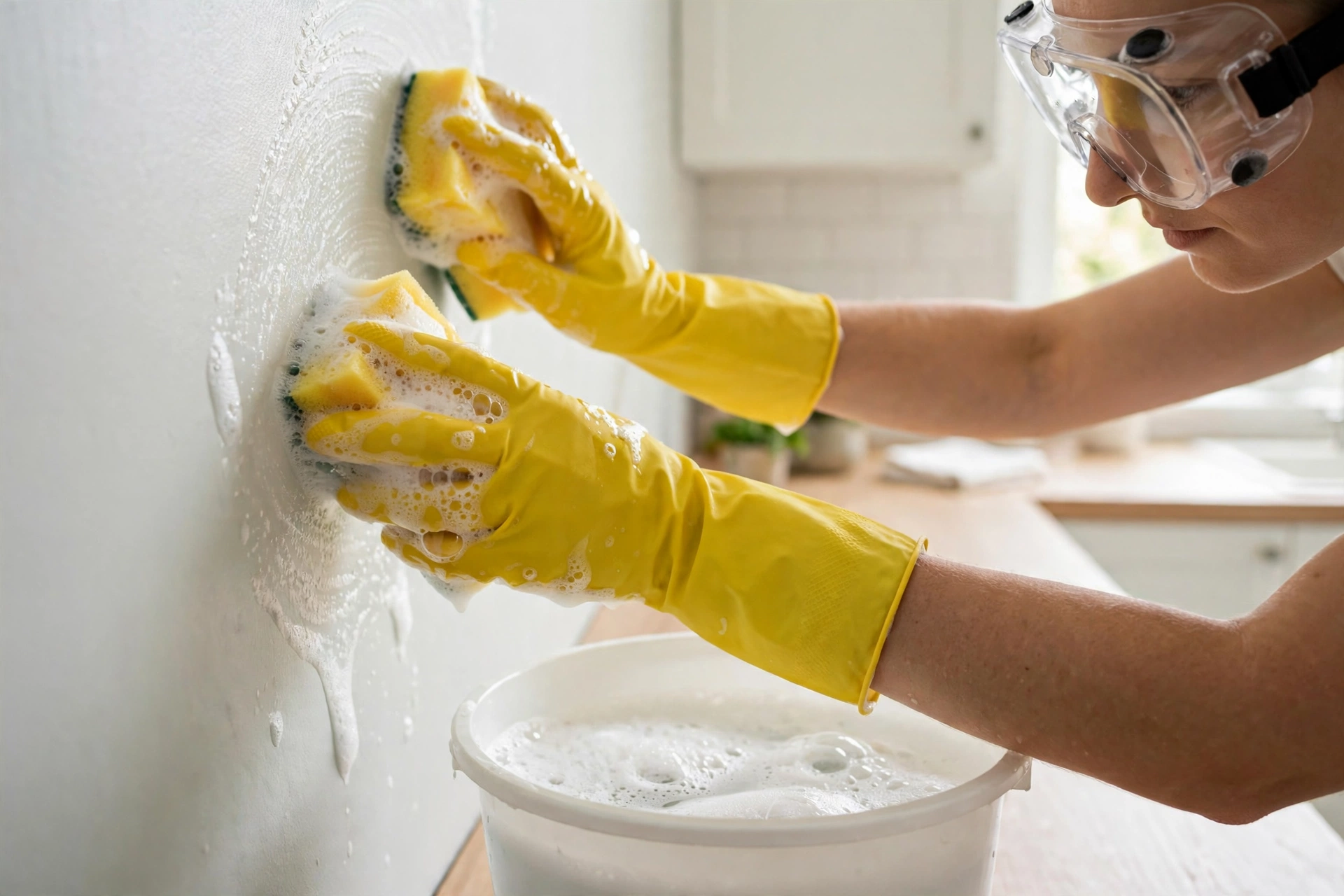
TSP Cleaner: What It Is, How to Use It Safely, and When to Skip It
TSP cleaner is the heavy-duty cleaner painters reach for when soap and water give up. If your kitchen walls wear a yellow film near the stove, your deck is grey with mildew staining, or your paint keeps peeling no matter how carefully you roll it on, a TSP cleaner wash is often the missing step. It is also a strong chemical that can burn skin, etch glass, and harm plants — so it deserves respect, not fear. This guide explains exactly what TSP cleaner is, what it cleans best, how to mix and use it step by step, what never to use it on, and when a TSP substitute is the smarter choice.
TL;DR — TSP Cleaner in 30 Seconds
What it is: TSP cleaner is trisodium phosphate (Na₃PO₄), a white powder you dissolve in warm water. Its solution is strongly alkaline, around pH 11–12, which turns grease into soap so it rinses away — and lightly dulls glossy paint so new paint grips.
Best for: washing walls and trim before painting, greasy kitchens, soot and smoke film, concrete, brick, siding, and decks.
Mixing (label ratios): light cleaning — 1/4 cup per 2 gallons of warm water; heavy-duty — 1/2 cup per 2 gallons. Always follow your own box first; ratios vary by brand.
Safety: chemical-resistant gloves, full-cover eye protection, long sleeves and pants, and a respirator in enclosed spaces. Ventilate. Rinse twice. Never mix with ammonia.
Never use on: glass, aluminum, hardwood floors, grout and ceramic tile glaze, chrome fixtures, or glossy finishes you want to keep — and keep runoff off plants and grass.
Substitute: a TSP substitute is safer and often no-rinse, but weaker on baked-on grease. Choose it for light jobs and where phosphates are restricted.
What Is TSP Cleaner?
TSP is a heavy-duty powdered cleaner made of trisodium phosphate, a white, odourless, water-soluble salt that has been the professional standard for pre-paint cleaning for decades. Mixed with warm water it forms a strongly alkaline solution — about pH 11.9 at 1% — that breaks down grease, soot, and smoke film by saponification, turning fats into soap that rinses away.
Most boxes you buy today are not pure trisodium phosphate — the common powder is roughly 75–80% trisodium phosphate and 20–25% sodium carbonate (washing soda). That blend is part of why it works so well and part of why it is so harsh: the same alkalinity that strips a decade of kitchen grease will also dull a glossy finish, darken oak, and irritate bare skin.
It is also worth saying plainly what TSP is not. It is not an everyday all-purpose cleaner, it is not a disinfectant, and it is not a mold killer. It is not registered with the EPA for mold control, and it will not fix a damp wall — it only cleans the grime off the surface so a proper mildew treatment and a dry wall can do their jobs.
What Does TSP Cleaner Clean Best?
TSP cleans best where grease, soot, smoke, and years of built-up grime have bonded to a paintable or washable surface — kitchen walls, pre-paint walls and trim, concrete, brick, siding, and decks. It is the right tool when dish soap smears grease instead of removing it, or when a wall feels tacky after a normal wash.
Here is where it earns its keep, job by job:
Walls before painting. This is the number-one use. TSP removes the invisible film of cooking grease, hand oils, dust, and nicotine that stops paint from bonding, and it dulls glossy paint at the same time. Wash, rinse twice, let the wall dry for at least 24 hours, then prime. If you are repainting kitchen cabinets, the same wash is what keeps the new finish from peeling off in sheets — see our guide to cabinet refacing vs repainting before you decide whether to paint or reface.
Greasy kitchens. The wall behind the stove, the ceiling above it, the range hood surround, and the tops of cabinets collect a sticky, polymerised grease film that dish soap barely touches. TSP cleaner saponifies it — literally turns it into soap — so it rinses off instead of smearing. Change your rinse water often; grey water means you are painting dirt back onto the wall.
Soot and smoke film. After a fireplace season or cigarette smoke, walls carry a fine soot layer that bleeds through fresh paint as yellow-brown stains. A TSP wash lifts it, and a shellac-based primer seals whatever is left. Never paint directly over smoke film — the stains return within weeks.
PRO TIP: Do the water-break test before you paint.
After washing and rinsing, flick a few drops of clean water onto the wall. If the water sheets out evenly, the surface is clean. If it beads up or breaks into droplets, grease is still there — wash that section again. This 10-second test saves you from a peeling paint job.
How Do You Mix TSP Cleaner Safely?
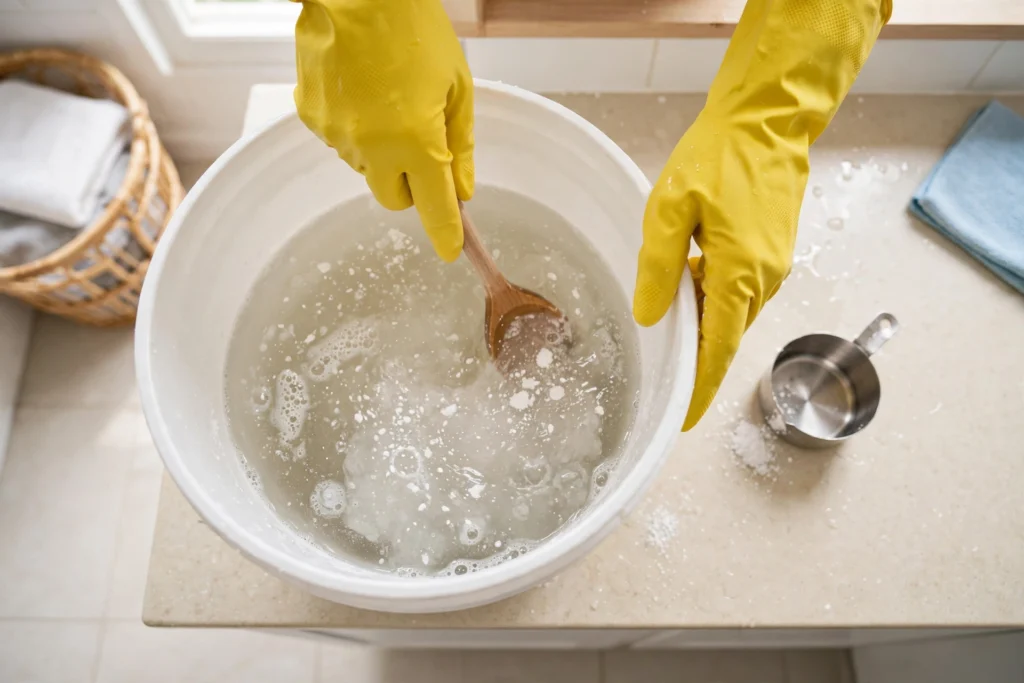
To mix TSP safely, always read your own box first, then dissolve the powder in warm water — never the other way around — using 1/4 cup per 2 gallons for light cleaning or 1/2 cup per 2 gallons for heavy-duty work. Warm water, roughly 90–120°F, dissolves the powder fully; cold water leaves grit that can scratch and leave residue.
Ratios vary by brand — some guides quote 1/4 cup per gallon, others 1/4 cup per 2 gallons — because products are formulated differently. The widely sold powder’s label gives heavy-duty as 1/2 cup in 2 gallons of hot water and household as 1/4 cup in 2 gallons. Treat the label as the authority; the table below is a planning guide.
| Job | TSP cleaner per warm water | Notes |
|---|---|---|
| Light household cleaning | 1/4 cup per 2 gallons | Dusty walls, light grime, general wash-down |
| Heavy-duty / pre-paint wash | 1/2 cup per 2 gallons | Greasy kitchens, smoke film, walls before painting |
| Stronger pre-paint (some brands) | 1/4–1/2 cup per 1 gallon | Only if your label directs it — stronger is not better |
| Mildew-stained deck/siding (label recipe) | 1 cup in 3 quarts warm water + 1 quart fresh bleach | Only where the label explicitly directs it; outdoors only |
| Paint/varnish removal (label recipe) | Up to 8 oz per 1/2 gallon hot water | Specialist use; rinse and dry fully before refinishing |
A few mixing rules that never change:
- Powder into water, never water onto powder. Add the powder to the bucket of warm water and stir until fully dissolved. Pouring water onto dry powder kicks up irritating dust.
- Use warm, not boiling, water. Hot water dissolves the powder and cuts grease faster, but boiling water splashes and steams the irritant into the air.
- Never mix TSP with ammonia. The combination can create dangerous fumes. Do not mix it with other cleaners at all unless your specific product label explicitly directs a recipe, such as the outdoor mildew recipe above — and even then, outdoors only, with ventilation.
How Do You Use TSP Cleaner Step by Step?
To use TSP cleaner, gear up first, protect the room, wash small sections from the bottom up, rinse each section twice with clean water, and let the surface dry for at least 24 hours before painting. The rinse is not optional — dried TSP residue leaves a white film and a high-pH surface that stops primer and paint from bonding.
Step 1: Gear up and ventilate
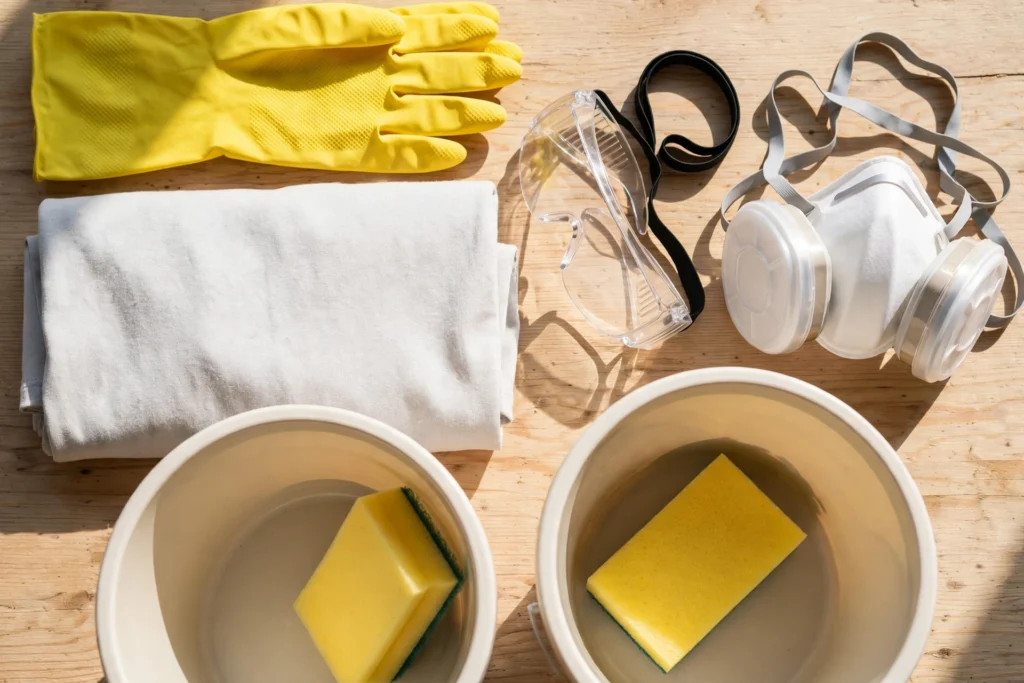
Put on chemical-resistant rubber gloves, full-cover goggles, long sleeves and pants, and closed shoes. In a small bathroom or enclosed room, add a respirator mask and open the windows. TSP is an irritant that can cause serious eye injury and skin burns, even diluted — this is not the step to skip because the job “is only a small wall.” Keep children and pets out until you are done and rinsed.
Step 2: Protect everything you are not cleaning
Lay drop cloths on the floor and cover furniture, switches, and outlets with plastic sheeting. The solution drips, and one drip on a hardwood floor, a chrome tap, or a mirror can mark it in minutes. Remove pictures and curtains from the wall.
Step 3: Dust first
Vacuum the wall with a soft brush head or wipe it with a dry microfibre cloth, ceiling down — washing a dusty wall just makes mud. Spot loose or peeling paint now: scrape and sand it before you wash, or water will get behind the loose film and make the failed patch bigger.
Step 4: Mix the solution
Fill one bucket with warm water and dissolve the TSP powder using the label ratio for your job — 1/4 cup per 2 gallons for light cleaning, 1/2 cup per 2 gallons for heavy-duty work. Fill a second bucket with clean, warm rinse water. You need two buckets: one wash bucket, one rinse bucket.
Step 5: Wash in small sections, bottom up
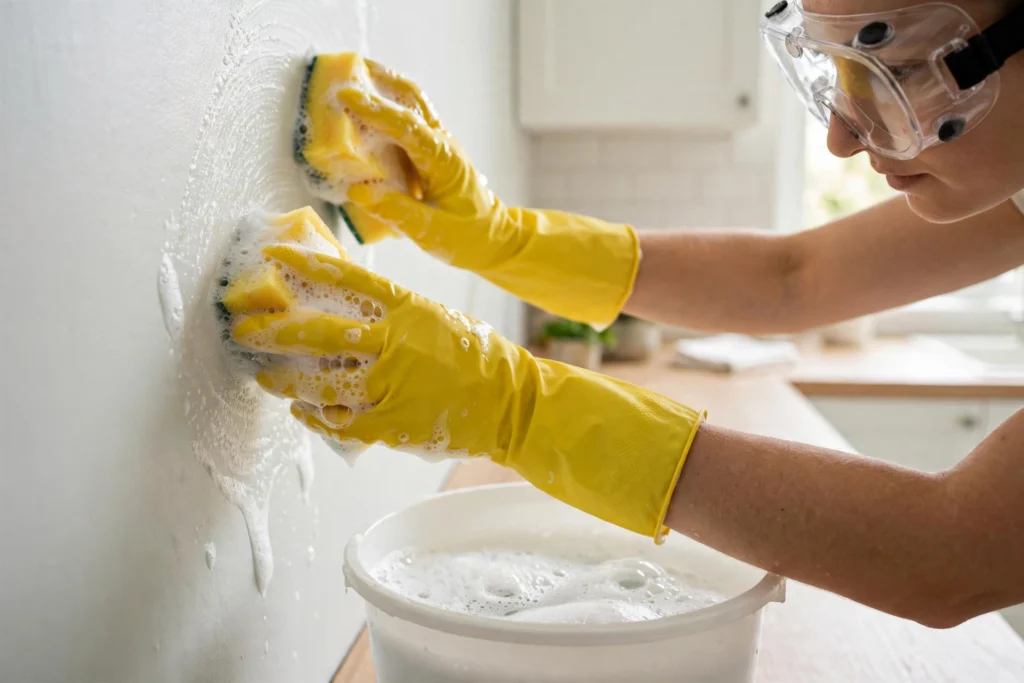
Dip a sponge in the solution, wring it until damp, and wash about 1 square metre at a time, from the bottom of the wall upward. Top-down washing lets dirty solution run onto dry wall and leaves streaks. Scrub greasy spots in small circles and never let the solution dry on the surface.
Step 6: Rinse twice
This is the step that decides whether your paint sticks. Wring a clean sponge in the rinse bucket, wipe the section, then rinse again with fresh water. Change the rinse water the moment it turns grey — grey water puts the grease straight back on the wall. If a white film appears as it dries, you did not rinse enough; wash that section again.
Step 7: Dry completely before painting
Open windows and run a fan. The surface may feel dry in an hour or two, but the drywall underneath still holds moisture — wait at least 24 hours before priming or painting. Painting over a damp, high-pH wall traps water under the paint and guarantees peeling.
PRO TIP: Wash twice on kitchen walls.
The first pass removes the surface grease; the second pass, with a fresh bucket of solution, removes the thin film the first pass left behind. Two quick passes beat one aggressive scrub — and they use less chemical, not more.
What Should You Never Use TSP Cleaner On?
Never use TSP cleaner on glass, aluminum, hardwood floors, grout, ceramic tile, chrome fixtures, or any glossy finish you want to keep — and never let its runoff reach plants, grass, or a storm drain. Its high alkalinity is exactly what makes it powerful, and exactly what damages these surfaces.
| Surface | What happens | Use instead |
|---|---|---|
| Glass, mirrors, shower doors | Etches and leaves a hazy, cloudy film | Glass cleaner or vinegar solution |
| Aluminum (siding, gutters, cookware) | Darkens, pits, and corrodes | Mild dish soap and water |
| Hardwood floors, oak, mahogany | Darkens and discolours the wood | Wood-floor cleaner made for the finish |
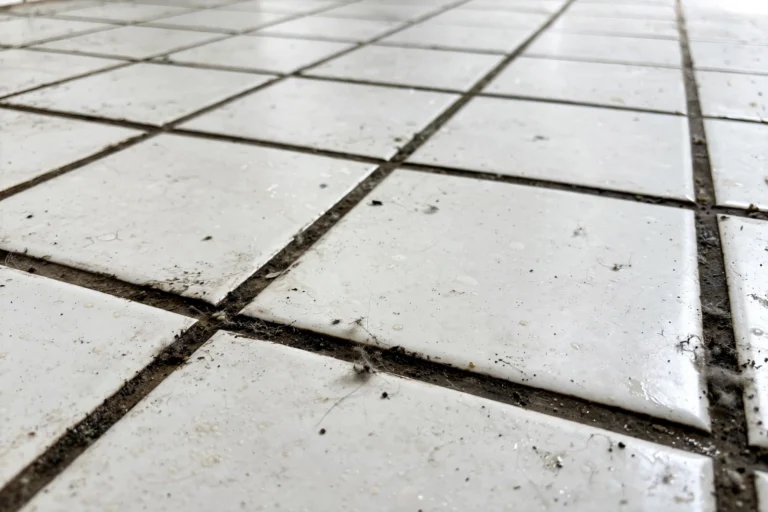
| Grout between tiles | Dissolves and weakens grout, which then crumbles | Grout-safe cleaner — see how to clean grout |
| Ceramic tile glaze, porcelain, enamel | Etches the glaze, leaving it rough and stain-prone | Mild bathroom cleaner |
| Chrome taps, metal fixtures, drains | Tarnishes, pits, and can corrode over time | Dish soap or a fixture-safe cleaner |
| Glossy paint or varnish you want to keep | De-glosses and dulls the finish | Mild soap and water |
| Plants, grass, shrubs | Phosphate runoff burns foliage and feeds algae in waterways | Wet plants before, rinse after; divert runoff |
| Printed floor coverings | Can damage the print unless very weak | Manufacturer-recommended cleaner |
Glass is the classic mistake: splashed solution etches mirrors and windows, leaving a haze that does not wipe off — cover glass before you start. Grout is the expensive mistake: TSP can dissolve it, so never use it as a bathroom tile cleaner. Aluminum is the sneaky one: even the bucket matters, so mix in a plastic bucket, never an aluminum one.
Outdoors, the rule is about water, not just surfaces. Phosphates feed algae, which is why phosphate cleaners are restricted or banned in many states and cities. Check your local rules before you buy, and when you work outside, wet down plants, grass, and shrubs with clean water before you start, keep them covered where you can, rinse them thoroughly afterwards, and never let the wash water run into a storm drain, pond, or stream.
Is TSP Cleaner Safe to Use?
TSP is safe to use when you follow the label, wear gloves and eye protection, ventilate the room, and rinse thoroughly — but it is a strong irritant that can burn skin, seriously injure eyes, and harm pets, plants, and aquatic life if mishandled. Treat it like the chemical it is, not like dish soap.
- Skin: the solution irritates and can burn skin, even diluted. Gloves and long sleeves are mandatory. If it touches your skin, rinse with plenty of clean water for 15 minutes.
- Eyes: this is the serious risk. TSP can cause serious eye injury. Full-cover eye protection — goggles, not ordinary glasses — is the single most important piece of gear.
- Breathing: the dry powder irritates airways. Do not breathe the dust when you open the box or pour it. Ventilate the room and wear a respirator in enclosed spaces.
- Swallowing: harmful if swallowed. Store the powder high, sealed, and out of reach of children and pets, and never put it in a food container.
- Pets: keep pets out of the room, and do not let them walk through puddles or lick soaked rags — it irritates their paw pads and mouths.
- Environment: phosphates in runoff feed algal blooms that deplete oxygen in waterways. Use the weakest solution that does the job and keep wash water out of drains that lead to waterways.
TSP Cleaner vs TSP Substitute: Which Should You Choose?
Choose real TSP cleaner for heavy, baked-on grease, soot, and smoke film; choose a TSP substitute for light to moderate grease, fast pre-paint prep, and anywhere phosphates are restricted. The substitute is not a weaker version of the same thing — it works by a different chemistry, and that difference decides the job.
Real TSP saponifies grease: it chemically turns fat into soap, which rinses away, and it dulls glossy paint so primer grips. No substitute does both jobs as aggressively. A substitute is usually surfactant-based or built on sodium sesquicarbonate or sodium metasilicate — it surrounds grease and lifts it off so it can be wiped away. It is far safer, many versions are no-rinse, and it has no phosphate, so it is legal everywhere. What it cannot do is saponify. On light grease that does not matter. On the yellowed, heat-baked film above a range hood that has been there for a decade, it matters a lot — the substitute leaves a slick film behind, and paint peels over it.
| TSP cleaner | TSP substitute | |
|---|---|---|
| Active chemistry | Trisodium phosphate, pH ~11–12 | Surfactants / sodium sesquicarbonate / sodium metasilicate |
| How it cuts grease | Saponifies fat into soap | Lifts grease off the surface |
| De-glosses paint | Yes — etches glossy finishes | Mildly, or not at all |
| Rinse needed | Yes — rinse twice | Often no-rinse; check the label |
| Safety gear | Gloves, goggles, respirator, long sleeves | Gloves and eye protection still wise |
| Best for | Heavy grease, soot, smoke film, old kitchens | Light–moderate grease, quick pre-paint prep |
| Environmental rules | Restricted/banned in many states and cities | Phosphate-free — widely allowed |
| Rough cost (planning estimate, not a quote) | ~$5–$15 per 1 lb box | ~$8–$20 per bottle/box |
The decision in one line: if the grease is old, baked-on, or smoky, use real TSP and rinse twice. If the wall is just dusty or lightly greasy, a substitute does the job with less risk and less rinsing — and if your state restricts phosphates, the substitute is not a compromise, it is the shelf.
Can You Use TSP Cleaner on a Deck or Siding With Mildew?
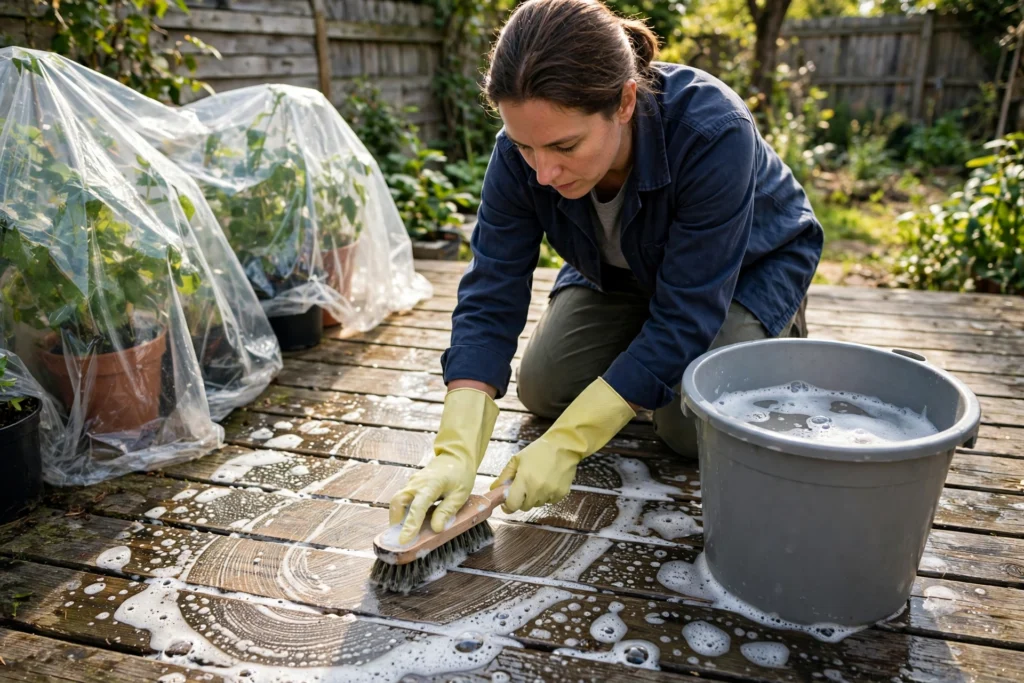
Yes — TSP can wash a mildew-stained deck or siding, but it cleans the grime and staining; it does not kill mold, so treat mildew separately and always rinse thoroughly. Some labels give a deck recipe of 1 cup of TSP in 3 quarts of warm water plus 1 quart of fresh chlorine bleach — use a bleach mix only if your label explicitly directs it, outdoors only, never with ammonia.
Here is the safe way to run the job:
- Wet the plants first. Hose down every plant and shrub near the deck and cover the closest ones with plastic sheeting — wet foliage absorbs far less runoff.
- Sweep and wet the deck. Clear leaves and debris, then hose it down so the wood is damp before the solution hits it.
- Apply in sections and keep it wet. Work in sections of about 150 square feet per gallon, keep the surface wet for 15–20 minutes, and scrub stubborn spots with a stiff brush. If the solution dries on the wood, it leaves a hard-to-remove residue.
- Rinse thoroughly. Hose it down completely, or pressure-wash at low pressure — around 500–1,400 PSI with a wide fan tip, 8–12 inches away, spraying with the grain. High pressure damages wood.
- Dry for days, not hours. A deck needs at least 24–48 hours of dry weather, ideally 3 dry days, before you stain or paint it. Wood should be at 18% moisture or less.
- Treat mildew as its own problem. TSP lifts the dirt mildew grows on, but it is not a mildewcide. If black or green patches remain, treat them with a dedicated mildew product, rinse, and use a mildew-resistant paint or stain.
How Much Does TSP Cleaner Cost — and What Else Do You Need?
A box of TSP costs roughly $5–$15, and a full wash kit for one room — powder, gloves, goggles, sponges, and two buckets — runs roughly $25–$60 in total. Those are rough planning estimates, not quotes — prices vary by store and brand, so check your local hardware store before you budget a whole-house job.
| Item | Rough cost (planning estimate, not a quote) |
|---|---|
| TSP cleaner powder, 1 lb box | ~$5–$15 |
| TSP substitute, spray or powder | ~$8–$20 |
| Chemical-resistant rubber gloves | ~$5–$10 |
| Safety goggles | ~$5–$12 |
| Respirator mask | ~$8–$20 |
| Sponges / scrub pads | ~$3–$8 |
| Two plastic buckets + drop cloths | ~$10–$20 |
| One-room wash kit, all in | ~$25–$60 |
How Do You Dispose of TSP Cleaner?
Dispose of TSP by using up the mixed solution on the job, letting small amounts of leftover solution dry out or diluting and disposing of it exactly as your product label and local rules direct — never pour it into a storm drain, stream, or onto soil. Rules vary by city and state; the label on your box is the first authority.
Practical disposal steps:
- Leftover solution: use it up on the job. Do not save mixed solution — it loses strength and the bucket becomes a hazard.
- Small amounts: many local rules allow small amounts of diluted wash water down a household drain to a sewer or septic system, since that water goes to treatment — but check local hazardous-waste guidance first, especially if you used the bleach recipe or washed lead paint.
- Never into a storm drain. Storm drains usually flow straight to rivers and lakes with no treatment, and phosphate in that water feeds algae. Keep wash water out of them.
- Dry powder: keep it sealed in its original container, dry, and out of reach of children. Unwanted powder goes to your local household hazardous-waste collection, not the bin.
- Rags and sponges: rinse them well, let them dry, and wash them separately. Do not leave soaked rags where pets or children can reach them.
Frequently Asked Questions About TSP Cleaner
Is TSP cleaner safe to use indoors?
Yes, when you follow the label, wear chemical-resistant gloves and full-cover eye protection, ventilate the room, and rinse the surface twice. It is an irritant that can burn skin and seriously injure eyes, so treat it as a chemical, not as dish soap. Keep children and pets out until the job is done and rinsed.
How do you mix TSP cleaner?
Dissolve the powder in warm water, powder into water, using your label’s ratio — commonly 1/4 cup per 2 gallons for light cleaning and 1/2 cup per 2 gallons for heavy-duty work. Stir until fully dissolved in warm water of roughly 90–120°F, and mix only what you need. Ratios vary by brand, so your box is the authority.
Do you have to rinse TSP cleaner off?
Yes — always rinse twice with clean water. Unrinsed residue leaves a white film and keeps the surface pH high, which stops primer and paint from bonding. If a white film appears as the wall dries, wash the section again and let it dry fully before painting.
Can you use TSP cleaner on wood floors?
No — do not use TSP on hardwood floors. It can darken and discolour wood, especially oak and mahogany, and it can damage the finish. Use a cleaner made for your floor’s finish instead. TSP is fine for unpainted wood you plan to refinish, such as a deck or bare trim, provided you rinse well and let it dry fully first.
Is TSP cleaner the same as TSP substitute?
No. TSP cleaner is trisodium phosphate, which saponifies grease and de-glosses paint. A TSP substitute is phosphate-free, usually surfactant-based, safer to handle, and often no-rinse — but weaker on baked-on grease and smoke film. Use real TSP for heavy grease and old kitchens; use a substitute for light jobs and where phosphates are restricted.
Can TSP cleaner remove mold?
TSP cleans grime and mildew staining from a surface, but it is not a mold killer and is not EPA-registered for mold control. It prepares the surface so a separate mildew treatment can work. Fix the moisture source first, clean with TSP cleaner, treat the mildew with a dedicated product, rinse, dry fully, and use mildew-resistant paint.
Is TSP cleaner legal where I live?
It depends on your state and city. Phosphate cleaners are restricted or banned in many states and cities because phosphates feed algal blooms in waterways. Check your local rules before you buy, and if real TSP is restricted where you live, a phosphate-free TSP substitute is the legal and practical alternative.
Final Thought
TSP is not a cleaner you reach for every week — it is the specialist you call in when a job is too greasy, too sooty, or too stained for ordinary cleaners, and when the paint you are about to apply deserves a surface it can actually grip. Used with gloves, goggles, the label’s ratio, and a proper double rinse, it turns a peeling-paint problem into a paint job that lasts. Used carelessly, it creates damage that costs more than the paint you were trying to save. Mix it weak, rinse it twice, protect what you are not cleaning, and when the grease is light, reach for the substitute instead. If you are tackling a whole-house clean before the holidays, our deep-cleaning guide for the holidays will help you plan the rest of the job around the wash.
Prices in this article are rough planning estimates, not quotes — check your local store for current prices. Always follow the label on your TSP cleaner product; if the label and this article ever disagree, the label wins.