Types of Christmas Decorations: A Room-by-Room Guide
The main types of christmas decorations are tree decorations, garlands and wreaths, mantel displays, table centrepieces, window and wall decor, lighting, and outdoor decorations. Each type belongs in a different room or zone, and the houses that look best repeat two or three of them — the same greenery, lights, and ribbon — from the front door to the bedroom.
Most people do not have a decoration problem. They have a placement problem. Boxes come out of storage, every ornament lands on the tree, the mantel gets whatever is left, and the dining table ends up so crowded that nobody can pass the potatoes.
This guide sorts the types of christmas decorations by room instead of by box — what belongs on the tree, the mantel, the table, and outside — plus the one colour story that ties it all together. It is a low-competition keyword (Semrush volume 210, KD 8), and few guides answer it room by room.
Before you buy anything new, walk your house with a notebook and note the spots people actually look at: the tree, the fireplace, the dining table, the front door, and the kitchen counter. Those five spots carry about 80% of your Christmas look. If you are still choosing a tree, our guide to the best Christmas tree brands will help you pick one.
TL;DR — The Types of Christmas Decorations at a Glance
| Decoration type | Where it goes | What it does |
|---|---|---|
| Tree decorations (baubles, ribbon, topper) | Living room tree | The main focal point |
| Garland and wreaths | Mantel, bannister, front door, windows | Connects rooms together |
| Mantel display (stockings, candles, greenery) | Fireplace | The second focal point |
| Table centrepieces | Dining table, coffee table | Festive without blocking meals |
| Kitchen touches (mini tree, wreath, gingerbread) | Counters, cabinet doors, windowsill | Small festive notes that stay out of the way |
| Bedroom and small touches | Nightstand, dresser, windowsill | A quiet festive corner |
| Outdoor decorations | Porch, yard, roofline | The first impression |
| Lighting (string lights, candles, lanterns) | Everywhere | The glue that ties it all together |
The rule for the whole house is simple: pick one colour story, repeat three elements (evergreen, warm lights, ribbon), and leave breathing room on every surface. The types of christmas decorations you repeat matter more than how many you own.
Types of Christmas Decorations: What Are the Main Kinds?
The main types of christmas decorations are tree ornaments, garlands, wreaths, mantel displays, table centrepieces, window and wall decor, lights, and outdoor pieces. Most homes need six or seven of these types, and the difference between a cluttered house and a calm one is not how many types you own — it is whether each type has one clear home.
Think of the types of christmas decorations as a small cast of characters, each with a job:
- Tree decorations: baubles, ornaments, ribbon, picks, and the topper.
- Garlands: long strands of evergreen, real or faux, draped on mantels, bannisters, doorways, and windows.
- Wreaths: circular greenery for the front door, above the mantel, and on interior doors and windows.
- Mantel displays: stockings, candles, small trees, and framed art arranged on the fireplace shelf.
- Table centrepieces: greenery runners, candles, and low arrangements for the dining and coffee tables.
- Window and wall decor: window clings, paper snowflakes, wall hangings, and advent calendars.
- Lighting: string lights, fairy lights, candles, and lanterns.
- Outdoor decorations: porch lanterns, pathway lights, yard figures, and roofline lights.
You do not need every type. A small home can look fully decorated with a tree, one wreath, a mantel garland, and a table runner, while a large home needs the same types repeated in more rooms, not more types.
Sort by Type, Not by Room
Before you decorate, sort everything into piles by type, not by room. One pile for ornaments, one for garland, one for candles. You will instantly see which of the types of christmas decorations you have too much of and which room is missing its piece.
How Do I Pick One Colour Story for the Whole House?
Pick one colour story by choosing three colours — one main, one supporting, and one metallic — and using only those colours in every room. Limiting yourself to three colours is what makes separate types of christmas decorations look like they belong together instead of looking like they came from different houses.
This is the most common pain point in Christmas decorating. People buy a red ornament set one year, a silver garland the next, and a gold table runner the year after, then wonder why the house never looks like the photos. The photos all share one thing: restraint.
| Colour story | Main colour | Supporting colour | Metallic | Best for |
|---|---|---|---|---|
| Classic red, green and gold | Deep red | Evergreen | Gold | Traditional family homes |
| Scandi white and wood | White | Soft green | Natural wood | Small rooms, calm look |
| Glam gold and champagne | Champagne | Cream | Gold | Formal dining rooms |
| Woodland | Forest green | Brown | Copper | Rustic and cabin style |
| Frosted silver and blue | Icy blue | White | Silver | Modern homes, snowy look |
Once you have your story, shop your own house first. A red throw from the sofa, a gold tray from the kitchen, and a green plant you already own can all join the scheme for free. Then buy only the gaps — the types of christmas decorations you already own probably fit one of these stories, and the trick is committing to it for the whole house, not just the tree.
Test the Colour Story in One Room First
Test your colour story in one room first. Decorate the mantel, step back, and look at it from the doorway. If it feels calm and finished, the story works. If it feels busy, remove one colour before you decorate the rest of the house with these types of christmas decorations.
What Decorations Go on the Christmas Tree — and in What Order?
The tree takes baubles, ribbon or garland, picks, and a topper. The order that works is: fluff the branches, add lights first, drape ribbon or garland, hang large baubles deep inside, fill in with smaller ornaments, and put the topper on last. That order makes the difference between a layered tree and a thrown-together one.
The tree is the biggest of all the types of christmas decorations, and it is also the one people rush. Work in layers — each step has a reason, and skipping one is why trees end up with bare patches at the back and a crowded front.
Step 1 — Fluff the branches. Pull every branch tip outward and upward, starting at the bottom. This takes 15–20 minutes on a full-size tree, but a well-fluffed tree needs fewer ornaments to look full.
Step 2 — Lights first. Wrap lights from the bottom up, weaving them in and out so some bulbs sit deep inside the branches. Lights go on before anything else because you cannot tuck them behind ornaments later. If you want the full technique, see our guide on how to put lights on a christmas tree.
Step 3 — Ribbon or garland. Drape ribbon in loose swags from top to bottom, tucking it into the branches every 12 inches or so. Ribbon sets the tree’s colour story in big sweeps, so it goes on before the small pieces.
Step 4 — Large baubles deep inside. Hang your biggest ornaments close to the trunk, where they fill the dark gaps and add depth. This is the step most people skip, and it is why so many trees look flat from the side.
Step 5 — Smaller ornaments on the tips. Fill the outer branches with smaller baubles, sentimental ornaments, and picks, evenly spaced. Step back every few minutes to check for bare spots.
Step 6 — Topper last. The star or angel goes on when everything else is done, so you can see the tree’s true height and balance.
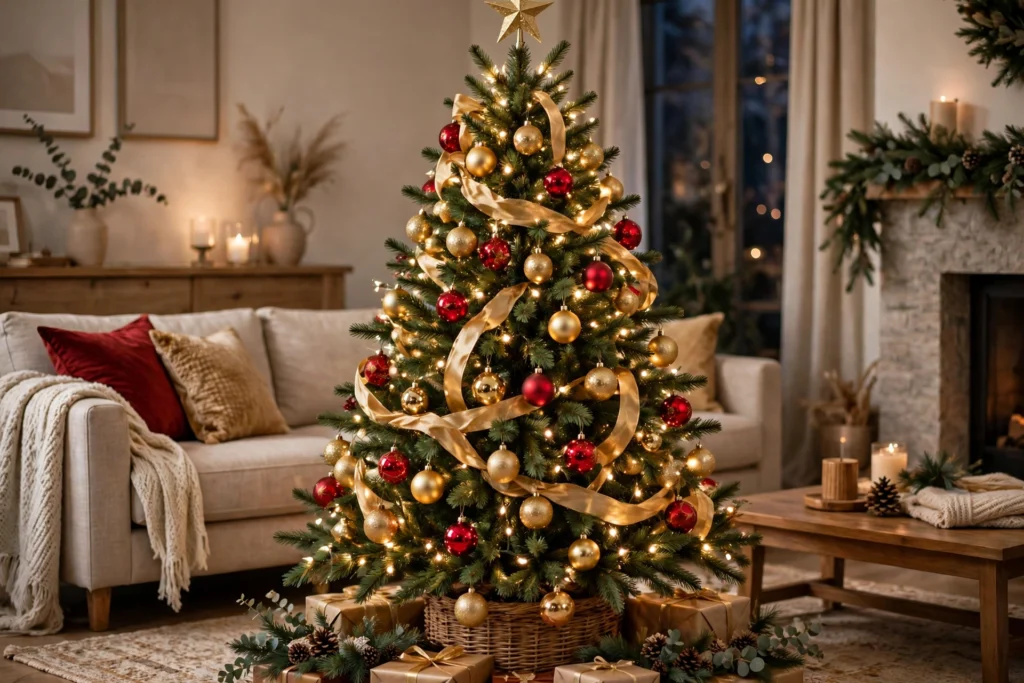
A rough guide is 10 ornaments per foot of tree height — about 60 for a 6-foot tree. Ornament sets typically run $15–$40, ribbon $6–$15 a roll, and a topper $10–$30 (planning estimates, not quotes).
Ribbon Hooks Beat Wire Hooks
Hang these types of christmas decorations with simple hooks or short lengths of ribbon instead of the wire hooks that come in the box. Ribbon hooks are invisible against the branches, they do not scratch the ornaments, and they let you hang ornaments at different depths.
How Do I Decorate the Mantel and Fireplace?
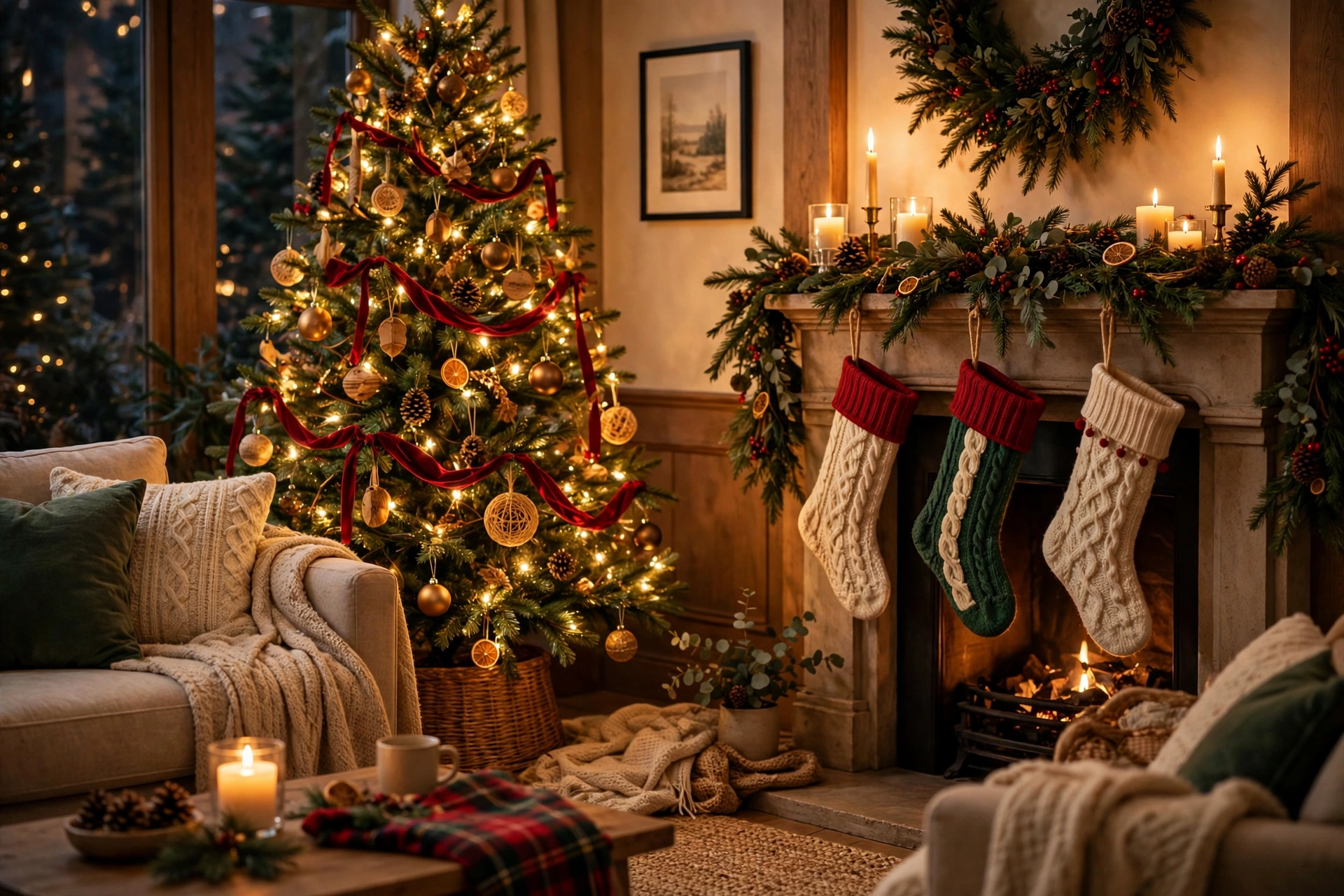
Decorate the mantel in three layers: a garland along the shelf as the base, stockings hung below it, and candles plus a few small objects on top. The mantel is the second focal point of the room after the tree, so it deserves the same care — but with fewer pieces, because the fireplace itself is already doing visual work.
Start with the garland: lay a faux or fresh evergreen garland along the shelf and let the ends drape down a few inches on each side. A 6-foot garland typically costs $20–$50. Our Christmas garland ideas cover more draping ideas for mantels, bannisters, and doorways.
Next, hang the stockings from the garland or from stocking holders on the shelf — one per person, evenly spaced, in your colour story. Stockings usually run $8–$25 each. Then add candles on top of the mantel: a mix of tall tapers and short pillars at different heights, with a mirror or framed art behind them to reflect the light.
What goes on the mantel, in order:
- Garland along the shelf, ends draped
- Stockings hung below, evenly spaced
- Candles in mixed heights on top
- One focal piece in the centre — a wreath, a mirror, or framed art
- Small filler: pinecones, dried oranges, or a small bottle-brush tree
What does not go on the mantel: the whole ornament collection or anything taller than the mirror. If you have no fireplace, the same arrangement works on a console table or bookshelf top.

Use Odd Numbers on the Mantel
If your mantel always looks lopsided, use odd numbers. Three candles on one side and two on the other look better than two and two. The eye reads odd groupings as intentional and even groupings as a matching set that is missing a piece.
What Makes a Good Christmas Dining Table Centrepiece?
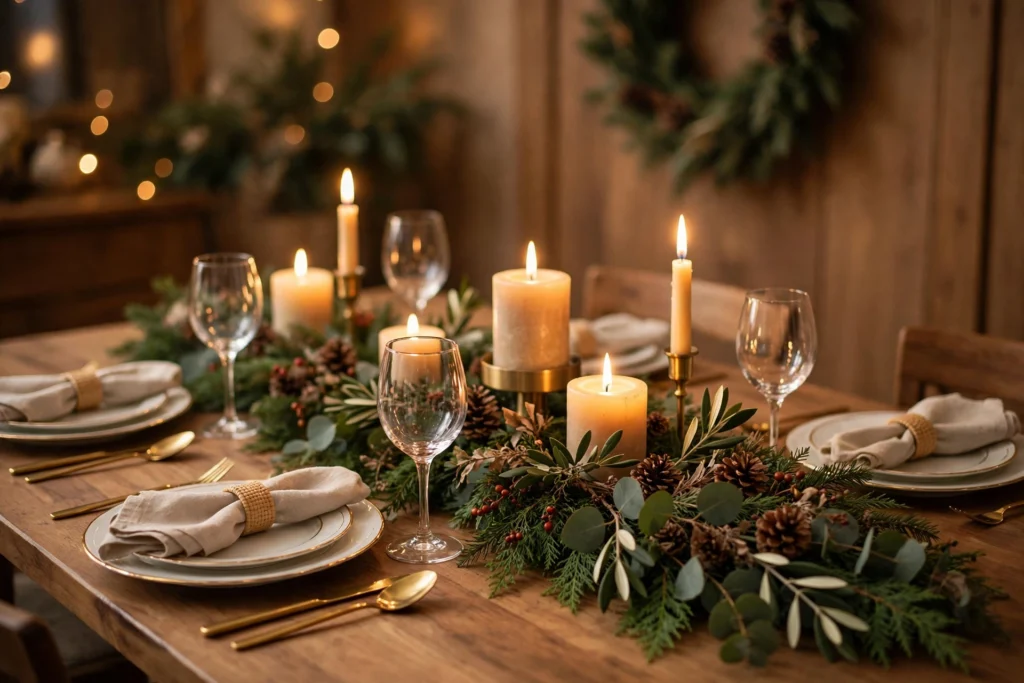
A good Christmas dining table centrepiece is low, narrow, and made of greenery, candles, and pinecones — beautiful from every seat, but low enough to see over and narrow enough to leave room for plates, glasses, and serving dishes. The rule is simple: if you have to move the centrepiece to eat, it is too big.
This is the pain point almost every editorial guide agrees on: dining tables get decorated like mantels, and then nobody can use them. Build your centrepiece along the centre line, no wider than about 12 inches, and keep everything under 12 inches tall.
A centrepiece that works:
- A greenery runner down the centre — real or faux, $20–$50 for 6 feet
- Candles in the middle of the runner — pillars in glass holders or slim tapers, $10–$25 for a set
- Pinecones and dried oranges tucked into the greenery for texture
- A few baubles in your colour story, nestled low so they do not roll
What to skip on the dining table: tall floral arrangements, wide trays that eat the place settings, loose glitter, and anything with a strong scent near the food.
Build the Centrepiece on a Tray
Build the centrepiece — one of the most useful types of christmas decorations for a busy house — on a long, narrow tray or a folded table runner. When dinner is over, you can lift the whole thing off the table in one move — and when you need the table for homework or wrapping, it lifts off just as easily.
How Do I Decorate the Kitchen for Christmas Without Losing Counter Space?
Decorate the kitchen with small, high, and out-of-the-way pieces: a mini tree on a shelf, a wreath on a cabinet door or window, a garland above the cabinets, and gingerbread touches on the windowsill. The kitchen is the busiest room in the house at Christmas, so every decoration must earn its place without taking counter space away from cooking.
The most common kitchen mistake is treating the counters like a mantel. At Christmas they are busier than ever, and the types of christmas decorations that work here are the ones that live above eye level or in corners nobody cooks in.
What works in the kitchen:
- A mini tree on a shelf or on top of the fridge — $15–$35 for a small pre-lit tree
- A wreath on a cabinet door or window — hung with a ribbon over the door, $25–$60
- Garland above the wall cabinets — one strand, tucked out of the way
- A gingerbread house or cookie jar on the windowsill or a side counter — a decoration that doubles as a snack
- Festive tea towels — the smallest touch, and one guests notice most
What to skip: anything on the main prep counter, anything hanging low over the stove, and anything glittery near open food. One wreath on the window and a mini tree on the fridge is a complete kitchen.
Use the Kitchen Window
Use the kitchen window as your decoration: of all the types of christmas decorations, a wreath and fairy lights take zero counter space and are visible from the garden as well as from inside.
What Decorations Work Best at the Entry and Front Door?
The best entry decorations are a wreath on the front door, garland up the bannister, lanterns by the door, and a simple mat or rug. The entry is the first thing guests see, so the types of christmas decorations you choose here should preview your colour story in just three or four pieces — not preview every decoration you own.
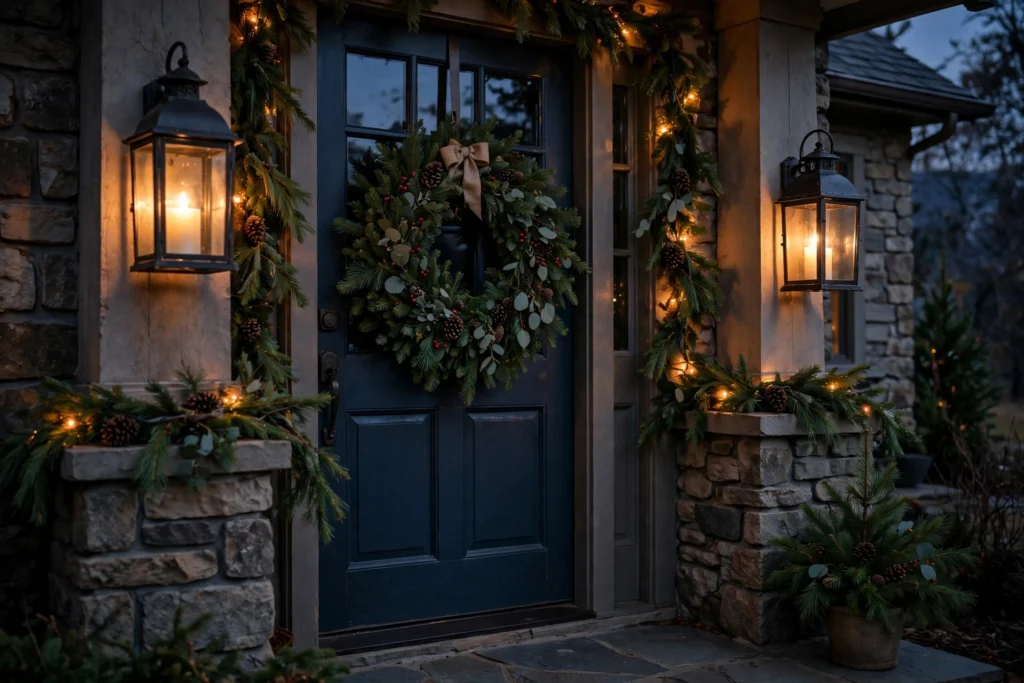
Start outside. A wreath on the front door is the single most recognisable of all the types of christmas decorations, and one good wreath does more than five small ones. Choose one at least 24 inches across, in your colour story, hung at eye level. A quality faux wreath runs $25–$60 and lasts for years.
Then work inward:
- Garland up the bannister — secured with ribbon every 18 inches, lights woven in if the stairs are dark
- Lanterns by the door — one or two, with LED candles inside for safety, $15–$40 each
- A doormat or runner — festive but flat, so the door still opens over it
- A small console inside the door with a candle and a bowl of pinecones
Inside the entry, less is more. Guests arrive with coats and bags, so keep the console clear: one candle, one small arrangement, and room for keys. The bannister garland and the door wreath do the heavy lifting — let them.
Hang the Wreath With Ribbon
Hang the wreath with a ribbon looped over the top of the door instead of a nail or suction hook. It holds better in cold weather, it does not damage the door, and the ribbon itself becomes part of the decoration.
How Do I Add Christmas Decorations to the Bedroom and Small Spaces?
Add Christmas to the bedroom with one small focal point and two or three tiny touches: a mini tree on the dresser, fairy lights along the headboard or window, and a festive pillow on the bed. Bedrooms are the most skipped rooms at Christmas, and the easiest to decorate — a little goes a long way in a quiet room.
The bedroom is where people wake up on Christmas morning, so it deserves more than nothing — but not a second tree. The types of christmas decorations that suit a bedroom are the soft, calm ones: warm lights, a small tree, a candle, and a touch of greenery.
Ideas that work in bedrooms and small spaces:
- A mini tree on the dresser or nightstand — 2–3 feet tall, pre-lit, $15–$35
- Fairy lights along the headboard, mirror, or window frame — $8–$15 a strand
- A small wreath on the bedroom door or above the bed
- A festive pillow and throw on the bed
- A candle or a small lantern on the nightstand (LED if you fall asleep with it on)
- A sprig of evergreen in a vase on the windowsill
The same approach works for the bathroom, the room most guides forget entirely: a small wreath on the mirror, a festive hand towel, and a candle is a complete bathroom. For more bedroom-specific ideas, see our guide to Christmas bedroom decor.
Decorate the Room You Wake Up In First
Decorate the room you wake up in first, even if it is the smallest job. Waking up to fairy lights and a tiny tree — two of the gentlest types of christmas decorations — on Christmas morning is worth more than a third garland in a hallway nobody sits in.
What Are the Best Outdoor Christmas Decorations?
The best outdoor Christmas decorations are a lit wreath on the door, lanterns and garland on the porch, warm-white string lights along the roofline or gutters, and one or two simple yard pieces. Outdoor decorations work best when they are visible from the street, built for weather, and limited to the same colour story as the inside of the house.
Outdoor decorating has its own rules. Everything must survive rain, wind, and cold, and everything must be safe — outdoor-rated lights, proper extension cords, and nothing that blocks a walkway or a step.
Start with the porch, then expand only if you want to:
- Wreath on the door — the anchor, same as the entry section above
- Lanterns flanking the door — LED candles inside, $15–$40 each
- Garland around the door frame or porch rail — secured tightly, lights woven in
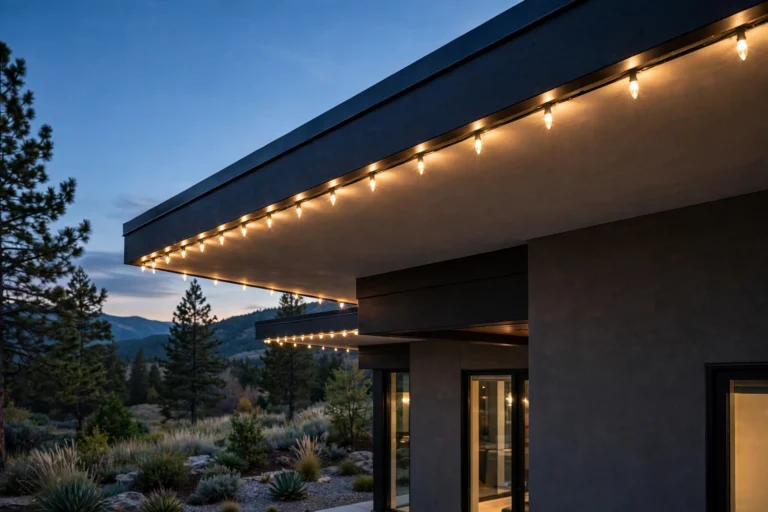
- String lights along the roofline or gutters — warm white, one colour, $15–$30 per strand
- One or two yard pieces — a lit tree or a reindeer, not a whole scene
- Pathway lights — small stakes along the walk, $20–$40 for a set
Keep the roofline to one colour of light. Mixed colours on the roof and white inside the house is the most common outdoor mismatch, and it is visible from the street. Outdoor lights and figures typically add $50–$150 to the season’s total (rough planning estimates, not quotes).
Put Outdoor Lights on a Timer
Put your outdoor types of christmas decorations on a timer. Six hours an evening — roughly 5 pm to 11 pm — gives you the full effect, saves electricity, and means you never have to go outside in the cold to switch them off.
How Do I Repeat the Same Elements Room to Room?
Repeat the same elements room to room by choosing three “through-lines” — evergreen, warm lights, and ribbon in your colour story — and using at least two of them in every decorated room. When the same greenery, light colour, and ribbon appear in the living room, kitchen, and bedroom, the house reads as one home instead of seven separate displays.
This is the fix for the most common complaint in the editorial guides: rooms that feel disconnected from each other. The tree is red and gold, the kitchen is silver, the bedroom is blue, and the house feels like three different homes. The answer is not to buy matching sets for every room — it is to repeat a few cheap elements everywhere.
Your three through-lines:
| Through-line | Living room | Kitchen | Bedroom | Entry |
|---|---|---|---|---|
| Evergreen | Tree, mantel garland | Wreath on window | Sprig in a vase | Wreath on door |
| Warm lights | Tree lights, candles | Fairy lights on window | Fairy lights on headboard | Lanterns by door |
| Ribbon | Tree ribbon | Ribbon on wreath | Ribbon on mini tree | Ribbon on bannister |
A fourth through-line, if you want one, is candles — real ones in the living room, LED ones in the bedroom and by the front door. The types of christmas decorations change by room, but the materials stay the same.
One practical way to do this: buy your ribbon and your lights in bulk, in one colour, and cut from the same rolls for every room. A 50-yard roll of ribbon ($10–$20) will cover the tree, the wreaths, and the bannister — and because it is the same ribbon, the rooms match without any extra effort.
Walk the House at Night
Walk your house at night with only the Christmas lights on. The rooms that glow the same colour are connected; the rooms that glow a different colour are the ones to fix. It takes two minutes and it shows you the problem better than any daylight inspection.
How Much Do Christmas Decorations Cost in Total?
A whole house of the types of christmas decorations in this guide typically costs $150–$400 from scratch with mid-range pieces, or $50–$150 if you already own the tree and the lights. Most of the cost sits in three items — the tree, the lights, and the garland.
All figures below are rough planning estimates, not quotes. Prices vary by size and quality, and faux greenery usually costs more up front but less over three or four seasons than fresh.
| Room or zone | What you are buying | Typical range |
|---|---|---|
| Tree | Ornaments, ribbon, topper, lights | $50–$120 |
| Mantel | Garland, stockings, candles | $40–$100 |
| Dining table | Runner, candles, pinecones | $20–$60 |
| Kitchen | Mini tree, wreath, towels | $25–$60 |
| Entry and porch | Wreath, lanterns, garland | $40–$90 |
| Bedroom | Mini tree, lights, pillow | $25–$60 |
| Outdoor | Roofline lights, yard pieces | $50–$150 |
| Whole house | Everything above | $150–$400 |
The cheapest way to decorate is to buy after Christmas, when the same types of christmas decorations sell for 50–75% off, and to store them properly — ornaments wrapped, lights coiled, garland in a bag, not a bin. The most expensive way is to buy one new colour story every year.
Frequently Asked Questions
How many types of Christmas decorations are there?
There are eight main types of christmas decorations: tree decorations, garlands, wreaths, mantel displays, table centrepieces, window and wall decor, lighting, and outdoor decorations. Most homes need six or seven, and the best-looking houses repeat a few types in more rooms rather than buying one of everything.
What goes on the tree first?
Lights go on the tree first, after you fluff the branches — the first step for the biggest of the types of christmas decorations. Wrapping the lights before the ornaments lets you tuck bulbs deep inside the branches, where they glow through the greenery instead of sitting on the surface. Ribbon comes next, then large baubles deep inside, smaller ornaments on the tips, and the topper last.
How do I match decorations across rooms?
Match decorations across rooms by picking one colour story — three colours, one of them metallic — and repeating three elements in every room: evergreen, warm lights, and ribbon in that story.
When should I put Christmas decorations up?
Most homes put their types of christmas decorations up in the last two weeks of November or the first week of December, and take them down in the first week of January. Put the outdoor lights up first, while the weather is still mild, then decorate inside room by room.
What decorations should I put on the dining table?
Put a low, narrow centrepiece on the dining table: a greenery runner down the centre, candles in the middle, and pinecones or a few baubles tucked low. Keep everything under 12 inches tall and no wider than 12 inches, so guests can see each other and pass dishes without moving anything.
How do I decorate a small home for Christmas?
Decorate a small home with fewer types of christmas decorations and smaller pieces: a slim or tabletop tree, one wreath, a short garland on the mantel or shelf, and a single centrepiece. In a small space, one colour story and warm lights matter more than the number of decorations — and every piece should have a clear home, not a crowded corner.
Are real or faux Christmas decorations better?
Faux decorations cost more up front but last for years and need no watering, while real greenery smells wonderful but dries out and needs replacing each season. Most homes mix the two: a faux tree and garland for the big pieces, and fresh sprigs, oranges, and pinecones for the small, fragrant touches.
How do I store Christmas decorations after the holidays?
Store Christmas decorations by type, not by room: ornaments wrapped in tissue in divided boxes, lights coiled around a spool, garland in a breathable bag, and candles upright in a cool place. Label every box with its type and colour story.
Final Thought
The best houses at Christmas are not the ones with the most types of christmas decorations. They are the ones where every type has a clear home, one colour story runs from the front door to the bedroom, and the same evergreen, warm light, and ribbon show up in every room. Start with the tree, give the mantel its three layers, keep the table usable, and let the small rooms have their small touches — the types of christmas decorations matter less than where you put them.