Baby Shower Backdrop Ideas: The Complete At-Home Photo Zone Guide
TL;DR
In 2026, the backdrop is the first thing guests photograph at a baby shower, so build one wall well and leave the rest of the room simple. You need a stand, drape panels, a sign, warm lighting, and a balloon garland that frames — never covers — the photo spot. Spend most of your budget on the stand and the lighting, keep the chair and sign clear, and test one phone photo before guests arrive.
If you are planning a whole shower, start with our complete guide to baby shower decorations and then come back here for the photo zone itself.
Introduction
Good baby shower backdrop ideas solve one problem: every guest wants a photo with the parent-to-be, and without a planned spot those photos happen against a cluttered living room wall. A backdrop fixes that by giving the camera one clean, styled wall to look at. It does not need a venue, a stylist, or a large budget. It needs five parts working together — a stand that holds its shape, drape panels that hide the wall behind it, a sign that names the occasion, warm lighting that flatters faces, and a balloon garland that frames the scene without blocking it. This guide builds that photo zone step by step, with realistic costs, a small-space version, and the mistakes that ruin otherwise good backdrops.
How Do Baby Shower Backdrop Ideas Work at Home?
Baby shower backdrop ideas work at home when you treat the backdrop as a photo studio wall, not as wall decoration: one flat, well-lit surface, one clear place to stand or sit, and nothing in the frame that does not belong there. That single discipline is what separates a backdrop that photographs beautifully from a wall covered in decorations.
Start by choosing the wall, not the decor. Pick the wall with the best natural light and the least clutter behind it — usually the longest blank wall in the living room, or a corner if no blank wall exists. Measure it before you buy anything: most at-home backdrops are 6 to 8 feet wide and 7 to 8 feet tall, which fits a standard living room wall and leaves room for a chair and two people to stand in front of it. A backdrop that is too wide for the wall bends at the edges and looks temporary; one that is too narrow leaves the room visible in every photo.
Once the wall is chosen, build in this order: stand, drape, sign, lighting, garland. The order matters because each layer depends on the one before it — drape needs a stand, the sign needs drape behind it, lighting needs to fall on the sign and the faces, and the garland needs to frame all of it without covering any of it.
What Size Backdrop Stand Do You Need for a Living Room?
For most living rooms, a 6 to 8 foot wide, 7 to 8 foot tall adjustable stand is the right size: wide enough for two people and a chair, tall enough that the top of the drape stays out of phone photos, and narrow enough to fit a normal wall. Measure your wall first and leave at least a foot of clear space on each side.
A freestanding pipe-and-drape stand is the most forgiving choice at home because it adjusts to your wall, breaks down flat for storage, and does not need nails or hooks in the wall. Avoid taping drape directly to the wall unless you have tested the tape on your paint first — painter’s tape holds light fabric on most walls, but heavier drape pulls away mid-party and takes paint with it. If you are renting, a freestanding stand is the safer spend, and it is the one piece you will reuse for birthdays and other celebrations.
Place the stand a foot or two out from the wall, not flush against it. That gap lets the drape hang straight instead of bunching against baseboards, gives you room to hide light cables behind it, and keeps the backdrop from casting a hard shadow line in photos. Put the gift table and the chair in front of the backdrop, never behind it, so the backdrop stays the background in every shot.

Which Drape Colors and Fabrics Photograph Best?
Plain, matte fabric in one or two colors photographs best: white, cream, sage, dusty blue, or blush, in chiffon, linen-look, or polyester drape. Avoid shiny satin and busy patterns, which reflect camera flash and compete with the people in front of them.
Matte fabric is the key detail most first-time hosts miss. Shiny fabric catches every light in the room and creates bright spots in photos, while matte fabric absorbs light evenly and lets faces stay the focus. Two drape panels in your shower’s main color, plus one sheer white panel layered over them, give depth without pattern. If your shower has a strong theme color, use it for one panel and keep the rest neutral — a backdrop in three loud colors looks like a different party in every photo.
Steam or iron the panels the night before. Wrinkles are the most visible flaw in backdrop photos because the camera is pointed straight at the fabric, and no filter fully hides them. Hang the panels, let them drop overnight if you can, and do a quick steam in the morning. This one unglamorous step is worth more than any extra decoration.
How Do You Choose and Hang a Backdrop Sign?
Choose one sign, in a large readable font, hung at eye level in the center of the backdrop: “Oh Baby,” the baby’s name, or a short phrase in the shower’s theme. Hang it so it stays visible above seated guests and below the top of the drape, and keep the garland clear of it.
One sign beats three. A backdrop with a name sign, a phrase sign, and a date sign forces the eye to read instead of look, and in photos the signs compete with the people. Pick the sign that matters most — usually “Oh Baby” for a general shower or the baby’s name for a more personal one — and let everything else stay unlettered. Gold, white, or natural wood signs read best against cream and sage drape; dark signs disappear against dark drape, so match the sign color to contrast with the fabric behind it.
Hang the sign with fishing line or clear hooks from the stand’s crossbar, not with tape on the drape, so it hangs flat and does not pull the fabric forward. Test the height with someone sitting in the chair: the sign should sit just above their head in a photo, not behind it. If guests will stand for group photos, raise it a few inches so it stays above the tallest head in the group.
What Lighting Makes a Backdrop Look Professional in Phone Photos?
Warm, front-facing light makes a backdrop look professional: one warm-white light source in front of the backdrop, at face height, plus a string of warm fairy lights woven through the garland or along the drape edge. Avoid overhead-only lighting, which casts shadows under eyes, and avoid colored lights, which tint skin in photos.
Natural window light is ideal when the backdrop faces a window, but most showers run into the evening, so plan for artificial light too. A floor lamp with a warm bulb, placed to one side of the camera position and aimed at the backdrop, fills faces without flattening them. Fairy lights add sparkle, but they are decoration, not the main light — without a real light source in front, fairy lights alone leave faces dark and the backdrop glowing behind them. Take one test photo with the exact phone and light you will use on the day, and adjust before guests arrive; lighting is the one thing you cannot fix after the party with a filter.

How Should a Balloon Garland Frame a Backdrop Without Covering It?
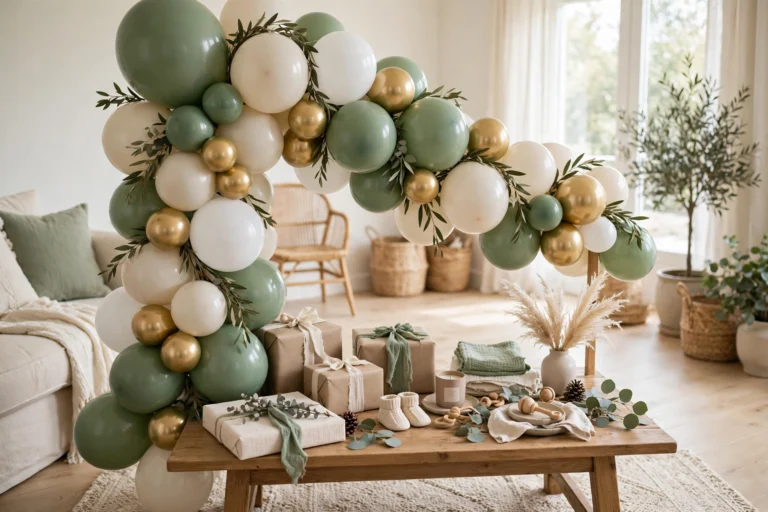
A balloon garland should frame the backdrop asymmetrically — draping from one upper corner down one side, leaving the sign and the chair fully visible. Build it in mixed-size clusters, hang it after the sign and lighting are set, and leave a clear gap in the center where photos happen.
This is where most backdrops go wrong: the garland goes up first, grows across the whole backdrop, and by party time the sign is hidden and the parent-to-be sits behind balloons. Hang the garland last, after the stand, drape, sign, and lighting are finished, and step back to check the frame from camera distance before you call it done. The garland should lead the eye toward the center, not block it. If you cannot see the full sign and the full chair from where photos will be taken, move balloons, not people.
For the garland itself, mixed sizes in two or three colors that match the drape — for example cream, sage, and gold — look full and intentional. A single-color, single-size chain looks flat by comparison. Our balloon garland setup guide covers the cluster method in detail; the framing rule here is the part to remember: garland is the frame, the backdrop is the picture, and the people are the subject.

How Do You Build a Backdrop in a Small Room or Corner?
In a small room, build a corner backdrop: two drape panels meeting at a corner, a chair angled into the corner, and the garland running down one side only. The camera sees only the backdrop, so the room’s size never shows in photos.
A corner is actually easier than a flat wall in a small room because the corner gives the backdrop depth and hides side clutter automatically. Hang one panel on each wall of the corner, put the chair at a slight angle facing into the room, and keep the garland to one side so the corner does not feel crowded. Skip a full stand if the corner is tight — two removable hooks and a tension rod can hold light drape in a corner, though a small stand is still steadier if you have the floor space.
Keep the rest of the room simple on purpose. When the backdrop is the only styled wall, guests naturally gather there for photos and the rest of the room can stay functional — food on the kitchen counter, gifts on a side table, seating wherever it fits. Trying to decorate every wall in a small room makes the whole space feel crowded; decorating one wall well makes it feel intentional.

How Much Does an At-Home Backdrop Cost?
A complete at-home backdrop typically costs $85 to $200 in total, with the stand as the largest single spend and drape, sign, lights, and garland sharing the rest. Buying a stand you reuse brings the per-party cost down sharply after the first shower.
| Part | Typical cost (planning estimates, not quotes) | Notes |
|---|---|---|
| Backdrop stand kit | $35–$60 | Reusable; the best long-term spend |
| Drape panels (2–3) | $20–$40 | Matte fabric; steam before the party |
| Backdrop sign | $15–$35 | One sign only, hung at eye level |
| Fairy lights | $8–$15 | Warm white; decoration, not main light |
| Balloon garland kit | $15–$30 | Frame, do not cover, the sign |
| Removable hooks / line | $5–$10 | For sign and garland hanging |
| Total | $98–$190 | Mid-range setup; reuse cuts later costs |
If the budget is tight, cut in this order: skip the custom sign and use a printed banner, skip the garland and use one pampas arrangement, but do not skip the stand or the lighting. A backdrop without a stand sags, and a backdrop without front light photographs dark no matter how pretty the decor is. Conversely, if you have money to spend, spend it on better lighting and a sturdier stand before you buy more balloons — the photos will show the difference, and the stand will serve the next celebration too.
What Are the Most Common Backdrop Mistakes to Avoid?
The most common backdrop mistakes are covering the sign with the garland, hanging the sign too low, using shiny or wrinkled fabric, lighting only from above, and building the backdrop too wide for the wall. Each one is easy to avoid with a single test photo before guests arrive.
Run this checklist the morning of the shower: sign fully visible from camera distance, chair fully visible, drape steamed and hanging straight, front light on, garland framing not covering, and one test photo taken with the phone you will actually use. If any item fails, fix it before the first guest arrives — after that, nobody will want to stop the party to rehang a backdrop. Keep a few spare balloons, a roll of fishing line, and a steamer or iron nearby for last-minute fixes; backdrops rarely fail dramatically, but they often need one small adjustment.
FAQ
Do I need a backdrop stand, or can I hang drape on the wall?
A stand is worth it for most homes because it holds drape straight, adjusts to your wall, and avoids wall damage. Wall hanging works for very light fabric with tested tape, but heavier drape pulls away and can take paint with it, especially in rented homes.
How far in front of the backdrop should guests stand?
About two to three feet in front of the drape is ideal. Closer than that casts shadows on the fabric; farther than that makes people look small in the frame. Put a chair at that distance as a natural marker for photo poses.
Can I reuse a backdrop for another party?
Yes — a neutral stand, cream drape, and warm lights work for birthdays, bridal showers, and holidays too. Only the sign and the garland colors need to change, which is why the stand and lighting are the smartest first purchases.
What if my living room has no blank wall?
Use a corner. Two drape panels meeting at a corner create a complete photo zone, and the camera only sees the backdrop. Keep the garland to one side so the corner feels open, not crowded.
Should the backdrop match the shower theme exactly?
It should match the palette, not every theme detail. A sage, cream, and gold backdrop works for a boho, garden, or neutral shower alike. Matching colors exactly matters more than matching every motif, because the camera reads color first.
Conclusion
A great at-home photo zone is not about buying the most decorations — it is about building one wall in the right order: stand, drape, sign, lighting, and a garland that frames instead of covers. Do that, take one test photo, and every guest photo from the shower will look like it came from a styled venue, even though it came from your living room. For the rest of the shower, return to our complete guide to baby shower decorations and plan the table, dessert corner, and gift area in the same palette.