How to Get Rid of Bats: The Safe, Legal Exclusion Method
How to get rid of bats comes down to one method: exclusion. You fit a one-way door over the bats’ exit point so they can leave at night to feed but cannot get back in, you wait until the whole colony has left, and then you seal every gap for good. There is no poison, no trap and no shortcut — in almost every state bats are protected wildlife, and killing them is illegal. The house is the problem, not the animal: find the hole, let them out, close the hole.
Timing matters as much as method. Late fall is the best season for bat exclusion, because the colony is whole, the pups can fly, and the bats are still active enough to leave every night. Never exclude bats during maternity season, roughly May through mid-August, when flightless pups are in the roost — sealing the exits then traps the pups inside and locks the mothers out. If you are not sure whether bats are even in the house yet, our guide to signs of bats in house is the ID guide — guano, dusk sounds and smudge marks — and this post picks up where that one ends: removal only.
This guide to how to get rid of bats covers the exclusion method step by step, the timing rules, how to find the entry point, how a one-way door works, sealing after the bats leave, guano cleanup safety, costs, and when to call a professional. It covers removal only. It never advises killing bats, and it never advises cleaning guano without protective gear.
TL;DR — How to Get Rid of Bats in 5 Steps
1. Confirm the exit point: watch the house at dusk for several evenings and note exactly where bats leave — that spot is the one you fit the door over.
2. Check the season first: never exclude during maternity season (May–mid-August); late fall is the best window.
3. Fit a one-way door: mesh netting, a cone or a tube over the main exit, left in place at least 5 nights including 3 good-weather nights.
4. Seal everything else first: close every other gap 3/8 inch or wider so the colony cannot move three feet over and re-enter.
5. Seal the main exit last: only after you are certain no bats remain, then remove the device and seal the opening permanently.
That is the short version — the sections below explain each step in full.
How to Get Rid of Bats the Safe Way
The safest way to get rid of bats is exclusion: a one-way door fitted over the colony’s exit point that lets bats leave at night and blocks them from coming back. It is the only method that is effective, legal and humane at the same time, and it is the method wildlife agencies recommend. Poison, fumigants and kill traps are illegal for bats in almost every state, and they do not fix the hole the bats used — a dead bat does not close an entry point, so the next colony moves straight in.
Exclusion works because it uses the bats’ own routine. Bats leave every night at dusk to feed and return before dawn, so a device that opens outward and not inward empties the roost over a few nights without handling a single animal. The work is in the preparation: finding the real exit, sealing every backup gap, and waiting long enough to be sure the roost is empty before the permanent seal goes on. Done in the wrong season or in the wrong order, the same method traps bats inside — which is why the timing and sealing sections below are not optional.
Watch at Dusk for Three Evenings Before You Touch Anything
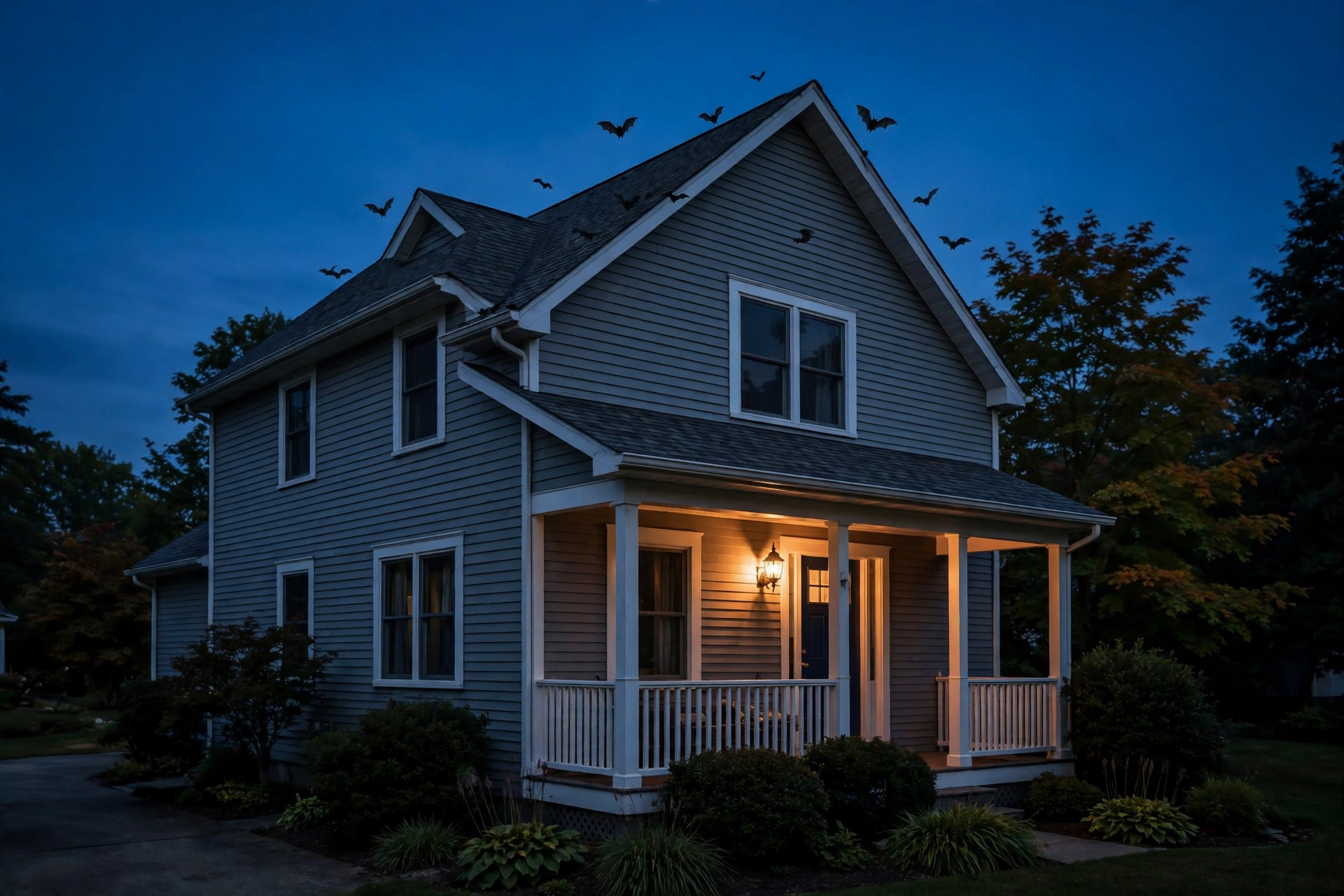
The exit point is the whole job, and guessing it is how homeowners move a colony to another part of the roofline. Sit in the yard at dusk for three evenings and watch where bats actually leave — same spot, same time, every night. Mark it, look for the greasy smudge around the hole, and fit the one-way door over that exact opening.
When Is It Safe to Exclude Bats?
It is safe to exclude bats only when the whole colony can leave on its own — never during maternity season, roughly May through mid-August, when female bats give birth to pups that cannot fly. Sealing exits during that window traps flightless pups inside the attic and locks the mothers out, which is cruel, often illegal, and leaves dead animals in the walls. Late fall is the best window: the pups can fly, the colony is still active, and the bats leave every night.
The exact maternity dates vary by state and species — Georgia’s wildlife agency, for example, warns against exclusions from April 1 to July 31 — so check your state wildlife agency’s guidance before starting, or call a local wildlife-control operator. The principle is the same everywhere: only exclude when every bat in the roost can fly out. If you find the colony in May, June or July, wait. Use the time to find every entry point and buy the materials, then exclude in the fall. A bat in the living space is different — see the section below on a single bat indoors — but a colony exclusion always waits for the right season.
How Do I Find Where Bats Are Getting In?
Find the bats’ entry point by watching the house at dusk and looking for greasy smudge marks around holes near the roofline. Bats can squeeze through a gap as small as 3/8 of an inch, so the entry is usually smaller than people expect: loose fascia boards, attic vents, chimney flashing, ridge vents, gaps where utilities enter, and cracks in siding. The smudge — a dark, greasy stain from the oils on their fur — marks the holes they use every night, and it is the most reliable sign after the dusk watch itself.
Walk the outside of the house in daylight after your dusk watches and check every spot you marked. Look low and high: bats enter at the roofline, but they also use gaps at ground level and around the foundation. If you find one entry point, assume there are more — a colony that has used a house for a season knows every gap in it. Seal the secondary gaps before you fit the one-way door, but leave the main exit open until the device is in place. For the full list of signs that confirm bats are present at all, see our signs of bats in house guide.
How Does a One-Way Exclusion Door Work?
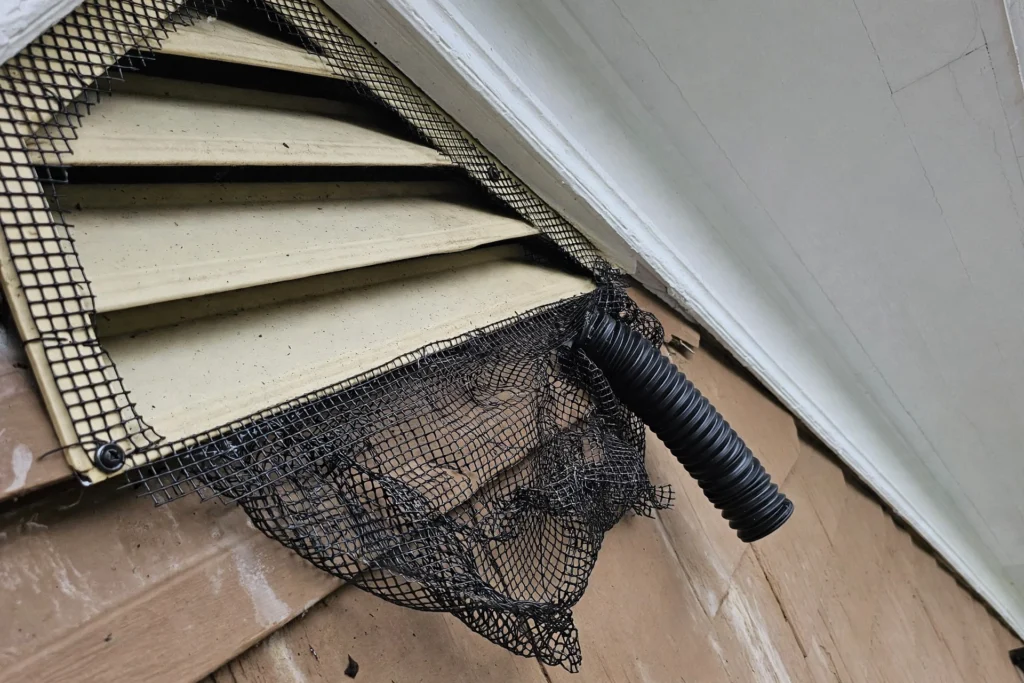
A one-way exclusion door is a device fitted over the bats’ exit point that lets them crawl out and drop away but will not let them climb back in. The common forms are plastic netting or sheeting fixed firmly at the top and sides and left loose along the bottom edge, hanging 18–24 inches below the exit; a cone-shaped piece that is easy to leave through and too smooth to climb back up; or a tube about 2 inches in diameter and 10 inches long fitted into a small opening. The bat leaves through its normal route at dusk, and when it returns before dawn the device has closed behind it.
Leave the device in place for a minimum of five nights, including at least three consecutive nights of weather good for bat flight — temperatures above 50 °F, winds below 10 mph, and no sustained or heavy rain. Not every bat leaves every night, so a device pulled after two nights strands part of the colony inside. After the waiting period, watch at dusk again: no exits for two or three calm evenings means the roost is empty, and only then do you remove the device and seal the opening.
| Device | How it works | Rough cost | Best for |
|---|---|---|---|
| Mesh netting one-way door | Netting fixed top and sides, loose at the bottom, hangs 18–24 in below exit | $10–$25 | Vents and wide openings |
| Exclusion cone | Smooth cone, easy out, hard to climb back | $15–$30 | Single entry holes |
| Exclusion tube (2 in x 10 in) | PVC or flexible tube in a small opening | $10–$20 | Small gaps, corners |
| Professional exclusion service | Pro fits devices, monitors, seals | $300–$1,500 | Large colonies, high roofs |
All prices are rough planning estimates, not quotes.
How Do I Seal My House After the Bats Leave?
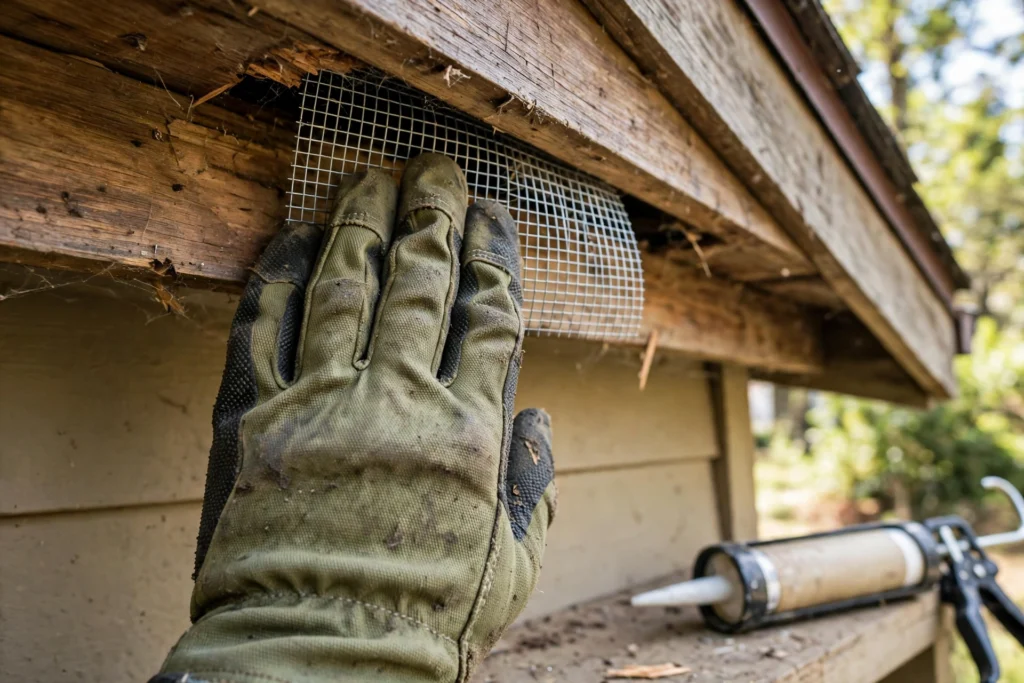
Seal the house only after you are certain no bats remain: remove the one-way device, then close the original opening and every secondary gap with galvanized hardware cloth (1/8-inch mesh) screwed tight with no gaps at the edges, water-based silicone caulk, caulk-backing rod, or heavy-duty mesh. Check attic vents, flashing, chimney edges, ridge vents and the spots where cables and pipes enter. The permanent repair is exclusion plus sealing — exclusion alone leaves the door open for the next colony.
Work from the outside in and do not use foam or soft filler alone on a bat gap; hardware cloth is the standard because bats cannot chew through it and it still lets the vent breathe. Recheck the sealed spots at dusk for a week after sealing — if bats are circling and cannot get in, the seal is working, and a bat house (below) gives them somewhere to go instead. If bats are still getting in after a week, there is a gap you missed, usually at the ridge vent or behind a loose fascia board.
Give Them a Bat House, Not a Reason to Come Back
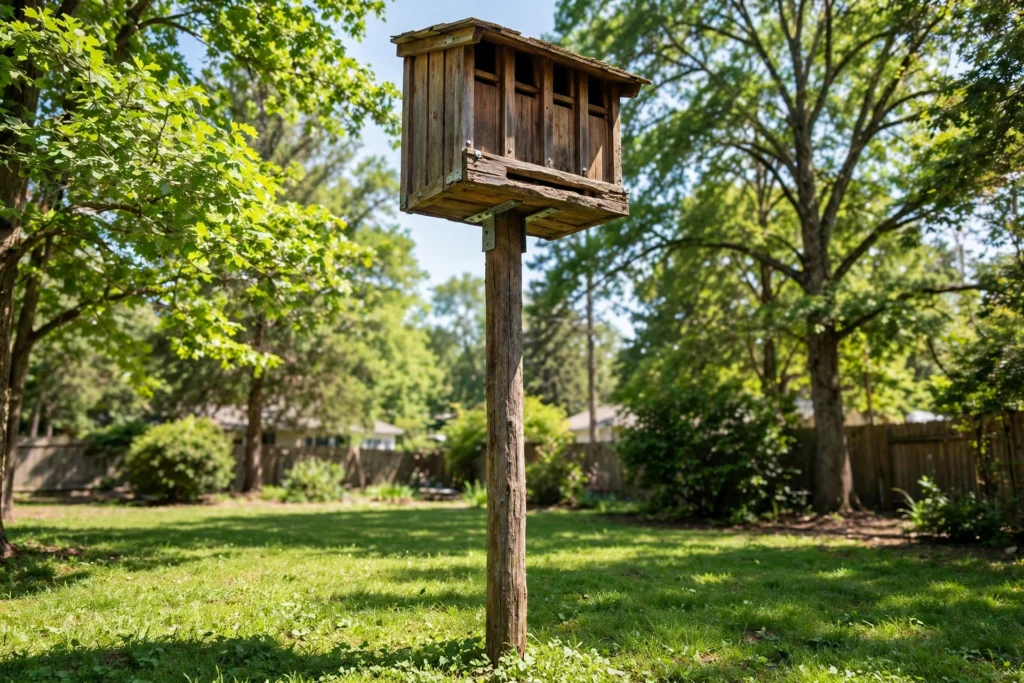
Put up a bat house on a pole or a south-facing wall at least 10–15 feet up, away from the house, before you exclude the colony. Bats eat thousands of mosquitoes a night, and a colony with a ready-made roost nearby is far less likely to test your new seals. Mount it in spring so it is occupied by the time the colony needs it.
What Should I Do About Bat Guano?
Treat bat guano as a job for a professional with protective gear, not a DIY cleanup. Guano can carry histoplasmosis, a fungal infection caught by breathing in spores from dried droppings, and sweeping or vacuuming it dry throws those spores into the air. If the pile is small and you must handle it yourself, wear a proper respirator (not a dust mask), gloves, goggles and disposable coveralls, mist the droppings with water before touching them so nothing goes airborne, and bag everything sealed. Never sweep or vacuum guano dry, and never clean it without the gear.
For anything more than a small pile — a colony roosting all season, guano in insulation, or a smell through the ceiling — call a professional. Guano cleanup is part of what the $300–$1,500 professional exclusion price covers, and a pro has the respirators, containment and disposal the job needs. If anyone in the house develops a cough or fever after guano exposure, see a doctor and mention the bats.

What Should I Do If a Bat Is in the House Right Now?
If a single bat is flying inside a living room, stay calm: the bat is terrified, disoriented and looking for a draft of fresh air, not trying to attack you. Close all interior doors so the bat is confined to one room, turn off the ceiling fans and the lights, and open an exterior door or a large window at least 2–3 feet wide. Stand quietly in a corner and wait — most bats find their own way out within minutes.
If the bat lands and will not leave, put on thick leather work gloves, wait for it to settle completely, and place a plastic container or small cardboard box gently over it, then slide a stiff piece of cardboard flat against the wall to cover the opening. Carry it outside, set the box on an elevated surface like a deck rail, and remove the cardboard. But if you woke up to a bat in a room with a sleeping person, a young child, a pet or someone intoxicated, do NOT release it — call animal control or a wildlife professional, because a bite can go unnoticed and bats can carry rabies.
When Should I Call a Professional?
Call a professional when the colony is large, the entry points are on a high roof or in a crawl space you cannot safely reach, when guano cleanup is extensive, or when the timing falls inside maternity season and the work needs a permitted wildlife operator. A professional exclusion usually runs $300–$1,500, rough estimate, not a quote, and most companies include the devices, monitoring and the full sealing plan in the visit. If you want a sense of pricing first, our guide to how much pest control costs breaks down typical prices by pest and by visit type. Do not wait out a bat colony the way you might wait out mice: bats are protected, the colony grows every year, and every season the guano pile and the entry holes get worse.
What Should I Never Do to Get Rid of Bats?
Never kill bats, never poison them, never fumigate a roost, and never seal an opening while bats — especially flightless pups — are still inside. In almost every state bats are protected wildlife, and poisons and kill traps are illegal as well as useless: they do not close the entry point, so the next colony moves in. Never use mothballs either — the naphthalene smell is impractical at the scale needed and the mothballs disintegrate fast. Also skip the gadgets: ultrasonic repellers have weak evidence and do not pass through walls, bright lights and wind chimes may shift a roost a few feet but will not evict a colony, and essential-oil sprays are a deterrent at best, not a removal method. The only fix that lasts is exclusion plus sealing, done in the right season, with the bats alive and outside when the last gap closes.
FAQ — How to Get Rid of Bats
How long does it take to get rid of bats?
Exclusion takes about one to two weeks: a few evenings to find the exit, five nights minimum with the one-way door in place (including three good-weather nights), then sealing once no bats have exited for two or three calm evenings. The whole job, done properly in the fall, is usually finished inside two weeks.
Can I get rid of bats myself?
Yes, for a small colony with an entry point you can reach safely — fit a one-way door, wait the full five nights, then seal with hardware cloth. Call a professional for a large colony, a high roof, extensive guano, or any work inside maternity season, when a permitted wildlife operator is required.
Do bats come back after exclusion?
They try, but they cannot get back in if every gap is sealed with hardware cloth and caulk. Bats follow scent trails to the same roost year after year, so sealing is the step that makes exclusion permanent. A bat house nearby gives the colony somewhere to go instead of testing your seals.
Is it illegal to kill bats?
In almost every state, yes — bats are protected wildlife, and poisons, fumigants and kill traps are illegal. The legal method is exclusion: let them leave through a one-way door and seal the entry after the roost is empty. Check your state wildlife agency for the exact rules where you live.
What time of year is best to remove bats?
Late fall is best: the pups can fly, the colony is active and leaving every night, and the weather is still warm enough for bat flight. Never exclude during maternity season, roughly May through mid-August. If you find bats in summer, plan the work and exclude in the fall.
How much does professional bat removal cost?
Professional bat exclusion usually runs $300–$1,500, rough estimate, not a quote, depending on colony size, roof height and how much sealing and guano cleanup is needed. Most companies include the devices, monitoring and the full sealing plan in the price.