Best Permanent Christmas Lights: 6 Kits Compared With Real Prices and Owner Complaints
The best permanent Christmas lights are the ones you install once and never think about again — no ladder every December, no dead strand found on the coldest night of the year. But the kits are not equal, the prices move weekly, and the thing owners complain about most is something no product page mentions. We compared six systems — Govee, eufy, Asahom, Twinkly and the budget tier — on price per foot, brightness, whether you can cut them, and what real owners say after a year on the roof. If a full permanent install is more than you need this year, our guide to hanging Christmas lights without a ladder covers the one-weekend alternative.
A note on method: instead of repeating spec sheets, we dug through owner discussions — the big Reddit permanent-lights threads, DIY lighting forums, Facebook installer groups and hundreds of verified-buyer reviews — and cross-checked every claim against manufacturer specs. Where owners consistently contradict the marketing, we say so.
TL;DR
Best overall: Govee Elite (Lights 2) — $279.99/100ft, brightest-in-class app, Matter support. Best value on sale: eufy E22 — the brightest lights here (90 lm), routinely $129.99–$149.99. Best for custom rooflines: Govee Pro or Asahom Pro — both cuttable. Best effects: Twinkly. And the one warning every buyer needs: screw the mounts, never trust the adhesive alone — falling strands are the #1 owner complaint across every brand.
What Are Permanent Christmas Lights?
Permanent Christmas lights are LED systems designed to stay on your roofline all year: weather-sealed strands or pucks mounted under the eaves, controlled by an app, invisible or near-invisible by day and scheduled by night. Most owners actually run them as warm-white house lighting most of the year and switch to color for holidays, game days and parties — which is how a “Christmas” purchase justifies itself in March.
They come in two classes. DIY kits ($36–$400 per 100ft) are what this guide compares: you install them yourself in a day, with adhesive mounts, clips and screws. Pro-installed systems (JellyFish, Gemstone, Trimlight and local installers) hide the lights in a color-matched aluminum track and cost $18–$35 per linear foot installed — $3,000–$6,000 for a typical home. Same glow at night, very different daytime look and price. The full DIY-vs-pro math is below; first, the kits.
The Quick Comparison: 6 Permanent Christmas Light Kits With Real Prices
Govee vs eufy vs Twinkly: The Short Version
Buy the Govee Elite for the safe default: the strongest app, Matter support, $279.99 for 100 feet (about $179.99 on deal days). Buy the eufy E22 for the brightest lights at the lowest price: 90 lumens per light, $129.99–$149.99 on sale — no Matter, no cutting. Buy Twinkly only if the show is the point: its app maps effects to your house shape for $299.99.
|
Kit |
Price (100ft) |
$/ft |
Cuttable? |
Brightness |
App / ecosystem |
Warranty |
|---|---|---|---|---|---|---|
|
Govee Elite (Lights 2) |
$279.99 (Black Friday $179.99) |
~$2.80 |
No |
40 lm/light |
Govee app, Matter, Alexa, Google |
3 years |
|
Govee Pro |
$349.99–$399.99 |
~$3.50–4.00 |
Yes |
50 lm/light |
Govee app, Matter, Alexa, Google |
3 years |
|
eufy E22 |
$299.99 (sales $129.99–$149.99) |
~$3.00 list / ~$1.30 sale |
No |
90 lm/light |
eufy app, Alexa, Google (no Matter) |
Check listing |
|
Asahom Pro |
~$199.99–$259.99 |
~$2.00–2.60 |
Yes |
70 lm/light |
Asahom app + WLED, Alexa, Google |
3 years |
|
Twinkly Permanent |
$299.99 starter (~98ft) |
~$3.06 |
No |
RGB + white |
Twinkly app (camera mapping), Alexa, Google |
Check listing |
|
Budget kits (Walmart/Amazon) |
$30.88–$39.99 (49–100ft) |
~$0.40–0.73 |
Varies |
Low |
Generic apps |
Rarely published |
Three numbers in that table do most of the deciding. If your roofline needs a strand shortened, only the two cuttable kits survive your shortlist. If you buy on sale, the eufy is half the price of everything else. And if you want the lights to disappear into a smart home, Matter support (Govee only, in this set) matters more than any scene mode.
1. Govee Elite (Lights 2): The Best Permanent Christmas Lights for Most Homes
The Govee Elite — sold as the Lights 2, and at Costco simply as the Elite — is the default recommendation in owner communities, and the reasons are boring in the best way: it’s bright enough, the app is the strongest in the class, the power supply is properly weather-rated, and it supports Matter, so it ties into Alexa, Google and smart-home routines without a fight. One hundred feet costs $279.99 at Govee and major retailers, and it has dipped to about $179.99 on deal days — at that price nothing else is close.

The honest catches: you cannot cut it. Strands come in fixed segments up to a 150ft maximum, so an awkward roofline means tucking or doubling back the excess. And the mounting adhesive is the single most complained-about part of the whole Govee experience (more in the downsides section) — plan on the included screw clips, and budget an extra hour.
Owner verdict: a pro installer who fits these weekly called Govee “the best consumer-grade permanent smart lights I’ve encountered so far,” and the big review consensus matches: bright, sturdy, app a little clunky but manageable, and a whole 100ft run draws only about 22 watts at full blast.
2. Govee Pro: Best for Rooflines You Have to Cut to Fit
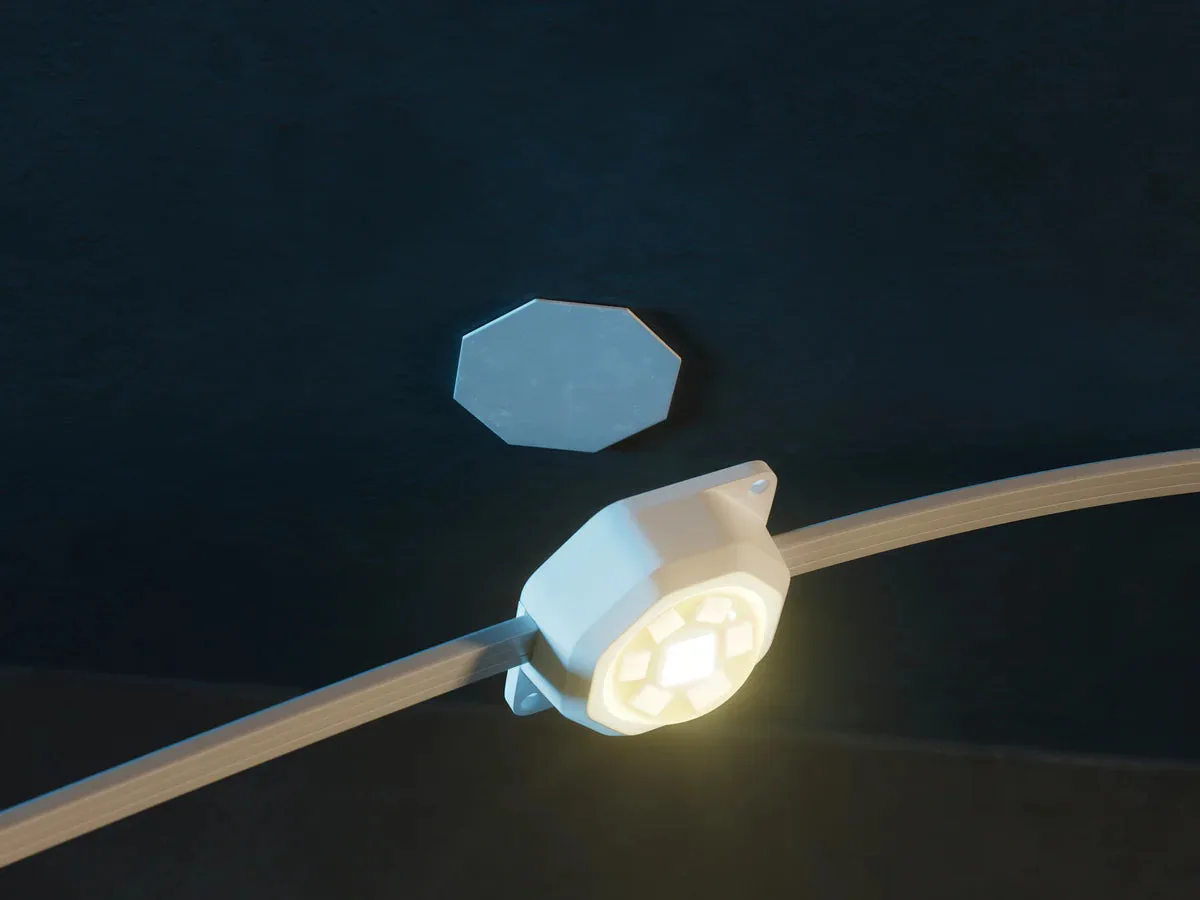
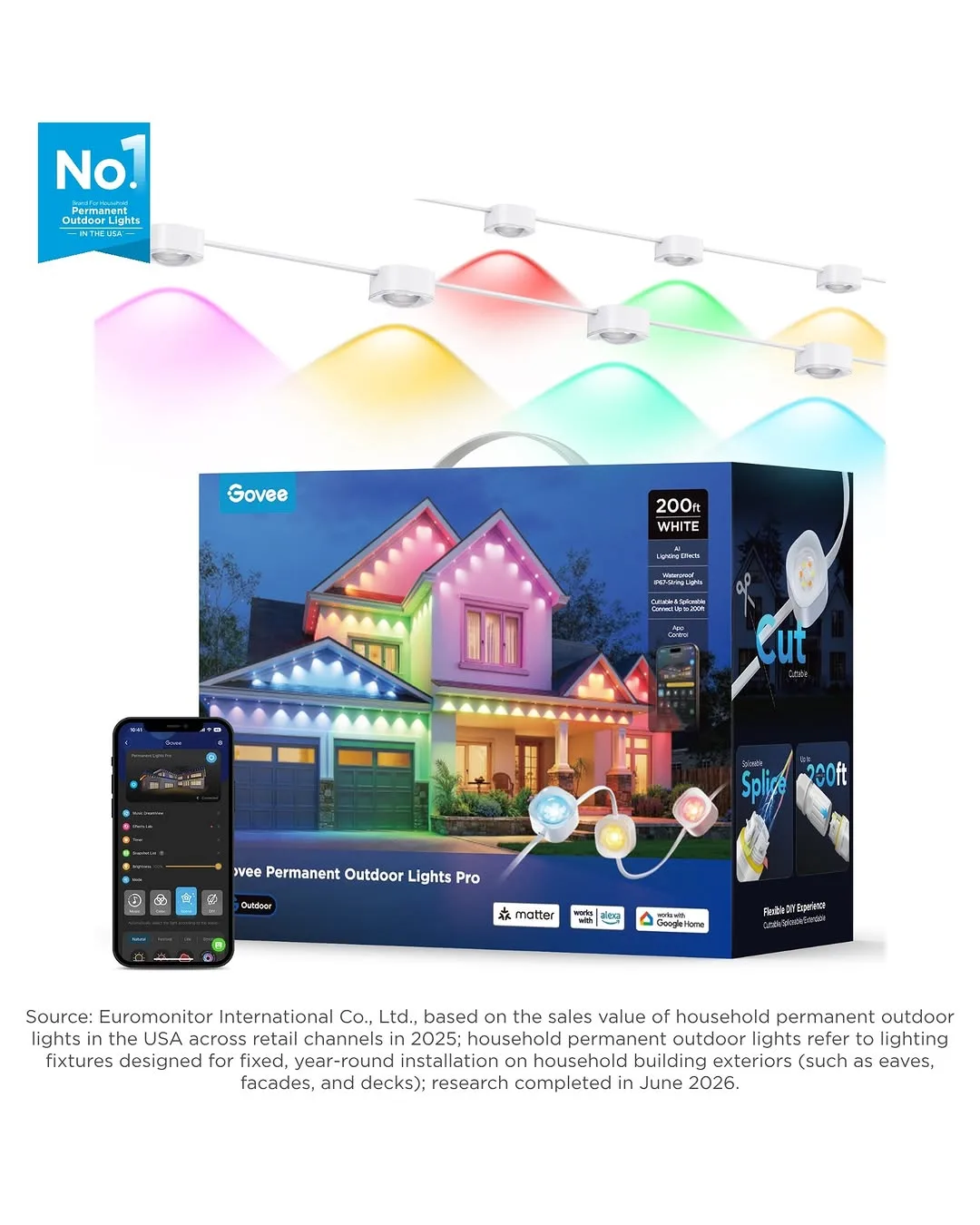
The Pro is the Elite’s more serious sibling: brighter (50 lm/light), true warm-to-cool tunable white, up to 200ft of run — and the feature that justifies its $349.99–$399.99 price: you can cut and splice it. Real rooflines have dormers, returns and odd corners; being able to cut at a corner and splice across a gap is the difference between a clean install and a visible cable mess. A driver module is required past 150ft (included in the 200ft kit).
One gotcha owners hit mid-install: on the current model, Govee rates the adapter for indoor use, so plan your power run to an indoor or properly covered outlet. It’s a small thing that has ruined more than one Saturday — know it before the ladder comes out.
3. eufy E22: The Brightest — and the Best Sale Price in the Class
The eufy E22 is the spec-sheet winner: triple-LED pucks putting out 90 lumens each — more than double the Govee Elite — with whites that owners consistently describe as the most natural of the group. List price is $299.99, but the E22 is the price-war product of this category: it has repeatedly dropped to $129.99–$149.99, at which point it is simply the buy.

The trade-offs are real. Like the Elite, it cannot be cut (eufy’s answer is to switch excess lights off in the app). There’s no Matter — Alexa and Google only, through the eufy app. And eufy’s own FAQ quietly concedes its adhesive is temporary support and screws are “essential” for a lasting install — credit to them for printing it; plan accordingly. A bonus the enthusiast crowd loves: the E22 can be driven by a WLED controller, which is why one of the most respected reviewers in this space keeps the eufy on his own house, ahead of the Govee Pro that costs $100 more.
4. Asahom Pro: Best for Big Homes and Tinkerers
Asahom is the brand the DIY lighting forums respect and everyone else overlooks. The Pro (about $199.99–$259.99 for 100ft) is cuttable with proper waterproof connectors in the box, UL-listed (rare here), 70 lm per light, and it runs up to 800 feet off one system — no other kit in this guide is close. Its controller talks to the Asahom app and voice assistants, but also integrates WLED natively, so the light-show hobbyists and the set-and-forget crowd can both live with it.
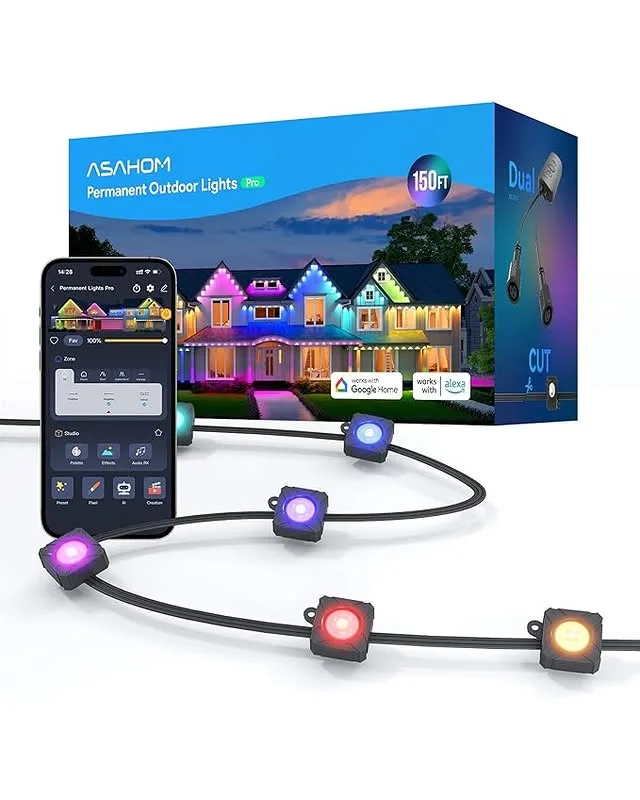
When something does fail, Asahom sells replaceable individual modules — the only brand here that treats a dead section as a spare-part swap instead of a strand problem. The catch is brand size: a smaller company means a smaller support footprint than Govee, and the app is a step behind. For a big or complicated roofline, it’s the engineering pick.
5. Twinkly Permanent Lights: Best Effects, Mapped to Your Actual House
Twinkly’s party trick is genuinely different: its app photographs your roofline and maps every LED’s position, so effects sweep across your real house shape instead of a generic line — waterfalls follow gables, waves break at corners. The starter kit is $299.99 for roughly 98 feet, IP65, with adhesive plus screw-plate mounting.

As a lighting system it’s more “show” than “utility”: no cuttability, expansion means linking more Twinkly devices, and Twinkly doesn’t headline a lifespan rating or warranty term the way Govee does. Buy it if the light show is the point — for Halloween and Christmas displays, nothing else here touches it.
6. Budget Kits Under $60: What $36 Actually Buys You
The shopping results for this category are full of kits like the 49ft XEAZON set at $35.99 and 100ft no-name kits around $39.99 at Walmart. Honest framing: these are a legitimate way to test whether you like the look before committing $280 — and some carry surprisingly decent early reviews. What you give up is everything that makes lights “permanent”: generic apps, no published multi-year warranty, dimmer output, and mounts you’ll be redoing. Treat them as a one-or-two-season rental you own, not an install-and-forget system.
How Many Feet of Permanent Lights Do I Need?
A two-story front roofline needs 100–150 feet of lights. Measure every eave — the owners who regret their install mis-measured, not mis-mounted. Kits come in 100-foot boxes (the Govee Elite runs in segments up to 150 feet, the Govee Pro up to 200 feet), so buy the next size up if your roofline has dormers, returns, or corners.
DIY Kit vs Pro Install: The Real Cost Math
This is the comparison the installer sites hope you never do carefully:
|
Route |
100ft roofline |
150ft roofline |
What you get |
|---|---|---|---|
|
DIY kit (this guide) |
$140–$400 |
$210–$600 |
A day of your labor; exposed wire + pucks by day |
|
Kit + hired install help |
+~$249 (going rate for up to 100ft) |
+$300–400 |
Someone else’s ladder day |
|
Pro system (JellyFish/Gemstone/Trimlight class) |
$1,800–$3,500 |
$2,700–$5,250 |
Color-matched aluminum track, near-invisible by day, pro warranty (5-yr parts to lifetime product; labor usually 1 yr) |
Pro quotes typically include the track, lights, controller and labor — and typically exclude a new electrical circuit if you lack an exterior outlet, fascia repairs, and second controllers on long homes. The typical pro-installed home lands at $3,000–$6,000 all-in. What the 10× price actually buys is the daytime invisibility and the warranty, not a better light show — at night, a well-installed $280 Govee and a $4,600 pro system are closer than any installer will admit. For the full cost breakdown by home size, see our permanent Christmas lights cost guide.
What Are the Downsides of Permanent Lights?
The question every brand site dodges — and one of the most-searched questions in this category. Here it is straight:
- The adhesive fails. This is the #1 owner complaint across brands — verified reviews describe a third of a strand on the ground within days or weeks when owners trusted the sticky pads, especially installed in cold weather. Every kit here should be screwed, not stuck. Owners standardly swap the tiny included screws for 3/8″ sheet-metal screws that a cordless driver can actually grip on a ladder.
- They’re visible by day. DIY kits leave exposed wire and pucks under your eaves. Pro track systems exist precisely because of this — the track reads as a shadow line. If your HOA regulates daytime appearance (many do), a track system or HOA approval before installing is the safe route.
- Your lights run on someone else’s cloud. Every app-controlled kit depends on the maker’s servers and app support. If a brand is sold or sunsets its app, you own expensive trim. This is the WLED crowd’s core argument — Asahom and eufy (via WLED) hedge it best.
- Failures mean a ladder. One loose connector can darken everything downstream of it. A dead section mid-roofline is a climb, a cut-and-splice (cuttable kits) or a segment swap — plastic clips also yellow and go brittle after a year or two of UV.
- Style lock-in. A color-cycling roofline is a look. Most owners end up running warm white 90% of the year — buy for the white quality first, the party modes second.
None of these are deal-breakers. All of them are cheaper to know before the install than after.
Can You Install Permanent Christmas Lights Yourself?
Yes — for a one-story home with accessible eaves, a 100ft kit is a one-day job the average DIYer can finish, and our step-by-step installation guide walks the whole thing. Decide honestly on three things first:
- Height: two-story peaks and steep roofs are where DIY installs stall. If the ladder work worries you, that’s the answer — hire the install (about $249 and up for a kit install) or go pro.
- Power: you need an outlet plan before you start — where the controller lives, how the adapter stays dry (remember the Govee Pro’s indoor-rated adapter), and how you’ll cross corners.
- Planning, not hanging, is the job. Measuring the roofline, ordering the right footage, and mapping corners takes longer than mounting. The owners who regret their install almost always mis-measured, not mis-mounted.
How Long Do Permanent Christmas Lights Last?
The LED ratings say 50,000 hours (Govee) to 55,000 hours (eufy) — at 6 hours a night, that’s over 22 years of light. The chips are not what dies first. Realistically: power supplies age, clips yellow, connectors corrode at corners, and app support has its own lifespan. Expect a quality DIY kit to give you 5–10 good years with possibly one power-supply or section fix along the way; pro track systems are built and warranted for longer, which is most of what their price buys. The published warranties tell the honest floor: 3 years on the Govee and Asahom kits, 5-year parts to lifetime product coverage (labor usually just 1 year) on pro systems.
PRO TIP
Whatever kit you buy, do the install in this order: mount with screws from day one, run the strand at dusk before final tightening to check the spacing look from the street, and photograph your connector layout with your phone as you go. Six months later, when one section is dark, that photo is the difference between a 10-minute fix and a full re-inspection on a ladder.
Frequently Asked Questions
How much do permanent Christmas lights cost?
DIY kits run $36–$400 per 100 feet (about $1.40–$4.00 per foot on sale), and a typical two-story front roofline needs 100–150 feet. Pro-installed track systems cost $18–$35 per linear foot — $3,000–$6,000 for a typical home, all-in.
Can permanent Christmas lights be cut to fit?
Some can. The Govee Pro and Asahom Pro are designed to be cut and spliced with waterproof connectors. The Govee Elite/Lights 2 and eufy E22 cannot be cut — you manage excess by tucking, doubling back, or (on the eufy) switching extra lights off in the app. Check before you buy; this is the spec that most often surprises people.
What are the downsides of permanent lights?
Adhesive mounts that fail if you don’t screw them, visible wiring by day (an HOA issue in some neighborhoods), dependence on the maker’s app and cloud, and repairs that require ladder work. The full honest list is in the downsides section above — no brand site publishes it.
Do permanent Christmas lights increase home value?
Not measurably, the way a kitchen does. What they do is remove a recurring cost and chore — professional holiday hanging runs hundreds per year — and they add nightly curb appeal as year-round accent lighting. Buy them for your own use and the math works; buy them as an investment and it doesn’t. Our worth-it analysis runs the break-even numbers.
Which permanent Christmas lights work with Alexa and Google?
All six kits here work with Alexa and Google Assistant through their apps. Only the Govee Elite and Pro currently add Matter, which is the standard that future-proofs them inside larger smart-home setups. Asahom additionally integrates WLED for local, cloud-free control.
Where is the best place to buy permanent Christmas lights?
The same kits cycle through Govee’s and eufy’s own stores, Amazon, Home Depot, Lowe’s, Walmart, Target and Costco — and the price gap between them is routinely $90–$160 on the exact same box (the eufy E22 has listed at $299.99 and sold at $139.99 within the same season). Check at least two retailers before buying, and expect the deepest cuts around Black Friday.
The Bottom Line
For most homes: buy the Govee Elite when it dips toward $180–$230, the eufy E22 when it’s at $149.99, and step up to the Govee Pro or Asahom Pro if your roofline needs cutting. Choose Twinkly if the show matters more than the utility. Whichever box lands on your porch, screw the mounts, plan the power first, and measure twice — then read our installation guide before the ladder comes out, and keep the cost guide handy if a pro quote lands in your inbox and you want to know whether it’s fair.