How to Thaw a Turkey Fast (Safely, Even on Thanksgiving Eve)
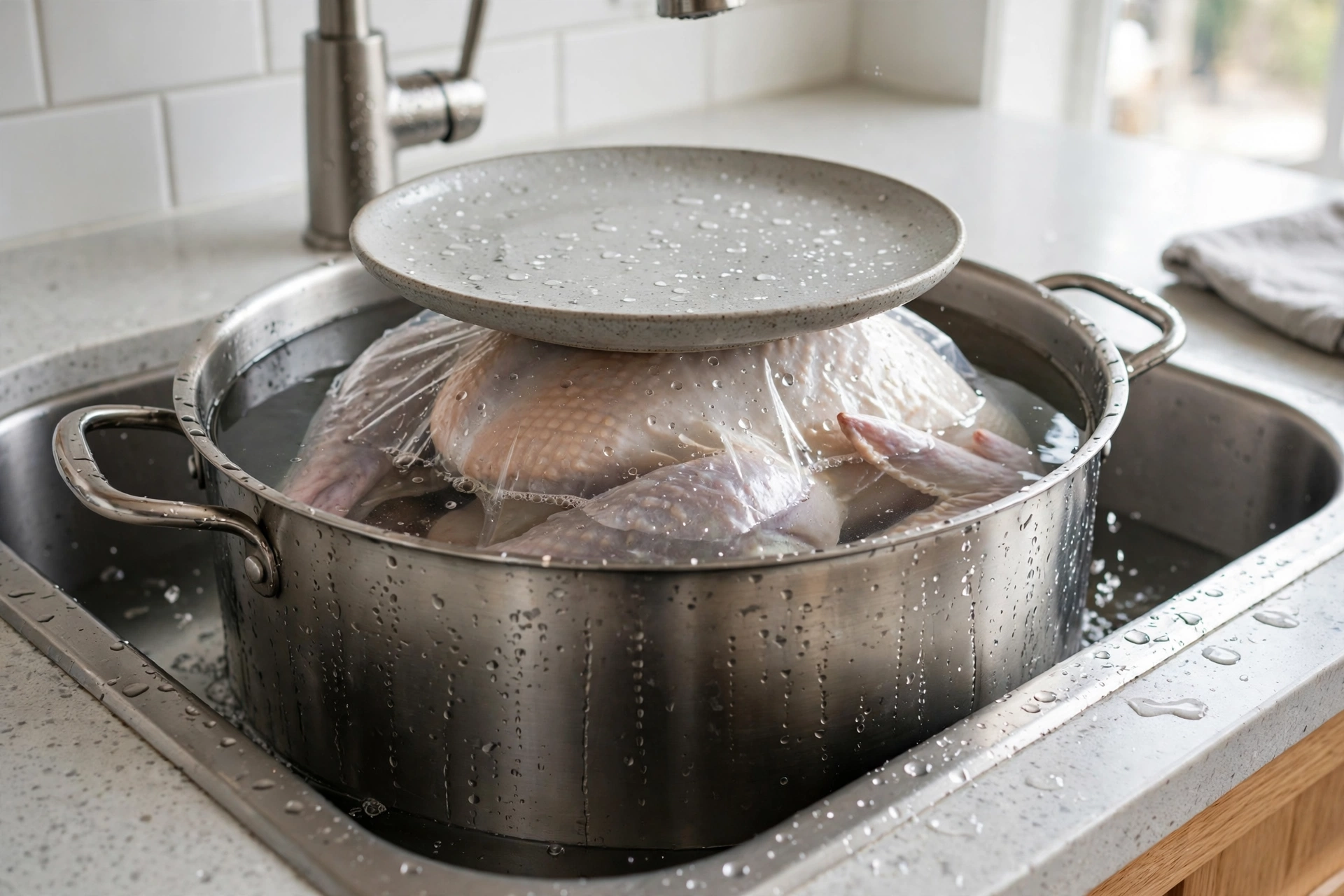
How to thaw a turkey fast is simple once you know the one method food-safety experts actually approve: the cold-water method. Submerge the wrapped turkey breast-side down in cold tap water, change the water every 30 minutes, and allow 30 minutes per pound — so a 12-pound turkey takes about 6 hours and a 20-pound turkey takes about 10 hours. Cook it immediately after thawing, and never refreeze it.
It is Thanksgiving eve, the turkey is still rock solid in the freezer, and dinner is tomorrow. That is the exact moment most cooks discover that the fridge method — the slow, safe one — needed three to five days they no longer have. The good news is that you are not stuck. The cold-water method is the USDA-approved fast way to thaw a turkey, and it works on the same day, even on Thanksgiving morning if you start early enough. The bad news is that the shortcuts people reach for instead — hot water, the countertop, leaving it in the sink overnight — are the ones that make people sick.
This guide covers how to thaw a turkey fast the safe way: the exact cold-water steps, a timing chart for every turkey size from 4 to 24 pounds, how the fridge method compares, the mistakes that send a turkey into the danger zone, how to tell when it is fully thawed, and what to do if it is still partly frozen when the oven needs to go on. While the turkey thaws, you can work through the rest of the house — our Thanksgiving cleaning checklist is built for exactly this kind of last-minute evening.
TL;DR — How to Thaw a Turkey Fast in Short
Use the cold-water method: it is the only USDA-approved fast method. Allow 30 minutes per pound.
Keep the turkey in its wrapper and submerge it breast-side down in cold tap water in a large pot or clean sink.
Change the water every 30 minutes so it stays cold — under 40°F at all times.
Weigh it down with a heavy plate or pot if it floats, so every part stays underwater.
Cook it immediately once thawed. Never refreeze a cold-water-thawed turkey.
Never use hot water, never thaw on the counter, never leave it in the sink overnight.
If it is still frozen at cooking time, roast it from frozen — it takes about 50% longer, and do not stuff it.
That is how to thaw a turkey fast in short — the sections below walk through each step in full.
How to Thaw a Turkey Fast With Cold Water
How to thaw a turkey fast with cold water comes down to three rules: keep the turkey sealed in its wrapper, keep it fully underwater, and keep the water cold. Submerge the wrapped bird breast-side down in a large pot or a clean sink filled with cold tap water, change the water every 30 minutes, and give it 30 minutes per pound. A 12-pound turkey needs about 6 hours, a 15-pound turkey about 7 and a half hours, and a 20-pound turkey about 10 hours — so start the morning of Thanksgiving eve at the latest for a big bird.
Step 1: Check the wrapper and find a container
Leave the turkey in its original sealed wrapper. If the wrapper is torn or leaking, put the whole bird inside a clean, leak-proof plastic bag and squeeze the air out before sealing it — water getting into the meat makes it soggy and spreads bacteria around the sink. Pick a container big enough to hold the turkey fully underwater: a large stock pot, a brining bucket, a clean cooler, or the kitchen sink itself. The sink works fine as long as it is scrubbed clean first and nothing else goes in it while the turkey is thawing.
Step 2: Submerge it breast-side down
Set the turkey in the container breast-side down and fill it with cold tap water until the bird is completely covered. Breast-side down matters because the thickest part of the bird — the breast — sits in the coldest water at the bottom, and the hollow cavity fills with water, which thaws the inside at the same time as the outside. If the turkey floats, weigh it down with a heavy plate, a pot, or a clean brick wrapped in foil. Any part sticking out of the water thaws in warm air instead of cold water, and that is where bacteria grow.
Step 3: Change the water every 30 minutes
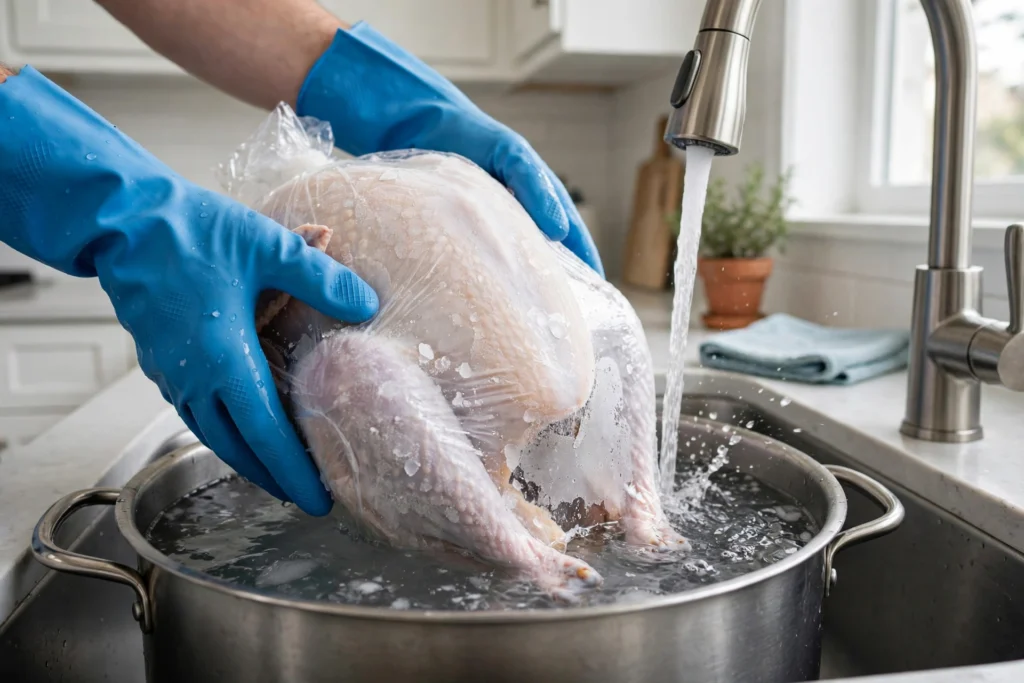
Set a timer and dump the water every 30 minutes, then refill with fresh cold tap water. This is the step people skip, and it is the step that keeps the method safe. Still water warms up as it pulls heat out of the frozen turkey, and once the water climbs above 40°F, the outside of the bird sits in the danger zone — the 40°F to 140°F range where bacteria double roughly every 20 minutes. Fresh cold water every half hour keeps the whole bird under 40°F the entire time. If you cannot commit to changing the water on schedule, use the fridge method instead, even if it is slower.
Set a 30-Minute Timer and Keep It Running
The water change is the whole safety system of the cold-water method. Put a repeating 30-minute timer on your phone the moment the turkey goes in, and treat each refill like a non-negotiable appointment. Three or four forgotten refills are enough to let the water warm past 40°F — and at that point you cannot tell by looking whether the outside of the bird is still safe.
Step 4: Check for thawing as the hours pass
After about half the expected time, check the bird. Press the breast and the thickest part of the thigh — they should start to give instead of feeling rock hard. Flex the legs and wings gently; when they move freely, the joints have thawed. Reach into the cavity and feel for ice crystals, and pull out the giblet bag and the neck as soon as they loosen — they often stay frozen in the middle long after the outside feels done, and leaving them in blocks water from circulating inside the cavity.
Step 5: Cook it immediately
The moment the turkey is thawed, it goes into the oven or into the fridge for at most a few hours — it does not sit on the counter while you finish other prep. The USDA rule is firm on this: a turkey thawed in cold water must be cooked right away, because the outside has spent hours near the top of the safe range even with perfect water changes. Do not refreeze it. If your plans change and you cannot cook it, you can cook it first and then freeze the cooked meat — but the raw bird never goes back in the freezer after a cold-water thaw.
How Long Does It Take to Thaw a Turkey? Timing Chart
The cold-water method runs at 30 minutes per pound, and the fridge method runs at about 24 hours for every 4 to 5 pounds. Work out your bird’s weight from the label, find it in the chart, and count backwards from dinner time — then add an hour of margin, because a turkey that is still icy in the middle at roasting time is a problem you do not want at 10 a.m. on Thanksgiving Day.
| Turkey weight | Cold-water method (30 min/lb) | Fridge method (24 hrs per 4–5 lb) |
|---|---|---|
| 4 lb (breast only) | 2 hours | 1 day |
| 8 lb | 4 hours | 2 days |
| 10 lb | 5 hours | 2–3 days |
| 12 lb | 6 hours | 3 days |
| 14 lb | 7 hours | 3–4 days |
| 15 lb | 7.5 hours | 3–4 days |
| 16 lb | 8 hours | 4 days |
| 18 lb | 9 hours | 4–5 days |
| 20 lb | 10 hours | 5 days |
| 24 lb | 12 hours | 6 days |
Two things worth noting from this chart. First, the fridge method needs days, not hours — a 20-pound turkey started on Thanksgiving eve in the fridge will not be ready for Thanksgiving dinner, which is why the cold-water method exists. Second, the cold-water times assume you change the water every 30 minutes without fail; if the water sits and warms, thawing slows down and safety drops at the same time, so the clock is only honest when the water stays cold.
Can You Thaw a Turkey in the Fridge Overnight?
You can thaw a turkey in the fridge, and it is the safest method there is — but overnight is only enough for a small bird. The fridge method needs about 24 hours for every 4 to 5 pounds, so a turkey under 5 pounds can thaw overnight, a 12-pound turkey needs about 3 days, and a 20-pound turkey needs about 5 days. If your turkey is already in the fridge and still frozen solid on Thanksgiving eve, the fridge has done its job as far as it can — switch to cold water in the morning and finish the job there.
The fridge method has two real advantages. The turkey stays under 40°F the whole time, so there is no danger-zone worry at all, and a fridge-thawed turkey can wait in the fridge for another day or two before cooking — unlike a cold-water turkey, which must be cooked immediately. It can even be refrozen if plans change, which a cold-water turkey cannot. The price of those advantages is time, and time is exactly what Thanksgiving eve does not have.
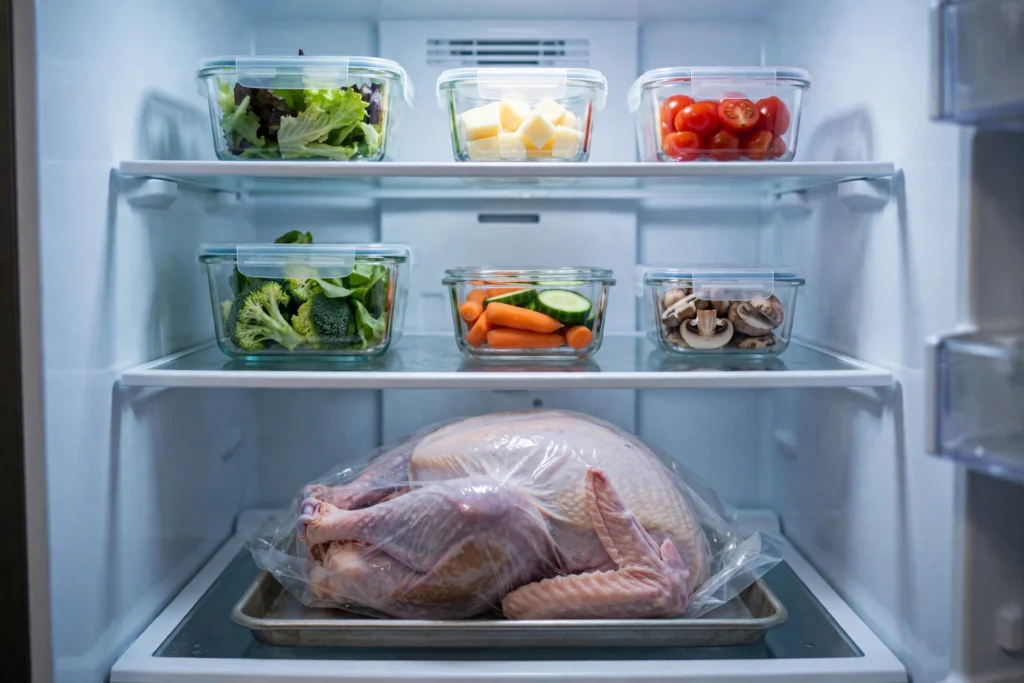
If you do use the fridge method, put the turkey on a rimmed tray or in a roasting pan on the bottom shelf, still in its wrapper. Raw turkey drips, and one tray of drippings over the salad and the cranberry sauce is a food-safety disaster that no amount of careful cooking can undo. Keep it on the lowest shelf, away from ready-to-eat food, and wipe up any drips immediately with hot soapy water.
What Should You Never Do When Thawing a Turkey?
Three thawing shortcuts are dangerous enough that the USDA warns against them by name: hot water, the countertop, and leaving the bird in the sink overnight. All three put the outside of the turkey in the danger zone — 40°F to 140°F — for hours while the inside is still frozen, which is the perfect setup for salmonella and campylobacter to multiply to levels that even a fully cooked bird cannot always fix, because some of the toxins they leave behind survive heat.
Hot water feels like the obvious fast fix, and it is the worst one. Hot tap water warms the outside of the bird into the danger zone within minutes while the center stays frozen solid, so you get the worst of both worlds: a surface crawling with bacteria and a middle that still needs hours. It also starts to cook the outer layer of meat, which turns rubbery and grey before the turkey ever reaches the oven.
The countertop is just as bad, only slower. A turkey left out on the counter thaws from the outside in, and the outside spends hours between 40°F and 140°F while the inside catches up. Room-temperature air is a far worse thawing medium than cold water, because air transfers heat slowly and unevenly — the breast can sit warm for hours before the legs even start to soften.
Leaving it in the sink overnight combines both mistakes: still water that warms to room temperature, a bird sitting in it for eight hours, and nobody changing the water. If you wake up to a turkey that has been sitting in lukewarm water all night, do not try to save it — that bird is not safe to cook, and the cost of a replacement turkey is far less than the cost of a Thanksgiving spent with food poisoning.
When in Doubt, Throw It Out
A turkey that spent the night on the counter or in warm, still water cannot be made safe by cooking it longer or hotter. Bacteria are only half the problem — the toxins some of them leave behind survive normal cooking temperatures. If you are unsure how long the bird sat warm, the safe answer is the bin, not the oven.
How Do You Know the Turkey Is Fully Thawed?
A turkey is fully thawed when it bends — or rather, when it stops resisting you. The legs should move freely at the joints, and the wings should flex without force. Press the thickest part of the breast and the inner thigh: both should feel soft and give under your fingers, not hard or icy. The cavity should be open enough to reach inside and pull out the giblet bag and neck without prying. If any part still feels like a block of ice, the bird is not ready, and the only honest fix is more time in cold water.
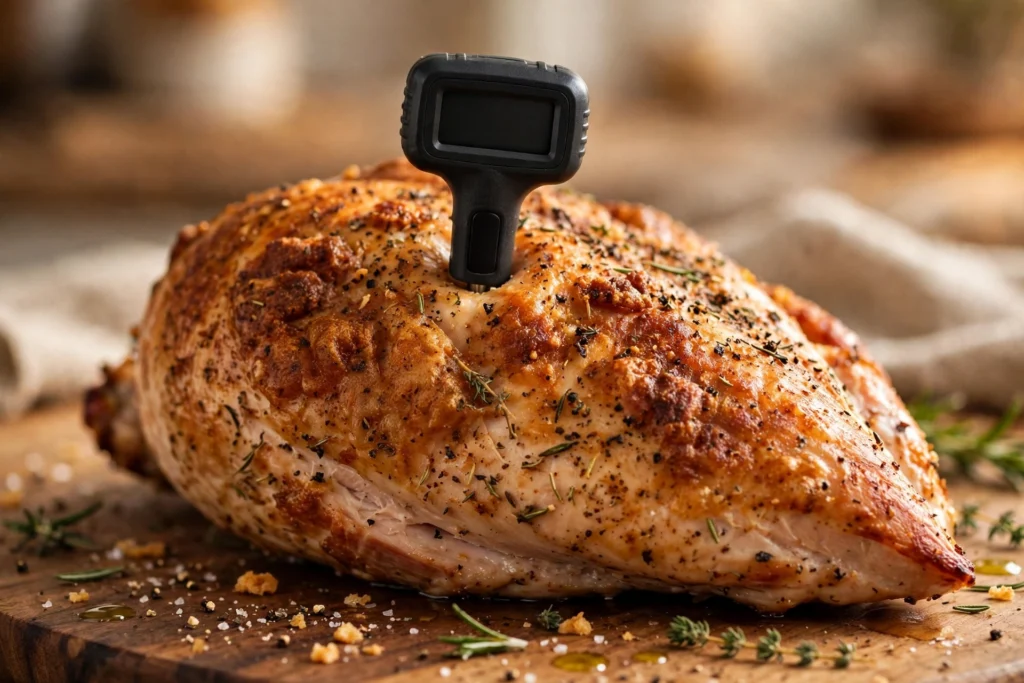
The thermometer is the final judge, and it is worth using even when the turkey feels thawed. A probe thermometer pushed into the thickest part of the thigh — without touching bone — should read above 32°F and, more importantly, the same temperature all the way through. A reading near 40°F in the breast while the thigh still reads 28°F means the outside is thawed and the inside is not, and that bird will cook unevenly. Trust the thermometer over your hands; hands are fooled by a soft breast and a frozen core.
There is one more check that costs nothing: smell. A thawed turkey smells like raw poultry — mild, almost nothing. A sour or off smell, or slimy skin, is a sign the bird spent too long warm, and no amount of cooking will make it right. That turkey goes in the bin, and the backup plan is the rotisserie chicken from the grocery store, which has saved more Thanksgivings than anyone admits.
What If the Turkey Is Still Frozen When Guests Arrive?
First, do not panic — a partially frozen turkey is not a ruined Thanksgiving, it is a delayed one. The USDA’s own advice is simple: roast it anyway. A turkey that is still partly frozen can go straight into the oven; it just needs about 50% more cooking time than a fully thawed bird of the same size, so a 12-pound turkey that normally roasts in 3 hours will need about 4.5 hours. Start it at 325°F, and do not stuff it — a stuffed, partly frozen bird is the one combination where the stuffing can stay in the danger zone while the meat cooks around it.
Second, adjust the meal, not the bird. Carve the schedule around the turkey instead of the other way round: serve the appetisers and the soup course first, let the side dishes take the spotlight, and keep the turkey resting — it needs at least 20 to 30 minutes of rest anyway, and a rested turkey carves better than a rushed one. Guests remember a relaxed host and a juicy bird; nobody remembers that dinner was forty minutes late.
Third, if the bird is still frozen solid and the oven is already full, the cold-water method can still buy you time in parallel: a 12-pound turkey needs about 6 hours in cold water, so a bird that went in at 8 in the morning can be in the oven by 2 in the afternoon. Keep changing the water every 30 minutes even while you are cooking the sides, and the bird will be ready for a late dinner rather than no dinner at all.
Is It Safe to Refreeze a Thawed Turkey?
It depends on how it was thawed. A turkey thawed in the fridge can be refrozen safely, because it never left the safe temperature range — the USDA allows it, though the meat will lose some moisture and texture on the second thaw. A turkey thawed in cold water must never be refrozen raw: its outside spent hours near the top of the safe range, and freezing it again just pauses the bacteria rather than killing them. The only safe path for a cold-water turkey you cannot cook is to cook it first, then freeze the cooked meat in portions.
The same rule covers leftovers, and Thanksgiving produces plenty of them. Cooked turkey should go into the fridge within two hours of serving, in shallow containers so it cools fast, and it keeps for three to four days. After that, freeze it or throw it out — and if you are planning the rest of the meal around those leftovers, our Thanksgiving side dishes and Thanksgiving desserts guides cover the dishes that reheat best the next day.
Frequently Asked Questions About Thawing a Turkey Fast
How long does it take to thaw a turkey in cold water?
Allow 30 minutes per pound: a 12-pound turkey takes about 6 hours and a 20-pound turkey takes about 10 hours. Change the water every 30 minutes and keep it under 40°F, and cook the turkey immediately once it is thawed.
Can I thaw a turkey in hot water to make it faster?
No. Hot water warms the outside of the turkey into the danger zone (40°F to 140°F) while the center stays frozen, which lets bacteria multiply to unsafe levels. Cold water is the only USDA-approved fast method.
Can I leave a turkey thawing in the sink overnight?
No. Water left standing overnight warms to room temperature, and the turkey sits in the danger zone for hours. If a turkey spent the night in warm, still water, it is not safe to cook — throw it out and buy a replacement.
How do I thaw a turkey fast in the fridge?
You cannot rush the fridge method — it needs about 24 hours for every 4 to 5 pounds, so a 12-pound turkey needs about 3 days. If you are short on time, switch to the cold-water method instead.
Can I cook a turkey from frozen?
Yes. Roast it at 325°F and allow about 50% more time than a thawed bird of the same size. Do not stuff it — cook the stuffing separately. Check that the breast, thigh and joint all reach 165°F before serving.
How do I know my turkey is fully thawed?
Press the breast and thigh — they should give with no hard frozen core. The legs and wings should flex freely, the cavity should have no ice crystals, and the giblet bag should slide out easily. A thermometer in the thigh should read above 32°F.
Final Thought
A frozen turkey on Thanksgiving eve feels like a disaster, but it is one of the most fixable problems in the kitchen. The cold-water method is fast, it is approved by the USDA, and it works on the same day — 30 minutes per pound, fresh cold water every 30 minutes, cook it right away. Start it tonight, set your timer, and by tomorrow morning the bird will be ready for the oven. And if you are still planning the rest of the meal, our Thanksgiving breakfast ideas will keep everyone fed while the turkey roasts.