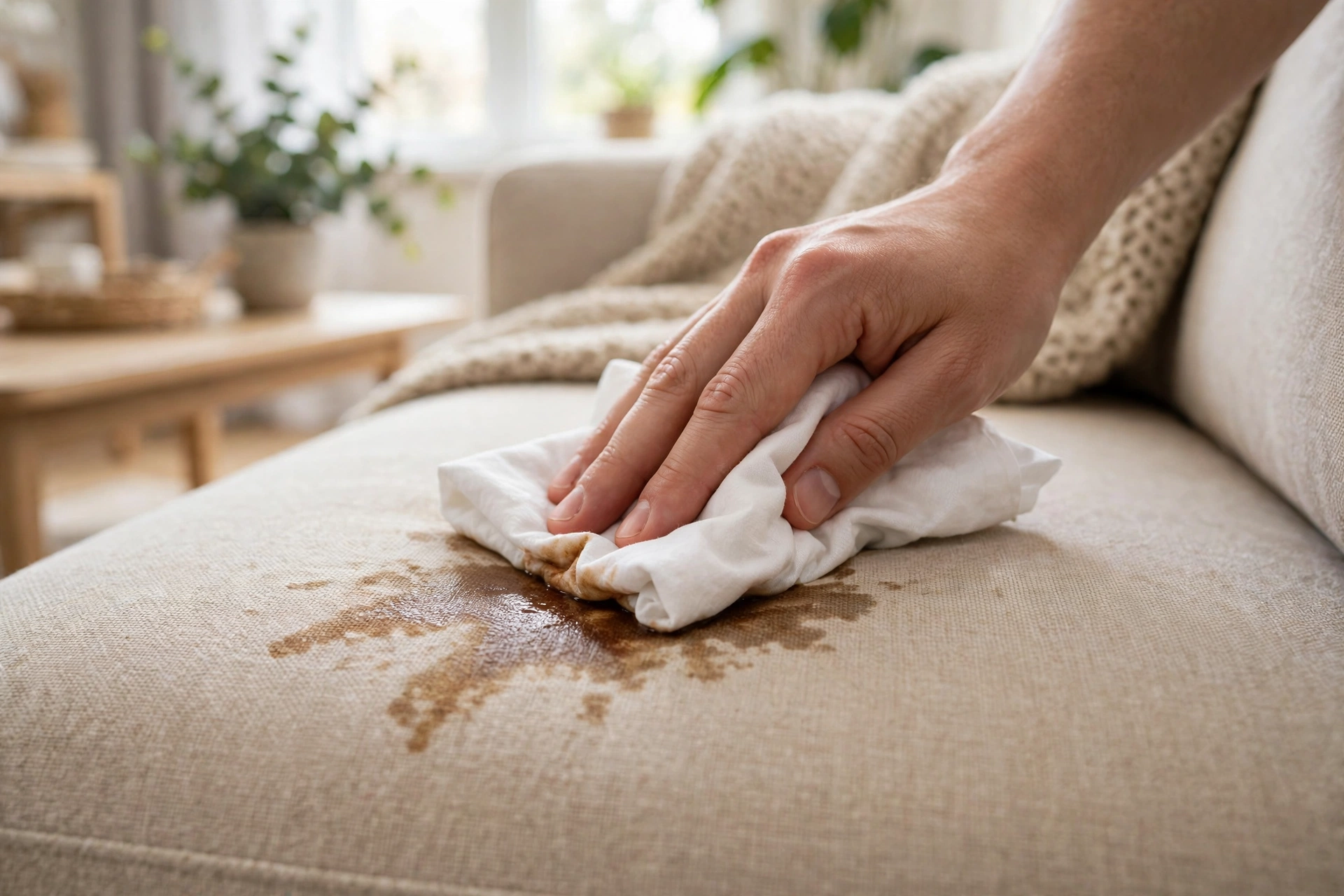
How to Remove Coffee Stain From Couch (Without Water Rings)
To remove a coffee stain from a couch, blot the spill with a clean white cloth, check the cleaning code tag under a cushion, then work a mild dish-soap solution into the stain from the outside in and blot until it lifts. The steps below cover how to remove coffee stain from couch fabric — fresh, dried, or milky.
A spilled mug feels like a disaster, and the worst damage happens in the first ten seconds — not from the coffee, but from panicked scrubbing. Coffee is a forgiving stain: mostly water, a little oil, and brown tannin. What turns a small spill into a permanent mark is one of three mistakes: rubbing instead of blotting, the wrong cleaner, or soaking one spot so it dries into a ring. Learning how to remove coffee stain from couch fabric the right way makes the next spill a five-minute job. This guide covers fresh, dried, and milky spills — the full method for how to remove coffee stain from couch fabric.
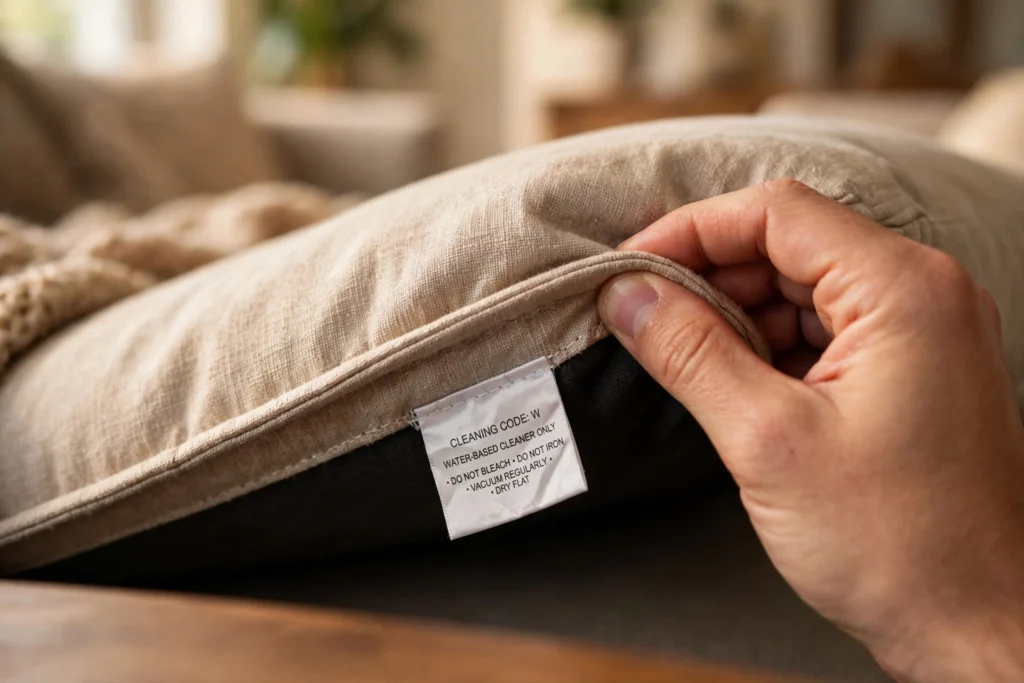
That is why this guide starts with the tag, not the stain. Every upholstered couch carries a cleaning code — W, S, WS, or X — on a tag under a seat cushion or along the deck. That letter decides whether water helps or harms, and whether dish soap will fix it. If it landed on the floor, the carpet version of this guide covers the same stain on carpet. For the couch, here is how to remove coffee stain from couch fabric without a ring.
TL;DR — How to Remove Coffee Stain From Couch in 6 Steps
Short version of how to remove coffee stain from couch fabric:
1. Blot, don’t rub. Press a clean white cloth down, lift, repeat on a clean section.
2. Read the tag. Find the cleaning code under a seat cushion: W, S, WS, or X.
3. Mix the solution. For W and WS fabrics: 1 cup cool distilled water, 2–3 drops clear dish soap.
4. Work outside in. Dab from the outer edge toward the centre.
5. Blot, rinse, repeat. Damp cloth, then dry, until the brown is gone.
6. Dry the whole panel. Clean seam to seam; dry with a fan.
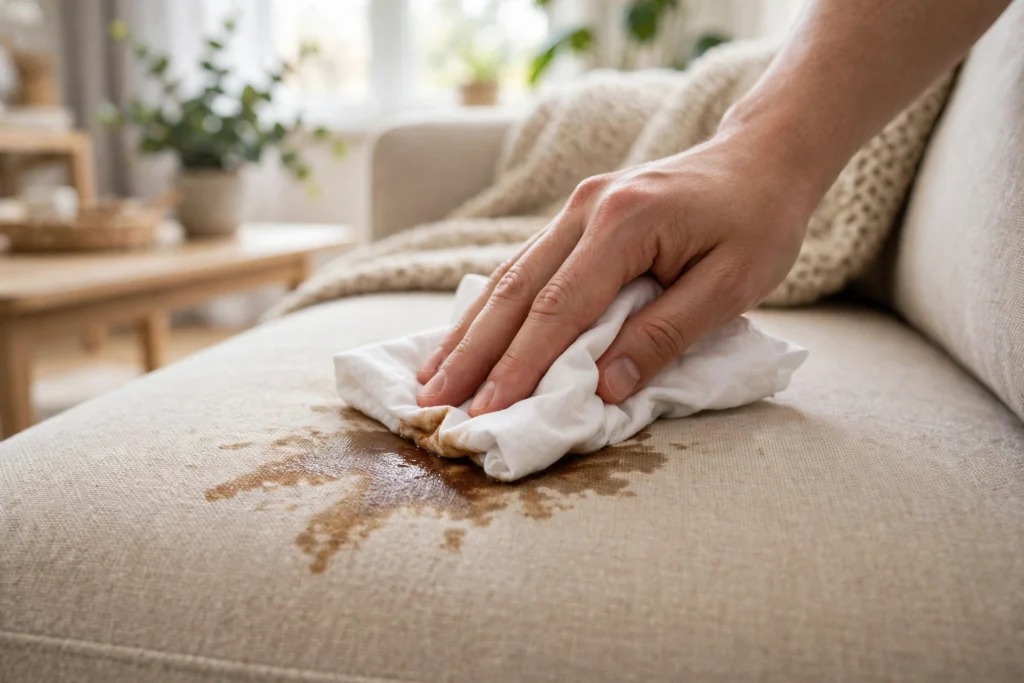
How to Remove Coffee Stain From Couch: Start With the Cleaning Code
The safest way to learn how to remove coffee stain from couch fabric is to read the cleaning code tag first, then match the cleaner to the code: W means water-based cleaners, S means solvent only, WS means either, and X means vacuum only. Skipping this step is how a small coffee spot turns into a permanent water ring.
That is the whole system — and the rest of how to remove coffee stain from couch fabric is just applying it.
The tag is easy to miss because manufacturers hide it. Lift a seat cushion and look underneath it, or check the fabric flap sewn along the deck — the flat upholstered platform the cushions sit on. It is usually white, about the size of a business card, and printed with care instructions plus one capital letter. That letter is the code.
If you cannot find a tag, treat the fabric as S, solvent only. Water on the wrong fabric can leave a pale ring, because the ring is the fabric’s finish, disturbed by moisture. Guessing W costs a visible mark; guessing S costs a second attempt.
What Do the Couch Cleaning Codes W, S, WS, and X Mean?
Couch cleaning codes tell you which cleaners are safe for the fabric. W allows water-based cleaners like diluted dish soap, S allows dry-cleaning solvents only and no water, WS allows both, and X allows vacuuming only — no liquid cleaner at all. The code is printed on the tag sewn under a cushion or along the deck.
| Code | What it means | What to use | What ruins it |
|---|---|---|---|
| W | Water-based cleaners only | Diluted dish soap, upholstery shampoo | Solvent cleaners, dry-cleaning fluid |
| S | Solvent cleaners only — no water | Dry-cleaning solvent or rubbing alcohol | Any water, steam, water-based shampoo |
| WS | Water or solvent cleaners | Dish-soap solution or a solvent cleaner | Bleach, harsh all-purpose cleaners |
| X | Vacuum only — no liquid cleaner | Vacuum only; baking soda for odour | Water, solvents, shampoo, steam |
Two details the table cannot show. First, the code describes the fabric, not the couch: one couch can have WS cushions and an S-coded back panel, so check the tag on the piece you clean. Second, X-coded fabric — usually silk or velvet — means a coffee stain is a professional’s job. Knowing when the tag says not to try is part of how to remove coffee stain from couch fabric.
How Do I Remove a Fresh Coffee Spill From My Couch?
Blot a fresh spill immediately with a clean white cloth, pressing down and rotating to a clean section each time, until no more coffee transfers. Then dab — never rub — a solution of one cup of cool distilled water and a few drops of clear dish soap over the spot, working from the outside edge inward, and blot dry.
That is the whole method in miniature — and the rest of this section is how to remove coffee stain from couch fabric step by step.
A fresh spill sits on top of the fibres, and most of it will come away on a cloth. Grab two or three clean white cloths — white matters, because a coloured towel can transfer dye — fold one into a pad and press it straight down. Lift, refold, and press again until the cloth comes away almost clean. This blotting-first habit is the foundation of how to remove coffee stain from couch fabric.
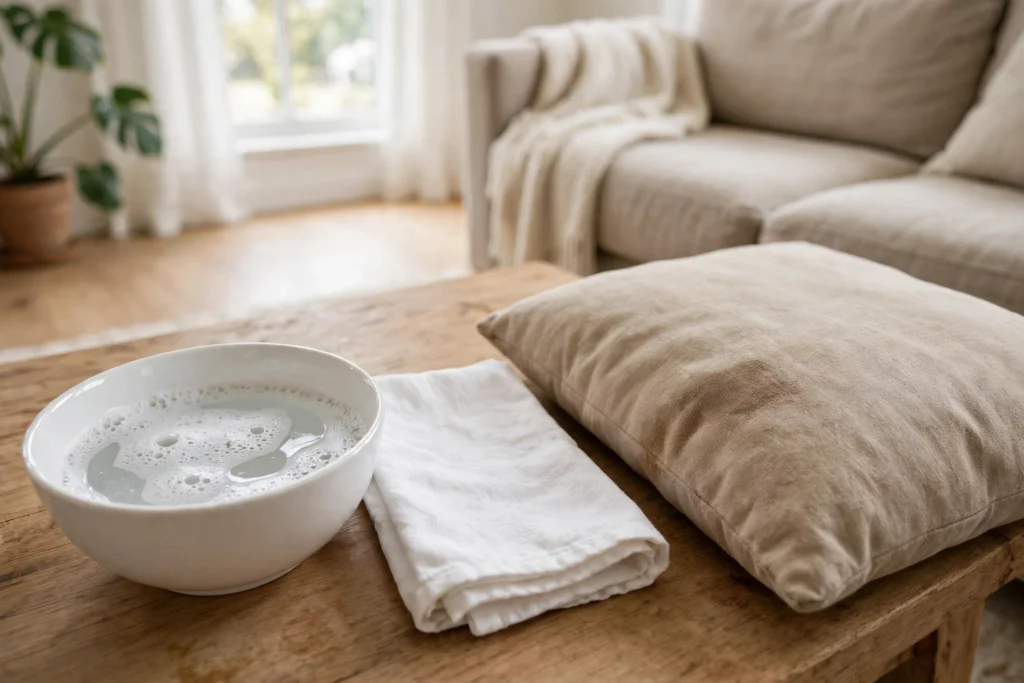
Next, mix the gentlest cleaner that works: for a W or WS couch, one cup of cool distilled water and two or three drops of clear dish soap — plain and clear, not coloured or antibacterial. Use distilled water, not tap water: tap-water minerals are half of what a water ring is made of. A gallon costs roughly $1–$2 — planning estimates, not quotes. Dip a fresh white cloth in, wring it barely damp, and dab from the outside edge toward the centre — working inward contains the coffee. Blot dry after each pass; repeat until the brown is gone, usually three to five rounds.
For S-coded couches, the method for how to remove coffee stain from couch fabric is the same shape with a different liquid: blot first, then dab with a solvent cleaner or a little rubbing alcohol on a white cloth. Use as little liquid as possible. For X-coded couches, blot only, then call a professional.
PRO TIP — Keep white cloths ready
Keep plain white cotton cloths for stain work. White cloths show how much coffee is still coming off — and they can never bleed dye into your couch. It is the cheapest preparation in how to remove coffee stain from couch fabric.
How Do I Get a Dried or Set-In Coffee Stain Out of a Couch?
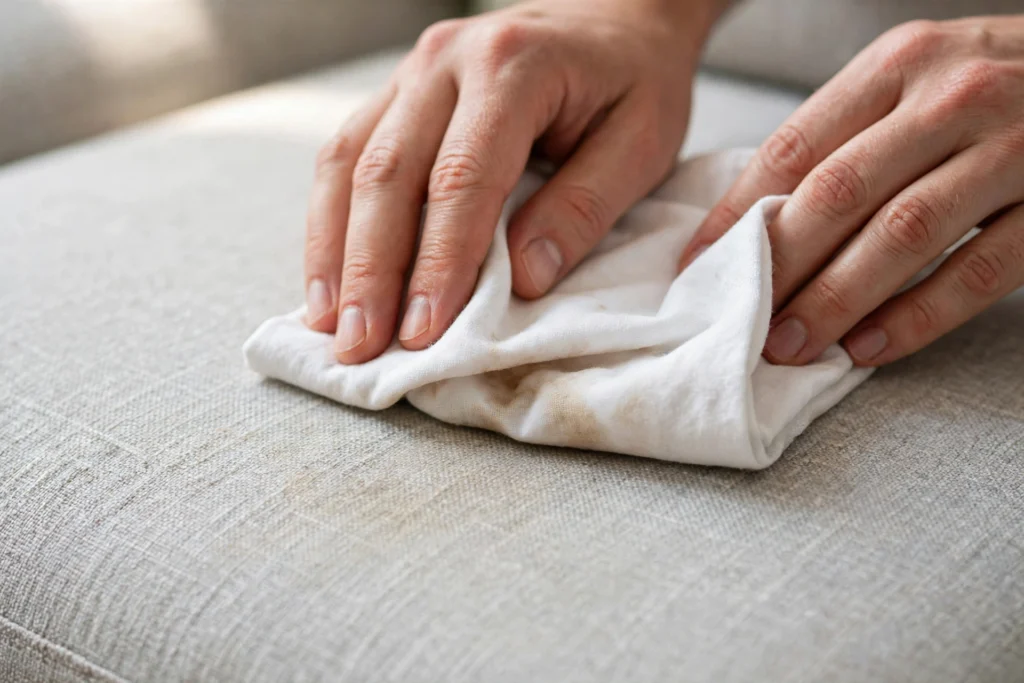
A dried coffee stain needs moisture and patience, not force. Rehydrate the spot with a lightly dampened white cloth for ten minutes, then apply the dish-soap solution in repeated light passes, blotting between each one. Stubborn brown shadows usually fade after three or four rounds, and a shop-bought upholstery spotter finishes what soap leaves behind.
The method below is the patient version of how to remove coffee stain from couch fabric.
A stain noticed the next morning is a different problem: the water has evaporated, leaving brown tannin. Scrubbing a dry stain grinds it into the weave, so the first step in how to remove coffee stain from couch fabric after drying is to put moisture back. Lay a white cloth dampened with cool distilled water over the stain for ten minutes; when you lift it, the mark will look darker and softer.
Now run the same dish-soap method: dab from the outside in, blot dry, and repeat. Expect five to eight rounds and gradual progress. If it has not lightened after three rounds, stop and change something: the cleaner, the code assumption, or the plan.
For a stain that has sat for days, two upgrades help. First, add white vinegar to the rinse cloth — one part vinegar to four parts water — for the final pass; the acid dissolves tannin soap leaves behind. Use vinegar only on W and WS fabrics, never S-coded couches. Second, if the shadow survives three rounds of soap, switch to an upholstery spotter on the cloth, never directly onto the couch.
The fix for how to remove coffee stain from couch cushions that keep reappearing is to clean deeper: the foam is holding coffee. Remove the cover if it unzips, treat the foam with a barely damp cloth, then air-dry it standing on edge with a fan for a full day.
How Do I Remove Coffee With Milk or Cream From a Couch?
Coffee with milk or cream is two stains in one: brown tannin from the coffee and protein from the milk. Treat the protein first with a cool-water rinse and an enzyme cleaner, because hot water cooks milk protein into the fibres and sets it permanently. Once the milky film is gone, the dish-soap method lifts the coffee colour.
The enzyme-first order is what makes how to remove coffee stain from couch fabric work when milk is involved.
This is the spill that catches people out: the method that works on black coffee can make a milky spill worse. Milk and cream are mostly protein and fat, and protein has one hard rule — never use hot water on it. Heat denatures milk protein, and once it sets in the fibres, it bonds there. A milky spill treated with hot water also develops a sour smell far harder to remove than the mark.
The order of operations is everything. First, blot up as much as possible with a dry white cloth. Then rinse with cool distilled water on a barely damp cloth — no soap, no heat — to lift the milk. Blot dry. Now apply an enzyme cleaner, which breaks protein down: dab it onto a white cloth, press it in, and give it the dwell time on the label, usually five to ten minutes.
After the enzyme step, blot with a cool-water cloth, then run the dish-soap method for the remaining brown. On a W or WS couch, this two-stage approach — enzyme first, soap second — is the correct way for how to remove coffee stain from couch fabric with milk or cream. On an S-coded couch, use a solvent cleaner after the enzyme step. If it still smells sour after drying, repeat the enzyme step — damp fabric hides smells.
Should I Remove the Cushion Covers or Clean the Couch in Place?
Remove the covers if they unzip and the tag allows machine washing — it is faster, more thorough, and the only way to clean both sides of the fabric. If the covers are sewn on, or the tag says dry-clean only, clean the couch in place with a damp cloth and a fan for drying, and never soak upholstery.
Covers change the job, but not the principles of how to remove coffee stain from couch fabric.
Unzip a cover and check the care label. If it says machine washable, turn it inside out, wash cold and gentle with a little mild detergent, and air-dry it. Never put a cover in the dryer — heat shrinks cotton, and it will not fit back over the foam. Air-dry it flat, and put it back on while still slightly damp.
If the tag says dry-clean only, believe it. Home washing risks shrinkage, colour loss, and a texture change no cleaning can reverse. Clean it in place, or take the cover to a dry cleaner — far cheaper than reupholstering.
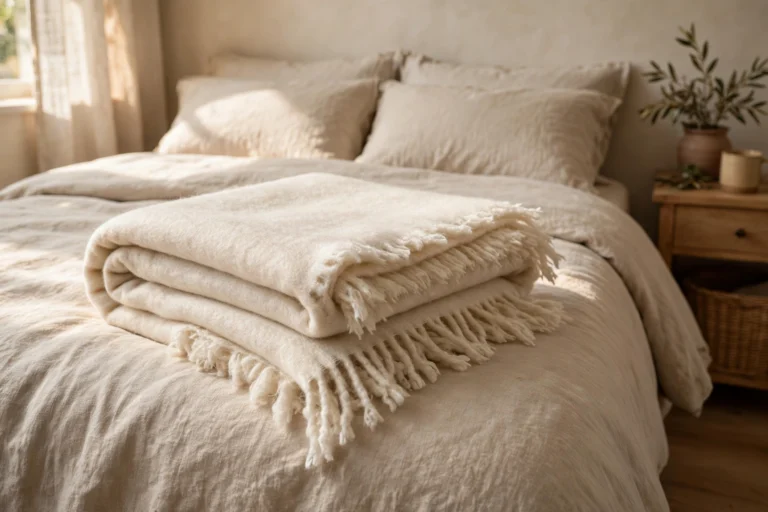
Wool-blend covers deserve a special note: wool felts when agitated in warm water, and felted wool cannot be unfelted. Treat a wool-blend cover the way you would treat a wool blanket: cool water, no agitation, no wringing, and flat drying. Our guide to how to wash a wool blanket covers the same gentle-handling rules, and every one applies to a wool cushion cover too.
Fixed upholstery — sewn-on covers, arms, back, deck — is cleaned in place, and the rule is restraint. Use a barely damp cloth, never a wet one, work in small sections, and dry with a fan: the foam below gives moisture nowhere to go but up. Soaking it grows mildew no surface cleaning can reach. Knowing how to remove coffee stain from couch fabric in place means knowing when to stop adding water.
How Do I Avoid Water Rings When Cleaning a Couch?
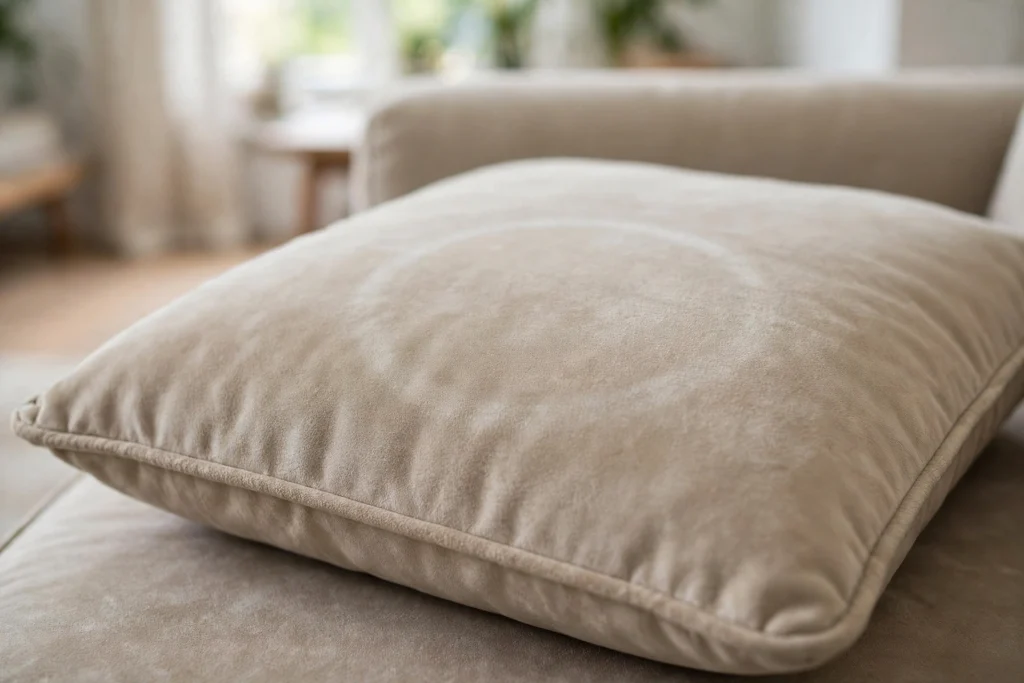
Water rings form when one damp patch dries faster at its edges than in the middle, dragging dissolved dirt outward — the coffee-ring effect. Prevent them by cleaning the whole cushion panel seam to seam, using distilled water instead of tap water, and drying the panel evenly with a fan so no wet edge lingers.
Ring prevention is the part of how to remove coffee stain from couch fabric most people skip — and most regret skipping.
The water ring is the injury cleaning itself causes. Dampen one spot and water wicks sideways, carrying dirt with it. The patch dries from the outside in, and each ring deposits dirt at the drying edge — a pale circle where the patch ended. On microfiber it is worse: the fine fibres wick moisture further and faster.
The fix is not less water. It is to stop having an edge at all: clean the whole cushion panel, seam to seam, instead of only the stained spot. Dampen the whole face lightly and evenly, so the panel dries evenly and dirt has no edge to collect on. It feels wrong the first time, but it is the standard professional technique — and the key habit in how to remove coffee stain from couch fabric on microfiber. A ring already formed can often be fixed the same way: re-wet evenly and fan-dry.
Three more habits make rings nearly impossible. First, distilled water, not tap water. Second, even drying: point a fan at the cushion. Third, blot the final rinse with a dry towel until the fabric feels barely damp.
PRO TIP — The seam-to-seam habit
Make seam-to-seam your default for any wet cleaning on upholstery. Remember one sentence from this guide on how to remove coffee stain from couch fabric: never leave a damp edge on a couch.
What Should I Never Do to a Coffee Stain on a Couch?
Never rub a coffee stain, never pour hot water on a milky spill, and never use bleach, undiluted vinegar, or an all-purpose cleaner on upholstery without checking the code first. Rubbing drives coffee deeper and frays the fabric, heat sets milk protein, and the wrong chemical can bleach the colour or leave a ring worse than the stain itself.
Keep this list beside you the first time you try how to remove coffee stain from couch fabric.
- Rubbing or scrubbing. Rubbing pushes coffee into the foam and frays fibres. Blot. Always blot.
- Hot water on a milky spill. Heat sets milk protein permanently. Cool water only.
- Bleach, including “colour-safe” bleach. Bleach cannot tell a stain from dye — it leaves a pale patch worse than the coffee.
- Undiluted vinegar. Dilute it 1:4 with water, and never use it on S-coded fabric.
- All-purpose cleaners and kitchen sprays. These are made for hard surfaces, not fabric, and leave sticky residues.
- Harsh degreasers and TSP. Trisodium phosphate is a heavy-duty cleaner for walls and pre-paint prep — it has no place on upholstery. Our TSP cleaner guide covers its proper uses; the couch is not one of them.
- Steam cleaners on S or X fabric. Steam is water, delivered hot and under pressure. On S or X fabric it causes rings, shrinkage, and watermarking.
- Coloured towels and printed paper towels. Dye can transfer from a coloured cloth into damp upholstery. White cloths only.
- Leaving the cushion damp. A damp cushion left to dry slowly invites mildew inside the foam. Finish with a dry blot and a fan.
That is the full don’t-list. Memorise it once, and the rest of how to remove coffee stain from couch fabric is just blotting, patience, and the right bottle.
When Should I Call a Professional Upholstery Cleaner?
Call a professional when the tag reads X or S and the stain will not lift, when coffee has soaked into the foam, or when a water ring has already set. A pro’s extraction equipment pulls dirty water out of the cushion instead of pushing it deeper, which is exactly what a home cloth cannot do.
Knowing when to stop is part of knowing how to remove coffee stain from couch fabric well. The home method handles most spills: fresh black coffee on W or WS fabric, milky spills caught early, and dried stains given patience. The cases below are where a professional earns their fee.
- X-coded fabric. Vacuum-only fabric should not meet liquid cleaner — a pro has dry methods no home can match.
- S-coded fabric with a stain that will not lift. Solvent cleaning has a ceiling. Once you have tried it twice, more solvent is not the answer.
- Coffee soaked into the foam. If the stain reappears every time the cushion dries, the foam is holding coffee. A pro’s machine flushes it out.
- A set water ring. A ring that survives two even re-wettings is a finish problem, and needs professional rinsing.
- A valuable, antique, or sentimental piece. If the couch is worth more than the cleaning visit, do not experiment on it.
- Smell that will not leave. A sour milk smell surviving two enzyme treatments means protein deep in the foam.
The middle ground is a portable upholstery machine, working on the same spray-and-extract principle. It is no substitute for reading the tag: a machine still puts water into the fabric, so it belongs on W and WS couches only — and knowing how to remove coffee stain from couch fabric by hand still matters.
How Much Does Professional Coffee Stain Removal Cost?
A professional upholstery cleaning visit for one stained cushion usually costs roughly $75 to $150, while a full couch cleaning runs roughly $150 to $300, depending on size, fabric, and your area. Spot-only callouts are the cheapest option, and most cleaners quote the stain work inside the per-seat price — planning estimates, not quotes.
The table below prices every version of how to remove coffee stain from couch fabric, DIY and professional.
The DIY route is nearly free: distilled water, dish soap, white cloths, and an enzyme cleaner if milk was involved come to roughly $10 to $25 all in. A solvent cleaner for S-coded fabric runs roughly $10 to $20 a bottle, and a portable extraction machine roughly $100 to $180. All figures are rough planning estimates, not quotes.
| Option | Rough cost | Best for |
|---|---|---|
| DIY dish-soap method | $10–$25 in supplies | Fresh spills on W/WS fabric |
| Solvent cleaner (S fabric) | $10–$20 a bottle | S-coded couches |
| Enzyme cleaner (milky spills) | $8–$15 a bottle | Coffee with milk or cream |
| Portable extraction machine | $100–$180 | Frequent spills |
| Pro spot treatment | $75–$150 | One cushion, S/X fabric |
| Pro full-couch cleaning | $150–$300 | Whole couch, deep stains |
All costs above are rough planning estimates, not quotes. Get a written quote before booking, and confirm whether stain treatment is included.
Frequently Asked Questions
The questions below cover the details people ask most about how to remove coffee stain from couch fabric.
Yes, but baking soda is a deodoriser, not a stain remover — it will not lift the brown colour. Its job comes after cleaning: sprinkle it over the damp area, leave it a few hours, and vacuum it off. Never use it as a scrub or leave it on a damp cushion for days. Think of it as the finishing step in how to remove coffee stain from couch fabric.
Undiluted vinegar can damage dyes — never use it on S-coded or X-coded fabric. Diluted vinegar, one part to four parts water, is safe as a rinse step on W and WS fabrics and helps dissolve tannin. Test it first on a hidden spot, such as the underside of a cushion.
Microfiber is usually coded S or WS, so check the tag first — many are solvent-only, and water on them causes rings. The method for how to remove coffee stain from couch microfiber depends on that letter: for WS, use the dish-soap method with even less water and fan-dry; for S, use a solvent cleaner or rubbing alcohol on a white cloth. When dry, brush gently to restore the nap.
No. S means solvent only, and water is the one thing the code forbids. Even a small amount can leave a lasting ring. The rule for how to remove coffee stain from couch fabric coded S is simple: blot dry, then clean with a solvent cleaner or rubbing alcohol on a white cloth. If it will not lift with solvent, that is a professional’s job — do not try water “just to see.”
Hydrogen peroxide can lighten a coffee stain, but it is a mild bleach, and on coloured upholstery it can lighten the fabric too. It is a last resort, only on light-coloured W or WS fabric after a hidden-spot test. Use 3% strength on a cloth, not the couch, and rinse by blotting afterwards. Never use it on dark fabric, silk, or wool. Peroxide is not a shortcut in how to remove coffee stain from couch fabric.
Leather is the one material where how to remove coffee stain from couch fabric does not apply — the method is different. Coffee cannot soak into fibres. Blot immediately, wipe with a barely damp cloth and a drop of mild soap, and dry, then condition the leather. Never use vinegar, alcohol, or solvent cleaners on leather — they dry it out and can remove the finish. If coffee has darkened it, a professional leather cleaner is the next step.
A spot-cleaned cushion usually feels dry within one to two hours with a fan, and the foam underneath can take four to six hours. Do not sit on it or judge it until it is dry — stains and rings look different wet than dry, and a mark that seems gone while damp can reappear.
That is wicking. Coffee soaked past the fabric into the foam, and as the surface dried, moisture carried it back up. The fix for how to remove coffee stain from couch cushions that keep wicking is to clean deeper: remove the cover if it unzips, treat the foam, and let it dry on edge with a fan. A stain that wicks back twice needs extraction — a portable machine or a professional visit.
Final Thought
A coffee stain looks like an emergency and behaves like a chore. Coffee is one of the easiest stains a couch will ever meet — water-soluble, surface-sitting, and quick to lift if you blot first and match the cleaner to the tag. The damage people remember is almost never the coffee: it is the scrubbing, the wrong bottle, and the wet patch left to dry into a ring. Read the code, blot instead of rubbing, clean seam to seam, and dry with a fan. And if it will not forget, the job belongs to a professional with an extraction machine. Once you know how to remove coffee stain from couch fabric properly, the next spill is a ten-minute job. That is how to remove coffee stain from couch fabric, start to finish.