Bathroom Wall Decor: Humidity-Proof Ideas for Every Style
Bathroom wall decor works when the material can handle steam: metal prints, acrylic-mounted prints, sealed canvas, ceramic plates, and living plant shelves survive daily showers, while unframed paper, fabric and valuable originals warp, stain and grow mildew. The rule is simple — pick the material for the wettest wall first, then pick the style. A bathroom that looks like a mini spa is one framed print, one shelf and one plant away, and none of the three has to cost much.
The bathroom is the hardest room in the house to decorate, because it is the only one that swings in humidity every single day. Steam from a shower does not just fog the mirror; it cycles into paper, wood and fabric, and over weeks that cycling warps frames, curls prints and feeds mold behind anything hung flat against the wall. That is why the usual living-room rules do not transfer — our guide to living room wall decor (link to https://silkstonehome.com/living-room-wall-decor/) can use raw wood and open paper, but a bathroom cannot.
This guide to bathroom wall decor covers which materials actually survive humidity, the best ideas for small bathrooms and powder rooms, how to hang art so steam cannot reach it, what everything costs, and what never to hang. Every idea below is chosen for a real bathroom, not a showroom.
TL;DR — Bathroom Wall Decor in 5 Steps
1. Pick humidity-proof materials first: metal, acrylic-mounted prints, sealed canvas, ceramic, tile and plants.
2. Avoid the losers: unframed paper, fabric, tapestries and valuable originals near the shower.
3. Hang it far from the spray: the wall farthest from the shower or tub, never inside the shower zone.
4. Seal and ventilate: seal wood and canvas, use acrylic glazing instead of glass, and run the fan 20–30 minutes after showers.
5. Start small: one framed print, one floating shelf and one plant transform the room for $50–$150.
That is the short version — the sections below explain each step in full.
What Kind of Wall Art Survives Bathroom Humidity?
Bathroom wall art survives humidity when it is made from a material that steam cannot soak into: metal prints, prints face-mounted on acrylic, ceramic plates, art tiles, sealed canvas and mirrors all hold up, while unframed paper and fabric do not. The repeated humidity cycling after every shower — not a single splash — is what destroys art, so the safest formats are the ones with no exposed paper edge for moisture to enter.
Sealed canvas deserves a note, because it surprises people: acrylic paint on canvas handles humidity well, and a coat of clear varnish seals it further. Framed prints behind glass work too, but only with a sealed frame and acrylic glazing rather than real glass, which fogs and is heavier on tile. Plants are the one form of bathroom wall decor that actually likes the humidity — ferns, pothos and peace lilies thrive in it.
| Material | Humidity-friendly? | Rough cost | Notes |
|---|---|---|---|
| Metal print (dye-sublimation on aluminum) | Yes | $40–$120 | Waterproof, light, wipe-clean |
| Print face-mounted on acrylic | Yes | $50–$150 | No exposed paper edge |
| Sealed canvas (varnished) | Yes | $30–$100 | Seal with clear varnish |
| Ceramic plates / art tile | Yes | $15–$60 | Fully waterproof, no frame needed |
| Framed print, sealed back, acrylic glazing | Mostly | $25–$80 | Best away from the shower |
| Mirror as art | Yes | $40–$200 | Doubles light in small rooms |
| Plants on a wall shelf | Yes | $20–$60 | Ferns and pothos love steam |
| Unframed paper, fabric, tapestry | No | — | Curls, stains, grows mildew |
All prices are rough planning estimates, not quotes.
The Fan Habit That Saves Your Art
Run the exhaust fan during every shower and for 20–30 minutes after. It is the single cheapest way to protect bathroom wall decor — a $0 habit that does more than any sealant. If the mirror is still fogged 20 minutes after a shower, the fan is too weak or the room needs a window cracked open.
What Is the Best Bathroom Wall Decor for a Small Bathroom?
The best bathroom wall decor for a small bathroom is one oversized piece, one floating shelf and one mirror — three items that add style without eating floor space. A single large metal or acrylic print above the tub or vanity reads as one calm focal point instead of clutter, a floating shelf over the toilet turns wasted wall into storage that looks like decor, and an oversized mirror bounces light and doubles the sense of space.
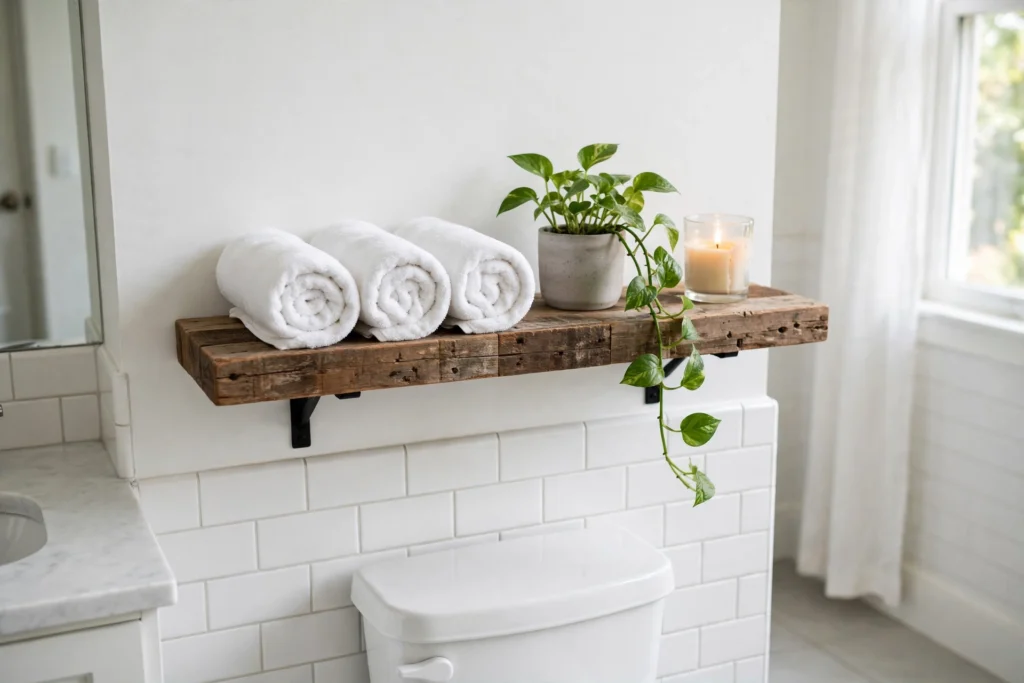
Small bathrooms punish clutter faster than any other room, so the gallery wall that works in a living room can overwhelm a 5-by-8 bath. If you want a gallery wall, keep it tight: six small prints in a two-by-three grid over the tub, all in matching frames, reads as one piece. The wall above the toilet is the most wasted space in most bathrooms — a single floating shelf from a reclaimed board and two hidden brackets holds rolled towels, a plant and a candle. Seal the wood with water-based polyurethane first, or use kiln-dried wood so it does not warp.
Our guide to how to hang pictures on wall (link to https://silkstonehome.com/how-to-hang-pictures-on-wall/) covers the height and spacing rules; in a bathroom, hang art at 60–75% of the vanity’s width and keep every piece at least an arm’s length from water zones.
How Do I Hang Art in a Steamy Bathroom Without Ruining It?
Hang bathroom art on the wall farthest from the shower or tub, leave a small air gap behind the frame, and use acrylic glazing instead of real glass. Small rubber bumpers on the back corners of a frame let air circulate behind it, so moisture does not get trapped against the wall. Seal the back of the frame with framing tape, add a silica gel packet behind the backing board, and choose metal, plastic or well-lacquered wood frames — raw wood swells and warps in steam.
Placement is the whole game. Never hang art inside the shower zone or directly above a tub without a curtain, and never hang a valuable original in a steamy family bathroom at all — put it in the powder room, where there is no shower. In a bathroom with no window, the fan habit matters twice as much, and a small dehumidifying routine after showers is what keeps sealed frames sealed. For the hanging itself — anchors for tile, height rules, levelling — our guide to how to hang a gallery wall (link to https://silkstonehome.com/how-to-hang-a-gallery-wall/) covers the mechanics step by step.
Which Bathroom Wall Decor Ideas Cost the Least?
The cheapest bathroom wall decor ideas are a eucalyptus shower bundle ($5–$10), a painted mural or stencil arch in bathroom-grade paint ($20–$40), woven baskets hung as a wall grouping ($20–$50), and one sealed canvas print ($30–$60). The highest-impact cheap move is a floating shelf over the toilet: a reclaimed board, two brackets and a coat of polyurethane, $30–$60 all in, holding towels, a plant and a candle.
| Idea | Rough cost | Time | Humidity-proof? |
|---|---|---|---|
| Eucalyptus shower bundle | $5–$10 | 5 minutes | Yes, lasts 1–3 weeks |
| Painted mural / stencil arch | $20–$40 | 2–3 hours | Yes, bathroom paint wipes clean |
| Woven basket wall grouping | $20–$50 | 30 minutes | Yes, with airflow |
| Sealed canvas print | $30–$60 | 10 minutes | Yes, varnished |
| Floating shelf over the toilet | $30–$60 | 1–2 hours | Yes, sealed wood |
| Ceramic plate cluster | $15–$60 | 30 minutes | Yes, fully waterproof |
| Single art tile | $10–$30 | 10 minutes | Yes, made for wet rooms |
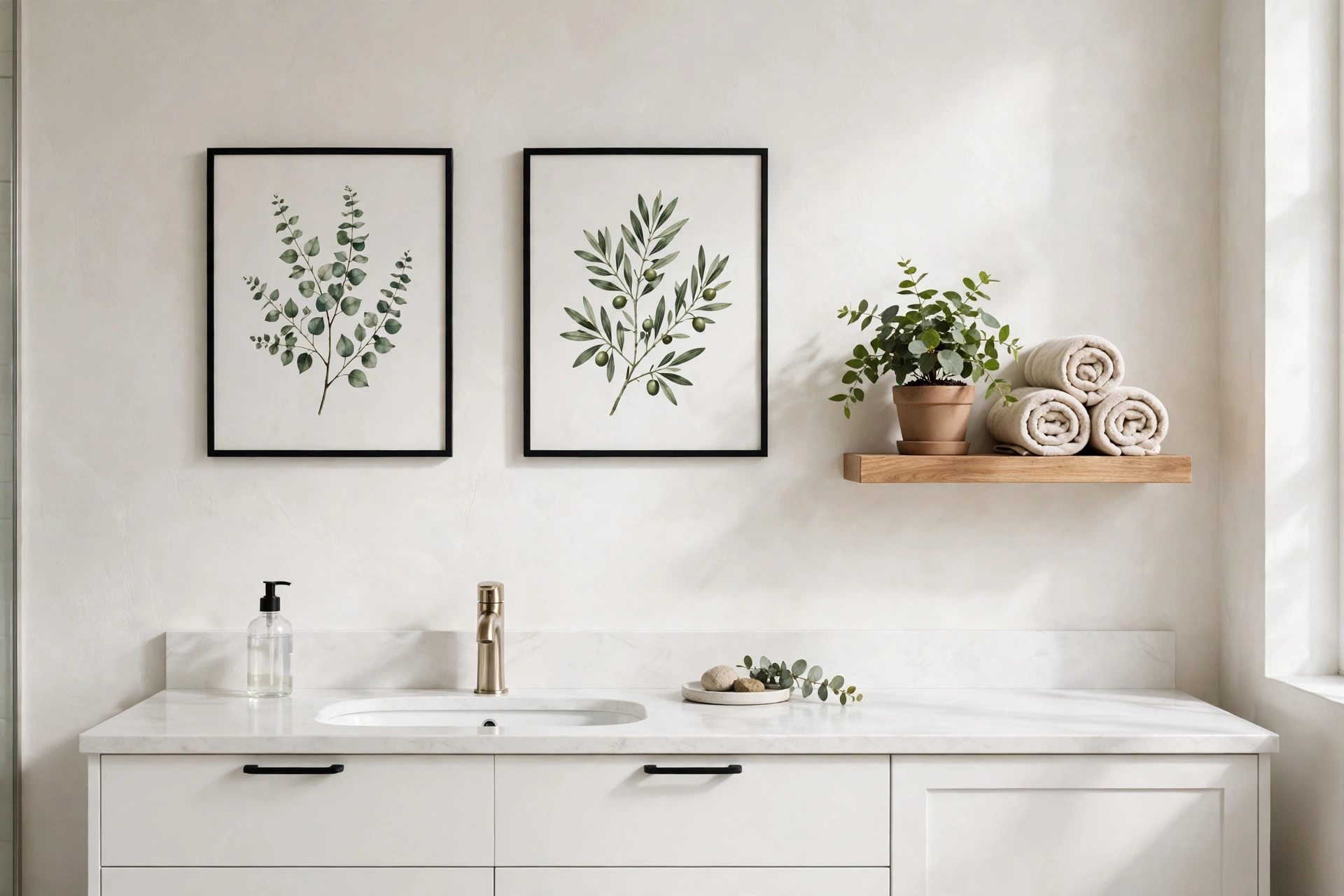
| Framed botanical prints (set of 2) | $40–$80 | 20 minutes | Mostly, sealed frames |
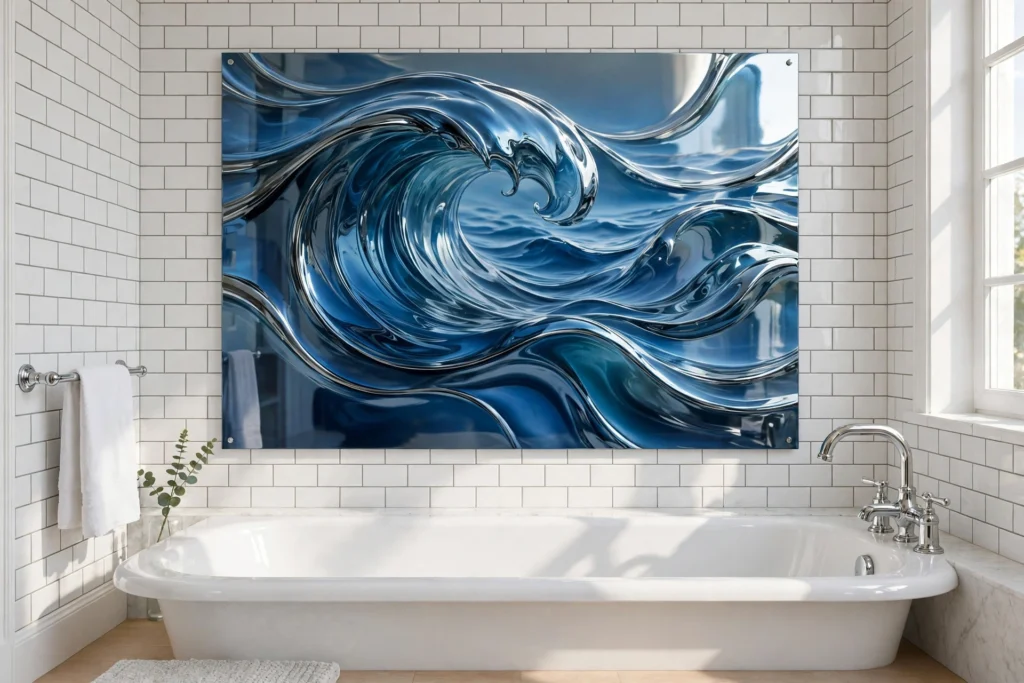
| Metal wave print above tub | $60–$120 | 20 minutes | Yes |
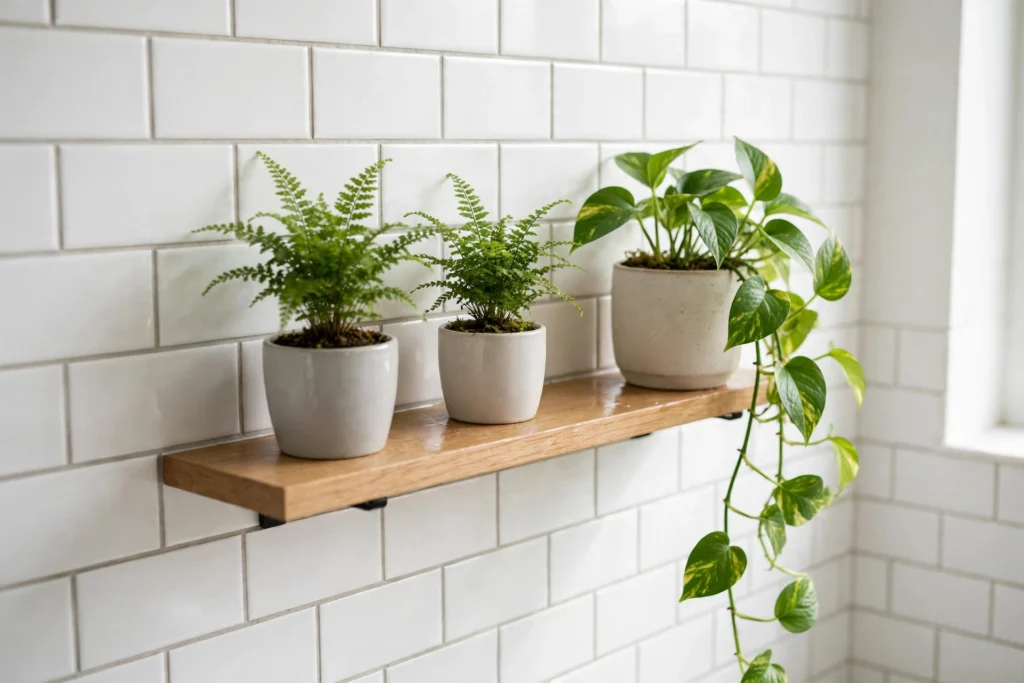
| Living plant shelf | $20–$60 | 30 minutes | Yes, plants love steam |
All prices are rough planning estimates, not quotes.
Paint Is the Most Steam-Proof Art There Is
If you are nervous about hanging anything in a steamy bathroom, paint the art on the wall instead. A simple arch in bathroom-grade paint costs $20–$40, can be wiped clean, and will never warp, fog or mildew. Tie a string to a pin for a perfect arch curve, and use the same paint as the walls so the finish matches.
How Do I Style a Bathroom Gallery Wall?
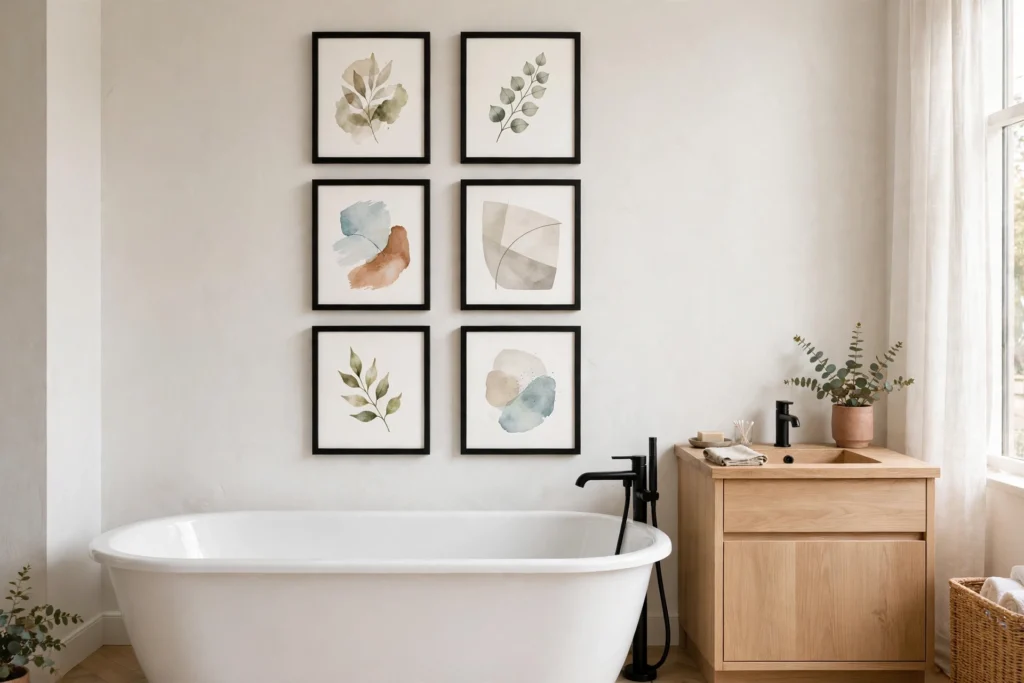
Style a bathroom gallery wall as one tight, matching set: same frames, same spacing, one theme, hung on the driest wall in the room. Six prints in a two-by-three grid over a freestanding tub is the classic layout — botanical prints, abstract water studies or black-and-white photography, all in matching black or brass frames with acrylic glazing. Keep the whole arrangement at 60–75% of the width of the tub or vanity below it, and leave the wall nearest the shower bare.
For a spa look, use one oversized tonal print or a triptych in muted neutrals — sand, sage and stone — instead of six small pieces. For a coastal bathroom, one serene seascape or abstract wave study in blues and sandy tones beats a cluttered assortment. For a bold bathroom, one graphic color-block piece as the focal point does more than five small ones. The matching-frames rule is what makes a gallery wall look designed rather than collected: mixed frames work in a living room, but in a small bathroom they read as mess. Our kitchen wall decor (link to https://silkstonehome.com/kitchen-wall-decor/) guide uses the same matching-frames principle for another hard-working room.
What Should I Never Hang in a Bathroom?
Never hang unframed paper, fabric wall hangings, tapestries, or valuable original artwork in a steamy bathroom. Paper curls and stains, fabric holds moisture and grows mildew, and an original loses value every time steam reaches it. Also skip raw wood frames, real glass in a shower-adjacent spot, and anything hung flat against the wall with no air gap — trapped moisture behind a frame is how mold starts where nobody looks.
The powder room is the exception: with no shower, it is the one bathroom where paper prints and fabric can live safely. If you love a particular paper print and only have a full bathroom, you can still hang it — but only in a gasketed frame with a taped, sealed back, acrylic glazing, a silica gel packet behind the backing board, and on the wall farthest from the shower. Even then, check the back of the frame every few months for the first sign of damp.
FAQ — Bathroom Wall Decor
Can I hang canvas art in a bathroom?
Yes, if it is sealed. Acrylic paint on canvas handles humidity well, and a coat of clear varnish seals it further. Hang it on the wall farthest from the shower, never inside the shower zone, and run the fan for 20–30 minutes after showers. Unsealed canvas and unframed paper will warp and stain.
What is the best wall decor for a bathroom with no window?
Metal prints, acrylic-mounted prints, ceramic plates and mirrors are the best choices for a windowless bathroom, because they do not absorb moisture at all. Add a plant shelf — ferns and pothos thrive in the humidity — and make the fan habit non-negotiable, since there is no window to crack open after a shower.
How high should I hang art in a bathroom?
Hang bathroom art so its center sits at about eye level, 57–60 inches from the floor, and size it at 60–75% of the width of the vanity or tub below it. Above a toilet, hang a shelf or a small print 12–18 inches above the tank so it clears the lid and stays out of the splash zone.
Will a gallery wall work in a small bathroom?
Yes, if you keep it tight and matching. Six small prints in a two-by-three grid with identical frames reads as one piece and suits a small bathroom far better than five mismatched frames scattered across the wall. Hang it over the tub or on the driest wall, never beside the shower.
Are floating shelves OK in a bathroom?
Yes, if the wood is sealed. Use kiln-dried or reclaimed wood sealed with water-based polyurethane, or a metal shelf, and mount it with proper anchors. A floating shelf over the toilet is the highest-impact cheap idea in a small bathroom — storage that looks like decor.
What plants are best for bathroom wall decor?
Ferns, pothos, peace lilies and air plants are the best bathroom plants — they love humidity and need little light. Put them on a narrow wall shelf or in wall planters, keep them out of direct shower spray, and water less often than houseplants elsewhere, because the steam does part of the job.