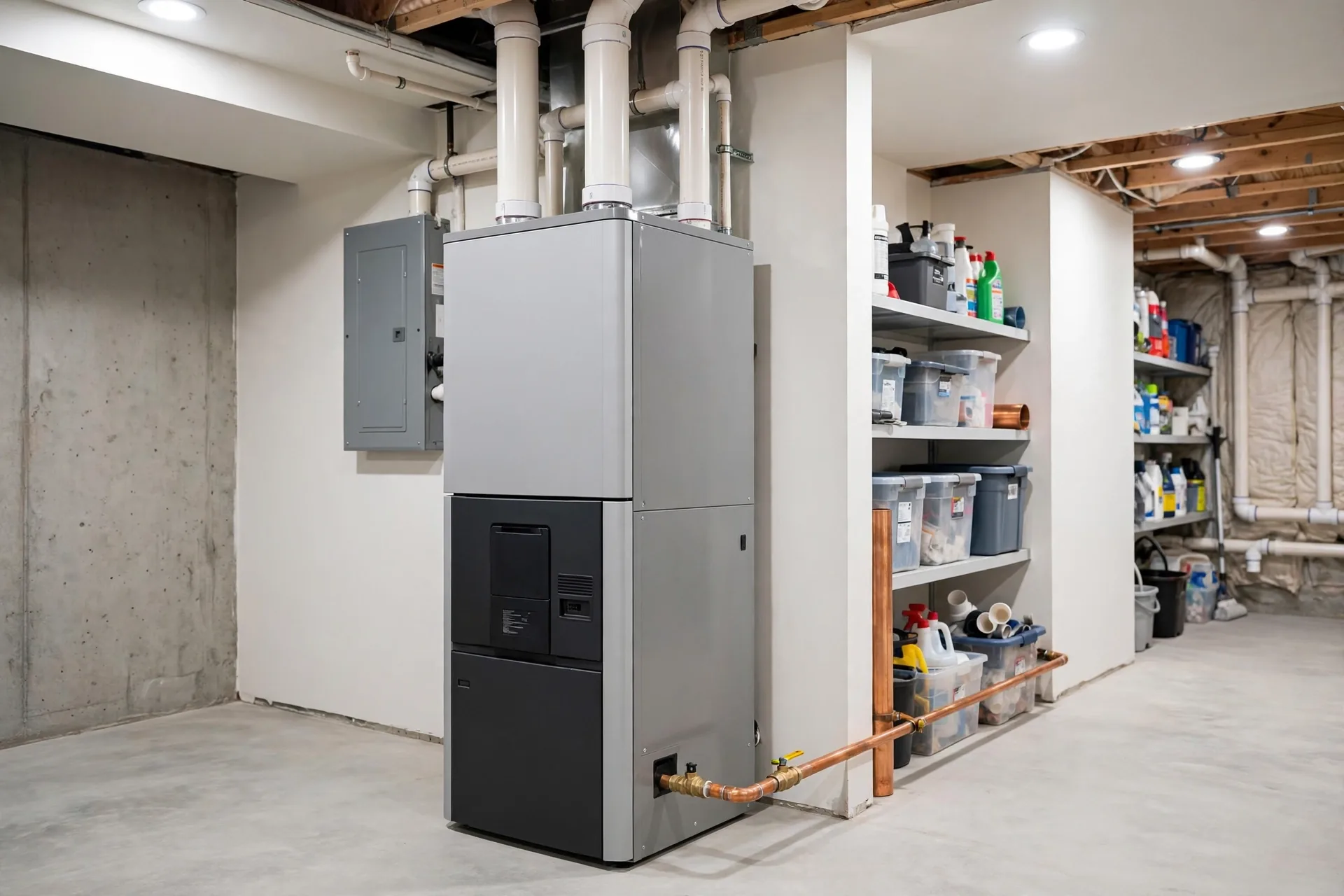
How Much Does Furnace Replacement Cost in 2026?
Last February, a Columbus homeowner’s 22-year-old furnace died on the coldest weekend of the year, and she’d gotten three conflicting quotes: a $900 blower motor, a $1,800 heat exchanger patch, or a $7,400 replacement. She had no idea which was throwing good money after bad.
She replaced it with a two-stage gas unit for $7,200, and her next January gas bill dropped 28%.
Your furnace replacement cost in 2026 will land between $4,000 and $12,000 — and the gap between a fair price and a bad one is information. Below: the real installed price ranges, what drives them up or down, and the simple math for deciding whether to repair or replace.
TL;DR
A furnace replacement in 2026 costs $4,000–$10,000 for gas (the most common type), $3,000–$7,000 for electric, and $6,000–$12,000+ for oil, fully installed. Two-stage and modulating gas furnaces cost more upfront but cut heating bills 10–25% versus single-stage units. If your furnace is over 15 years old or a repair costs more than half of replacement, replacing usually wins. The federal 25C/25D tax credits expired after December 31, 2025 — look to state and utility rebates instead.
Furnace Replacement Cost: What It Actually Runs in 2026
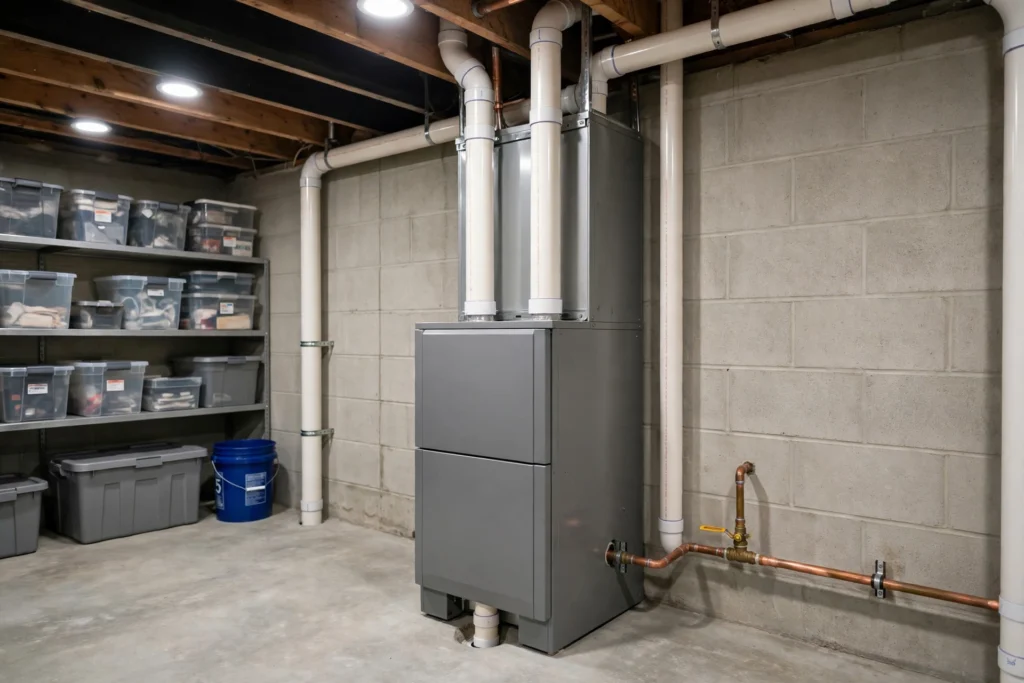
“Installed” means equipment plus labor, venting hookups, permits, and haul-away of the old unit — the check you’d write, not the box price.
| Furnace Type | 2026 Installed Range | Typical AFUE | Best For |
|---|---|---|---|
| Gas, single-stage | $4,000–$6,000 | 80–92% | Tight budgets; warm climates; rentals |
| Gas, two-stage | $6,000–$8,000 | 92–96% | Most US homeowners; cold to moderate winters |
| Gas, modulating | $8,000–$10,000+ | 95–98% | Long-term homeowners; maximum comfort and efficiency |
| Electric | $3,000–$7,000 | ~100% (no combustion losses) | Mild climates; homes without gas service |
| Oil | $6,000–$12,000+ | 80–90% | Northeast homes already on oil; no gas lines |
Prices skew high in expensive metros (Boston, Seattle, the Bay Area) and low in the Midwest and South, where labor is cheaper and contractor competition is fierce. Premium brands like Trane, Carrier, and Lennox run $800–$1,500 above value brands like Goodman or Amana for comparable equipment — and installation quality matters more than the logo on the cabinet.
What AFUE Actually Means for Your Bills
AFUE — Annual Fuel Utilization Efficiency — is the percentage of fuel your furnace converts into heat. An 80% AFUE furnace wastes 20 cents of every fuel dollar up the flue; a 96% AFUE furnace wastes only 4 cents.

Upgrading from a 20-year-old 80% AFUE furnace to a 96% AFUE two-stage unit typically cuts fuel use 17–20%. On a $1,800/year gas bill, that’s roughly $300–$360 saved annually — enough for the efficient unit to pay back its premium two or three times over a 20-year lifespan.
Three tiers worth knowing:
- 80% AFUE (standard): Cheapest upfront. Sensible only for warm climates where the furnace barely runs, or rentals where someone else pays the bill.
- 90–95% AFUE (mid-efficiency): The sweet spot. These condensing furnaces need a condensate drain and PVC venting instead of a metal flue — budget $500–$1,500 if your home isn’t set up for it.
- 96–98% AFUE (high-efficiency): Extra fuel savings over a 92% unit are modest (about 4–6%). Buy these for comfort — modulating burners run long and low instead of blasting on and off — not for dramatic bill reductions.
Sizing: Why Bigger Is Not Better
Furnace size is measured in BTUs, and the old rule of thumb — 30–50 BTUs per square foot depending on climate — is a starting point, not an answer. A 2,000 sq ft home in Minneapolis might need 90,000–100,000 BTU, while the same house in Atlanta needs 60,000–70,000.
An oversized furnace short-cycles: it blasts heat, hits the setpoint in minutes, and shuts off — over and over. That wears parts faster, leaves cold spots, and wastes fuel. An undersized one runs constantly and can’t keep up on the coldest nights.
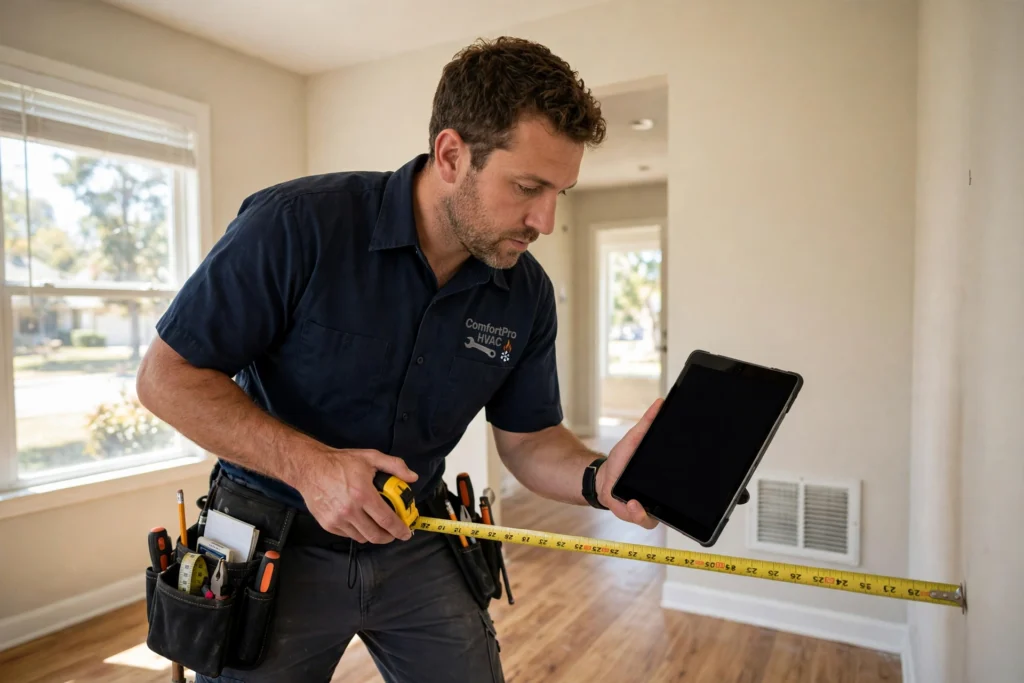
A competent contractor performs a Manual J load calculation — a heat-loss analysis accounting for insulation, windows, air sealing, and climate zone. It takes 30–60 minutes and is non-negotiable. If a contractor sizes by square footage alone or just matches the old unit, that’s a red flag: your insulation and windows may have changed since the original install, and the right size may have changed too.
Add-On Costs That Blindside Homeowners
A straight swap excludes the extras real-world jobs often include:
- New thermostat: $150–$600 installed. Two-stage and modulating furnaces need a compatible multi-stage thermostat; your old one may not work.
- Ductwork repairs or sealing: $500–$2,500. Leaky ducts waste 20–30% of your heat before it reaches a room — a new efficient furnace on leaky ducts is a race engine in a car with flat tires.
- Venting or chimney liner: $500–$2,000. Switching from an 80% furnace (metal flue) to 90%+ condensing (PVC venting) often means abandoning or lining the chimney.
- Permits and inspection: $100–$500. The contractor should pull the permit, not you.
- Old unit removal: $100–$400, usually included in the quote — confirm it’s in writing.
- Gas line or electrical upgrades: $300–$1,500, in older homes that need a larger gas line or a dedicated circuit.
Budget an extra 10–15% above the equipment-plus-labor quote for these. A $6,500 quote becoming $7,800 is normal scope, not a shakedown — as long as every item is listed.
PRO TIP
Get three written estimates and ask each contractor to itemize equipment, labor, permits, and add-ons separately. A bid 30% lower than the others usually isn’t a deal — it means something was left out, like venting, a permit, or the load calculation. The fair price is the one where all three quotes describe the same job.
Repair or Replace? The Decision Math
Use the 50% rule: if the repair costs more than half of replacement and the furnace is over 12–15 years old, replace it. Not sure which side of the line yours is on? Check it against the signs your furnace is dying. Four clear signals it’s time:
- Age. Furnaces last 15–20 years. Past 15, every repair is a loan against the inevitable. Past 20, stop repairing except for cheap fixes (flame sensors, ignitors under $300).
- Cracked heat exchanger. The line in the sand — it can leak carbon monoxide into your home. The exchanger alone costs $1,500–$2,500 on a unit that age. Put that money toward a new furnace.
- Rising bills without a rate increase. Compare this winter’s therms or gallons to three winters ago. A steady climb means efficiency is degrading.
- Frequency. Two or more repairs in one heating season, or a $1,000+ bill on a unit older than 12 years, means parts are failing in sequence. The next failure is already scheduled.
One exception: if you’re selling within two years, a mid-range single-stage replacement — or even a solid repair — is the rational move. The energy savings won’t have time to pay back a premium unit.
When to Buy: Timing and Pricing
Furnace pricing has a season. September through November — the fall shoulder season — is the best time to replace. Contractors are hungry for work between the summer AC rush and the winter emergency calls, and manufacturers run their deepest rebates in early fall to clear inventory.

January and February are the worst months to buy. Your furnace died at 2 a.m., it’s 15 degrees out, and the contractor knows you have no leverage. Emergency replacements cost 15–30% more than scheduled fall installations, and you’ll take whatever is in the warehouse. If your furnace is limping along in spring, get quotes then and schedule the install for September.
A Note on 2026 Incentives: No More Federal Credits
Stated plainly, because outdated articles still claim otherwise: the federal 25C and 25D residential energy tax credits expired for equipment placed in service after December 31, 2025. There is no federal tax credit for a furnace installed in 2026. If a contractor factors a “30% tax credit” into your quote, that math no longer exists.
- State and utility rebates. Many utilities offer $200–$1,000+ for 92%+ AFUE installations — check your utility’s website before signing, since some require pre-approval.
- Manufacturer rebates. Carrier, Lennox, Trane, and others run fall promotions, typically $300–$1,500 back on qualifying systems.
- Low-income programs. If you qualify, the federal Weatherization Assistance Program (WAP) can cover furnace replacement entirely.
Add every rebate to your comparison spreadsheet before choosing equipment — a 96% AFUE unit with an $800 utility rebate can end up cheaper than a 92% unit without one.
Shopping for quotes around Columbus, Ohio? You can have a licensed HVAC technician inspect your furnace or call (380) 273-8167 for an in-person assessment before you commit to a replacement.
Bottom line
- Budget realistically: $4,000–$10,000 for gas (most homes), $3,000–$7,000 for electric, $6,000–$12,000+ for oil — fully installed, plus 10–15% for add-ons: venting, ductwork, thermostats.
- Match the furnace to the home: Two-stage gas at 92–96% AFUE is the sweet spot for most US homeowners; modulating units are a comfort upgrade, not a savings miracle.
- Size it right: Insist on a Manual J load calculation. Oversized furnaces short-cycle, wear out faster, and cost more to run.
- Use the 50% rule: Repair costs over half of replacement on a furnace older than 12–15 years mean replacement time — especially with a cracked heat exchanger.
- Buy in the fall: September–November pricing beats January emergency pricing by 15–30%.
- Forget the federal tax credit: 25C/25D expired after 2025. Hunt for state, utility, and manufacturer rebates instead.
Frequently Asked Questions
How do I know what size furnace my home needs?
A Manual J load calculation from your contractor determines this — it accounts for square footage, insulation, windows, air sealing, and climate zone. Rough sanity check: cold climates run 40–50 BTUs per square foot, mild climates 25–35. Never accept a size based on square footage alone or a copy of the old unit’s rating.
Is a two-stage furnace worth the extra money over single-stage?
If you plan to stay 5+ years, usually yes. Two-stage units run on low fire most of the time — fewer temperature swings, quieter operation, 10–15% lower fuel bills. The $1,500–$2,000 premium typically pays back in 4–7 years.
How long does a furnace replacement take?
A straightforward like-for-like swap takes one day (6–10 hours). Add a day for venting conversion, ductwork repair, or a fuel-type switch like oil to gas.
Should I replace my furnace and AC at the same time?
If both are 12+ years old, replacing them together as a matched system saves $1,000–$2,000 in labor — one crew, one visit, shared ductwork adjustments. If the AC is under 8 years old and running fine, leave it; a mixed-age system carries no penalty.
What’s the cheapest way to replace a furnace?
Get three itemized quotes in the fall, choose a single-stage 80–92% AFUE gas unit from a value brand like Goodman if your winters are mild, and capture every utility and manufacturer rebate. Don’t skip the load calculation or the permit — the cheapest install that fails inspection or short-cycles is the most expensive one you’ll ever buy.